The Truth About Newsletter Money Nobody Tells You
Before DDH, I was doing this manually in spreadsheets. Here’s the faster way:
I’m going to be honest with you right from the start: most creators are leaving thousands of dollars on the table with their email newsletters, and they don’t even realize it.
They launch newsletters with genuine excitement. They build audiences. They send consistent emails. But then… nothing. They don’t make meaningful money from it.
The problem isn’t that newsletter revenue is impossible. It’s that creators don’t track it properly, don’t understand which monetization model actually works for their audience, and don’t have a system to grow past the painful first 1,000 subscribers.
This article breaks down the real money-making strategies I’ve seen work for creator businesses. Not theory. Actual systems you can implement this week.
Understanding Newsletter Monetization Models: Which One Actually Works for You?
There are five primary ways creators make money from email newsletters. Each works differently, and most creators succeed by combining two or three of them.
Sponsored Content and Brand Partnerships
This is the fastest path to revenue for creators with established audiences. Brands pay you to feature their products or services in your newsletter.
Here’s the real math: Most sponsors pay based on subscriber count. Budget $100-500 per 10,000 subscribers, depending on your niche. A creator newsletter with 50,000 subscribers might pull in $2,500-$5,000 per sponsored email.
The catch? Sponsors typically want at least 5,000-10,000 subscribers before they’ll consider you. That’s why this is a secondary revenue stream, not your starting point.
Pro tip: Platforms like Substack’s sponsorship network and direct outreach to brands in your niche make this easier to land deals. Keep detailed records of sponsorship revenue—this is where a proper revenue tracker becomes essential.
Paid Subscriptions (Substack, Beehiiv, ConvertKit)
This is the “newsletter as a product” model. You have a free tier that drives growth, then paid tiers unlock premium content.
The attractive part: Direct revenue from your audience, no middleman (mostly). ConvertKit and Beehiiv both support subscription features. Substack popularized this and takes 10% of subscription revenue.
Real numbers: Most newsletter creators pricing paid tiers at $5-$15/month see 1-3% of their free list convert to paid. So a 50,000-person free list might generate 500-1,500 paid subscribers, earning $2,500-$22,500/month.
But here’s what kills most creators: They launch paid subscriptions without having a genuinely valuable premium product. Readers can feel when you’re just gatekeeping email threads behind a paywall. The best paid newsletters offer something genuinely different—exclusive analysis, early access, private community, deep dives that take real work.
Affiliate Marketing
You recommend products you genuinely use. When readers click your link and buy, you earn a commission (typically 5-40% depending on the program).
This model works because it soligns with your newsletter’s purpose. A productivity newsletter recommending a tool readers actually need? That feels natural. A productivity newsletter recommending unrelated products? That kills trust fast.
The revenue potential: Affiliate marketing scales with your audience and the commission structure. A 10,000-subscriber newsletter with a 1% click-through rate and 10% conversion to purchase, recommending a $99 product with 20% commission, generates roughly $200/month. Not huge, but it compounds.
Best affiliates: Gumroad, Amazon Associates, SaaS tools in your niche, digital products. These typically have dedicated affiliate programs with real commissions.
Selling Your Own Products or Services
This is where newsletter monetization gets really interesting for creators building businesses.
Your newsletter is the sales channel. You’re selling digital products (templates, guides, courses), consulting, coaching, or productized services.
A creator with 15,000 email subscribers who launches a $47 digital product and sees 2-3% conversion gets roughly 300-450 sales = $14,100-$21,150 in revenue from one launch.
Here’s the secret most creators miss: Email lists have lifetime value. You’re not making one sale per subscriber. You’re building a relationship over months or years where you can present multiple offerings. A subscriber on your list for 24 months who never buys anything still costs you nearly nothing, but the one who buys your $97 course, then your $297 template bundle, then books a $500 consulting call has generated over $800 in lifetime value.
This is why tracking revenue per subscriber matters so much.
Consulting and Coaching Upsells
Your newsletter builds authority and trust. Readers eventually want direct help from you—that’s the opening for consulting calls, group coaching, or done-for-you services.
A newsletter creator with a modest 5,000 subscribers who books even 2-3 consulting calls/month at $200-500 per call generates $400-1,500/month just from this channel. Some creators I know have built entire 6-figure consulting businesses primarily through newsletter audiences.
The advantage: Newsletter audiences know you. They’ve read your insights for months. They’re genuinely interested in your perspective. That trust converts to higher consulting rates than cold outreach ever could.
The Metrics That Actually Matter (And Which Ones to Ignore)
| Approach | Startup Cost | Time Investment | Revenue Potential | Best For |
|---|---|---|---|---|
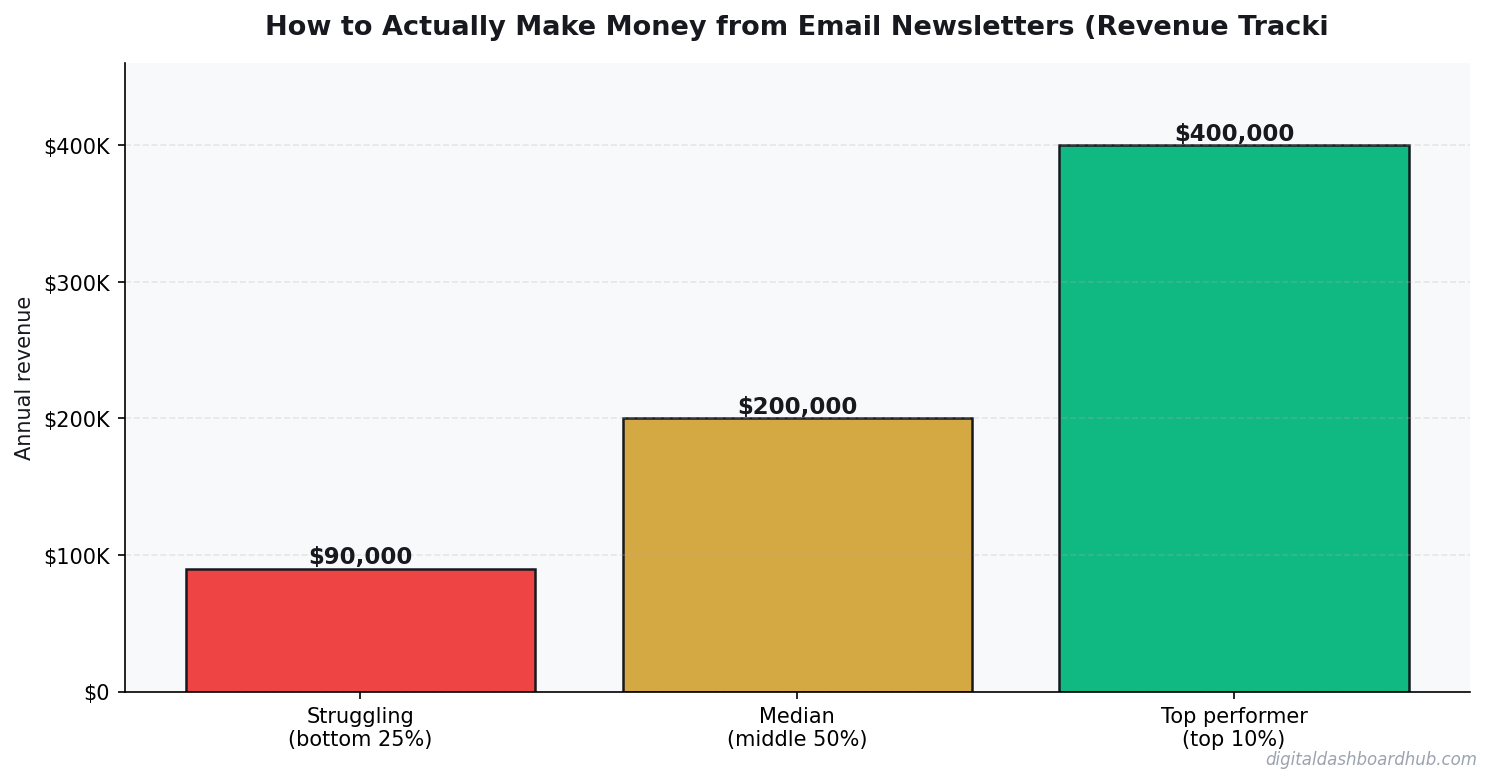
| Solo operator | Low ($1K-$10K) | Full time | $60K-$200K/yr | Maximum margins, full control |
| Small team (2-5) | Medium ($10K-$50K) | Management + some fieldwork | $200K-$800K/yr | Scaling without losing control |
| DDH Revenue Tracker | Free trial | 5 min setup | N/A (profit tool) | Know your real numbers in real time |
Most creators obsess over the wrong metrics. They check open rates religiously but never calculate revenue per subscriber. That’s backwards.
Here are the metrics that actually predict whether your newsletter will make money:
Open Rate
This matters, but not as much as creators think. Industry average is 20-30% depending on niche. Yours probably ranges 15-40%.
Why it matters: Higher open rates mean more people seeing your revenue opportunities (sponsorships, affiliate links, product recommendations).
Why it’s not everything: You can have a 50% open rate with a list of 2,000 people and make less money than someone with a 20% open rate and 50,000 people. Numbers matter more than percentages.
Click-Through Rate (CTR)
This is more important than open rate. It tells you whether people are actually engaging with your content in a way that leads to action.
A typical newsletter has 2-5% CTR. If you’re at 1%, your content isn’t compelling enough or you’re not including enough clear calls-to-action. If you’re at 10%+, you’ve cracked something most creators never figure out.
Why this matters for revenue: CTR directly correlates to affiliate income, sponsorship performance, and product sales. Every additional click is money potential.
Revenue Per Subscriber
This is the metric that separates successful newsletter creators from struggling ones.
Calculate it simple: Total newsletter revenue for the month ÷ Average subscriber count = Revenue per subscriber.
A creator making $500/month with 5,000 subscribers has $0.10/subscriber. That same creator making $500/month with 500 subscribers has $1.00/subscriber. The second creator is in a much stronger position because they can scale revenue much faster—just grow the list, and revenue follows.
Industry benchmarks:
– Starting out (no monetization yet): $0
– With one monetization method working: $0.10-0.50/subscriber
– Mature newsletter with multiple streams: $0.50-$2.00/subscriber
– Top-tier creator newsletters: $2.00-$10+/subscriber
If your revenue per subscriber is below $0.10, you’re leaving money on the table. Period.
Subscriber Growth Rate
How many new subscribers you gain per week or month. This should ideally be at least 5-10% of your current list size per month.
Early on, focus on doubling your list every 3-4 months. Once you hit 5,000+, you can afford to focus more on monetization and retention than pure growth. But growth never stops mattering.
Churn Rate
How many subscribers you lose per month (unsubscribes + email bounces). Most healthy newsletters have 1-3% monthly churn.
High churn (5%+) means people aren’t finding value. You need to either improve content or reconsider who you’re targeting. Even high-performing newsletters can tank revenue if churn is out of control because you’re spending all your energy replacing people instead of growing net new subscribers.
Lifetime Value
This is the total revenue one subscriber will generate over their entire time on your list.
Calculate it: Average revenue per subscriber × Average subscriber lifespan (in months) = Lifetime Value
A subscriber who stays for 12 months and generates $0.50/month in revenue has $6 lifetime value. That might sound small, but it changes your perspective entirely. If you can acquire a subscriber for $2 (ads, partnerships, sponsorships), and they’re worth $6 lifetime, that’s a 3x return. That’s profitable growth.
The Math of Newsletter Revenue: Concrete Numbers
Let me walk you through real scenarios because abstract percentages mean nothing.
Scenario 1: Growing 0 to 1,000 Subscribers (Timeline: 3-6 months)
This is the hardest phase. You have no revenue yet. Growth is slow. Momentum feels fake.
Here’s what realistic growth looks like:
- Month 1: 0 → 150 subscribers (starting from scratch, sharing with friends, publishing content)
- Month 2: 150 → 400 (word of mouth accelerating, some organic search traffic)
- Month 3: 400 → 700 (hitting rhythm, people finding you through others)
- Month 4: 700 → 1,000 (now people are talking about you)
Revenue at this stage: $0-100/month. Maybe a small affiliate commission if you’re lucky. Most likely, you’re investing time with no return yet.
Why this matters: You’re not trying to make money here. You’re building trust. You’re proving you can show up consistently. You’re learning what resonates.
Many creators quit here. This is normal. Push through to 1,000 because everything changes at 1K.
Scenario 2: Growing 1,000 to 10,000 Subscribers (Timeline: 6-12 months)
Now things get interesting. You have proof-of-concept. You understand your audience. You’ve got repeatable content that works.
Growth accelerates because:
– Sponsors start approaching you (or you can pitch sponsors)
– Your audience is large enough for affiliate programs to feel worthwhile
– You can launch a low-ticket digital product and expect 10-20 sales
Sample revenue mix at 5,000 subscribers:
– Sponsorships: $400/month (one sponsored email per month at $400)
– Affiliate marketing: $150/month
– Digital product sales (occasional): $100-300/month
– Total: $650-1,050/month
At 5K subscribers, you’re generating roughly $0.13-0.21 per subscriber. That’s workable.
Sample revenue mix at 10,000 subscribers:
– Sponsorships: $600-1,000/month (1-2 sponsored emails per month)
– Affiliate marketing: $200-300/month (audience is bigger, CTR should be optimizing)
– Digital product sales: $400-800/month (you’ve built trust, launching is easier)
– Total: $1,200-2,100/month
At 10K subscribers, you’re at $0.12-0.21 per subscriber. Still modest, but you can see how the next 10K will matter.
Scenario 3: Growing 10,000 to 25,000+ Subscribers (Timeline: Ongoing)
By this point, you’re a “real” newsletter creator in most people’s eyes. You have options.
Revenue mix at 25,000 subscribers (realistic, diversified):
– Sponsorships: $2,000-4,000/month (multiple sponsors, higher rates, possibly exclusive sponsorships)
– Paid tier subscriptions: $400-1,500/month (100-300 paying subscribers at $5-15/month)
– Affiliate marketing: $600-1,200/month
– Digital products: $1,000-3,000/month (regular launches, existing product sales)
– Consulting/coaching: $500-2,000/month
– Total: $4,500-11,700/month
At 25K subscribers, you’re at $0.18-0.47 per subscriber. Now you’re making real money. One more milestone: push to 50K and suddenly sponsors are offering $5,000-10,000 per email.
The pattern is clear: Grow the list, revenue follows. But only if you’ve built multiple revenue streams, not just betting on one channel.
The Biggest Mistakes Creators Make With Newsletter Revenue
After consulting with dozens of newsletter creators, I’ve seen the same mistakes repeatedly.
Mistake 1: Not Tracking Revenue by Source
You have no idea which monetization channel is actually working. Maybe sponsorships sound impressive but affiliate marketing is outperforming them. Maybe you’re spending energy on paid subscriptions when a productized service would be 10x easier for your audience.
Without tracking, you’re flying blind.
Fix: Use a simple spreadsheet (or our Creator Passive Income Tracker) to log every revenue source daily or weekly. Revenue from sponsorships in one column, affiliate commissions in another, product sales in a third. After 3 months, patterns emerge.
Mistake 2: Launching Monetization Too Early
New creators often try to sell before they’ve built trust. People unsubscribe because your second email is pitching them something.
Fix: Get to at least 500-1,000 subscribers of genuinely engaged people before monetizing. That means consistent 20%+ open rates and people clicking links. Then start introducing sponsorships, affiliates, and products. Audience trust is your asset. Don’t blow it for $200 in quick revenue.
Mistake 3: Not Understanding Your Audience’s Actual Needs
You’re monetizing with products/sponsorships your audience doesn’t want. Of course revenue is terrible.
The best newsletter revenue comes from solving real problems your subscribers already have.
Fix: Before launching any monetization, survey your audience. What are they struggling with? What tools do they actually use? What would they pay for? Then align your monetization with those answers. A finance newsletter sponsoring a budgeting tool makes sense. A finance newsletter sponsoring a fashion brand doesn’t.
Mistake 4: Ignoring Revenue Per Subscriber Entirely
You’re obsessed with raw subscriber count, not revenue quality. You have 50,000 subscribers and make $400/month because you haven’t optimized revenue per subscriber.
Fix: Calculate your revenue per subscriber monthly. Make it your north star metric. If you’re below $0.10/subscriber, fix monetization before chasing more growth. Growing a list with poor monetization is just giving yourself more work.
Mistake 5: Not Systematizing Newsletter Operations
You’re doing everything manually. Sending emails manually, tracking revenue in scattered spreadsheets, managing sponsorship inquiries in your inbox. This doesn’t scale.
At 10,000+ subscribers, you need systems. Templates for sponsorship pitches. Automated workflows for new subscriber onboarding. Dashboards showing revenue, growth, and engagement in one place.
Fix: Invest in tools early (even simple Google Sheets templates work). As you grow, layer in automation with tools like ConvertKit’s automations, Zapier, or simple spreadsheet templates like our Content Creator Dashboard Bundle. Small investments in systems save hundreds of hours and eliminate errors.
Why Revenue Per Subscriber Changes Everything
Let me show you why this single metric matters more than everything else.
Two creators. Both have newsletter revenue.
Creator A: 100,000 subscribers, $2,000/month revenue = $0.02 per subscriber
Creator B: 8,000 subscribers, $1,500/month revenue = $0.1875 per subscriber
Creator B is in a dramatically stronger position. Creator A would need to grow to 450,000 subscribers just to hit $15,000/month at their current rate. Creator B just needs to grow to 80,000 subscribers.
This isn’t theory. I’ve watched Creator B eventually build to $25,000+/month by scaling a list they already monetize well. Creator A got stuck trying to grow a massive, poorly monetized list that barely converts.
The insight: Focus on revenue quality first, quantity second.
This means:
– Spending time on sponsorship rates and conversion optimization before chasing 10,000 more subscribers
– Building a productized service your audience actually wants before launching another low-ticket product
– Calculating lifetime value and making growth decisions based on profitability, not vanity metrics
Your revenue per subscriber tells you whether your monetization model is working. If it’s staying below $0.05 for months, something’s wrong with your model, not your audience size.
Building a System to Track Newsletter Performance and Revenue
You can’t improve what you don’t measure. Most creators don’t have any system for tracking newsletter revenue. Let’s fix that.
The Minimum Viable Tracking System
This takes 30 minutes to set up and 5 minutes per week to maintain:
-
Daily/Weekly Revenue Log — Google Sheet with columns for Date, Revenue Source (sponsorship/affiliate/product/etc.), Amount, and Notes. Every dollar gets logged within 2-3 days.
-
Subscriber Count Snapshot — Record your subscriber count weekly (same day each week). Paste it in a spreadsheet. After 12 weeks you can see growth rate clearly.
-
Email Performance Tracker — Most email platforms (ConvertKit, Substack, Beehiiv) show open and click rates. Record your best-performing emails. What topic? What subject line length? What CTA? Patterns emerge.
-
Monthly Revenue Summary — Total revenue by source. Divide by average subscriber count that month. That’s your revenue per subscriber. Track it monthly.
That’s it. Four simple tracking mechanisms. After 3-6 months of data, you’ll see exactly which revenue channels work for your audience and which are wastes of energy.
Leveling Up: Systematic Dashboards
Once you’re consistently monetizing, a unified dashboard saves hours and surfaces insights faster.
Our Creator Passive Income Tracker and Weekly Revenue Tracker templates are specifically designed for creators tracking multiple income streams including newsletters. They automatically calculate:
- Total revenue by source
- Revenue per subscriber
- Month-over-month growth
- Projected annual revenue
- Which channels are strongest
You plug in numbers once and the dashboard does the math. No more hunting through spreadsheets wondering whether you actually made more money this month.
Growing from 1,000 to Your First $1,000/Month in Newsletter Revenue
This is the milestone everyone wants to hit. Let me be specific about what it actually takes.
The realistic path:
At 5,000 subscribers, you need revenue sources totaling $0.20/subscriber to hit $1,000/month. This breaks down roughly to:
- 1 sponsorship/month at $300-500
- Affiliate marketing at $150-250/month (depends on products you recommend)
- 1 digital product sale or course offering bringing $150-300/month
- Consulting or service offers at $100-200/month
By 10,000 subscribers, you can hit $1,000/month at $0.10 per subscriber (easier). By 15,000 subscribers, it becomes nearly automatic.
The real secret: You don’t wait to hit a specific subscriber count. You optimize revenue per subscriber while growing the list.
Start tracking revenue sources now, even if you only have 500 subscribers. Run one sponsorship deal (even $200 is a start). Add one affiliate link. Validate what works. Then scale that.
Most creators hit their first $1,000/month not when they have 10,000 subscribers, but when they’ve systematically built 3-4 working revenue streams with an audience of 5,000-8,000 genuinely engaged people.
Engagement matters more than raw count. A list of 5,000 people who open every email and click links is worth 10x more than 50,000 people who never engage.
Beyond $1,000: Scaling Newsletter Revenue to $5K+ Per Month
Once you’ve hit $1,000/month, scaling follows a predictable pattern.
$1,000 → $2,500/month: Requires better sponsorship rates (as you prove ROI to brands), more affiliate partnerships, or launching a digital product that sells consistently. Timeframe: 3-6 months of optimization.
$2,500 → $5,000/month: Requires either growing the list significantly (to 25,000+) OR diversifying revenue sources further (adding consulting calls, group coaching, productized services). Most creators use both.
$5,000 → $10,000+/month: At this level, you’re a recognizable voice in your niche. Sponsorships command premium rates ($3,000-10,000+ per email). You have multiple digital products. You probably have a coaching or service offering. This is where newsletter becomes a legitimate business revenue stream.
The creators hitting 6-figure annual newsletter revenue aren’t doing anything mystical. They’re:
– Growing systematically (10,000+ engaged subscribers)
– Tracking revenue obsessively (knowing exactly which channels work)
– Diversifying (4-5 revenue streams, not betting on one)
– Systematizing (they have templates, processes, and tools, not chaos)
Final Thoughts: Newsletter Revenue Is Real, But It Requires Systems
Here’s what I want you to take away:
Newsletter revenue is absolutely real. I’ve helped creators build from $0 to $10,000+/month in newsletter revenue. But it doesn’t happen by accident. It requires:
- Clear monetization models aligned with what your audience actually wants
- Relentless tracking of what’s working (revenue per subscriber is your north star)
- Patience through the 0-1,000 subscriber phase where you’re not making money but building trust
- Systematic growth from 1,000 to 10,000+ engaged subscribers
- Multiple revenue streams so you’re not dependent on one channel
- Tools and dashboards that let you see patterns and make decisions
Start this week. Even if your newsletter is brand new, set up a simple tracking spreadsheet. Log every dollar. Check back in 3 months. You’ll see exactly where your revenue is coming from and where the opportunities are.
Grab Your Free Newsletter Revenue Calculator
Want a shortcut? Our Newsletter Revenue Calculator helps you project realistic monthly revenue based on subscriber count, engagement rate, and monetization strategy.
Enter your current metrics and see:
– What your monthly revenue could be at 5K, 10K, 25K subscribers
– Which revenue sources would impact your bottom line most
– Timeline to your first $1,000/month
– Where your biggest opportunities are
[Get the Free Calculator]
Tools We Recommend for Newsletter Revenue Tracking and Creator Business Management
Building a newsletter revenue system is easier with the right tools. Here are the specific resources we’ve created for creators like you:
Creator Passive Income Tracker
The all-in-one dashboard for tracking newsletter revenue alongside other income streams. Automatically calculates revenue per stream, projects annual income, and identifies your strongest channels.
Get Creator Passive Income Tracker
Weekly Revenue Tracker
Simple, powerful tracking for creators who want to watch revenue grow week-by-week. Includes sponsor payments, affiliate commissions, product sales, and service income in one view.
Get Weekly Revenue Tracker
Content Creator Dashboard Bundle
The complete business dashboard combining email metrics, revenue tracking, growth monitoring, and quarterly planning. Everything a creator needs to see at a glance.
Get Content Creator Dashboard Bundle
Profit and Loss Template
Track not just revenue, but profitability. Newsletter revenue minus tools, ads, and time investments. Understand your actual margins.
Get Profit and Loss Template
Content Calendar Template
Strategic planning for newsletter content that actually converts. Plan sponsors, products, and affiliate opportunities alongside regular content.
Get Content Calendar Template
Creator Goal Scorecard
Track your newsletter goals quarterly—subscriber growth targets, revenue targets, engagement targets. Know whether your strategies are actually working.
Get Creator Goal Scorecard
Small Business Dashboard
If your newsletter is part of a larger creator business (which it should be), this dashboard connects newsletter revenue to overall business performance.
Get Small Business Dashboard
The creators making real money from newsletters aren’t smarter than you. They just track their revenue, understand their audience, and build systems that scale. You can do this too. Start today.
Keep reading (related guides):
- Free Sinking Fund Calculator — Try It Now
- Free Menopause Symptom Tracker — Try It Now
- Nervous System Regulation Tracker: The Visual Dashboard That Helps You Understand Your Bodys Stress Signals
- I Owed $47,000 in Taxes and Had $11,000 in the Bank: How I Rebuilt My Freelance Finances From the Ground Up
- Free Side Hustle Income Tax Tracker — Try It Now
255+ interactive tools for your money, time, and health.
14-day trial · Stripe checkout · Cancel anytime
Keep Reading
- Freelancer Finance Management Dashboard (VVS): Finally, a Money Tool Built for Variable Income
- Freelancer Finance Dashboard: Track Income, Taxes, and Cash Flow in One Visual Hub
- Freelancer Tax Guide 2026: What to Track All Year So April Doesn’t Destroy You

Andy Gaber is the founder of Digital Dashboard Hub, a suite of 255+ interactive financial, productivity, and wellness tools. He built DDH after getting frustrated with financial apps that gave outputs without context. Follow along for tool tutorials, revenue analytics breakdowns, and honest takes on personal finance.