
Plan Your Sinking Funds and Hit Your Savings Goals
Running a SaaS business means I track these numbers obsessively. Here’s what the data actually shows:
Unexpected expenses are a financial killer. Your car needs repairs. The roof needs replacement. Vacation season is around the corner. Without a plan, these costs catch you off-guard and send you into debt. But with sinking funds, you’re prepared.
Our free Sinking Fund & Savings Goal Planner helps you set clear targets, break them into bite-sized monthly or biweekly savings amounts, and watch your progress in real time. Whether you’re saving for a new laptop, holiday gifts, or home maintenance, this tool shows you exactly what to save from each paycheck to reach your goals stress-free.
Stop being caught off-guard. Start planning your future with confidence. Try the tool below and create your first savings goal today.
Ready to Supercharge Your Savings?
The free planner above is a powerful start, but the full version gives you complete control over your financial goals:
Unlock Full Version — Start Free Trial
What You Get With the Full Version:
- Unlimited Savings Goals — Create and track as many funds as you need without hitting a limit
- Cloud Sync & Mobile Access — Track your progress from any device, anytime
- Smart Goal Suggestions — AI-powered recommendations based on your income and spending habits
- Automated Contribution Tracking — Get reminders and auto-categorize your transfers
- Goal Priority Optimization — Allocate savings intelligently when funds are tight
- Progress Notifications — Celebrate milestones and stay motivated with real-time updates
- Portfolio View — See all your goals at a glance with visual progress tracking and timelines
Explore More Savings & Budgeting Strategies
| Approach | Startup Cost | Time Investment | Revenue Potential | Best For |
|---|---|---|---|---|
| Solo operator | Low ($1K-$10K) | Full time | $60K-$200K/yr | Maximum margins, full control |
| Small team (2-5) | Medium ($10K-$50K) | Management + some fieldwork | $200K-$800K/yr | Scaling without losing control |
| DDH Revenue Tracker | Free trial | 5 min setup | N/A (profit tool) | Know your real numbers in real time |
Take your financial planning to the next level with these practical guides:
- Zero-Based Budgeting: How to Give Every Dollar a Job — Master the strategy of allocating every dollar intentionally
- How to Save $10,000 in 12 Months — A practical roadmap to aggressive savings and wealth building
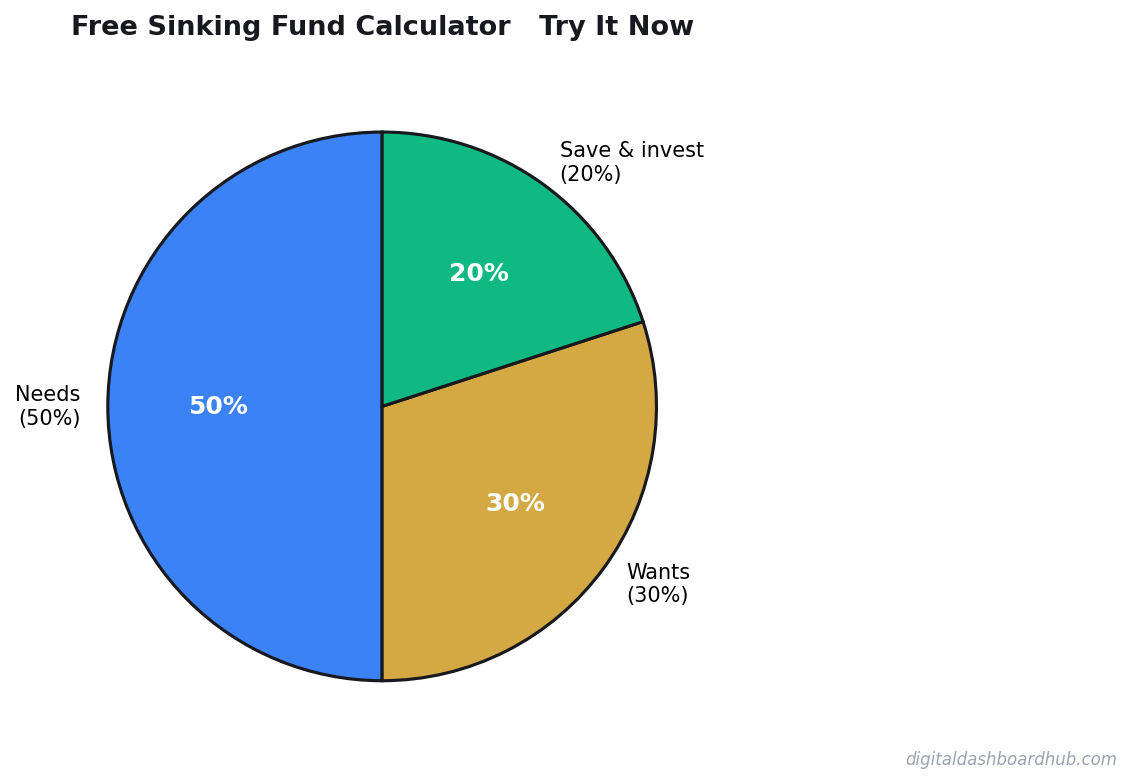
- The 50/30/20 Budget Rule: A Complete Guide — Learn the golden ratio for managing your money
Get Free Savings Tools & Money Strategies
Join our community of savers and goal-setters. Get exclusive tips, new tools, and proven strategies delivered to your inbox weekly:
Disclaimer: This tool provides estimates for planning purposes only. Actual savings amounts may vary based on income changes, unexpected expenses, and market conditions. Consult with a financial advisor for personalized planning tailored to your specific situation and goals.
Keep Reading
- I Tested 9 Expense Tracker Apps for 3 Months — Here’s What Actually Worked
- Freelancer Finance Management Dashboard (VVS): Finally, a Money Tool Built for Variable Income
- Airbnb Revenue Calculator: Estimate Your Short-Term Rental Income Before You List
Sinking Funds With Real Numbers: What They Actually Do
Here’s the problem sinking funds solve. Your car registration is $380. Car insurance comes due twice a year at $720 per payment. The family vacation costs $2,200. A new laptop every 3 years runs $1,400. In any given year, these “surprises” total $5,020 — but none of them are actually surprises. You know they’re coming. You just haven’t planned for them.
Spread $5,020 over 26 biweekly paychecks and you’re setting aside $193/paycheck. That’s it. The car registration comes due and you have the money. The insurance payment hits and there’s no panic. The vacation fund has been building since January. Sinking funds don’t require more money — they require only that you decide, in advance, where the money goes.
How to Structure Your Sinking Funds (Without Overcomplicating It)
You don’t need 14 separate sinking fund accounts. Most people need 3-5:
- Vehicle fund — registration, insurance installments, expected repairs, and eventual replacement. Even an “emergency” repair at $800 isn’t an emergency if you’ve been contributing $30/month to this fund.
- Annual expenses fund — anything that hits once a year: subscriptions, professional memberships, holiday gifts, tax prep fees.
- Travel fund — exactly what it says. Set a target, divide by pay periods until the trip, contribute automatically.
- Home fund — for renters, this is moving costs and security deposits. For owners, it’s the appliance that’s going to break, the roof that’s getting old, the HVAC that’s not going to last forever.
- Medical fund — even with insurance, the average out-of-pocket for an insured American is $1,400-$2,200/year. Monthly contribution to cover that isn’t optional; it’s baseline financial planning.
Automate the transfers on payday so the money moves before you see it. “Out of sight” is not a bug — it’s the entire mechanism.
The #1 Mistake People Make With Sinking Funds
They start with too many categories and too small contributions to each. A $5/month fund for something that costs $600 isn’t a fund — it’s a rounding error. Start with your 2-3 highest-impact categories, fund them properly, and add categories only when those are fully operational. A well-funded vehicle and annual expenses sinking fund will eliminate 80% of your “unexpected” financial stress.
The Math That Makes Sinking Funds Work
Let’s run real numbers. You have three sinking fund targets for the next 12 months:
- Car registration: $340, due in 8 months → need $42.50/month
- Annual car insurance: $1,440/year paid in two $720 installments, next due in 5 months → need $144/month
- Vacation: $2,800 trip in 10 months → need $280/month
Total monthly contribution: $466.50. Not $2,800 dumped from a checking account in October. Not $720 scrambled from whatever’s available when insurance comes due. $466.50/month, moved automatically, and every obligation is covered without stress.
The entire point of a sinking fund is eliminating the financial shock of predictable expenses. None of those three costs above are surprises — but without planning, they’re treated as emergencies. With planning, they’re non-events.
Where to Keep Sinking Funds
High-yield savings accounts are the standard choice — they’re FDIC insured, earn actual interest (4-5% APY in 2025 at most online banks), and are easy to organize by fund purpose. Some people use sub-accounts or “buckets” within a single HYSA. Others keep separate accounts. Either works as long as the money is clearly earmarked and not mixed with operating cash.
Don’t keep sinking funds in a brokerage account or anything with market exposure. The whole point is certainty — you need $340 in 8 months, and you need exactly $340, not approximately $340 depending on what the market does. HYSA. Done.
Don’t keep them in the same account as your emergency fund. Sinking funds are for planned expenses. Emergency funds are for unplanned ones. Mixing them means you spend your emergency fund on a car registration and then have nothing left when something actually breaks unexpectedly.
The Pro Move: Tiered Sinking Funds by Timeline
Short-term sinking funds (expenses due in under 6 months): keep in checking or a standard savings account. Easy access, no yield optimization needed for such a short window.
Medium-term (6-18 months): HYSA with automatic contributions. Let the interest work.
Long-term sinking funds (car replacement in 4 years, roof replacement in 7 years): consider I-Bonds for the first $10,000/year — inflation-linked, currently yielding competitive rates, redeemable after 12 months. The capital is locked for 1 year, but a 7-year roof fund doesn’t need liquidity in year 1.
Most people never get to the tiered approach because they’re still solving the basics. Get the basics working first — vehicle fund, annual expenses fund, one goal-based fund. Then layer in sophistication once the habit is automatic.
Keep reading (related guides):
- Free Menopause Symptom Tracker — Try It Now
- Free ADHD Impulse Spending Tracker — Try It Now
- Nervous System Regulation Tracker: The Visual Dashboard That Helps You Understand Your Bodys Stress Signals
- I Owed $47,000 in Taxes and Had $11,000 in the Bank: How I Rebuilt My Freelance Finances From the Ground Up
- Bakery Revenue Calculator
255+ interactive tools for your money, time, and health.
Full dashboard access · Stripe-secure checkout · Cancel anytime

Andy Gaber is the founder of Digital Dashboard Hub, a suite of 255+ interactive financial, productivity, and wellness tools. He built DDH after getting frustrated with financial apps that gave outputs without context. Follow along for tool tutorials, revenue analytics breakdowns, and honest takes on personal finance.