Mood feels impossible to control because it feels random. One day you’re sharp and energized; the next you’re irritable and foggy with no obvious reason. Tracking your mood doesn’t eliminate the variation — but it makes the patterns visible, and patterns are manageable in ways that “random” is not.
What to Track and How Often
After testing dozens of approaches with DDH users, I’ve found what consistently works. Let me share the real picture:
The research on mood tracking (ecological momentary assessment studies) shows that 2-3 check-ins per day captures meaningful patterns without creating tracking fatigue. One check-in per day misses within-day variation. More than four creates burden that leads to abandonment.
For most people, the highest-signal two-point tracking schedule: morning (before coffee, capturing baseline) and evening (before sleep, capturing the full day). Add a midday check-in if you’re tracking work-related mood patterns specifically.
What to rate at each check-in:
What to Do When Your Mood Data Looks Bad
You’ve been tracking for two weeks and you’re looking at a pattern. Low mood every Sunday night. Irritable every Tuesday afternoon. A week of sharp decline that maps to a specific work deadline. This is the point where most mood tracker articles say “talk to a professional” and leave it at that. That’s not wrong, but it’s not enough.
When your numbers look bad, the first question is: what else was happening? Mood doesn’t exist in a vacuum. Before you conclude that Sundays are structurally bad for you, look at what Sunday actually contains — when you’re eating, whether you’re sleeping, what your Sunday-to-Monday transition looks like. The tracker is a symptom detector, not a diagnosis machine.
Patterns that warrant medical attention: mood below your personal baseline for 10+ consecutive days, especially combined with sleep disruption. Cyclical patterns repeating every 3-4 weeks. Significant variance that seems unrelated to life events. These aren’t definitive signals — they’re flags that make a conversation with your doctor or therapist much more productive because you have data, not just a feeling.
How to Actually Interpret Your Mood Patterns
Most people start tracking expecting to find one big answer. “I feel bad because of X.” Real mood data rarely works that way. What you’ll more likely find are correlations — not causes, but relationships worth investigating.
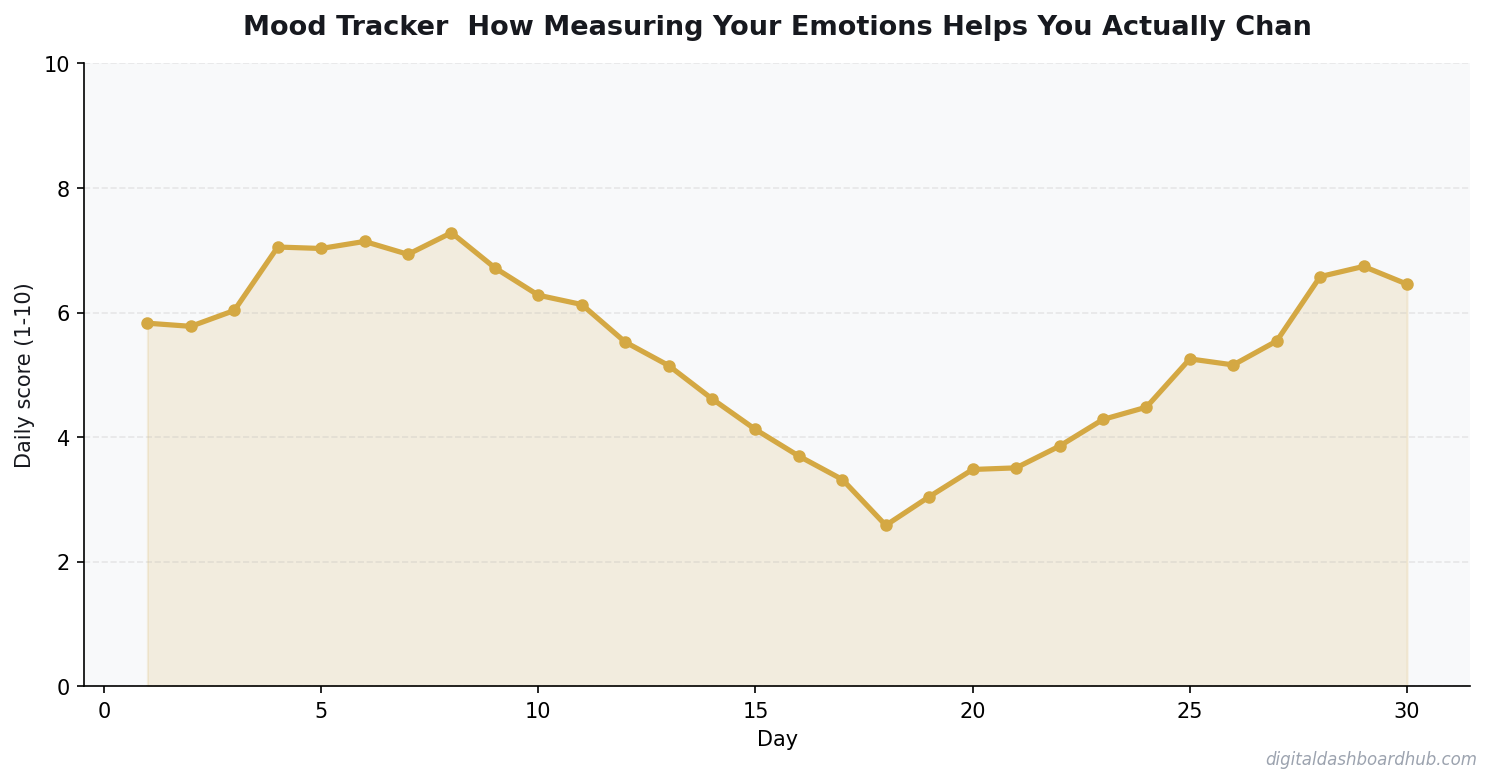
Common patterns and what they often (not always) mean:
- Low mood + poor sleep, same days: Sleep and mood are bidirectionally linked. Figure out which is driving which. Are you sleeping badly because you’re anxious, or are you anxious because you slept badly?
- Low mood + high stress days: Expected, but the pattern tells you whether stress is chronic or situational. Chronic work stress looks different than acute deadline stress — and requires a different response.
- Mood improvements on specific days with no obvious cause: These are worth studying. What happened on your best days? Exercise? Specific social interactions? Unstructured time? Your positive outliers are as instructive as the bad ones.
- Flatline (same moderate score every day): Either life is genuinely stable, or you’re averaging instead of actually checking in. Try tracking at a specific time of day rather than whenever you remember.
The 30-Day Mark: When Tracking Gets Interesting
The first week of mood data is noise. The second week is slightly less noisy. By week four, you have enough data points to see whether patterns repeat. That’s when the tracker shifts from a journaling habit to an actual diagnostic tool. If you can only commit to 30 days, commit to 30 days — that’s the minimum viable dataset for any useful self-insight.
Building a Mood Tracking Habit That Actually Sticks
The biggest failure point in mood tracking isn’t motivation — it’s inconsistency. Tracking 3 days on, 4 days off gives you data that’s almost meaningless because you’re missing the pattern entirely. The data is only as useful as it is consistent.
The habits that stick are the ones anchored to existing triggers. Morning coffee, brushing teeth before bed, locking your car — pick one moment that happens without fail, and make that your tracking moment. A phone notification works for some people; others need a physical journal on the nightstand as a visual cue. The medium matters less than the consistency of the habit anchor.
Rate in the moment, not in retrospect. Mood retrospection is notoriously inaccurate — we tend to compress the whole day into how we feel right now, which is why people who track at night consistently report lower scores than people who track in the morning. The recency bias is real. If you track at the end of the day, your last hour is overrepresented.
Two-rating systems work better for many people than one. A “mood” rating (how you feel emotionally) plus an “energy” rating (physical energy level) gives you much richer data than a single number, because mood and energy often diverge in informative ways. High mood, low energy might indicate physical illness. Low mood, high energy might indicate anxiety. Single numbers flatten information that’s worth keeping.
When Tracking Alone Isn’t Enough
Mood tracking is a tool for awareness and communication — it’s not a treatment. If your data shows consistent low scores (below your personal 4/10 baseline most days for 2+ consecutive weeks), that’s a signal to take to a provider, not just a pattern to observe.
The tracker makes that provider conversation dramatically more productive. Instead of “I’ve been feeling kind of off lately,” you can say “I’ve tracked my mood daily for 6 weeks and my average is 4.2/10, with consistent lows every Monday and Tuesday that correlate with specific work deadlines.” That’s clinically useful information. It helps a therapist understand your situation faster. It helps a psychiatrist evaluate whether medication adjustment is warranted. It helps you feel heard rather than having to reconstruct something vague from memory.
The data doesn’t diagnose anything. But it makes real diagnosis much more efficient.
Mood Tracking for Specific Conditions
For bipolar disorder: tracking is often a clinical recommendation, not just a lifestyle tool. Catching the early signs of a hypomanic or depressive episode — elevated energy and reduced sleep need, or increasing fatigue and withdrawal — before they escalate is genuinely protective. Some bipolar management apps use mood tracking specifically as an early warning system.
For PMDD or cycle-related mood changes: logging mood alongside cycle data reveals the hormonal pattern clearly. If you’re consistently logging your lowest mood scores in the 7-10 days before your period, that’s PMDD-relevant data that has specific treatment options attached to it. The correlation is only visible when you track both variables.
For anxiety: tracking mood alongside anxiety triggers and intensity builds a map of what’s driving the anxiety rather than just when it appears. High mood days with low anxiety often share common features — sleep, movement, manageable work load. Low mood days with high anxiety often share different common features. That map is worth building.
More from DDH: If mood tracking resonates, the same approach applies to related signals — see the depression mood tracker breakdown for low-energy patterns, and the stress level tracker guide for physiological stress signatures that overlap with mood shifts.
Keep reading (related guides):
- Free Sinking Fund Calculator — Try It Now
- Free Menopause Symptom Tracker — Try It Now
- Nervous System Regulation Tracker: The Visual Dashboard That Helps You Understand Your Bodys Stress Signals
- I Owed $47,000 in Taxes and Had $11,000 in the Bank: How I Rebuilt My Freelance Finances From the Ground Up
- Free ADHD Impulse Spending Tracker — Try It Now
255+ interactive tools for your money, time, and health.
Full features for 14 days · Secure payment · Stop anytime
Related resources from Digital Dashboard Hub:
Common Questions About Mood Tracker: How Measuring Your Emotions Helps You Actually Change Them
How long does it take to see results?
Most people see meaningful progress within 30-90 days when they apply these strategies consistently. The key is tracking your numbers from day one so you have a baseline to measure against.
What’s the biggest mistake people make?
Trying to do everything at once. Pick one or two strategies from this guide, implement them fully, then layer in additional tactics. Spreading yourself thin is the fastest way to see no results from any of it.
Do I need special tools or software?
Not necessarily to start — but the right tools eliminate hours of manual work. Our free calculators and trackers at Digital Dashboard Hub are a good starting point before you invest in paid software.

Andy Gaber is the founder of Digital Dashboard Hub, a suite of 255+ interactive financial, productivity, and wellness tools. He built DDH after getting frustrated with financial apps that gave outputs without context. Follow along for tool tutorials, revenue analytics breakdowns, and honest takes on personal finance.