# ADHD and Money: Why Your Brain Makes Budgeting Feel Impossible (And What Actually Works)
—
You opened your banking app this morning and felt that familiar pit in your stomach. There's less in your account than you expected — again. You know you got paid. You know you had a plan. But somewhere between the dopamine-driven Amazon binge at 11 PM, the DoorDash orders you don't even remember placing, and that "just this once" purchase that turned into four purchases, the plan evaporated. And now you're doing that thing where you scroll back through transactions trying to piece together where the money went, like a detective investigating a crime you committed against yourself.
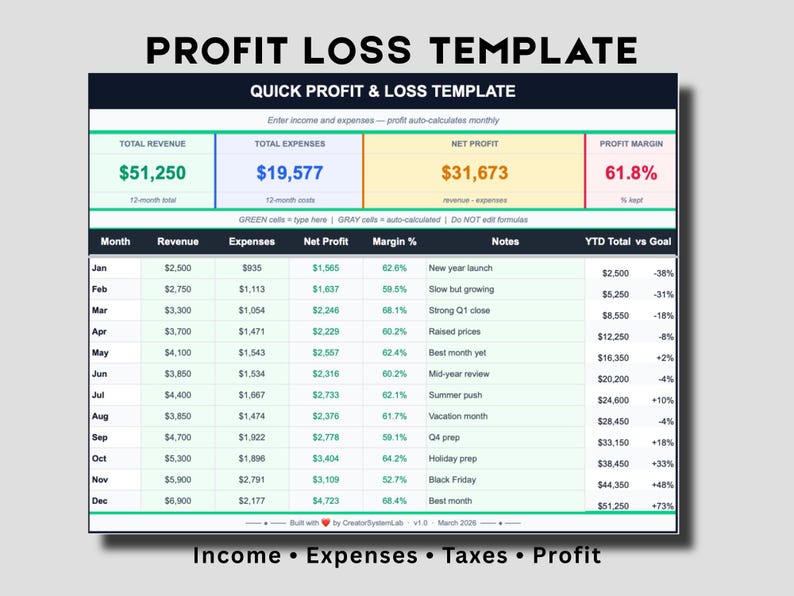
Profit & Loss Template
Simple Google Sheets P&L spreadsheet to track income, expenses & net profit — perfect for managing money
If this is your recurring financial reality, and you have ADHD, I want you to hear something that might change how you think about all of it: **this isn't a moral failing. It's a neurological pattern.** Your brain is doing exactly what ADHD brains do — seeking dopamine, struggling with impulse control, losing track of things that aren't immediately visible, and time-blinding you into ignoring consequences that aren't happening right now.
The good news? Once you understand the specific ways ADHD sabotages your finances, you can build systems that work *with* your brain instead of against it. Not willpower-based systems that last three days. Actual structures that make the right financial behavior the easy behavior.
## The ADHD-Money Connection: Why Your Brain and Your Wallet Are at War
ADHD isn't a budgeting problem. It's a brain chemistry problem that shows up everywhere, and finances are one of the places it hits hardest. Here's why.
### Dopamine Shopping: Your Brain's Favorite Coping Mechanism
ADHD brains have lower baseline levels of dopamine — the neurotransmitter that drives motivation, reward, and satisfaction. Your brain is perpetually hunting for anything that produces a quick dopamine hit, and few things deliver faster than buying something.
The anticipation of a purchase. The click of "add to cart." The confirmation email. The package arriving. Each stage is a little dopamine bump, and your brain has learned that this loop is one of the most reliable ways to feel good *right now*. It's not greed. It's self-medication.
The problem is that the hit is always temporary. The satisfaction fades within hours (sometimes minutes), and you're left with a thing you don't need and less money than you planned to have. Then the guilt kicks in, which feels bad, which makes your brain seek another dopamine hit, which leads to more spending. It's a cycle, and it's not your fault — but it is your responsibility to interrupt it.
### Impulse Spending: The Tax on Low Impulse Control
ADHD fundamentally affects impulse control. The prefrontal cortex — the brain's CEO that handles planning, judgment, and saying "maybe not right now" — is under-activated in ADHD brains. This means the gap between "I want that" and "I bought that" can be milliseconds.
Online shopping has made this infinitely worse. There's no friction. No drive to the store, no waiting in line, no physical act of handing over cash. Just a saved credit card and a thumb print. The impulse and the action are separated by nothing, and for an ADHD brain, nothing is not enough.
### Bill Blindness: The "Out of Sight, Out of Mind" Tax
ADHD dramatically affects object permanence and working memory. If something isn't visible, it might as well not exist. Bills that aren't due today? Tomorrow's problem. Subscriptions you forgot about? They're invisible until your bank statement isn't. The dentist appointment you need to schedule? Not happening until it becomes an emergency.
This "bill blindness" leads to late fees, missed payments, overdrafts, and credit score damage — not because you can't afford the bills, but because your brain literally forgot they existed when they weren't in front of your face.
### Time Blindness: Why "Future You" Doesn't Feel Real
ADHD brains experience time differently. "Now" and "not now" are the only two time zones your brain naturally recognizes. This means the consequences of overspending today don't feel real — because they're happening to Future You, and Future You might as well be a stranger.
This is why ADHD and credit card debt so often go together. The purchase feels immediate and real. The payment feels distant and abstract. Your brain gives the dopamine hit more weight than the financial consequence every single time — not because you're bad with money, but because your neurological hardware is biased toward the present.
## What Actually Works: ADHD-Friendly Money Strategies
Generic budgeting advice is built for neurotypical brains. "Just track your spending" is about as helpful as telling someone with poor eyesight to "just read the sign." The method matters. Here are strategies designed for how your brain actually operates.
### Strategy 1: Make Your Money Visible
If your brain forgets what it can't see, the solution is to make everything visible — constantly. This means a financial dashboard you check daily that shows you exactly what's in your accounts, what's due this week, and what you've spent so far this month.
Not an app you have to remember to open. A dashboard that's your browser homepage. A spreadsheet pinned to your bookmarks bar. A physical whiteboard on your wall with your account balances updated every morning. The format matters less than the visibility.
The **[Business Expense Tracker](https://www.etsy.com/listing/4474041699/business-expense-tracker-tax-deduction)** from Creator System Lab is built for exactly this kind of visibility — a dashboard that shows your spending by category in real time, so nothing hides in the background. If you're a freelancer or side hustler, it also tracks tax deductions, which is one more financial task your ADHD brain is likely neglecting.
**The rule:** If you can't see your financial status without opening something, you won't see it.
### Strategy 2: Automate Everything That Can Be Automated
Every financial decision you have to make manually is an opportunity for your ADHD brain to make the wrong call — or, more likely, to make no call at all. The solution is to remove as many manual decisions as possible.
Set up auto-pay for every recurring bill. Set up automatic transfers to savings accounts on payday — not at the end of the month when there's nothing left. Set up automatic debt payments above the minimum. Set up automatic investment contributions.
The goal is a system where your money moves to the right places the moment it arrives in your account, before your impulse-driven brain gets a chance to redirect it. If $300 for savings disappears from your checking account on payday, you can't spend it on an impulse buy at 11 PM. What's automated is protected.
### Strategy 3: Create Friction for Spending, Not Saving
Your ADHD brain follows the path of least resistance. Right now, that path leads to spending, because spending is frictionless. Flip it.
**Add friction to spending:** Remove saved credit cards from online stores. Delete shopping apps from your phone. Institute a 48-hour rule: anything over $50 goes on a wish list and has to survive 48 hours before you buy it. Unsubscribe from promotional emails that trigger impulse purchases. Use cash or a prepaid debit card for discretionary spending so you can physically see the money leaving.
**Remove friction from saving:** Automate transfers. Use round-up savings apps. Make your savings account harder to access (different bank, no linked debit card). Set up visual progress trackers for savings goals so your brain gets dopamine from *saving*, not spending.
### Strategy 4: Use the "Fun Money" Account
One of the worst things you can do with an ADHD brain is try to eliminate all discretionary spending. Your brain will rebel, and the rebellion will be expensive. Instead, give yourself permission to spend impulsively — within a boundary.
Set up a separate account or category specifically for fun money. Fund it with a specific amount each month (or each paycheck). This money is yours to blow on whatever you want with absolutely zero guilt. When it's gone, it's gone until next month.
This works because it satisfies your brain's need for spontaneous spending while containing the damage. The dopamine shopping doesn't stop — it just happens inside a container. And because you've given yourself explicit permission, the guilt cycle breaks.
### Strategy 5: Make Bills Impossible to Forget
Bill blindness is one of the most expensive ADHD financial symptoms. Late fees, overdraft charges, and credit score damage add up fast — and they're entirely preventable with the right system.
**Option A:** Autopay everything. This is the gold standard. If a bill can be auto-paid, auto-pay it. Check your accounts weekly to make sure nothing weird is happening, but let the automation handle the timing.
**Option B:** For bills that can't be auto-paid, create a bill calendar that's physically visible — on your wall, on your fridge, on your desk. Not a digital reminder you'll dismiss. Something you can't avoid seeing. Write the bill name, amount, and due date. Cross it off when paid.
**Option C:** Consolidate due dates. Many creditors will let you change your payment due date. Move everything to the 1st and 15th (or whatever aligns with your pay dates) so you only have to think about bills twice a month instead of every random day.
The **[Profit and Loss Template](https://www.etsy.com/listing/4472916206/profit-and-loss-template-google-sheets)** gives you a structured overview of what's coming in and what's going out, making it much harder for expenses to hide in your financial blind spots.
### Strategy 6: Use Body Doubling for Financial Tasks
Body doubling — working alongside someone else — is one of the most effective ADHD productivity strategies, and it works for financial tasks too. Schedule a monthly "money date" with a partner, friend, or accountability buddy where you both sit down and review your finances.
Not a lecture. Not a judgment session. Just two people doing their financial check-ins at the same time. The social presence activates your brain in a way that solo financial review never will. Review your spending, adjust your budget, check your accounts, and pay anything that's outstanding.
If you don't have an in-person buddy, virtual co-working sessions on platforms like Focusmate work just as well. The key is turning a solitary, avoidance-prone task into a social, structured one.
### Strategy 7: Forgive Yourself and Reset Weekly
This might be the most important strategy on this list. ADHD and money shame are deeply intertwined. Every overspend, every late fee, every moment of "how did I let this happen again" adds a layer of shame that makes it harder — not easier — to engage with your finances. Shame leads to avoidance. Avoidance leads to worse financial outcomes. Worse outcomes lead to more shame.
Break the cycle by building in a weekly reset. Every Sunday (or whatever day works), spend 15 minutes reviewing your week. What did you spend? Did any impulse purchases sneak through? Are any bills coming up? How's your fun money account looking?
The weekly reset isn't about perfection. It's about course correction. A budget that goes off track on Tuesday and gets corrected on Sunday is infinitely better than a budget that goes off track on Tuesday and doesn't get looked at until the next bank statement arrives.
## Building Your ADHD Money System: The Starter Stack
If you implement nothing else from this article, build this three-piece system:
**Piece 1: Visibility.** A dashboard or spreadsheet that shows your account balances, upcoming bills, and spending-to-date. Check it daily — make it your browser homepage if you have to. The **[Small Business Dashboard](https://www.etsy.com/listing/4472968543/small-business-dashboard-google-sheets)** works perfectly for this if you're a freelancer or business owner — it's a single-view financial command center that makes hiding from your numbers impossible.
**Piece 2: Automation.** Auto-pay every bill. Auto-transfer savings on payday. Auto-invest if applicable. Reduce the number of financial decisions you need to make manually to as close to zero as possible.
**Piece 3: Containment.** Fun money account with a fixed amount. The 48-hour rule for anything over $50. Shopping apps deleted. Saved credit cards removed. Create friction between your impulse and the transaction.
These three systems — visibility, automation, and containment — work with your ADHD brain instead of pretending it works like everyone else's. They don't require willpower. They require setup — and then they run.
For structured goal-setting and progress tracking that keeps your financial objectives visible and rewarding, the **[Creator Goal Scorecard](https://www.etsy.com/listing/4472919488/creator-goal-scorecard-business-progress)** helps you track progress across multiple goals simultaneously, providing the visual progress indicators that ADHD brains need to stay motivated.
And if time management is part of your financial problem — because disorganized days lead to stress spending and missed financial tasks — the **[Time Blocking Productivity Planner](https://www.etsy.com/listing/4474042853/time-blocking-productivity-planner-deep)** helps you map tasks to time blocks that respect your energy patterns and attention span, including dedicated blocks for financial check-ins.
## You're Not Bad With Money. You Have ADHD.
Let me say that again, because it's the most important sentence in this article: **you are not bad with money. You have a brain that processes reward, impulse, time, and memory differently than the systems and advice around you were designed for.**
The financial industry, the productivity industry, and most budgeting advice assume a neurotypical brain. They assume you can delay gratification easily, that you remember bills without reminders, that abstract future consequences motivate present behavior, and that "just track your spending" is a complete instruction.
None of that maps to ADHD. And when you try to follow systems built for a different brain and inevitably fail, the conclusion isn't that the system was wrong — it's that you're broken. You're not broken. You're using the wrong tools.
The strategies in this article work because they're built for your brain. They externalize the executive functions that ADHD impairs. They create structures that do the remembering, the impulse-checking, and the planning for you. They turn good financial behavior from a willpower exercise into an environmental design project.
You can build a financial life that works. It just has to be built *your* way.
## Your Next Step
Pick one strategy from this article and implement it today. Just one. If you've never automated your bills, set up auto-pay on your three biggest recurring expenses. If impulse spending is your main problem, delete two shopping apps from your phone and institute the 48-hour rule. If bill blindness is killing you, create a visible bill calendar on your wall.
One change. Today. Not tomorrow. Today — because your ADHD brain and "tomorrow" have a complicated relationship.
—
### Grab Our Free ADHD Money Reset Checklist
**Want a step-by-step system for getting your finances unstuck?** We built a free ADHD Money Reset Checklist — a concrete, ADHD-friendly protocol for auditing your current money situation, setting up automation, creating your fun money container, and building the visibility system that keeps you in control.
👉 **[Grab the Free ADHD Money Reset Checklist](#signup)** — Straight to your inbox. No spam. No shame. Just the system.
—
*
This article is for informational purposes only and is not a substitute for professional medical, psychological, or financial advice. ADHD is a neurodevelopmental condition with a wide range of presentations. If you suspect you have ADHD, consider seeking evaluation from a qualified healthcare provider. If you're experiencing financial distress, consider consulting with a financial counselor who has experience working with neurodivergent clients.*