Gratitude feels good in the moment—but does it actually change your brain? The answer from neuroscience is a resounding yes. When you practice gratitude journaling with intention, you’re not just feeling better temporarily; you’re literally restructuring your neural pathways, increasing serotonin and dopamine production, and training your brain to spot opportunities and joy you’d otherwise miss. But here’s the catch: the way most people journal about gratitude doesn’t work. Generic lists of “three things I’m grateful for” become rote and lose their power within weeks. The real magic happens when you know how to practice gratitude in ways that actually stick—and that’s exactly what we’re diving into today.
The Neuroscience Behind Gratitude: Why Your Brain Actually Changes
Let’s start with the science, because understanding why gratitude works makes it much easier to commit to the practice.
Your brain is constantly looking for threats. This negativity bias—our evolutionary tendency to focus on what could harm us—once kept us alive on the savanna. Today, it keeps us stressed, anxious, and fixated on what’s wrong. Gratitude practice interrupts this loop.
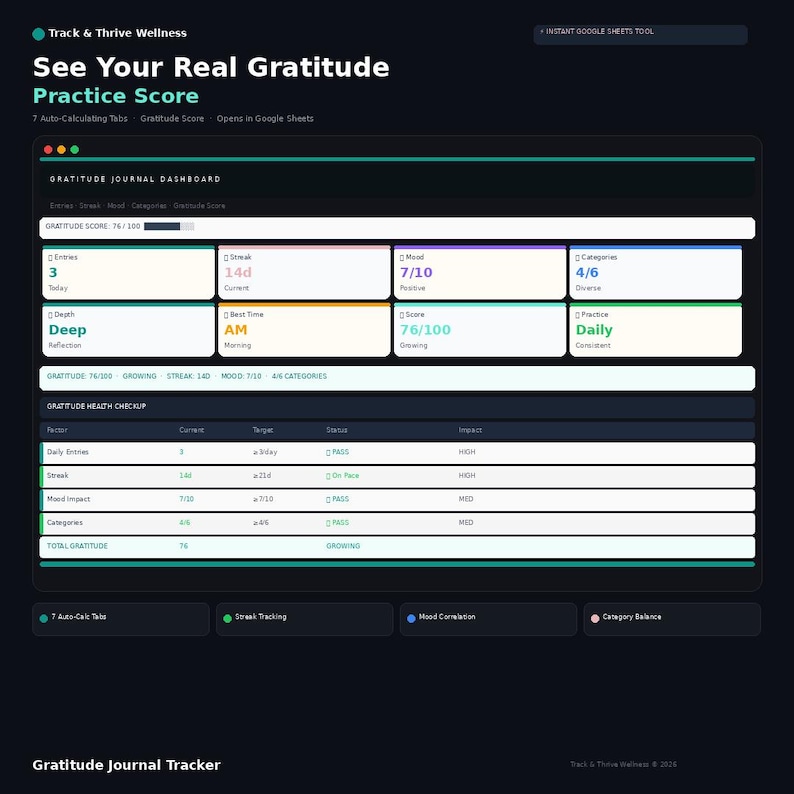
Gratitude Journal Tracker
Interactive Google Sheets dashboard to track daily gratitude entries, mood patterns & happiness score
When you consciously acknowledge something you’re grateful for, you activate your brain’s reward system, specifically triggering the release of dopamine. Dopamine isn’t just about pleasure; it’s the neurochemical of motivation and meaning-making. Over time, regular gratitude practice also increases baseline serotonin, which stabilizes mood and reduces anxiety. Researchers at UC Berkeley found that people who kept gratitude journals showed measurably increased activity in brain regions associated with social bonding, reward, and perspective-taking—and these changes were visible on brain scans.
But here’s where neuroplasticity comes in. Neuroplasticity is your brain’s ability to physically reorganize itself by forming new neural connections. When you repeatedly activate the gratitude circuits in your brain, those pathways become stronger and more automatic. After about 60 days of consistent practice, gratitude starts to feel like your brain’s default setting, not something you have to force.
The catch? Your brain also adapts—and that’s where most gratitude journals fail.
The Gratitude Journal Problem: Why “Three Things” Stops Working
You’ve probably tried the classic advice: write down three things you’re grateful for each day. It feels great on day one. Maybe day two. By day seven or fourteen, you’re writing down the same things. “My family. My health. My home.” Your brain recognizes the pattern and stops paying attention. This is called hedonic adaptation—your brain adapts to positive stimuli and stops finding them novel or rewarding.
A 2014 study published in the journal Social Psychological and Personality Science found that people who journaled about gratitude too frequently (five times per week) actually showed less benefit than those who journaled once or twice weekly. Why? Because their brains adapted to the practice and it lost its neural impact.
Additionally, surface-level gratitude—the kind that doesn’t require real thought—doesn’t engage your brain deeply enough to create lasting change. When you mindlessly write “grateful for my job,” you’re not activating the emotional and sensory cortices that actually rewire your reward system. You need specificity. You need emotion. You need to feel the gratitude, not just think it.
The solution isn’t to gratitude journal more. It’s to gratitude journal better.
Better Gratitude Prompts: Frameworks That Actually Rewire Your Brain
Here’s how to write gratitude entries that keep your brain engaged and create real neurological change.
Specificity Over Generality
Instead of: “I’m grateful for my family.”
Try: “I’m grateful for the five-minute conversation with my mom this morning where she laughed so hard at my story that she almost spilled her coffee. I haven’t heard her laugh like that in weeks.”
Specificity forces your brain to retrieve detailed memories, which activates more neural regions and creates stronger emotional engagement. When you specify why you’re grateful and include concrete details, you’re leveraging what neuroscientists call “elaborative encoding”—and that’s when real rewiring happens.
Sensory Details and Contrast
The most powerful gratitude entries include sensory information and contrast. Here’s why: your brain notices difference. When you contrast what you have with what you lack, or what you currently enjoy with how you’d feel without it, you activate deeper emotional centers.
Instead of: “Grateful for good health.”
Try: “Grateful for being able to take a walk without pain this morning. I remember last year when my knee was injured and I couldn’t walk more than a block. Today, I felt the sun on my face, heard the birds, and realized I’d gotten my freedom back. That feels like a gift.”
The contrast (pain vs. no pain) and sensory details (sun, birds) make this entry neurologically powerful. Your brain is more engaged, and your reward system fires more strongly.
The Surprise Factor
Gratitude becomes strongest when it reveals something you hadn’t consciously appreciated. This is why “surprise” gratitude works so well.
Instead of: “Grateful for my house.”
Try: “Grateful for my broken shower that finally got fixed today—because it made me realize how often I’ve taken hot water for granted. Three showers, and I’ve already thanked the plumber in my head a dozen times. Spending 20 minutes under hot water and noticing it for the first time in years reminded me that comfort isn’t something I should sleepwalk through.”
The surprise here is the realization itself. You didn’t know you’d taken showers for granted until you almost lost the ability to take one. This kind of insight creates profound neural engagement.
The “What If” Reflection
This framework involves imagining your life without something you typically take for granted.
“What if I couldn’t attend meetings because I didn’t have video conferencing tools? I’d lose access to my team, miss collaborations, and probably lose my job. Today I’m grateful for the technology that keeps me connected to my work and my colleagues. That stability matters.”
This technique forces your brain to actively construct an alternate reality, which deeply engages your prefrontal cortex and makes the gratitude feel genuinely earned rather than obligatory.
One way to ensure your gratitude practice stays engaging is to use a structured template that rotates through different types of prompts, preventing the “three things” rut. The Gratitude Journal Spreadsheet includes guided prompts that shift daily, so you’re never just listing surface-level items—each entry uses a different framework to deepen your practice.
Making Gratitude Stick: The Habit Stack That Works
Knowing how to journal is one thing. Actually doing it every day is another. Neurologically speaking, building a habit requires three elements: a trigger (a cue to start the behavior), the behavior itself, and a reward (something your brain recognizes as worth repeating).
Habit Stacking: Anchor Gratitude to Something You Already Do
The most reliable way to make gratitude journaling a permanent habit is through “habit stacking”—attaching it to something you already do daily. Your existing habits are already wired into your brain; you just need to link gratitude to them.
Examples of habit stacking anchors:
– After your morning coffee: Write one gratitude entry before you do anything else.
– Right before dinner: Spend three minutes reflecting on one moment from the day that surprised you with how good it felt.
– In bed before sleep: Five-minute gratitude reflection with sensory details.
– After your shower: One entry about something you’re grateful for in your body.
The key is immediacy. Your trigger should be something you already do without thinking. When you attach gratitude to it, the existing habit becomes the reminder, and your brain learns to associate that time of day with reflection.
Time Anchoring and Environmental Design
Beyond habit stacking, you need environmental cues. Keep your journal in a visible place—on your nightstand, your desk, your kitchen table. Every time you see it, your brain gets a small reminder. Some people also use phone notifications at the same time each day, which creates an external trigger while your habit pathways are still forming.
Streak Tracking and Micro-Rewards
This is where dopamine comes in again. Humans are motivated by progress and visible rewards. When you track your gratitude journaling streak (even just checking off a calendar), you’re triggering a small dopamine hit each day, which reinforces the behavior. This is why gratitude trackers—tools that log your practice visually—are so effective. Seeing a 7-day streak, then 14 days, then 21 days, provides concrete evidence that you’re building something real.
While you’re building your gratitude habit, pairing it with meditation amplifies the neuroscience. The Meditation Practice Spreadsheet tracks your meditation sessions alongside other wellness practices, so you can see how your mindfulness practice and gratitude journaling work together to shift your mood and emotional resilience.
The Compound Effect: What Actually Happens at 21, 60, and 90 Days
The research on gratitude journaling shows a fascinating progression. Here’s what neuroscience predicts—and what people actually experience.
Days 1-14: The Honeymoon Phase
You feel motivated and uplifted. You’re probably writing longer entries and feeling genuinely grateful. Your dopamine system is firing strongly because this is new. Don’t worry that it feels easy—that’s the point. But know that this phase won’t last unchanged.
Days 15-30: The Adaptation Dip
This is where most people quit. Your brain has adapted to the novelty, so gratitude feels less automatic. Your journal entries might feel duller. If you’re just listing “three things,” you’ll probably stop here. But if you’re using varied prompts and shifting your framework, you push through this adaptation. This is where the real neural rewiring intensifies.
Days 31-60: The Shift
Around day 35-40, something changes. Gratitude starts becoming your default lens. You notice small good things throughout your day without prompting. You catch yourself smiling at details you’d usually miss. Neurologically, your reward system is being reprogrammed. Baseline serotonin is increasing. Your brain is genuinely recalibrating what it considers “normal” to notice.
Days 61-90: The New Baseline
By 60-90 days of consistent practice, gratitude has become a genuine neural pathway preference. You’re not forcing gratitude anymore; you’re noticing it naturally. Research shows that people who’ve maintained the practice for 90+ days show sustained improvements in mood, sleep quality, relationship satisfaction, and overall life satisfaction—even after they stop journaling formally.
If you’re building a comprehensive wellness habit stack, the Stress Management Spreadsheet helps you track how your gratitude practice correlates with actual stress reduction. Seeing the data can be incredibly motivating—you’ll notice measurable improvements in stress levels as your gratitude practice deepens.
Gratitude During Hard Seasons: A Nuanced Approach
Here’s where we need to be honest: gratitude journaling during grief, depression, or anxiety isn’t about forcing positivity or pretending everything’s fine. That’s toxic positivity, and it backfires neurologically and emotionally.
When you’re struggling, your brain’s negativity bias is stronger. Your dopamine and serotonin are lower. Pushing yourself to find things to be grateful for can feel inauthentic and actually increase your sense of shame (“I should feel better, so why don’t I?”).
The answer is shifting what you journal about.
Gratitude Reframed for Difficult Times
Instead of: “I’m grateful for this experience because it’s making me stronger.”
Try: “Today was awful. I’m grateful for the one moment when my friend texted to check on me. I didn’t have to ask. They just knew.”
Notice the difference? You’re not manufacturing positivity. You’re acknowledging the hard and then pointing to the real, small thing that helped.
Other frames for hard seasons:
– Gratitude for small mercies: The hot shower that helped. The nap you managed. The one task you completed. The pain medication that worked.
– Gratitude for support: Specific people, pets, or resources that helped you survive the day.
– Gratitude for resilience: “I’m grateful that I survived today, even though today was hard. I’m still here.”
– Gratitude for what didn’t happen: “I’m grateful I didn’t yell at my kids, even though I felt angry. I’m grateful I didn’t use that coping mechanism I’ve been avoiding.”
This kind of gratitude is neurologically powerful because it’s honest. Your brain recognizes authenticity, and authentic gratitude creates real dopamine and serotonin release.
If you’re struggling with anxiety or depression alongside your gratitude practice, tools that help track your mood and emotional state make a huge difference. The Anxiety Management Spreadsheet helps you log anxiety levels while you track your gratitude practice, so you can actually see if and when your practice is helping. Sometimes when you’re in the depths, data-driven proof that you’re getting better is what makes the practice feel worth continuing.
For those navigating depression specifically, the Depression Tracking Bundle takes the guesswork out of whether your wellness practices are helping. Depression whispers that nothing changes, that you’re stuck. Having actual data—”I’ve been journaling for 45 days and my energy is measurably higher on journaling days”—can be neurologically healing in itself. Proof that you’re making progress helps rebuild dopamine-driven motivation.
The Neuroscience Bottom Line
Gratitude journaling isn’t magical thinking or positive psychology window-dressing. It’s a practical neuroscience tool that, when done correctly, literally reorganizes your brain’s default settings toward resilience, joy, and connection.
The ingredients are simple:
– Specificity over generality
– Sensory details and contrast over abstract lists
– Novelty and rotation to prevent adaptation
– Habit stacking to make it automatic
– Streak tracking to leverage dopamine
– Authenticity especially during hard times
The timeline is realistic: expect the first 30 days to feel motivated, days 30-60 to feel like you’re pushing, and days 60+ to feel genuinely transformed.
Your Next Step
You now have the frameworks. The next step is building the habit in a way that sticks. Because knowing what to do and actually doing it are two different things neurologically—and that’s where structure helps.
Our Gratitude Journal Spreadsheet is built specifically for the frameworks in this article. It rotates through five different prompting styles—specificity, sensory, contrast, surprise, and resilience—so you never fall into the “three things” rut. Tracking is built in. Visual streaks show your progress. And the prompts are thoughtful enough to keep your brain engaged past day 30.
Get Our Free 21-Day Gratitude Challenge Cards
Want to build a gratitude habit that actually sticks? We created a free set of 21-Day Gratitude Challenge Cards with one specific, thoughtful prompt for each day—designed to go deeper than generic lists.
👉 Download the Free 21-Day Gratitude Challenge Cards — Delivered straight to your inbox. No spam, ever.
This article is for informational purposes only and does not constitute medical or mental health advice. While gratitude journaling is evidence-based and supported by neuroscience research, it is not a substitute for professional mental health treatment. If you’re experiencing depression, anxiety, suicidal ideation, or other serious mental health concerns, please contact a mental health professional, your doctor, or a crisis line. Gratitude practices work best as part of a comprehensive wellness approach that may include therapy, medication, exercise, and social connection.