Let's be honest: you're probably undercharging.
I say this not to shame you, but because nearly every freelancer I've talked to has been there. You accept a "quick project" at $25/hour. You take on that website redesign at a flat rate that works out to $18/hour once you factor in revisions. You negotiate your retainer down because you're afraid to lose the client.
Then months go by, and you're exhausted, stressed about money, and wondering why running your own business doesn't feel profitable.
The problem? You never actually calculated your freelance rate.
Most freelancers either copy whatever the market says they should charge, ask their friend what they charge, or just pick a number and hope it works. None of these approaches account for your actual costs, your experience, or your real financial needs.
This article walks you through the exact process I use to set rates that actually cover my expenses, taxes, and desired income—plus give me breathing room. Whether you're just starting out or you've been freelancing for years and know it's time for a raise, you'll have a clear framework by the end.
The Real Math Behind Your Freelance Rate Calculator
Before we talk about how much to charge, let's talk about the math that makes the number real.
Your freelance rate isn't arbitrary. It flows directly from three things:
- How much money you actually need to earn in a year
- How many hours you can realistically bill each year
- What it actually costs to run your business
Let's break this down with a practical example.
Start here: How much money do you need to make per year after taxes to live the life you want?
Not what you made at your last job. Not what you think you "should" make. What do you actually need?
Let's say you want to take home $60,000 per year after taxes. (This is your personal living expense target, not your gross business revenue.)
This is where freelancers get tripped up. You don't work 2,080 hours per year, even though that's 52 weeks × 40 hours.
Here's why:
- You need vacation time (let's say 3 weeks = 120 hours)
- You need sick days (2 weeks = 80 hours)
- You need time for admin, invoicing, marketing, proposal writing, and learning (roughly 10 hours per week = 520 hours)
- You might have slow periods or client delays where you can't bill
A realistic number for most freelancers is 1,000 to 1,200 billable hours per year.
Let's use 1,100 billable hours.
This is the biggest mistake freelancers make: they forget they have to pay taxes on top of their living expenses, and they have business costs.
If you earned $60,000 and you're self-employed in the US, you'll owe:
- Self-employment tax (~15.3% = $9,180)
- Federal income tax (varies by bracket, but roughly 12-22% = $7,200-$13,200)
- State income tax (varies, but let's say 5% = $3,000)
That's roughly 27-32% of your income going to taxes. If you want to take home $60,000, you need to earn about $82,000-$88,000 in gross revenue.
Plus, let's say your business costs $300/month for software, equipment, internet, and other overhead = $3,600/year.
So your total target revenue = $85,000 (using the midpoint).
Now divide your target revenue by billable hours:
$85,000 ÷ 1,100 billable hours = $77.27/hour
Round up to $80/hour (or whatever makes sense for your market and experience).
This is your baseline. But let's dig deeper into whether hourly is actually the right model for you.
Why Hourly Rates Aren't Always Your Best Option
If you're a designer, developer, or strategist, charging hourly can actually hurt your earning potential.
Here's the problem: an experienced freelancer can do in 5 hours what a junior takes 15 hours to do. If you're both charging $80/hour, the junior makes $1,200 and you make $400. That's backwards.
Hourly rates also create misaligned incentives. Your client wants you to work slowly (more billable hours), and you want to work fast (to move to the next project). These goals are in direct conflict.
Project-Based Pricing: Instead of "$80/hour," you charge "$2,500 for a logo design package." This works great when you have well-defined deliverables and you've done similar work enough times to estimate accurately.
The advantage? You can work efficiently and keep the profit. If you knock out a project in 8 hours instead of 10, you're not penalizing yourself.
Retainer Pricing: "$1,500/month for 10 hours of design work per month." This gives clients predictability and gives you reliable recurring revenue. It's especially powerful if you build a roster of several retainer clients.
Value-Based Pricing: "I'll redesign your website so your conversion rate increases by 2%, which is worth $50,000 in additional revenue to you. My fee is $8,000." This is the most profitable model—you're charging based on the value you create, not the time you spend.
Each model has a place. But most freelancers default to hourly when they should be thinking bigger.
The "Double Your Salary" Rule (And Why It's Real)
You've probably heard this: "Your freelance rate should be double what you made as an employee."
If you made $50,000 as an employee, you should charge $100/hour as a freelancer ($50,000 ÷ 500 hours = $100/hour, assuming lower billable hours and the need to cover benefits, taxes, and overhead yourself).
This rule actually works because:
-
Benefits: When you were an employee, your company paid for health insurance, retirement match, paid time off, and workers' comp. You're now paying all of this yourself. Health insurance alone can be $300-600/month.
-
Taxes: Employees split self-employment tax with their employer. As a freelancer, you pay the full 15.3%.
-
Unpaid work: Time spent on invoicing, contracts, client acquisition, and learning doesn't get billed but has to be paid for.
-
Business risk: Slow months, late-paying clients, and scope creep mean you need buffer room.
The "double your salary" rule actually under-corrects for all these factors. But it's a solid starting point.
What Freelancers in Different Industries Actually Charge
Here's the reality: your industry and experience level matter enormously.
-
Beginners: $25-40/hour
-
Mid-level: $50-75/hour
-
Experienced: $100-150+/hour
-
Beginners: $30-50/hour or $0.10-0.25/word
-
Mid-level: $60-100/hour or $0.50-1.50/word
-
Experienced: $125+/hour or $2-5+/word
-
Beginners: $40-60/hour
-
Mid-level: $75-125/hour
-
Experienced: $150-300+/hour
-
Beginners: $35-60/hour
-
Mid-level: $80-150/hour
-
Experienced: $200+/hour
-
Beginners: $75-150/hour
-
Mid-level: $200-400/hour
-
Experienced: $500-1,500+/hour
These ranges vary wildly by location, niche, and demand. A freelance developer in San Francisco charges more than one in rural Ohio. Someone who specializes in e-commerce optimization for high-growth startups charges more than a generalist.
The point: know what the 50th percentile of your industry charges, then figure out where you should be on that spectrum based on experience.
A Real Freelance Rate Calculation (With Numbers You Can Use)
Let's walk through this with a specific example: you're a mid-level web designer, and you're currently charging $60/hour. You want to know if that's sustainable.
-
Current rate: $60/hour
-
Target billable hours: 1,100/year
-
Current gross revenue: $66,000/year
-
After-tax income (estimated): ~$45,000
-
Business expenses: $300/month ($3,600/year)
-
Location: Mid-sized US city (5% state tax, 12% fed bracket)
-
You need $60,000 after taxes
-
Add back taxes (~30%): $60,000 ÷ 0.70 = $85,714
-
Add back business expenses: $85,714 + $3,600 = $89,314
-
Divide by billable hours: $89,314 ÷ 1,100 = $81.19/hour
Your action: You're undercharging by about $20/hour. Instead of raising your rate immediately (which could shock clients), you could:
- Raise to $70/hour for new clients (10% increase)
- Move toward project-based pricing for predictable work (pricing higher)
- Aim to hit $80/hour within 12 months through a series of smaller increases
If you increased to $75/hour right now, that's an extra $16,500/year in gross revenue. That's the difference between stressed and stable.
This is why calculating your rate matters. You can't optimize what you don't measure.
Beyond Hourly: Introduction to Value-Based Pricing
If you're serious about scaling your income, you need to understand value-based pricing.
In value-based pricing, you're not selling your time—you're selling outcomes.
Example: A freelance marketer doesn't charge $100/hour to create an email campaign. They charge $5,000 to run an email campaign because the client expects a 3x return on that investment.
Here's how to start thinking in value-based terms:
-
Ask your clients about their goals. If you design websites, ask: "How many leads do you need to break even on this investment? How much is one qualified lead worth to you?"
-
Estimate the value you'll create. If your design increases their conversion rate by 1%, and they get 10,000 monthly visitors, that's 100 extra conversions. At $500/sale, that's $50,000 in value.
-
Price based on value, not time. Your fee might be $5,000-8,000, which is 10-16% of the value created. The client is thrilled because they make 6-10x their investment. You're thrilled because you made 10 hours of well-paid work feel like 100 hours at your old hourly rate.
The challenge is that value-based pricing requires confidence. You have to believe in the outcomes you deliver. But once you do it a few times, you'll never go back to hourly.
Common Pricing Mistakes Freelancers Make (And How to Avoid Them)
You think, "I need to make $80/hour, plus I have $3,600/year in software costs, so I should charge $81.64/hour." Wrong. You're double-counting.
Your $80/hour already includes overhead. Don't add it on top.
You calculated 1,100 billable hours, but you only got 900 hours of work. Now you're short $16,000.
Build a 10% buffer into your rate to account for this, or set aside 10% of earnings during good months.
If you design logos, rebrand full companies, and create social assets, these shouldn't all be $75/hour. Logo design might be $80/hour. Full rebrands with strategy might be $150/hour.
Segment your services and price accordingly.
You accept $40/hour for your first big client, planning to raise it later. But they become your main client, and every raise is awkward. Meanwhile, you've trained the market that this is your rate.
Set your real rate from day one. You'd rather get fewer clients at your true rate than many clients at a poverty rate.
Your client asks for "a few small tweaks" that take 4 hours. If you're not tracking this and it's not billable, you're working at $0/hour.
Define scope in writing. Charge for revisions beyond X rounds. Protect your rate.
Inflation is real. Your costs go up 3-5% every year. Your experience improves. You should raise your rate at least annually.
Aim for 5-10% annual increases, or more if you've added significant expertise.
How to Raise Your Rates Without Losing Clients
This is the question I hear most: "I want to charge more, but I'm scared I'll lose all my clients."
Good news: you will lose some clients. And that's the point.
Your worst clients—the ones who don't respect your time, negotiate endlessly, and complain about price—they'll leave. These are usually your least profitable relationships anyway.
Your good clients, the ones who value your work, will often accept rate increases without pushback.
1. Grandfathering is optional. You don't have to honor old rates for existing clients. It's actually better not to. Explain: "I'm restructuring my pricing to better reflect the value I deliver. Starting [date], my rate for new work is $90/hour (up from $75/hour)."
Most clients accept this as normal business.
2. Use project transitions as natural breakpoints. When a client finishes a project, that's when you mention: "For the next phase, I'll be at my updated rate of $90/hour."
3. If you need to grandfather someone, set an expiration date. "For the next 3 months, I'll honor your current rate. After that, we'll move to $90/hour." This prevents you from grandfathering people forever.
4. Justify with value, not greed. Don't say, "I need more money." Say, "I've completed [number] of projects for you with [specific results]. My rate now reflects the specialized value I bring to businesses like yours."
5. Offer a small trade-off. "My rate is increasing to $90/hour. To keep this a smooth transition, I'm offering a monthly retainer discount—$4,000/month for 50 hours of guaranteed availability" (instead of $90 × 50 = $4,500).
Most clients are keeping you around because you're good. A 15-20% increase won't scare them away. And if it does? That's working as intended.
Your Rate Is Not Your Worth
Before we wrap up, I need to say this: your rate is a business number. It's not what you're worth as a human.
Some of the most skilled people I know charge less than they should because they feel guilty, or they grew up hearing that money is a sensitive topic, or they're afraid of being perceived as greedy.
Your rate is the price you've decided your work-hours are worth in the current market. It can go up. It can go down if you want to shift niches. It's not a judgment on you.
That said, don't undercharge out of insecurity.
You deserve to be paid fairly for the value you create. You have bills, a life, and goals. A sustainable freelance income—where you're not stressed, where you can take time off, where you actually enjoy running your business—requires charging your true rate.
Tools to Help You Calculate and Track Your Freelance Pricing
Once you've done the math, the next step is managing it. Here are the tools that make this actual.
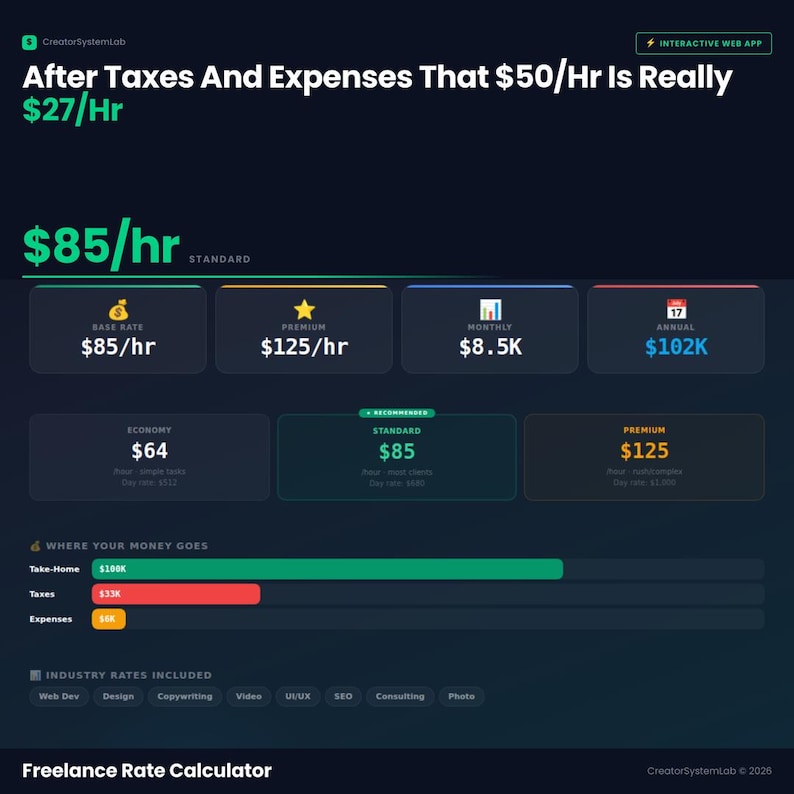
The Freelance Rate Calculator does the math we just walked through. Plug in your desired income, your estimated billable hours, and your business costs. It spits out the exact rate you need. It's the fastest way to know your number.
For pricing different types of services, the Service Package Pricing Builder lets you create tiered offerings (basic, standard, premium) and compare per-unit costs. It's especially useful if you're transitioning from hourly to project-based pricing.
Once you've set your rates, the Freelancer Business Suite (14 Tools) includes the proposal builder, time tracker, and profitability analyzer. This keeps you from the common mistake of setting a great rate and then losing track of whether you're actually hitting it.
For the tax side—which is crucial—the Freelance Tax & Quarterly Payment Calculator tracks your income and automatically calculates what you owe quarterly. It's the backstop that keeps your pricing sustainable (because if you forget about taxes, all that careful rate-setting falls apart).
The Freelance Proposal & Quote Builder is where you communicate your pricing to clients. Professional proposals with itemized rates and timelines increase close rates and reduce scope creep arguments.
And if you're doing project-based work, the Client Project Profitability Tracker shows you exactly how much you made (or lost) per project, per client, and per month. This is how you know if your rates are actually working in the real world.
Your Next Step: Calculate Your Real Rate
You came here undercharging, probably. You might still be unsure if your current rate is actually sustainable.
Here's what I want you to do:
-
Go through the calculation above. Plug in your real numbers. What do you actually need to earn? How many hours can you actually bill? What does your software and equipment cost?
-
Compare it to what you're charging now. Be honest. Are you significantly under your real rate?
-
Make a decision. Are you going to increase your rate? When? How will you communicate it to clients?
-
Grab the Freelance Rate Calculator worksheet. Put your real numbers into the CSL calculator. Print it. Look at it. Let the real number sink in.
You deserve to run a profitable freelance business. Not a struggling one. Not a "barely getting by" one. A profitable one where you take time off guilt-free, invest in your growth, and actually enjoy what you built.
It starts with knowing your number.
Subscribe for More Freelancer Resources
Get our free Freelance Rate Calculator Worksheet (plus weekly tips for freelancers who are tired of undercharging)
We'll send you:
- The Freelance Rate Calculator Worksheet (fill-in-the-blank)
- "The 5 Pricing Mistakes You're Probably Making" guide
- Weekly tips on raising rates, pricing projects, and running a sustainable freelance business
Enter your email and we'll get it to you right now.
The CSL Freelancer Toolkit
If you're serious about scaling your freelance income, the right tools make all the difference.
The CSL Freelancer Business Suite is built specifically for freelancers who want to stop guessing and start pricing with confidence.
You get the rate calculator (so you know your number), the proposal builder (so you can quote professionally), the profitability tracker (so you see what's actually working), and the tax calculator (so you don't get surprised come April).
Grab the Freelancer Business Suite now and stop leaving money on the table.
[Link: https://www.etsy.com/listing/4476577124/freelancer-business-suite-14-tools-for]
Your future freelance self will thank you for getting this right today.