You know the feeling. You open your banking app, scroll through the balances, and your chest gets tight. Credit cards. Student loans. Maybe a car payment that felt reasonable at the dealership but now feels like an anchor. You do the math in your head — again — and the number is so big it almost doesn’t feel real.
Here’s what nobody talks about: debt isn’t just a math problem. It’s an emotional one. The shame spiral, the avoidance, the 2 AM anxiety — that’s the real weight. The interest rates and minimum payments are just the paperwork.
But here’s the thing I want you to hear before we go any further: people get out of debt every single day. Not lottery winners. Not trust fund kids. Regular people with regular incomes who got a plan, stuck with it, and watched the balances drop month after month until they hit zero.
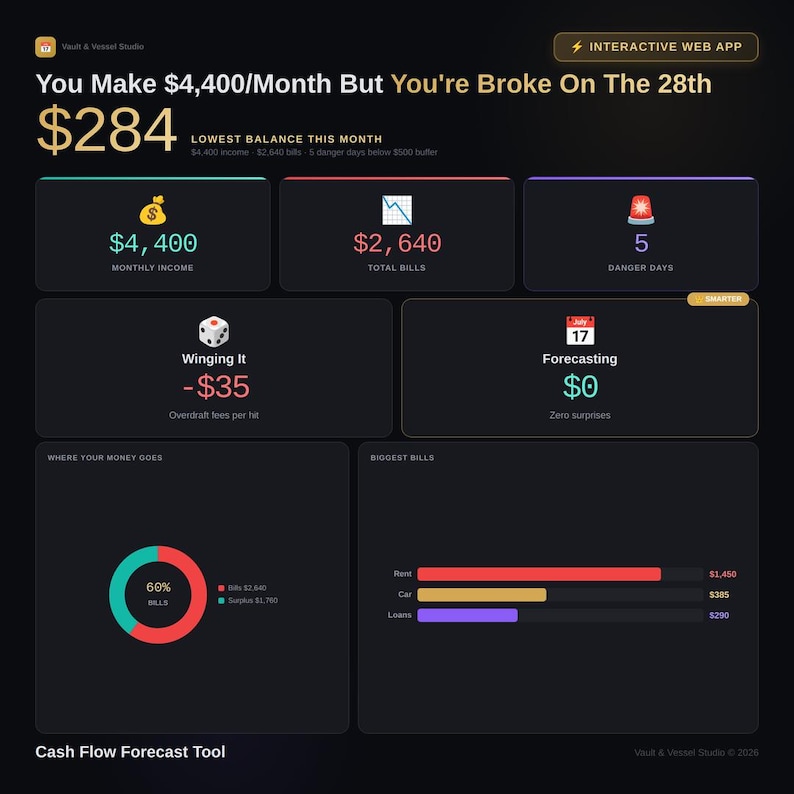
Cash Flow Forecast Tool
Bill timing alerts, low balance warnings & income vs expense forecasting in Google Sheets
This guide is going to show you exactly how to build that plan. And I’m going to give you the actual tools to do it — not some vague advice about “spending less.”
Why Most Debt Payoff Plans Fail (And What to Do Instead)
Let’s be honest about why your last attempt didn’t stick. It probably wasn’t because you lacked willpower. It was because of one of these three things:
You didn’t have visibility. You were guessing at numbers instead of seeing them clearly. When you don’t know your exact balances, interest rates, and minimum payments, you can’t make smart decisions about where to put extra money. You’re fighting blindfolded.
You didn’t have a strategy. Throwing random extra payments at whichever bill feels most urgent isn’t a plan — it’s panic. A real debt payoff plan tells you exactly which debt to attack first, how much to pay, and when you’ll be done.
You didn’t see progress fast enough. This is the big one. If your plan says “you’ll be debt-free in 14 years,” your brain checks out by week three. You need wins. Real, tangible, this-is-actually-working wins.
The good news? All three of these problems are solvable. And they’re solvable right now, today, with nothing more than your debt balances and 30 minutes of your time.
The Two Proven Methods: Avalanche vs. Snowball
Every serious debt payoff strategy comes down to one core decision: which debt do you pay off first? There are two schools of thought, and they both work. The right choice depends on your brain, not your bank account.
The Debt Avalanche Method (The Math Winner)
With the avalanche method, you line up all your debts by interest rate — highest to lowest. You make minimum payments on everything, and throw every extra dollar at the highest-interest debt first.
Why it works: You pay the least amount of total interest. Period. If you have a credit card at 24.99% APR and a student loan at 5.5%, every dollar you put toward that credit card is saving you nearly five times more in interest than the same dollar on the student loan.
The catch: Your highest-interest debt might also be your biggest balance. That means it could take months before you eliminate your first debt completely. For some people, that slow start kills motivation.
Best for: People who are motivated by logic, who get fired up by seeing the interest savings stack up, and who can stay disciplined even when the first payoff is months away.
The Debt Snowball Method (The Psychology Winner)
With the snowball method, you line up your debts by balance — smallest to largest. Ignore interest rates entirely. Pay minimums on everything and attack the smallest balance with everything you’ve got.
Why it works: You get wins fast. Paying off a $400 medical bill in six weeks feels incredible. That momentum carries you through the bigger balances. Research from Harvard Business Review found that people who use the snowball method are statistically more likely to eliminate all their debt — because they don’t quit.
The catch: You’ll pay more in total interest than the avalanche method. Depending on your debt mix, the difference could be hundreds or even thousands of dollars over the life of your payoff plan.
Best for: People who need momentum, who have several small debts they can knock out quickly, and who know from experience that motivation is their biggest challenge.
The Hybrid Approach (What I Actually Recommend)
Here’s what most financial advisors won’t tell you: you don’t have to pick just one. Start with the snowball method to build momentum. Knock out your two or three smallest debts to prove to yourself that this works. Then switch to the avalanche method to minimize interest on your remaining balances.
This hybrid approach gives you the psychological wins AND the mathematical efficiency. It’s the best of both worlds.
How to Build Your Debt Payoff Plan: Step by Step
Enough theory. Let’s build your actual plan.
Step 1: Face the Number
Get every single debt balance in one place. Every credit card. Every loan. Every medical bill. Every “I’ll deal with it later” balance that you’ve been avoiding.
For each debt, you need three numbers: the current balance, the interest rate (APR), and the minimum monthly payment.
This step is the hardest emotionally and the easiest practically. Log into your accounts, pull the numbers, and write them down. No judgment. No shame. Just data.
Step 2: Find Your Extra Payment Amount
Look at your monthly income and your non-debt expenses. What’s left after you cover the essentials? That leftover amount — even if it’s just $50 or $100 — is your debt acceleration payment. This is the money that goes above and beyond minimum payments, directed at your target debt.
If that number is currently zero, don’t panic. Look for one or two expenses you can temporarily reduce. The streaming service you forgot about. The subscription box that brings more guilt than joy. Even $25/month of extra payments can shave months off your timeline.
Step 3: Choose Your Strategy and Sequence Your Debts
Decide: snowball, avalanche, or hybrid? Then arrange your debts in the order you’ll attack them. Your debt acceleration payment goes entirely to Debt #1 while you make minimums on everything else. When Debt #1 is gone, its minimum payment rolls into your acceleration fund, and you attack Debt #2 with even more firepower. That’s the “snowball” effect — your monthly attack amount grows with every debt you eliminate.
Step 4: Calculate Your Freedom Date
This is the moment that changes everything. When you see a concrete date — not “someday” but “November 2027” — it shifts from a vague hope to a real destination. You can count the months. You can put it on your calendar. You can visualize what life looks like on the other side.
Step 5: Track, Adjust, and Celebrate
Your plan isn’t a “set it and forget it” document. Check in monthly. Update your balances. Celebrate every debt you eliminate — actually celebrate, not just move on to the next one. And when you get a raise, a tax refund, or unexpected money, ask yourself: “What would happen if I threw this at my target debt?”
The Tools That Make This Actually Doable
Here’s where most advice articles leave you hanging. They tell you what to do but hand you a blank spreadsheet and say “good luck.”
You need a tool that does the math for you, shows you the comparison between strategies, and gives you a clear visual of your progress. That’s exactly what a dedicated debt payoff calculator does — and it’s why I built one.
The Debt Payoff Tracker for Google Sheets is a complete debt elimination dashboard that auto-calculates your payoff timeline, shows you exactly how much interest you’ll save with each strategy, and gives you a visual scoreboard of your progress. It handles the avalanche method, the snowball method, and the hybrid approach — so you can see exactly which one gets you to zero fastest with your specific numbers.
If you’re comparing multiple options for debt consolidation, the Debt Consolidation Comparison Calculator helps you model whether consolidating actually saves you money — because sometimes it does, and sometimes the longer term means you pay more total interest even at a lower rate.
And if you want to really see the avalanche vs. snowball math play out with your own numbers, the Debt Snowball vs. Avalanche Simulator lets you run both scenarios side-by-side so you can make a fully informed decision.
5 Strategies That Accelerate Your Payoff (That You’re Probably Not Using)
Once you have your base plan, these strategies can shave months — sometimes years — off your timeline.
1. The Balance Transfer Window Play
If you have good credit, a 0% APR balance transfer card can give you 12-18 months of zero interest on your highest-rate debt. Transfer the balance, divide it by the number of 0% months, and pay that amount every month. You’ll eliminate it without a penny of interest. Just make sure to factor in the 3-5% transfer fee.
2. The Bi-Weekly Payment Hack
Instead of paying your monthly minimum once a month, pay half the amount every two weeks. Because there are 26 bi-weekly periods in a year (not 24), you’ll make the equivalent of 13 monthly payments instead of 12 — one extra payment per year, automatically.
3. The Round-Up Rule
Round every debt payment up to the nearest $50 or $100. If your minimum is $127, pay $150. If it’s $340, pay $400. These small bumps compound dramatically over time and you’ll barely notice the difference in your monthly budget.
4. The Windfall Commitment
Make a deal with yourself right now: every unexpected dollar goes to debt. Tax refund? Debt. Birthday money? Debt. Side hustle income? Debt. This one commitment alone can cut years off your timeline.
5. The Accountability Calendar
Mark every payment on a physical calendar or tracker. Cross off each month. Watch the balances drop. The visual progress is powerful — it turns an abstract financial goal into a daily, visible reminder that you’re winning.
What Happens After Debt Freedom
I want to leave you with this because it matters more than any calculation.
The day you make your last debt payment, something shifts. It’s not just financial — it’s psychological. The bandwidth that debt was consuming in your brain suddenly opens up. The low-grade anxiety that you’d learned to live with just… stops. You start making decisions based on what you want instead of what you owe.
That moment is coming for you. And it starts with a plan.
Your Next Step
Don’t let this be another article you read, nod along to, and forget. Grab the Debt Payoff Tracker and plug in your real numbers today. See your real freedom date. Pick your strategy. And start.
If you want to go even deeper, pair it with the Monthly Budget Planner to find exactly where your extra payment money is hiding in your current spending.
Download Your Free Debt Freedom Checklist
Want a quick-reference checklist that walks you through every step of building your debt payoff plan? We put together a free Debt Freedom Checklist that covers the exact process from this article — from gathering your balances to choosing your strategy to calculating your freedom date.
👉 Download the Free Debt Freedom Checklist — No spam, just the checklist delivered straight to your inbox.
This article is for informational purposes only and does not constitute financial advice. Every debt situation is unique. Consider consulting with a financial advisor for guidance specific to your circumstances.