# Period Tracking 101: What Your Cycle Is Telling You About Your Health
—
Let's talk about something that affects roughly half the world's population for roughly 40 years of their lives and still somehow gets treated as either a mystery or an inconvenience: your menstrual cycle.
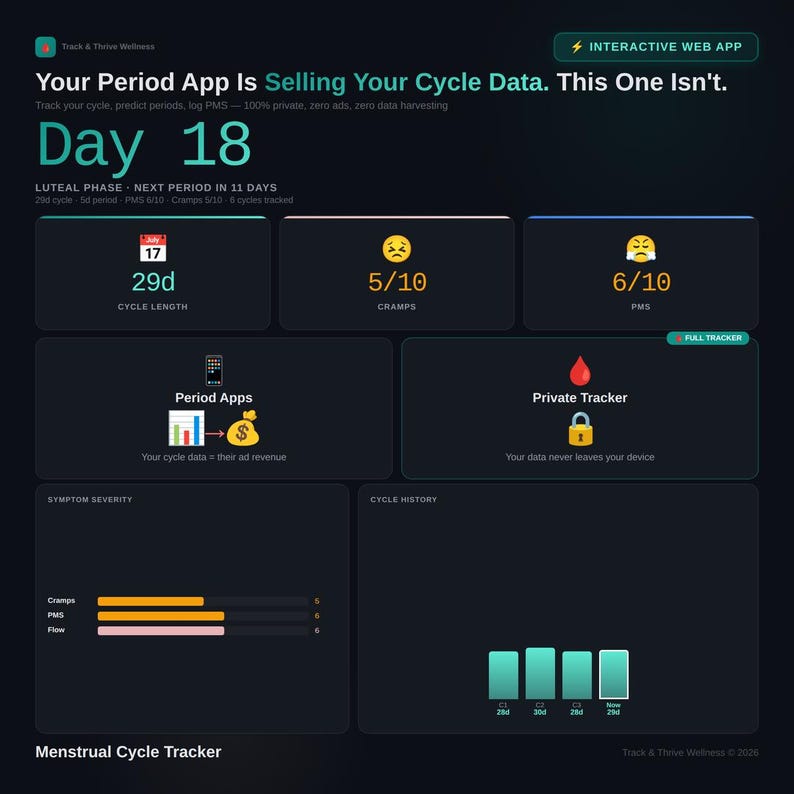
Menstrual Cycle Tracker
Private period tracking in Google Sheets — cycle length, symptoms, mood & flow patterns all in one dashboard
Here's what most people weren't taught in health class: **your period isn't just a period.** It's the final act of a roughly month-long hormonal symphony that affects your energy, your mood, your sleep, your skin, your digestion, your pain levels, your focus, and yes — your overall health. When you track it properly, your cycle becomes one of the most powerful health indicators you have. Not because it tells you when to carry tampons (though it does that too), but because changes in your cycle are often the first signal that something in your body needs attention.
This guide is going to walk you through everything you need to know about period tracking — the four phases of your cycle, what's actually worth tracking, how to spot patterns that matter, and when those patterns should prompt a conversation with your doctor. No shame, no euphemisms, and no treating your period like a problem to be managed rather than data to be understood.
## Why Period Tracking Is Health Tracking
The American College of Obstetricians and Gynecologists has called the menstrual cycle a vital sign — right alongside blood pressure, heart rate, and temperature. That's not a metaphor. Your cycle reflects the state of your endocrine system, your stress levels, your nutritional status, and your reproductive health. When something is off internally, your cycle often shows it first.
Thyroid dysfunction can make your periods irregular or unusually heavy. Chronic stress can delay ovulation by days or weeks. Nutritional deficiencies can change your flow. Conditions like PCOS and endometriosis leave distinct patterns in cycle data — patterns that are dramatically easier to identify when you have several months of consistent tracking rather than a vague recollection that "things have been weird lately."
The point isn't to self-diagnose. The point is to have data. When you walk into a doctor's office and say "my cycle has been 26 days for the past year, and the last three months it's been 35, 42, and 38" — that gives your provider concrete information to work with. That's the difference between a productive appointment and a shrug.
## The Four Phases of Your Cycle (And What's Happening in Each One)
Your cycle isn't just "period or no period." It has four distinct phases, each driven by different hormones, each affecting your body differently. Understanding them changes how you relate to your own energy, mood, and capabilities throughout the month.
### Phase 1: Menstruation (Days 1-5ish)
Day 1 of your period is Day 1 of your cycle. This is when progesterone and estrogen are at their lowest levels, which triggers the shedding of your uterine lining. You might feel lower energy, more introspective, and possibly crampy. Your body is doing real physical work.
**What to track:** Flow intensity (light, medium, heavy), pain level and location, clot presence and size, energy level, mood. A "normal" period lasts 3-7 days with 30-80ml of total blood loss. If you're soaking through a pad or tampon every hour for several consecutive hours, that's worth discussing with a healthcare provider.
**What your body is telling you:** Unusually heavy periods can signal fibroids, polyps, or hormonal imbalances. Very light periods (consistently just spotting) can indicate low estrogen. Severe pain that disrupts your daily life isn't something to "just deal with" — it's data that deserves medical attention.
### Phase 2: The Follicular Phase (Days 1-13ish)
Overlapping with your period, the follicular phase begins when your brain's pituitary gland releases follicle-stimulating hormone (FSH), triggering follicles in your ovaries to develop. Estrogen starts climbing, and with it, many people notice their energy, mood, and creativity picking up. This is often when you feel most "yourself" — social, motivated, and clear-headed.
**What to track:** Energy levels, mood, cervical mucus changes (it starts dry or sticky and gradually becomes more wet and clear as estrogen rises), any mid-cycle spotting, skin changes.
**What your body is telling you:** A follicular phase that's consistently very short (under 10 days) can mean your body is rushing to ovulation, which sometimes indicates diminished ovarian reserve. A very long follicular phase (over 20 days) often reflects delayed ovulation — frequently caused by stress, illness, or conditions like PCOS.
### Phase 3: Ovulation (Day 14ish — But Your Day Will Vary)
A surge of luteinizing hormone (LH) triggers the release of a mature egg from your ovary. This is a 12-24 hour event, but the fertile window around it spans roughly six days (sperm can survive up to five days in the reproductive tract). Estrogen peaks just before ovulation, and many people notice a spike in libido, clearer skin, and peak social energy.
**What to track:** Cervical mucus (peak fertility mucus is clear, stretchy, and resembles raw egg whites), ovulation test results if using them, ovulation pain (mittelschmerz — a twinge or cramp on one side), libido changes, BBT if you're charting temperature.
**What your body is telling you:** Consistent ovulation is a sign of hormonal health, whether or not you're trying to conceive. If your temperature charts show no thermal shift, or your cervical mucus never reaches the egg white stage, you may not be ovulating regularly — and that's worth investigating regardless of your pregnancy goals.
### Phase 4: The Luteal Phase (Days 15-28ish)
After ovulation, the empty follicle transforms into the corpus luteum, pumping out progesterone. This hormone thickens the uterine lining and tends to have a calming, warming, and sometimes slowing effect on your body. Many people notice their energy declining, cravings increasing, and mood becoming more sensitive during this phase — especially in the final week before their period.
This is the PMS zone. Not everyone experiences PMS, and severity varies enormously. But if you do, understanding that it's progesterone-driven (and that it's a phase, not a permanent state) can be genuinely helpful.
**What to track:** Mood shifts, breast tenderness, bloating, cravings, sleep quality, headaches, anxiety levels, skin breakouts, digestive changes. Track these daily, not just as "PMS happened."
**What your body is telling you:** A luteal phase shorter than 10 days can indicate low progesterone, which can affect fertility and cause spotting before your period. Severe PMS or PMDD (premenstrual dysphoric disorder) that significantly disrupts your functioning is a medical condition with treatment options — not something you have to white-knuckle through every month.
## What to Track (and How to Keep It Simple)
If the idea of logging five data points daily sounds overwhelming, start with three. You can always add more later.
### The Essential Three (Start Here)
**Cycle day and flow:** Mark Day 1 when your period starts. Log flow intensity each day of your period. This alone gives you cycle length data, which is one of the most important health indicators.
**Energy and mood:** A simple 1-5 scale each day. Over a few months, you'll see patterns you never noticed — like the energy dip that happens at the same point in every cycle, or the mood boost that reliably appears around ovulation.
**Cervical mucus:** This one feels awkward for about three days until it becomes automatic. Check when you use the bathroom and note the category: dry, sticky, creamy, watery, or egg white. This single data point can tell you more about your hormonal health than almost any other self-observation.
### Level Two (Add When Ready)
**Pain and physical symptoms:** Cramps (location and severity), headaches, breast tenderness, bloating, back pain, joint pain. Tracking where and when pain occurs — not just that it exists — reveals patterns that help both you and your doctor.
**Sleep quality:** Your cycle affects your sleep more than you might realize. Progesterone has sedative effects, so sleep quality often changes across cycle phases. If you're struggling with insomnia, your cycle data might explain the pattern.
**Skin and digestion:** Breakouts, constipation, diarrhea, and bloating all commonly fluctuate with your cycle. Tracking them alongside your cycle days helps you distinguish hormone-related symptoms from other causes.
### Level Three (For the Data-Driven)
**Basal body temperature (BBT):** Taken first thing every morning before getting out of bed. Confirms ovulation after the fact (you'll see a sustained temperature rise of about 0.2-0.5°F). Requires consistency but provides powerful cycle confirmation data.
**OPK results:** Ovulation predictor kits detect the LH surge before ovulation. Useful for anyone who wants to pinpoint their ovulation day — not just those trying to conceive.
**Exercise and nutrition:** How your workouts feel and what you're eating can be influenced by your cycle phase. Tracking these alongside your cycle helps you understand why some weeks your runs feel amazing and other weeks the same distance feels brutal.
## Red Flags to Watch For
Period tracking isn't about anxiety — it's about awareness. That said, certain patterns warrant a healthcare conversation.
**Cycles shorter than 21 days or longer than 35 days consistently.** Occasional variation is normal. A pattern of very short or very long cycles can indicate hormonal imbalances, thyroid issues, or conditions like PCOS.
**Periods lasting longer than 7 days regularly.** Extended bleeding can signal fibroids, polyps, clotting disorders, or hormonal issues.
**Sudden changes in your established pattern.** If your cycle has been 28 days like clockwork for a year and suddenly becomes 40+ days, something changed. Stress, weight changes, medication, and medical conditions can all be the cause.
**Severe pain that prevents normal activities.** Period cramps are common. Period cramps that make you miss work, school, or social commitments are not "normal" — they're a symptom worth investigating.
**Heavy bleeding that soaks through protection hourly.** This level of flow can lead to anemia and often indicates an underlying condition.
**Bleeding between periods.** Occasional spotting around ovulation can be normal, but regular mid-cycle bleeding or post-sex bleeding should be evaluated.
**Absence of periods for 90+ days (when not pregnant, breastfeeding, or on certain contraceptives).** This is called amenorrhea and warrants medical evaluation.
## The Right Tracking System Makes This Sustainable
Here's the truth about period tracking: the data is only valuable if you actually collect it consistently. And consistency requires a system with low friction. Scribbling in a notebook works for a week. You need something structured that takes 30 seconds a day and shows you the patterns over time.
The **[Menstrual Cycle Tracker](https://www.etsy.com/listing/4476402470/menstrual-cycle-tracker-2026-period)** is an interactive web app designed specifically for cycle tracking. It lets you log symptoms, flow, mood, and cycle data in a clean dashboard that calculates your patterns automatically. It runs in your browser with zero app installations and zero data privacy concerns — your data stays on your device.
If you prefer working in Google Sheets, the **[Menstrual Cycle Spreadsheet](https://www.etsy.com/listing/4476402848/menstrual-cycle-spreadsheet-period)** gives you a structured charting template with auto-calculating cycle length, phase identification, and symptom tracking built directly into the sheet. It's the same data, organized for people who like the control and flexibility of a spreadsheet.
For the complete toolkit, the **[Menstrual Cycle Bundle](https://www.etsy.com/listing/4476394519/menstrual-cycle-bundle-interactive)** combines both the interactive tracker and the spreadsheet — so you can use whichever format fits your day.
If you're dealing with PCOS specifically, the **[PCOS Management Tracker](https://www.etsy.com/listing/4476397868/pcos-management-tracker-2026-symptom)** is built for the unique tracking needs of polycystic ovary syndrome — including symptom severity, medication tracking, and the specific markers that matter for PCOS management. The **[PCOS Management Spreadsheet](https://www.etsy.com/listing/4476398200/pcos-management-spreadsheet-symptom)** offers the same functionality in Google Sheets format.
And if you're tracking your cycle as part of a fertility journey, the **[Fertility TTC Tracker](https://www.etsy.com/listing/4476386139/fertility-ttc-tracker-2026-cycle-day)** adds the conception-specific data points — BBT charting, OPK results, fertile window predictions, and intimacy timing — on top of your core cycle data.
## How to Talk to Your Doctor Using Your Data
Here's a practical tip that most tracking guides miss: **bring your data to appointments.** Several months of tracked cycle data transforms a vague "my periods have been weird" into specific, actionable information.
Before your appointment, review your tracked data and note the following: your average cycle length over the past 3-6 months and whether it's been consistent, any symptoms that have changed or worsened, the dates and details of anything unusual, and any patterns you've noticed (like headaches always appearing in your luteal phase, or energy crashes that correlate with specific cycle days).
Most healthcare providers will tell you that patients who arrive with this kind of documented history get better, faster evaluations. You're not diagnosing yourself — you're giving your provider the raw material they need to diagnose effectively.
## Your Cycle Is Not Your Enemy
I want to close with this, because the cultural narrative around periods deserves pushback.
Your menstrual cycle is not an inconvenience to endure. It's not a curse, a weakness, or a reason to power through pain without question. It's a monthly status report from your body about your overall health — and when you learn to read it, you gain an understanding of yourself that no annual blood test can replicate.
Tracking your cycle doesn't make you obsessive. It makes you informed. And in a healthcare system that has historically under-researched, under-funded, and under-listened to women's health concerns, being informed is one of the most powerful things you can be.
## Your Next Step
Start with Day 1 of your next period. Open a tracker and log three things: your flow, your energy, and your mood. Do that every day for one full cycle. That's it. No pressure to be perfect, no need to track everything at once. Just one cycle of consistent data — and you'll already see patterns you never noticed before.
The **[Menstrual Cycle Tracker](https://www.etsy.com/listing/4476402470/menstrual-cycle-tracker-2026-period)** makes that first cycle as simple as possible, even if you've never tracked before.
—
### Get Our Free Cycle Phase Cheat Sheet
**Want a quick reference for what's happening in your body during each phase of your cycle?** We created a free Cycle Phase Cheat Sheet that breaks down the four phases — what hormones are driving each one, what symptoms to expect, what to track, and how to work with your energy instead of against it.
👉 **[Get the Free Cycle Phase Cheat Sheet](#signup)** — Delivered straight to your inbox. No spam, ever.
—
*
This article is for informational purposes only and does not constitute medical advice. Menstrual cycle tracking is a tool for understanding your health, not a substitute for professional medical guidance. If you have concerns about your cycle or reproductive health, please consult with a qualified healthcare provider.*