The Reality Nobody Prepared You For
You made it through pregnancy. You survived labor. You have your baby in your arms. And yet… something nobody told you is that the real recovery is just beginning.
They call it the fourth trimester for a reason. Your body didn’t just go through nine months of changes—it went through the most intense physical event of your life. And unlike pregnancy, which comes with doctor’s appointments and attention and constant monitoring, postpartum recovery often happens in the shadows. You’re sent home from the hospital with a pamphlet, a “call us if something feels wrong” instruction, and the assumption that you’ll figure it out.
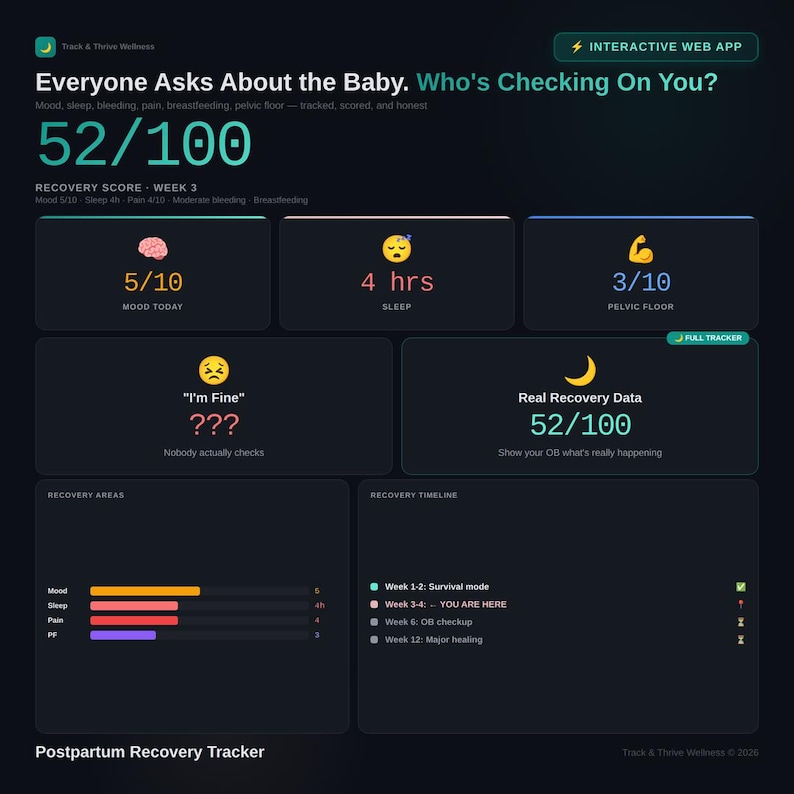
Postpartum Recovery Tracker Mood Sleep
From Track & Thrive Wellness on Etsy
At 3 AM, when you’re bleeding through your fifth pad of the day, exhausted beyond belief, with a baby attached to your breast, you realize: I have no idea if this is normal.
That’s where tracking comes in. This isn’t about adding more burden to your already overwhelming plate. It’s about giving yourself concrete information during a time when everything feels like a blur. It’s about having proof that you’re healing, that you’re not going crazy, and that what you’re experiencing is real and valid.
This guide walks you through exactly what to monitor during the first 12 weeks postpartum—the things your doctor might ask about but probably won’t think to explain until you’re already struggling. Because your recovery matters just as much as your baby’s wellbeing.
Why Tracking Postpartum Recovery Matters (And It’s Not About Being Obsessive)
Before we dive into what to track, let’s talk about why this matters.
When you’re in survival mode—and trust me, you will be—your brain becomes unreliable. You won’t remember if you bled less today than yesterday, or more. You won’t notice if your mood has gradually gotten darker, or if that fog you feel is just normal exhaustion. You’ll lose track of how many times the baby fed. You’ll forget whether your pain is getting better or worse.
Tracking isn’t obsessive. It’s protective. It gives you:
- A clear picture of your healing timeline so you can recognize what’s normal and what’s not
- Evidence to show your doctor if something feels wrong (instead of “I feel weird,” you can say “My lochia hasn’t decreased in three days”)
- Reassurance when anxiety hits (which it will) that you can look back and see that yes, yesterday was harder, but today is better
- Permission to focus on yourself — because postpartum recovery is your health crisis, and it deserves attention
Your baby will get tracked: weight checks at the pediatrician, development milestones, feeding logs. But who’s tracking you? You are. And that matters.
Weeks 1-4: The Survival Phase
The first four weeks are intense. Your body is literally healing from major trauma (whether you delivered vaginally or via C-section), your hormones are in free fall, and you have a newborn who needs you every 2-3 hours. It’s not dramatic to call this a crisis—it kind of is. And you need to track it accordingly.
Bleeding and Lochia
One of the things that shocks new mothers most is the bleeding. It’s heavy. Heavier than a period. Much heavier. This is lochia—your uterus shedding the lining that nourished your baby.
What to track:
– The heaviness of flow (light spotting, moderate, soaking through a pad in 1-2 hours, soaking through in less than an hour)
– The color (bright red at first, then gradually becoming pink or brown)
– The presence of clots (small golf-ball-sized clots are normal; fist-sized clots are not)
– How many days into the bleeding you are
Why it matters: Lochia should gradually lighten and decrease. By week 4, it should be mostly brown spotting. If you’re still heavily bleeding by day 10, or if you soak through a pad in less than an hour, that’s a sign to call your doctor.
Pain Assessment
Whether you delivered vaginally or via C-section, you’re going to have pain. It’s not weakness. It’s not you being dramatic. It’s your body healing.
For vaginal delivery, track:
– Perineal pain (your vaginal area, including any tears or episiotomy)
– Afterpains (cramping as your uterus shrinks—these are especially intense if you’re breastfeeding)
– General body aches
– Where the pain is worst
For C-section delivery, track:
– Incision pain (sharp, pulling, or throbbing)
– When pain increases (usually after increased activity)
– Swelling around the incision
– Any signs of infection (more on this below)
How to scale it: Use a simple 1-10 scale, or even easier: “low,” “medium,” or “high.” Track it 2-3 times a day for the first week, then daily after that.
Breast Changes and Feeding
If you’re breastfeeding, your breasts are going through major changes. If you’re not, they still are—just different changes.
Track:
– Engorgement (how hard/swollen your breasts feel)
– Nipple pain or damage
– Whether you’re feeling milk letdown
– Any redness, lumps, or warmth (signs of plugged ducts or mastitis)
– How many minutes per side your baby is nursing (if you’re tracking)
Why it matters: Early intervention on nipple pain or engorgement prevents serious complications like mastitis, which is genuinely awful and often requires antibiotics.
Sleep and Mental State (Even Though Both Are Terrible)
Here’s the thing: in week 1, you probably won’t sleep more than 2-3 hours at a stretch. This is expected. Your body is flooded with oxytocin (from bonding and breastfeeding), adrenaline, and the simple fact that you have a newborn.
Track:
– Total sleep hours per 24 hours (even if it’s fragmented)
– How many times you woke to feed the baby
– Whether you’re able to fall back asleep between feedings (or if you’re lying awake anxious)
– Your mood right after waking (even a simple: peaceful, neutral, anxious, or tearful)
The emotional truth: Baby blues are real, normal, and usually peak around day 3-5. You might cry for no reason. You might feel overwhelmed or frustrated. This is hormonal, and it usually passes within 2 weeks. What you’re tracking here isn’t to diagnose depression—it’s just to notice if you’re on the typical trajectory of baby blues (getting better) or if things are getting darker (which means talk to your doctor).
Weeks 5-8: The Turning Point
If week 1-4 is survival, week 5-8 is slowly remembering you’re a human being. Your body is healing faster. You might start to feel like yourself again—or you might feel worse emotionally even though physically you’re improving. This is more common than you’d think.
Lochia Resolution
By week 5, you should be seeing mostly brown or pink discharge, and by week 8, it should be minimal or gone.
Track:
– Is the bleeding continuing to decrease?
– Any changes in pattern (it got better, then worse again)
– Any clots, odor, or unusual changes
Mood and Emotional Patterns
This is where postpartum anxiety and postpartum depression often show up. The exhaustion of early parenthood combines with hormonal shifts, and suddenly you’re spiraling in ways you didn’t expect.
Track:
– Your overall mood each day (great, good, neutral, bad, terrible)
– Specific anxiety patterns (Do you panic when the baby cries? Do you have intrusive thoughts? Do you check if the baby is breathing constantly?)
– When you feel best vs. worst (morning? evening? after your partner takes the baby for an hour?)
– Any physical symptoms of anxiety: racing heart, sweating, panic attacks, or feeling disconnected from reality
Important distinction: Baby blues make you cry and feel overwhelmed. Postpartum depression makes you feel hopeless, numb, or like you’re failing. Postpartum anxiety makes you feel like catastrophe is imminent. If you’re seeing a consistent downward trend, especially after week 2, this is what your doctor needs to know.
Energy Levels
Track your energy simply: High, Medium, Low. Compare this week to last week. Is it improving?
Feeding Schedules and Baby Growth
You’re probably already tracking this for the baby, but notice: are you eating? Are you hydrating? Postpartum mothers often prioritize baby feedings over their own nutrition, which tanked their recovery. Your body needs fuel.
If you’re breastfeeding, track:
– Wet diapers (8+ is ideal)
– Baby’s alertness after feeding
– Your own water intake and meals
Weeks 9-12: The Homestretch
By week 9, many women start thinking about exercise, returning to work, or just… getting their life back. This is when real questions emerge: Am I healed? Can I run? Can I have sex? Why do I still feel weird?
Physical Recovery Milestones
Track your capabilities:
– Can you walk without pain?
– Can you go up and down stairs without pain or heaviness?
– Can you lift objects heavier than the baby?
– Can you do light exercise without bleeding increase?
– Is your incision (if C-section) fully healed without tenderness?
– Have you passed your 6-week postpartum checkup?
Return to Exercise
Don’t jump into your pre-pregnancy routine. Your pelvic floor needs rebuilding, and abdominal separation (diastasis recti) is common postpartum.
Before restarting exercise, ask yourself:
– Can you cough, jump, or laugh without leaking urine?
– Does exercise increase your lochia?
– Do you have pain?
If the answer to any of these is “yes,” wait longer. Talk to your doctor or a pelvic floor physical therapist. This isn’t forever—usually 8-12 weeks. But rushing can set you back.
Emotional Adjustment and Life Integration
By week 12, the newborn fog is lifting. And sometimes what you see underneath is adjustment that needs attention.
Track:
– How are you feeling about motherhood? (Overwhelmed, adapting, enjoying moments, mostly anxious)
– How is your relationship with your partner? (This postpartum period is hard on relationships—track whether you’re connecting or distant)
– Do you feel like yourself? (Not necessarily “back to normal”—that’s not a real thing—but like a recognizable version of yourself)
– Are you getting any breaks? Any time alone?
Sexual and Physical Intimacy
This is awkward to talk about, but worth tracking. Many women feel ready by 6-8 weeks. Some don’t feel ready until 4-6 months. Both are normal.
Track:
– When did you have your first postpartum period?
– Any pain with intercourse? (If yes, how much, where, and whether it’s improving)
– Your emotional comfort with physical intimacy
– Whether you’re using contraception (your doctor should discuss this—you can get pregnant while breastfeeding)
Red Flags: When to Call Your Doctor Right Now
This is not meant to alarm you. Most postpartum recoveries are uncomplicated. But these signs mean you need medical attention today:
Bleeding Red Flags
- Soaking through more than one pad per hour for more than 2 hours
- Passing clots larger than a golf ball
- Lochia that was improving but suddenly got much heavier
- Foul-smelling discharge
- Bright red bleeding after it had turned brown
Pain and Infection Red Flags
- Fever of 100.4°F or higher
- Increased redness, warmth, swelling, or pus at your incision (C-section) or perineal area
- Severe pain that worsens instead of improving
- Abdominal pain with tenderness
- Red streaks on your chest (possible mastitis or blood clot)
- Leg pain, calf swelling, or redness (possible blood clot)
Mental Health Red Flags
- Thoughts of harming yourself or your baby
- Inability to sleep even when the baby is sleeping (not just frequent waking)
- Feeling like you’re failing or that your baby would be better off without you
- Severe panic attacks or feeling like you’re losing control
- Complete numbness—not feeling anything toward your baby
Other Red Flags
- Difficulty urinating or persistent incontinence
- Severe constipation lasting more than a few days
- Painful urination that doesn’t improve
- Chest pain or difficulty breathing
These are not signs of weakness or failure. They are signs that your body needs medical support. Call your doctor, call your OB, go to urgent care, or call the postpartum support hotline. You deserve help.
The Tools That Help: Tracking Made Simple
Here’s the truth: you don’t have the mental energy to track complicated things right now. You need simple, easy, something you can fill out in 30 seconds while one-handed feeding a baby.
This is where a postpartum recovery tracker becomes invaluable. Instead of trying to remember everything, you have a simple template where you log:
– Bleeding heaviness
– Pain levels
– Mood check-in
– Sleep hours
– Feeding notes
– Any concerning symptoms
Whether you use a spreadsheet, an interactive HTML tracker, or even a paper journal, having something dedicated to your recovery prevents the important stuff from slipping through the cracks of your exhaustion.
Many women who tracked their pregnancies (if you used the Pregnancy Week Tracker during your pregnancy) find that continuing with a postpartum recovery spreadsheet creates continuity in self-care. You’ve already built the habit of tracking. Why stop when tracking your recovery might be even more important?
Normalize This: It’s Supposed to Be Hard
The thing nobody tells you is that postpartum recovery is harder than pregnancy in many ways. During pregnancy, you have regular medical care, cultural acknowledgment that you’re going through something big, and nine months of adjustment time. Postpartum? You’re home alone (or with a partner who’s also exhausted), everyone’s attention is on the baby, and you’re expected to recover while providing constant care for a newborn.
It’s okay to find it hard. It’s okay to grieve your body, your independence, your sleep. It’s okay to not feel instant maternal joy. It’s okay to be furious, heartbroken, exhausted, and completely in love with your baby—sometimes all at once.
Tracking isn’t about being a “perfect” postpartum patient. It’s about giving yourself information, compassion, and a clear record that what you’re experiencing is real and deserves attention.
You made a human. Your body is healing from one of the most intense experiences possible. Of course this is hard. You’re not failing. You’re recovering. And you deserve support while you do it.
Start Your Postpartum Recovery Tracking Today
You don’t have to wait until you feel more “together” to start tracking. In fact, the sooner you start, the more valuable baseline information you’ll have.
Whether you’re already postpartum and realizing you wish you’d tracked more, or you’re pregnant and want to be prepared for recovery, having a dedicated tracking system makes an enormous difference in your awareness and peace of mind.
The Postpartum Recovery Tracker makes this effortless. It’s designed specifically for what matters most in the first 12 weeks: bleeding patterns, pain levels, mood shifts, sleep, and baby feeding. No complicated fields. No judgment. Just space to record what’s actually happening with your body and mind.
If you’re looking for a complete solution, the Postpartum Recovery Bundle includes the interactive tracker plus additional resources for comprehensive recovery tracking—exactly what most new moms tell us they wish they’d had.
And if you prefer a spreadsheet format that you can customize and keep alongside your other health tracking, the Postpartum Recovery Spreadsheet gives you that flexibility with all the same tracking fields.
Free Resource: Your Postpartum Recovery Timeline
Understanding what’s normal when is half the battle. Different things matter in week 1 vs. week 8 vs. week 12. Knowing what to expect helps you distinguish between “normal healing” and “something might be wrong.”
Get our free Postpartum Recovery Timeline—a week-by-week breakdown of what’s typical, what to expect, and what warrants a doctor’s call. It’s designed to be your companion guide during these 12 weeks, helping you recognize the pattern of healing and spot when something needs attention.
Product Recommendations for Your Recovery
If you’re preparing for postpartum recovery, the Postpartum Recovery Bundle is the most comprehensive option—it includes everything from tracking templates to recovery milestones. Start there if you want the complete picture.
Already further along in recovery and just discovering tracking? The individual Postpartum Recovery Tracker (HTML version) is the most popular choice—it’s interactive, easy to fill out on your phone, and gives you that visual progress tracking that’s so reassuring when you’re struggling.
And if you used our Pregnancy Week Tracker during pregnancy, continuing with the postpartum tools creates a beautiful continuity in your health tracking through this transition.
As your cycle returns postpartum, the Menstrual Cycle Bundle can help you track your period’s return and understand what your new normal looks like.
You’ve already grown a human. You’ve already birthed them. Now let’s make sure your recovery gets the attention it deserves.
Disclaimer: This article is informational and meant to support your awareness of postpartum recovery. It is not a substitute for medical advice. Always consult with your healthcare provider about your specific postpartum experience, especially if you’re experiencing any of the red flag symptoms mentioned. If you’re experiencing thoughts of self-harm, contact the Postpartum Support International helpline at 1-800-944-4773 (call or text) or your local emergency services.