
You Dream About Owning a Salon. But Can You Tell Me What Chair Utilization Rate You Need to Break Even?
The dashboard below loads instantly in your browser. Plug in your numbers, see your answer. No signup to try the basics.
Most aspiring salon owners have a vision — the aesthetic, the vibe, the Instagram grid. What they don’t have is a P&L projection. And that’s how people end up $80,000 in debt with a beautiful salon that bleeds money because they priced haircuts at $45 when their overhead demands $65.
Let me walk you through the real revenue math. Not the “follow your passion” stuff. The numbers.
Salon Revenue Model: The Core Formula
Salon revenue comes down to a simple equation:
Revenue = Number of Chairs x Services Per Chair Per Day x Average Service Price x Operating Days Per Month
From my testing that looks like in practice:
Those numbers assume 26 operating days/month and decent utilization. Reality check: most salons run at 60-75% chair utilization, not 100%. Adjust those numbers down by 25-40% for a realistic projection.
Booth Rental vs. Commission: Two Completely Different Businesses
This is the single biggest decision that determines your revenue model:
In a booth rental model with 5 chairs at $300/week each, you’re collecting $6,500/month in rent regardless of how many clients walk through the door (as long as your chairs are occupied). In a commission model, a busy month with experienced stylists can generate $12,000-$15,000 for the same 5 chairs — but a slow January might drop to $7,000.
The Real Expense Breakdown
Here’s where the dream meets the spreadsheet:
- Rent/lease: $2,000-$6,000/month depending on location and square footage. Aim for 10-15% of gross revenue.
- Product costs: 8-15% of service revenue. Color and chemical services have higher product costs (12-15%). Cuts and styles run 3-5%.
- Labor: If commission model, 40-50% of service revenue goes to stylists. This is your biggest line item.
- Insurance: $200-$500/month for general liability, professional liability, and property coverage.
- Utilities: $400-$800/month. Water bills are higher than you’d expect in salons — constant washing.
- Marketing: 3-5% of revenue. Instagram is free but advertising isn’t. Budget $300-$800/month.
- Software/POS: $100-$300/month for booking software, point-of-sale, and payment processing.
Product Sales: The Margin Most Owners Ignore
Retail product sales in salons average 5-15% of total revenue, but the margins are 40-50%. A salon doing $30,000/month in services with $3,000 in product sales adds $1,200-$1,500 in pure profit. That’s an extra $15,000-$18,000/year from products sitting on a shelf.
The best salons train stylists to recommend (not push) products during services. When your stylist says “I’m using this leave-in conditioner because your hair needs moisture” — that’s a sale that doesn’t feel like a sale.
Want to model your specific salon’s revenue potential? Our business revenue calculators let you plug in your chair count, pricing, and local market rates to see projected monthly income, expenses, and take-home pay.
What Salon Owners Actually Take Home
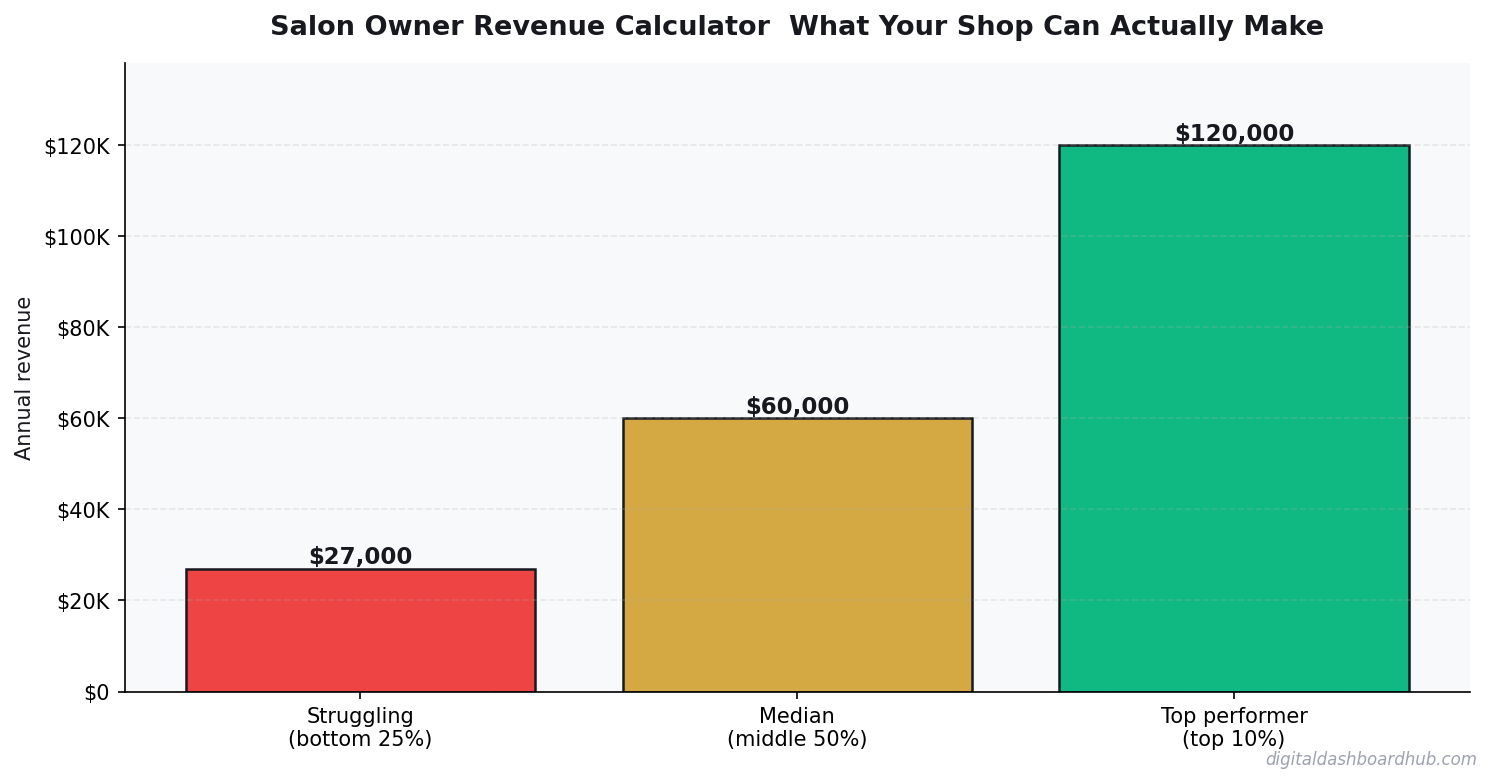
After all expenses, here are realistic owner compensation ranges:
Notice the trend: bigger isn’t always better in terms of percentage. A solo stylist working from a suite keeps 60% of revenue. A 10-chair salon owner keeps 15%. The gross numbers go up, but so does the complexity and risk.
The Client Retention Number That Makes or Breaks You
New client acquisition costs $25-$75 in a salon (advertising, first-visit discounts, Groupon margins). Retaining an existing client costs roughly $0. If your retention rate drops below 60%, you’re spending more on acquisition than you’re making on services.
Target retention rates: 70-80% is healthy, 80-90% is excellent. Below 65%, something is broken — either service quality, pricing, or booking convenience.
Where to Go From Here
- Pick your model. Booth rental for predictable income and less management. Commission for higher upside and more control. Decide before you sign a lease.
- Run break-even math. Total your fixed monthly costs (rent, insurance, utilities, software). Divide by your average service price. That’s how many services per month you need just to keep the lights on.
- Start tracking before you open. If you’re still employed at another salon, start tracking your personal metrics now — services per day, average ticket, retention rate. Those numbers are your business plan.
Hundreds of business owners use Digital Dashboard Hub to model revenue, track expenses, and make informed decisions. Start your free trial and build your salon business plan with real numbers.
A Real Salon: Monthly Numbers for a 4-Chair Shop
Hair salon in Charlotte, North Carolina. 4 stylists (owner plus 3 booth renters). Owner’s chair: 8 clients/day, 5 days/week, $85 average ticket. That’s $3,400/week, $13,600/month gross for the owner’s chair alone.
Booth renters: each pays $400/week. Three renters = $1,200/week, $4,800/month in booth rent. Owner’s total monthly revenue: $13,600 (chair) + $4,800 (booth rent) = $18,400/month.
Costs: rent ($3,800), utilities ($400), supplies for owner’s chair ($600), insurance ($350), software/scheduling ($80), laundry service ($200). Total costs: $5,430. Owner’s net before taxes: $12,970/month. That’s a strong small business — but it’s 100% dependent on the owner staying productive at the chair 40 hours/week.
The Revenue Variables Most Salon Owners Ignore
Retail attachment rate. A stylist who suggests and sells one retail product per day at $28 margin adds $560/month to revenue with zero additional time. Most salons do under 5% retail-to-service revenue. The industry benchmark for well-run salons is 15–20%. That gap is the easiest money in the salon industry.
Service mix shift. Coloring services average $140–$200/appointment at 90 minutes. A haircut is $65 at 45 minutes. The revenue per hour on a color is $93–$133 vs. $87 for a cut. A stylist who shifts 30% of their book from cuts to color services increases revenue by 15–25% with the same client count and hours. Most salons let clients self-select services without any active management of the service mix — that’s leaving real money on the table.
The most overlooked revenue variable in a salon business: gift card float. A salon that actively sells gift cards — especially around Mother’s Day, Christmas, and Valentine’s Day — builds a float of prepaid revenue that improves cash flow and brings in new clients when gift recipients redeem. A $3,000 gift card month creates immediate cash with no immediate service delivery required. Most small salons treat gift cards as an afterthought. The ones that treat them as a revenue strategy see 8–12% lifts in quarterly cash flow.
Keep reading (related guides):
255+ interactive tools for your money, time, and health.
Full dashboard access · Stripe-secure checkout · Cancel anytime
Keep Reading
- The Side Hustle Tax Trap: Track Every Dollar
- Freelancer Finance Dashboard: Track Income, Taxes, and Cash Flow
- How Sinking Funds Saved Me from Financial Emergencies
Common Questions About Salon Owner Revenue Calculator: What Your Shop Can Actually Make
How long does it take to see results?
Most people see meaningful progress within 30-90 days when they apply these strategies consistently. The key is tracking your numbers from day one so you have a baseline to measure against.
What’s the biggest mistake people make?
Trying to do everything at once. Pick one or two strategies from this guide, implement them fully, then layer in additional tactics. Spreading yourself thin is the fastest way to see no results from any of it.
Do I need special tools or software?
Not necessarily to start — but the right tools eliminate hours of manual work. Our free calculators and trackers at Digital Dashboard Hub are a good starting point before you invest in paid software.

Andy Gaber is the founder of Digital Dashboard Hub, a suite of 255+ interactive financial, productivity, and wellness tools. He built DDH after getting frustrated with financial apps that gave outputs without context. Follow along for tool tutorials, revenue analytics breakdowns, and honest takes on personal finance.