habit tracker template, habit tracking spreadsheet, daily habit tracker
Introduction: The Power of the Simple Checkmark
There’s something almost magical about the moment you check off a completed habit. That small satisfying click of a pen, the filled box on your tracker, the visible proof that you did what you set out to do—these tiny moments add up to something extraordinary over time.
But here’s what science reveals: it’s not just psychology. It’s neuroscience.
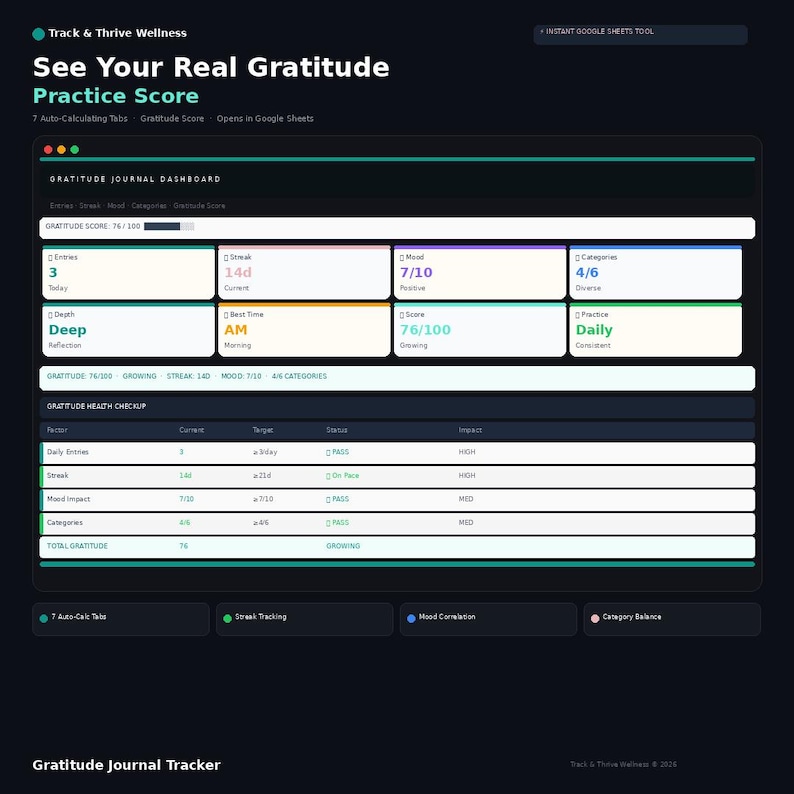
Gratitude & Habit Tracker
Build lasting habits with daily tracking, streaks & visual progress charts in Google Sheets
When you write down your habits and track them daily, you activate something researchers call the self-monitoring effect. Dr. Gail Matthews at Dominican University conducted a landmark study showing that people who write down their goals are 42% more likely to achieve them than those who simply think about them. For habit building specifically, this effect multiplies—because unlike one-time goals, habits require consistency, visibility, and accountability.
If you’ve struggled to build lasting wellness habits, the answer might not be motivation or willpower. It might be as simple as choosing the right tracking system.
How Habits Are Built: Understanding the Loop
Before we dive into tracking systems, let’s understand how habits actually form in your brain.
In his groundbreaking book Atomic Habits, James Clear popularized the habit loop—a concept originally researched by Charles Duhigg. The loop has three essential parts: cue (what triggers the behavior), routine (the behavior itself), and reward (the benefit your brain gets).
When you meditate each morning, the cue might be your alarm. The routine is the 10-minute meditation. The reward is the calm focus you carry into your day. Repeat this loop consistently, and your brain starts to anticipate the reward, pulling you toward the routine automatically.
The challenge is consistency. Your brain doesn’t care about willpower—it cares about pattern recognition. And that’s exactly where habit tracking becomes powerful.
Why Tracking Works: The Science Behind Visible Progress
Research in behavioral psychology identifies several reasons why the act of tracking itself supercharges habit formation.
The Monitoring Effect
Simply knowing you’ll record something changes your behavior. This is called the Hawthorne effect in industrial psychology—people change their actions when they know they’re being observed. When you’re the observer (tracking yourself), this effect is even stronger. Your brain doesn’t want to break the visual chain, so it pulls you toward consistency. A Stress Management Spreadsheet works on this principle—when you know you’ll log your stress levels at the end of the day, you naturally pay more attention to what’s causing stress and what’s helping.
Dopamine and the Reward System
Each time you check off a habit, your brain releases a small amount of dopamine—the same neurotransmitter involved in reward and motivation. This isn’t placebo. This is biology. Over time, your brain learns to crave that dopamine hit, which means the habit becomes intrinsically rewarding, not dependent on external motivation.
Pattern Recognition and Awareness
Our brains are pattern-detection machines. When you see your habits recorded across weeks and months, you develop visual awareness of your patterns. You notice what you’re actually doing versus what you think you’re doing. You see the weeks you crushed your meditation habit, and the weeks stress derailed you. That awareness leads to intelligent adjustment—not harsh self-judgment.
Accountability Without Shame
Unlike posting your goals on social media (which can create social pressure that backfires), private tracking creates accountability that’s intrinsically motivating. You’re not performing for anyone. You’re building trust with yourself.
The Science Says: 66 Days, Not 21
One of the most persistent myths in self-help is that habits form in 21 days.
The reality? Dr. Phillippa Lally’s research at University College London tracked 96 participants developing new habits and found the average was 66 days for a habit to feel automatic. More importantly, the range was enormous—from 18 to 254 days, depending on the person and the habit.
What this tells us: you need a tracking system durable enough to sustain you through 2+ months of consistent behavior change.
Simple pen-and-paper systems often fail because they’re inconvenient. Excel spreadsheets sometimes work, but they’re rigid and don’t provide the emotional reinforcement visual systems can offer.
What to Track: The Wellness Habit Stack
Not all habits are created equal. If you try to track 10 habits at once, your system will collapse by day four.
Start small: 2-3 habits maximum.
The most successful habit trackers in the wellness space focus on habits that create a foundation for everything else. Consider these:
Sleep and Hydration
These non-negotiable habits affect every other wellness outcome. A simple daily tracker asking “Did I get 7+ hours?” and “Did I drink 8 glasses of water?” takes 10 seconds to complete but anchors your entire wellness practice.
Meditation or Breathwork
The most tracked wellness habit, and for good reason. Even five minutes of daily meditation measurably reduces anxiety and improves focus. Tracking it gives you proof of the investment you’re making in your nervous system.
Gratitude or Journaling
A daily reflection practice—whether three things you’re grateful for, or 5 minutes of journaling—rewires your brain toward positivity and provides emotional resilience you’ll notice immediately.
Movement
This doesn’t mean tracking intense workouts. A simple “Did I move intentionally today?” captures whether you took a walk, did yoga, stretched, or exercised. The key is making the bar low enough to sustain.
The Seinfeld Method: Never Break the Chain
One of the most effective habit-tracking philosophies comes from an unexpected source: Jerry Seinfeld’s writing practice.
Seinfeld reportedly uses a large wall calendar and marks an X through each day he writes. The goal becomes simple: never break the chain. This visual representation of consecutive days is extraordinarily powerful because:
- It creates a motivational game (can I get to 30 days straight?)
- It makes relapse immediately visible (the break in the X’s)
- It shifts focus to process, not outcomes (you track showing up, not writing a bestseller)
When applied to wellness habits, the Seinfeld method is devastatingly effective. You’re not tracking whether you feel perfect or whether meditation “worked.” You’re simply tracking: Did I show up? Did I do the thing?
This reframe is crucial. Your brain can’t control whether you feel calm after meditation on a given day. But it can absolutely control whether you sit down for 10 minutes. By tracking the process (the behavior) rather than the outcome (the feeling), you set yourself up for consistent wins.
Building Your Tracking System: Template and Tools
An effective habit tracker needs three things:
1. Simplicity — If it takes more than 2 minutes to update, you’ll stop using it by week three.
2. Visibility — You need to see your habits and progress at a glance. This is why a simple spreadsheet or printed template beats journaling apps that hide information behind screens.
3. Emotional Reward — Whether it’s a visual chain of X’s, filled boxes, or color-coded dates, your tracker should create a small sense of satisfaction when you update it.
Many wellness professionals recommend starting with a digital spreadsheet template. A simple three-column design works beautifully: Date | Habit | Completed (Yes/No). Add a weekly summary row showing streak length, and you’ve got a system that provides both the Seinfeld effect and quantifiable tracking.
For those focused on meditation and mindfulness, our Meditation Practice Spreadsheet offers a specialized template tracking session length, time of day, and mood before/after. This level of detail helps you identify when meditation is most effective in your life.
Why Wellness Tracking is Different from Goal Tracking
General goal tracking (like losing 20 pounds) and habit tracking serve different purposes, and this distinction matters.
Goal tracking focuses on outcomes. You set a target and measure whether you hit it. The problem: outcomes take time, and they depend on variables you can’t fully control. You can’t guarantee the scale moves on Tuesday.
Habit tracking focuses on inputs. You measure whether you did the behavior, not whether the outcome materialized. The beautiful truth: if you consistently do the right behaviors long enough, outcomes follow inevitably.
For wellness specifically, this distinction is liberating. You can’t directly control whether your anxiety disappears tomorrow. But you can absolutely control whether you meditate today. You can’t guarantee the scale moves, but you can guarantee you take a 20-minute walk.
By tracking inputs (the habits) rather than obsessing over outcomes, you build momentum that sustains you through the weeks it takes for results to show. And you build unshakeable confidence in your own consistency.
The Anxiety and Stress Exception: Tracking as Treatment
One important nuance: for anxiety and stress management, tracking itself becomes part of the treatment.
Research on Cognitive Behavioral Therapy (CBT) shows that tracking your anxiety levels and stress responses—without judgment—helps you identify triggers and patterns. When you record your stress level on a scale of 1-10, what happened before it spiked, and what helped, you develop the insight needed to interrupt patterns.
Our CBT Worksheet Tracker specifically structures this process. It’s designed for people managing anxiety or working with therapists, incorporating the CBT model directly into the tracking system. Similarly, our Anxiety Management Spreadsheet gives you a daily framework for tracking triggers and coping strategies.
For anyone working through depression or chronic anxiety, this type of structured tracking provides both data and hope—the data shows what interventions actually help you, and the hope comes from seeing your resilience patterns.
Common Mistakes People Make with Habit Tracking
Even with a perfect system, people often sabotage themselves with these patterns:
Tracking Too Much
The #1 reason tracking systems fail is overambition. You wake up January 1st and decide to track 15 habits. By January 5th, the system feels like a chore. Start with 2-3 habits. Master consistency there. Add habits once they’re automatic.
Perfectionism and the “Broken Chain” Problem
You miss one day and think you’ve failed. You break your chain and abandon the whole system. This is counterproductive. Instead: if you miss a day, mark it honestly, and resume the next day. The goal isn’t perfection—it’s patterns.
Tracking Outcomes Instead of Processes
“Did I lose weight?” is outcome tracking. “Did I walk for 30 minutes?” is process tracking. You control only the process. Focus there.
Using the Wrong Medium
A tool that looks beautiful but takes effort to use is worse than a tool that’s simple and boring. Don’t optimize for Instagram. Optimize for consistency.
Forgetting Why You Started
Your tracker needs occasional context. A simple note on your spreadsheet—”Why am I tracking this habit?”—reminds you during low-motivation weeks.
Implementing Your Habit Tracker: The 7-Day Launch Plan
Ready to start? Here’s how to begin:
Day 1: Choose your 2-3 habits and define them precisely. Not “exercise more”—”30-minute walk before 10 AM.” Not “meditate”—”10-minute meditation with Insight Timer, immediately after coffee.”
Days 2-3: Set up your tracking system. Whether it’s a printed template, Excel sheet, or a specialized wellness spreadsheet, spend time making it visually appealing and easy to access.
Days 4-7: Track those habits for a full week without changing anything. Build the tracking behavior before analyzing patterns.
Week 2: Notice what happened. Did certain times of day make habits easier? Did you notice the dopamine hit from checking them off? This information guides refinement.
By week three, something shifts. The tracking itself becomes part of your routine. You miss the moment of checking in if you skip it. That’s when you know the system is working.
The Multiplication Effect: How One Habit Tracker Changes Everything
Here’s what most people miss about habit tracking:
It’s not just about the habits you’re tracking.
When you commit to tracking three wellness habits for 66 days straight, something happens psychologically. You build trust in your own consistency. You prove to yourself that you can follow through. You develop the identity of someone who shows up.
That identity shift ripples outward. Once you’ve built a meditation habit using a tracker, adding an exercise habit feels possible. Once you’ve proven you can stick with something for 66 days, bigger changes feel achievable. Former smokers often quit after building one small habit—because that first success rewires their relationship with change itself.
This is the multiplication effect. One tracked habit isn’t just one habit—it’s a catalyst for systemic transformation.
Your Habit Tracker Awaits
The science is unambiguous: writing down your habits and tracking them daily makes you dramatically more likely to succeed. The 42% statistic from Dr. Matthews’ research isn’t theoretical—it’s what happens when people make their commitments visible.
The wellness habit trackers we recommend are designed specifically for this. Whether you’re tracking meditation and gratitude, managing stress and anxiety, or building a comprehensive wellness practice, a good tracker turns invisible commitment into visible progress.
Your future self is waiting for you to choose consistency today.
Ready to Build Lasting Wellness Habits?
Get our free 30-Day Habit Tracker Starter Kit — complete with setup guides, habit templates, and daily encouragement. We put together a free starter kit that includes pre-designed templates for meditation, gratitude, movement, and stress management — plus a printable 30-day tracker you can use immediately.
👉 Get the Free 30-Day Habit Tracker Starter Kit — No spam, just the kit delivered straight to your inbox.
This article is for informational purposes and is not a substitute for professional medical or mental health advice. If you’re managing anxiety, depression, or other mental health conditions, please work with a qualified healthcare provider. Habit tracking is a complementary tool, not a replacement for treatment.