# Wedding Budget Breakdown: Where Every Dollar Should Go (Free Planner Template)
—
You said yes. The ring is on your finger, the champagne has been popped, and your Instagram announcement got more likes than anything you've ever posted. Life is beautiful.
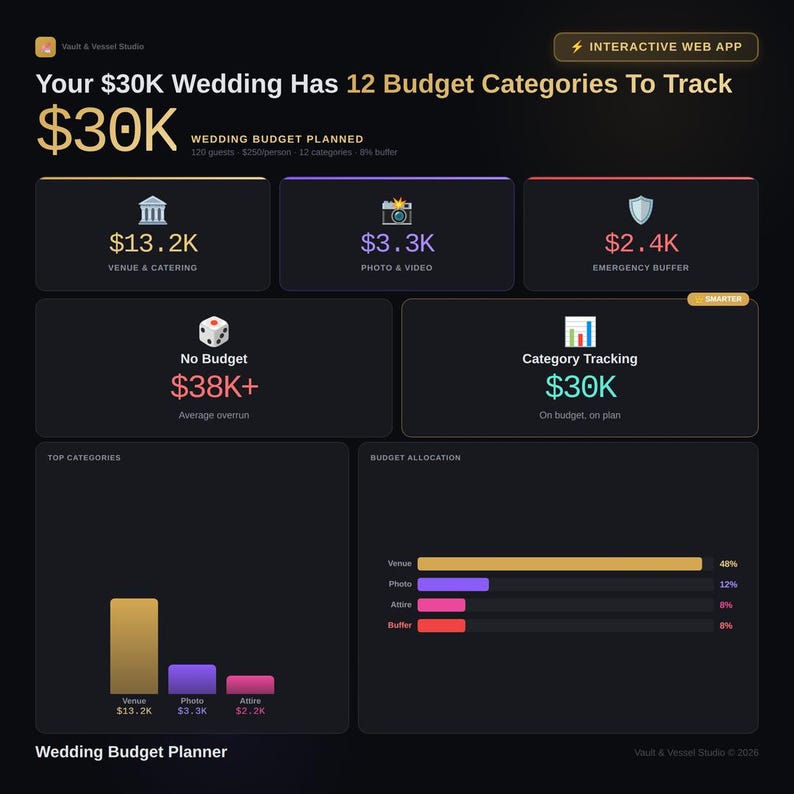
Wedding Budget Planner
Category tracker, vendor payment schedule & interactive budget dashboard for your big day
And then someone asks, "So, what's your budget?"
Suddenly the dreamy Pinterest boards and venue tours collide with a very real question: how much does a wedding actually cost, and where is all that money supposed to go?
Here's the truth that the wedding industry doesn't love talking about: the average American wedding in 2025 cost $35,000 to $40,000. That number makes most people's stomachs drop. But here's what matters more than the national average — what YOUR wedding costs is entirely within your control, as long as you build a plan before you start booking vendors.
This guide is going to walk you through exactly where every wedding dollar typically goes, show you where the biggest savings opportunities hide, and give you a framework to build a realistic budget that doesn't require a second mortgage or a rich uncle.
## What Does a Wedding Actually Cost? (The Real Numbers)
Before you can build a budget, you need to understand what you're working with. Here's where average wedding spending actually lands across major categories, based on 2024-2025 industry data:
Venue and catering eat the largest chunk — typically 40-50% of your total budget. For a $35,000 wedding, that's $14,000 to $17,500. This includes the ceremony site, reception venue, food, drinks, cake, and any rental fees. If you're going to make one category-level decision that shapes your entire wedding budget, this is the one.
Photography and videography typically run 10-15% — around $3,500 to $5,250. And this is the one category where most couples say they wish they'd spent more, not less. Your photos are the only thing you keep after the food is eaten and the flowers have wilted.
Music and entertainment (DJ, band, photo booth) land around 8-10%, or $2,800 to $3,500.
Flowers and decor take another 8-10% — $2,800 to $3,500. This is also one of the most flexible categories, with huge potential for savings if you're willing to get creative.
Attire (dress, suit, alterations, accessories) runs about 5-8%, or $1,750 to $2,800.
Stationery and invitations typically claim 2-3% — $700 to $1,050.
Transportation, favors, officiant, hair and makeup, and miscellaneous expenses fill out the remaining 10-15%.
## The Realistic Wedding Budget Framework
Now here's where most wedding planning advice falls flat: they give you national averages but don't help you build YOUR numbers. The framework below scales to any total budget.
### Tier 1: The Non-Negotiables (60-65% of budget)
These are the categories that make or break the day. They're also the hardest to change once you've signed contracts, so get them right first.
Venue + Catering (40-50%): This is your anchor number. Everything else flexes around it. When you're evaluating venues, always ask for the all-in cost — many venues quote a per-person food price but don't mention the service charge, tax, bartending fees, or room rental until later. A $150/person dinner becomes $195/person real fast.
Photography (10-12%): Book your photographer early. The best ones book 12-18 months out, and this is genuinely one area where quality matters enormously. Look at full galleries from real weddings, not just the highlight reel on Instagram.
Music/DJ (5-8%): Your DJ controls the energy of the entire reception. A great DJ reads the room. A cheap DJ plays a playlist. There's a massive difference.
### Tier 2: The Experience Shapers (20-25% of budget)
These categories make your wedding feel like YOUR wedding, not a generic banquet hall event.
Flowers and Decor (8-10%): This is where creative couples save thousands. Seasonal flowers instead of imported ones. Greenery-heavy arrangements instead of all-bloom centerpieces. Candles instead of elaborate floral arches. The visual impact can be just as stunning at half the cost.
Attire and Beauty (5-8%): Your dress or suit, alterations, shoes, accessories, hair, and makeup. Sample sales, trunk shows, and consignment shops can save 30-50% on bridal attire without sacrificing the moment you walk down the aisle.
Stationery (2-3%): Digital invitations have gone from taboo to totally normal. A beautiful digital save-the-date paired with a printed invitation is a smart hybrid that cuts this category in half.
### Tier 3: The Extras That Add Up (10-15% of budget)
Transportation: Shuttle for guests? Vintage car for photos? These add up. Budget $500-$1,500 depending on your situation.
Favors: Most wedding favors end up in the trash. Controversial opinion, but true. If you're tight on budget, skip them entirely. Nobody leaves a wedding angry because they didn't get a personalized candle.
Tips and Gratuities: This is the line item that blindsides people. Budget 15-20% tips for catering staff, bartenders, hair and makeup artists, and your DJ. On a $35,000 wedding, gratuities alone can run $1,000-$2,000.
The Emergency Buffer (5%): Always, always, always budget a 5% contingency. Something will cost more than expected. A last-minute rental. A weather backup plan. An alteration that requires extra work. If you don't use it, congratulations — that's your honeymoon fund.
## How to Cut Costs Without Cutting Corners
Saving money on your wedding doesn't mean it has to feel cheap. It means being strategic about where you invest and where you get creative.
### Pick an Off-Peak Date
Friday and Sunday weddings can be 20-40% cheaper than Saturday events at the same venue. January, February, March, and November weddings (outside holiday weekends) often come with significant venue discounts. The flowers are just as beautiful, the cake tastes just as good, and your guests will still dance until midnight.
### Negotiate Everything
Most wedding vendors have more flexibility on pricing than they let on, especially if you're booking during their slower season, paying in full upfront, or combining services. Your photographer might discount a package if you also book them for engagement photos. Your florist might reduce the per-centerpiece cost if you simplify the bridal bouquet.
### Do the Math on All-Inclusive
All-inclusive venues and packages look expensive at first glance, but when you add up the a la carte cost of venue rental + catering + tables + chairs + linens + coordination separately, the all-inclusive number is often cheaper. Always compare apples to apples.
### Prioritize Ruthlessly
Sit down with your partner and each rank the categories by importance to YOU. Not what the internet says matters — what YOU care about. If you both love food and couldn't care less about flowers, put 50% toward catering and use grocery store greenery on the tables. If live music is your dream, spend on the band and use a playlist during cocktail hour.
The couples who stay on budget aren't the ones who cut everywhere. They're the ones who cut strategically in the categories they care least about to invest in the moments that matter most.
### Limit the Guest List (Seriously)
Every guest costs $150-$250 when you factor in food, drinks, favors, stationery, and seating. Cutting 20 guests saves $3,000 to $5,000. That's your entire photography budget. Guest list decisions aren't just social decisions — they're the single biggest financial lever in your wedding budget.
## The Wedding Budget Timeline: When to Spend What
Your budget doesn't happen all at once. Here's a realistic spending timeline:
12+ months out: Book your venue (deposit: 25-50% of venue cost), photographer (deposit: 25-50%), and band/DJ (deposit: 25-50%). These three vendors book the fastest and lock in your date.
9-12 months out: Choose your wedding party attire. Order invitations. Book your florist and officiant.
6-9 months out: Book hair and makeup, transportation, and any rental companies. Send save-the-dates. Begin menu tastings.
3-6 months out: Final dress fittings and alterations. Order favors. Finalize ceremony details. Send invitations.
1-3 months out: Final payments due to most vendors. Confirm all delivery times and setup details. Create your day-of timeline.
Week of: Final headcount to caterer. Prepare tip envelopes. Pack an emergency kit (stain remover, sewing kit, phone charger, snacks).
## Tools That Make Wedding Budgeting Actually Work
If you've ever tried to track a wedding budget in a notes app or a random spreadsheet, you know the chaos that creates. You need a system that breaks everything down by category, tracks deposits vs. final payments, shows you what you've spent vs. what's left, and keeps you honest when the "but it's our special day" impulse kicks in.
The Wedding Budget Planner (https://www.etsy.com/listing/4475933232/wedding-budget-planner-category-tracker) does exactly this.
If you want to drill deeper into the true cost of your wedding, the Wedding Budget Calculator (https://www.etsy.com/listing/4476009604/wedding-budget-calculator-real-cost) breaks down every expense line by line.
Planning a destination wedding? The Destination Wedding Cost Calculator (https://www.etsy.com/listing/4476006813/destination-wedding-cost-calculator) is built specifically for destination weddings.
The Wedding Timeline Builder (https://www.etsy.com/listing/4476010966/wedding-timeline-builder-day-of-schedule) maps out your entire planning journey week by week.
The Seating Chart Planner (https://www.etsy.com/listing/4476011942/seating-chart-planner-table-assignment) handles table assignments.
## The One Mindset Shift That Changes Everything
Here's the biggest financial mistake couples make with wedding planning: they set a budget AFTER they start falling in love with venues and vendors.
Set your total number first. Before you tour anything. Before you browse anything. Before you pin anything.
Write it down. Tell your partner. Tell anyone helping you plan. That number is your ceiling, not your starting point.
Your wedding should be the start of your best financial life together — not a setback that takes years to recover from.
## Your Next Step
Grab the Wedding Budget Planner (https://www.etsy.com/listing/4475933232/wedding-budget-planner-category-tracker) and plug in your real numbers today.
The 50/30/20 Budget Calculator (https://www.etsy.com/listing/4475927242/503020-budget-calculator-needs-wants) helps you balance wedding savings with everyday expenses.
—
### Download Your Free Wedding Budget At-a-Glance Guide
Download the Free Wedding Budget At-a-Glance Guide (#signup) — No spam, just the guide delivered straight to your inbox.
—
This article is for informational purposes only and does not constitute financial advice. Every wedding and financial situation is unique. The budget percentages referenced are based on industry averages and may vary by region and personal priorities.