Introduction: Tracking Isn’t Weakness—It’s Intelligence
You track your budget. You track your workouts. You might track your sleep, your steps, or your water intake. So why does tracking your mood or depression feel different? Why does it feel like admitting defeat?
It doesn’t. It’s the opposite.
Tracking your mental health is an act of self-care and empowerment. It’s gathering data about yourself—the same way a fitness tracker gathers data about your body or a budget app gathers data about your spending. Depression often leaves us feeling disconnected from patterns and patterns, making it hard to see what helps and what hurts. A mood tracker changes that. It transforms invisible emotional struggles into visible information you can use to take back control.
Depression Tracking Bundle
From Track & Thrive Wellness on Etsy
Shop Now on Etsy →
This isn’t weakness. This is intelligence gathering.
What Depression Tracking Actually Means
Before we talk about why to track, let’s talk about what to track. Depression tracking isn’t about obsessing over every emotional fluctuation. It’s about noticing patterns.
A mood tracking template doesn’t need to be complicated. In fact, simplicity is your friend. Here’s what matters:
Core Tracking Elements
Rate your overall mood on a simple scale. 1 might be “lowest I’ve ever felt” and 10 might be “great.” You don’t need to overthink it—a gut-level number works. This gives you concrete data instead of vague feelings.
Depression and sleep are deeply connected. Track how many hours you slept and how rested you actually felt. Was it restless? Did you sleep 12 hours but still feel exhausted? These details matter.
Separate mood from energy. You might feel emotionally okay but physically drained, or vice versa. Rate your energy independently (also 1-10). This helps your doctor understand whether you’re dealing with depression-related fatigue or something else.
If you’re on medication, note when you take it and any noticeable effects. Did your mood improve 30 minutes after taking medication? Did side effects kick in? This information is gold for your healthcare provider.
This is where tracking becomes powerful. Note what happened before a mood dip:
- Social situations (spent time with friends, had a conflict, felt isolated)
- Work or school stress
- Weather changes (seasonal patterns are real)
- Hormonal changes (if applicable)
- News or social media exposure
- Other environmental factors
What did you do? Exercise, creative work, time in nature, TV binges, social connection? Track activities to see which ones correlate with better or worse moods.
We often underestimate how physical health affects mental health. Note your eating patterns and whether you noticed any connection to mood.
The Magic of Pattern Recognition
| Tracking Method | Setup | Data Quality | Doctor-Shareable? | Best For |
|---|---|---|---|---|
| Paper journal | Immediate | Inconsistent | Sometimes | Low-tech preference |
| Generic health app | 5 min | Medium | Export only | Basic logging |
| DDH Symptom Tracker | 5 min | High (structured fields) | Yes — generates patterns | Chronic conditions, complex symptom tracking |
Here’s where tracking transforms from interesting to life-changing: patterns.
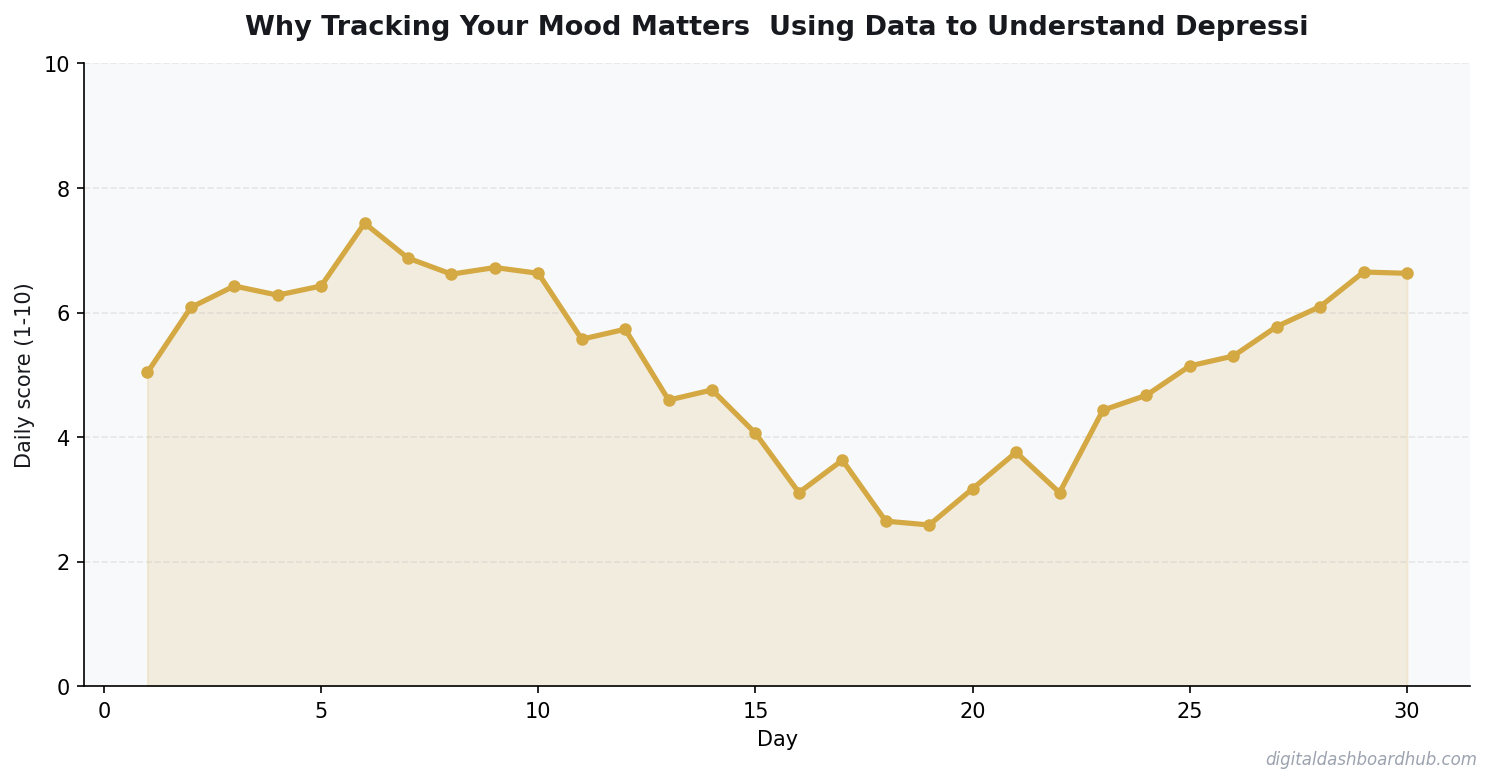
Depression thrives in ambiguity. It whispers “everything is always terrible” because when you’re depressed, it feels like everything is always terrible. Your brain isn’t lying—it’s just showing you the world through a dark filter. Tracking breaks that filter.
Real Patterns That Emerge
Maybe it’s not depression. Maybe it’s the work stress spike on Monday mornings. Once you see this pattern, you can plan for it: extra self-care on Sunday nights, a supportive friend call on Monday afternoon, or a conversation with your manager about workflow.
If this pattern appears in your tracker, you’re not imagining it. Hormonal fluctuations are real and can significantly impact mood and energy. Knowing this helps you prepare and explains why some days feel so much harder.
Even 15 minutes of movement correlates with a measurable mood boost for you personally. This isn’t motivational nonsense—it’s your data telling you what works for your brain.
Or worse on days you stay isolated. This objective evidence helps combat depression’s lie that “no one cares” or “isolation is what you deserve.”
These patterns are invisible without tracking. With it, they become undeniable.
Why Your Doctor Needs This Data
Here’s what most people don’t realize: your healthcare provider is flying partly blind without your mood tracking data.
During a typical doctor’s appointment, you might say “I feel depressed” or “things have been hard.” Your doctor listens and takes notes, but they’re working from a snapshot—this moment, this conversation. They can’t see what the last three months actually looked like.
A mood tracker changes everything.
How Tracking Transforms Mental Healthcare
Instead of relying on memory (depression is excellent at distorting memory), you have data. “I was a 3/10 on March 15, a 5/10 on March 20, and a 2/10 today.”
If your doctor suggests a medication change or therapy approach, your tracking data shows whether it’s actually working. Placebo effects exist, but so does real improvement—and your tracker shows which is happening.
You might notice that one of your medications correlates with better mood, or that a certain therapy technique genuinely helps. Your doctor can see this in your data.
Instead of trying to describe how you feel, you show: “Here’s my mood, sleep, energy, and medication timing. You’ll notice the pattern here.” This is more helpful and less emotionally taxing.
Over weeks and months, your tracker becomes a visual representation of your mental health journey. You can look back and see “actually, I’ve improved,” even when depression insists you haven’t.
Bring your mood tracking template or journal to your therapy or doctor appointments. Many healthcare providers are grateful for this data.
Getting Started: Keep It Simple
The biggest barrier to mood tracking is overthinking it. People imagine they need to track 20 variables, fill out a 5-page questionnaire daily, and maintain perfect data. Then they give up after three days.
You don’t need perfection. You need consistency and simplicity.
Your Minimal Viable Mood Tracker
Start with just three things:
- Daily mood (1-10) — takes 5 seconds
- Sleep hours and quality — takes 10 seconds
- One sentence about what happened or how you felt — takes 30 seconds
That’s it. Two minutes a day, maximum.
Best Practices
Digital (phone app, spreadsheet, note app) or paper (journal, printed template)? Choose whichever you’ll actually use consistently. Digital is easier to search for patterns. Paper feels more personal. Neither is better—better is whichever one you’ll stick with.
Evening is often best—you can reflect on the whole day and won’t forget by bedtime. But if morning works for you, that works too. Consistency matters more than timing.
Missed two days? Start again. Didn’t track triggers one week? That’s okay. Perfect data for 30 days is better than 90% data for 90 days. Depression will use “I already messed up” as an excuse to stop tracking entirely. Remind yourself that this is about progress, not perfection.
Begin with mood + sleep. After two weeks, add energy or triggers if you want. Building gradually prevents overwhelm.
Every Sunday (or whatever day), take 5 minutes to look back. Do you see any patterns? This isn’t to judge yourself—it’s to notice what’s true.
Tools and Resources to Support Your Tracking
If you want more structure and guidance, several tools can help jumpstart your tracking practice:
Depression Tracking Bundle Interactive — A comprehensive digital tracker designed specifically for depression patterns, mood monitoring, and treatment tracking.
Anxiety Management Spreadsheet Daily — If anxiety accompanies your depression (which it often does), this daily tracker helps separate and manage both.
CBT Worksheet Tracker Spreadsheet — If you’re in therapy, especially cognitive-behavioral therapy, this tracker helps you log thought patterns and behavioral experiments.
Stress Management Spreadsheet Daily — Stress often triggers depression. This helps you identify and manage stress sources.
Meditation Practice Spreadsheet Session — If you use meditation or mindfulness as part of your mental health routine, track its impact.
Gratitude Journal Spreadsheet Daily — A gentle practice to track alongside mood data, helping you notice small good moments.
These resources remove the “what do I track?” question and give you a proven structure to work from.
What Tracking Isn’t
Before we close, let’s address what mood tracking is not, because depression loves to twist self-care into self-harm:
It’s not punishment. You’re not tracking to judge yourself or prove how broken you are. You’re gathering data.
It’s not a replacement for treatment. If you need medication, therapy, or hospitalization, tracking supports those—it doesn’t replace them.
It’s not about forcing positivity. If you’re a 2/10, you’re a 2/10. The tracker is honest. That honesty is the point.
It’s not one-size-fits-all. Your mental health is unique to you. Your tracker should be too.
It’s not a sign you’re doing something wrong. People track their health when they want to optimize it, understand it, and care for it. That’s you doing something right.
Start Your Tracking Journey Today
Depression wants you to believe you have no control and no agency. Mood tracking is a quiet rebellion against that lie. It says: “I’m gathering data. I’m paying attention. I’m taking responsibility for my own understanding and care.”
This week, choose one tracking method. Tomorrow, write down three numbers: your mood, your sleep hours, and your energy. That’s all. Just those three things.
Then do it again the next day.
After two weeks, look back. You might see something you didn’t expect. A pattern. A connection. A small piece of understanding that depression was hiding from you.
Get Our Free 14-Day Mood Tracking Starter Guide
Want a guided introduction to tracking? Join the Track & Thrive Wellness community and receive our free 14-Day Mood Tracking Starter Guide—with daily prompts, a pre-made template, and tips to establish your tracking habit.
No credit card. No upsells. Just practical, shame-free tools to help you understand yourself better.
Your Mental Health Matters
You deserve to understand your own mind and body. You deserve healthcare providers who see your actual patterns, not just your worst days. You deserve the knowledge and power that comes from tracking your own data.
Mood tracking is the tool that makes all of that possible.
Start today. Even if it’s just three numbers in your phone tonight. You’re worth the two minutes.
- 988 Suicide & Crisis Lifeline: Call or text 988 (available 24/7)
- Crisis Text Line: Text HOME to 741741
- National Alliance on Mental Illness (NAMI): nami.org
- Depression and Bipolar Support Alliance (DBSA): dbsalliance.org
You might also find this helpful: I Tracked My Autoimmune Disease Flare for 30 Days — Here’s What the Data Showed.
Keep Reading
- How to Regulate Your Nervous System: 8 Steps to Move From Chronic Stress to Calm
- I Tracked My Nervous System for 90 Days — Here’s What I Learned About My Stress, Sleep, and Sanity
- Nervous System Regulation Tracker: The Visual Dashboard That Helps You Understand Your Body’s Stress Signals
Keep reading (related guides):
- Free ADHD Impulse Spending Tracker — Try It Now
- ADHD Impulse Spending Tracker: The Free Visual Dashboard Built for Your Brain
- Nervous System Regulation Tracker: The Visual Dashboard That Helps You Understand Your Bodys Stress Signals
- I Tracked My Nervous System for 90 Days — Heres What I Learned About My Stress, Sleep, and Sanity
- Bakery Revenue Calculator
255+ interactive tools for your money, time, and health.
Full dashboard access · Stripe-secure checkout · Cancel anytime

Andy Gaber is the founder of Digital Dashboard Hub, a suite of 255+ interactive financial, productivity, and wellness tools. He built DDH after getting frustrated with financial apps that gave outputs without context. Follow along for tool tutorials, revenue analytics breakdowns, and honest takes on personal finance.