Year One as a Freelancer: $68,000 and Feeling Unstoppable
Before you scroll: the calculator below is running in your browser right now. For the full feature set — saved scenarios, history, exports — open the dashboard.
Bottom Line
In This Article
- Year One as a Freelancer: $68,000 and Feeling Unstoppable
- Year Two: The Ceiling Hits — $82,000
- The shift: Hiring My First Subcontractor
- Year Three: The Ugly Middle — $124,000 Revenue, $61,000 Take-Home
- Year Four: The Turning Point — $218,000 Revenue
- Year Five: When the Agency Finally Won — $347,000 Revenue
- How the DDH Revenue Projection Calculator Handles This
- The Five-Year Revenue Comparison (Full Picture)
- What I’d Tell My Freelancer Self
- Mid-Article Bonus: The “Agency Math” Gut Check
- The Practical Takeaway
Revenue jumped to $124,000. Sounds great, right? Here’s the breakdown that humbled me:
I quit my agency job on a Friday and had my first freelance client by Monday. A friend’s startup needed a website. $4,500. Took me two weeks. I thought: if I can do two of these per month, that’s $108K a year. Easy.
Worth Noting
These calculations account for inflation, taxes, and real-world variables most free tools ignore.
It was not easy. But year one still went better than most freelancers’ first year. I landed 14 projects at an average of $4,857 each. Total revenue: $68,000. After taxes and expenses (about $18K combined), I took home roughly $50,000. Less than my old salary, but I was free. No commute. No meetings about meetings. No one telling me to use their preferred shade of corporate blue.
What I didn’t realize was that $68K was also my ceiling as a solo operator working the way I was working. And it would take me three more years and a lot of painful lessons to figure out how to break through it.
Year Two: The Ceiling Hits — $82,000
Year two I got better at sales and raised my rates from $4,500 average to $6,200 average. I completed 13 projects (one fewer than year one — I was getting pickier about clients). Revenue: $82,000. Take-home after taxes and expenses: about $57,000.
But something was wrong. I was maxed out. Every week was 45-55 hours of billable work plus another 10-15 hours of admin, sales, and marketing. I couldn’t take more clients. I couldn’t take a vacation. When I got sick for a week in March, I lost $6,000 in potential revenue and spent the next three weeks catching up.
I remember sitting at my desk at 11 PM on a Saturday, working on a client revision, and thinking: I didn’t leave a job to build a worse job. Something has to change.
The shift: Hiring My First Subcontractor
In October of year two, I hired a developer as a subcontractor. I paid him $50/hour for implementation work while I focused on design, strategy, and client management. My first project with him was a $9,000 website where I spent 15 hours (design + client management) and he spent 25 hours (development).
My cost: $1,250 (my time at opportunity cost) + $1,250 (his time) = $2,500 in labor. Revenue: $9,000. That’s a $6,500 gross profit, and I freed up 25 hours. Those 25 hours let me take on another project simultaneously. For the first time, I was earning money from someone else’s work.
That single project showed me the path from freelancer to agency owner. But the path was a lot bumpier than I expected.
Year Three: The Ugly Middle — $124,000 Revenue, $61,000 Take-Home
Year three was when I officially became an “agency.” I hired two full-time employees (a developer and a designer) and kept one part-time subcontractor. I rented a small office. I got business insurance. I set up payroll.
Revenue jumped to $124,000. Sounds great, right? Here’s the breakdown that humbled me:
Read that last line again. I increased revenue by 51%, hired two people, rented an office, took on all the stress and liability of being an employer — and my take-home increased by $4,000. Seven percent. That’s the overhead surprise nobody warns you about.
I was also working more, not less. Instead of doing client work for 50 hours a week, I was managing employees, handling HR issues, doing sales, managing cash flow, and putting out fires for 55-60 hours a week. The freedom I’d felt as a freelancer was gone.
Year Four: The Turning Point — $218,000 Revenue
Year four is when the agency model finally started proving itself. I’d learned from year three’s mistakes: I raised prices significantly (average project went from $8,500 to $14,000), I hired a part-time project manager to handle client communication, and I stopped doing any production work myself.
That last part was the hardest. I’m a designer. I love designing. But every hour I spent designing was an hour I wasn’t selling, and selling was the bottleneck. The moment I fully committed to being the sales and strategy person and letting my team handle execution, revenue nearly doubled.
Revenue: $218,000. Team costs: $98,000. Overhead: $24,000. Pre-tax profit: $96,000. Owner take-home: approximately $72,000. Now we’re getting somewhere — but I was still only making $15K more than I made as a solo freelancer charging lower rates. The use hadn’t fully materialized yet.
Year Five: When the Agency Finally Won — $347,000 Revenue
Year five is when everything clicked. I had a team of four full-time employees, a reliable pipeline of referrals, and an average project size of $18,000. I also added a monthly retainer service that generated $6,500/month in recurring revenue from ongoing clients.
Revenue: $347,000. Team costs: $156,000. Overhead: $31,000. Pre-tax profit: $160,000. Owner take-home: approximately $112,000. For the first time, the agency was clearly outearning what I could have made as a solo freelancer.
But here’s the comparison that matters most: in year five, I was working about 40-45 hours per week, mostly on sales, strategy, and relationship management. As a freelancer in year two, I was working 55-60 hours per week doing everything. The agency gave me $55K more in take-home pay and 10-15 fewer hours per week. The trade was worth it — but it took five years to get there.
How the DDH Revenue Projection Calculator Handles This
The freelancer-to-agency transition is fundamentally a financial modeling problem. You need to project the revenue increase from adding team members, subtract the very real costs of those team members, and see when the crossover happens — the point where agency income exceeds freelancer income.
The Freelancer Revenue Projection Calculator inside Digital Dashboard Hub can model both scenarios side by side. For the freelancer model, input your capacity, rates, and utilization. For the agency model, add employees with their costs, increase your capacity accordingly, and see the net profit comparison. You can model the transition year by year and identify exactly when the agency starts winning.
For me, the crossover was year four. For some people, it’s year three. For others, it’s year six. Knowing your specific crossover point before you hire your first employee is the difference between a strategic transition and a stressful gamble.
The Five-Year Revenue Comparison (Full Picture)
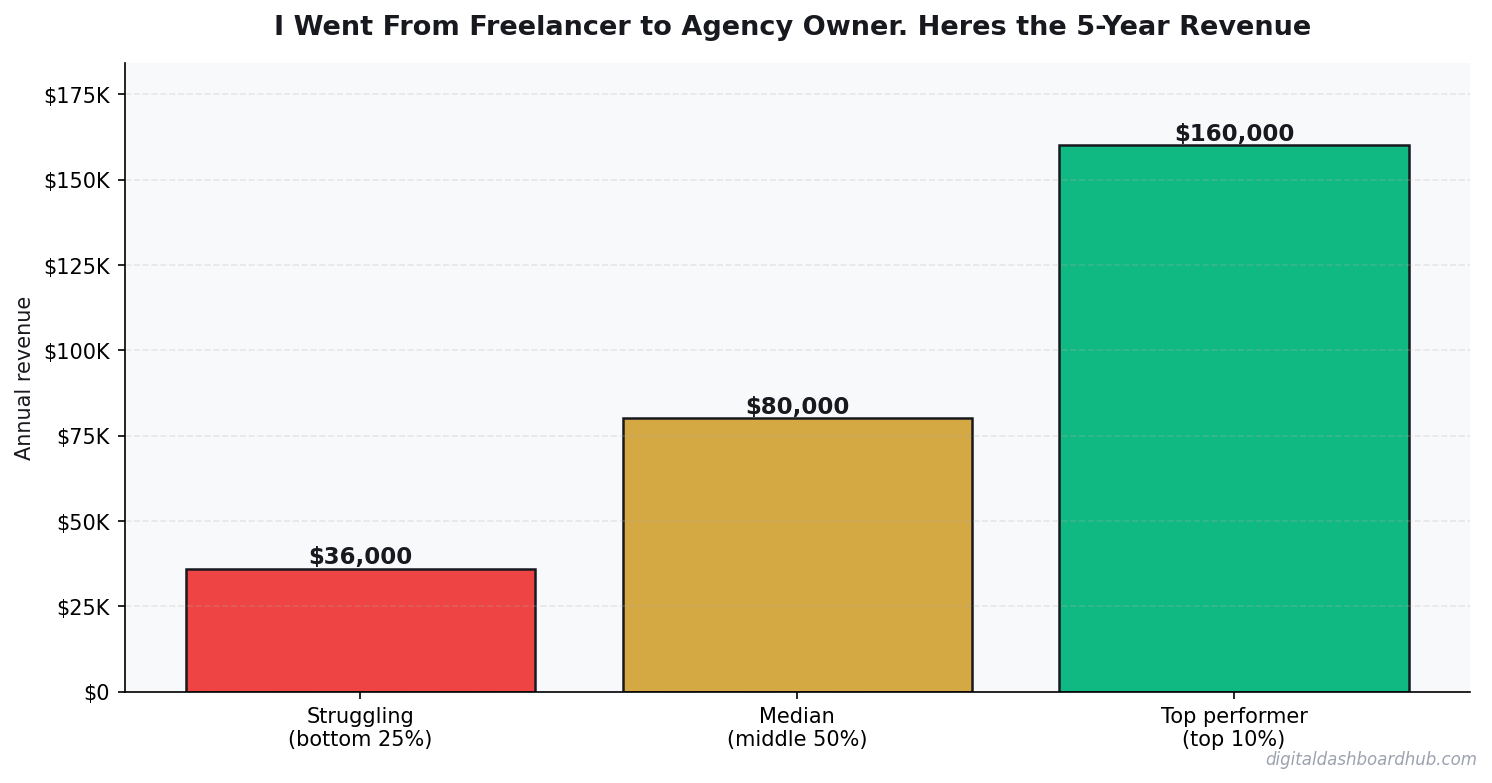
That effective hourly rate in the last row is the number that tells the real story. It wasn’t until year five that my effective hourly rate as an agency owner significantly exceeded what I could have earned as a well-priced freelancer. The first three years of the agency, my effective hourly rate actually went down.
What I’d Tell My Freelancer Self
Don’t rush the transition. I started hiring before I had enough revenue to comfortably support employees. My bank account was stressed for all of year three. Wait until you’re consistently turning down work because you’re at capacity — that means the demand exists to support a team.
Raise your prices before you hire. I should have raised my freelance rates to $12K-$15K per project before adding overhead. Higher revenue per project means fewer projects needed to cover team costs, which means less sales pressure during the transition.
Hire a project manager before a second producer. The biggest time sink in early agency life is client communication, not production work. A part-time PM frees up 15+ hours per week of your time for sales and strategy — which is where the revenue growth comes from.
The agency isn’t better than freelancing. It’s different. Freelancing at high rates with 4-5 premium clients is a perfectly good business that can generate $120K-$180K with minimal overhead and maximum freedom. Not everyone needs or wants to build an agency. I’m glad I did, but I know plenty of happy freelancers earning more than some agency owners, with a fraction of the stress.
Mid-Article Bonus: The “Agency Math” Gut Check
Before you hire your first employee, answer these three questions honestly. If you can’t answer yes to all three, you’re not ready.
1. Am I turning down at least 2-3 projects per month because I’m at capacity? (If no, you don’t have enough demand to feed another person.) 2. Is my average project fee at least $8,000? (Below this, the margins are too thin to support employees.) 3. Do I have 3 months of operating expenses saved — including the new employee’s salary? (If no, one slow month will force a layoff.)
Real-Time
Calculations
Results update as you type your numbers
The Practical Takeaway
Step 1: Calculate your current effective hourly rate. Total take-home pay divided by total hours worked (not just billable hours — all hours). If that number is below $40, raising your rates is a better move than hiring.
Step 2: Map out the freelancer-to-agency transition on paper. What would year one of the agency look like? What are the real costs? When does the agency income exceed your current freelance income? Be conservative — it always takes longer than you think.
Step 3: Start a free trial of Digital Dashboard Hub and model both paths in the Revenue Projection Calculator. See the 5-year income trajectory for staying solo vs. building a team. Let the numbers show you which path leads to the income and lifestyle you actually want.
Keep reading (related guides):
- Mortgage Comparison Calculator: Find the Best Rate and Term
- How to Calculate Your Freelance Rate (So You Stop Undercharging)
- Freelance Quote Builder: Stop Undercharging (Free Calculator)
- Freelancer vs. Agency Revenue Calculator: A 5-Year Income Comparison
- Rent vs. Buy Calculator 2026: The True Cost of Each Option (Real Numbers)
The Freelancer-to-Agency Moments That Matter Most
You don’t scale from freelancer to agency in one leap. You cross five specific thresholds, and how you handle each one determines whether you actually make it.
Year 1: first subcontractor
The first person you pay to do work you used to do yourself. This is where most freelancers break — they stay solo because hiring feels expensive. The unlock: charge clients based on value, not your hours, so you can profit on work someone else executes.
Year 2: first full-time employee
Subcontractors are cheap but unpredictable. Your first W-2 hire costs $65K-$95K fully loaded (salary, tax, benefits, equipment). You need $15K-$25K of recurring monthly revenue that you won’t personally execute to make this sustainable.
Year 3: first operations hire
Most founders stall at $350K-$500K because they’re still running operations in their head. An ops manager, account manager, or project manager turns your one-person delivery system into a repeatable team system. This is the unlock to $800K+.
Year 4: sales function that isn’t you
Either a hired salesperson, a referral engine, or a marketing machine that generates leads without your time. Until sales runs without you, the agency is still a freelancer business that has employees. When sales runs without you, you have an actual agency.
Year 5: the profitability discipline
Lots of $1M+ agencies net $60K for their owner. The ones that net $250K+ are aggressive about profitability — gross margin targets per service line, utilization targets per role, and hard rules about which clients they’ll take on.
255+ interactive tools for your money, time, and health.
14-day trial · Stripe checkout · Cancel anytime
Keep Reading
- Freelancer Finance Dashboard: Track Income, Taxes, and Cash Flow in One Visual Hub
- Freelancer Tax Guide 2026: What to Track All Year So April Doesn’t Destroy You
- The Side Hustle Tax Trap: Track Every Dollar

Andy Gaber is the founder of Digital Dashboard Hub, a suite of 255+ interactive financial, productivity, and wellness tools. He built DDH after getting frustrated with financial apps that gave outputs without context. Follow along for tool tutorials, revenue analytics breakdowns, and honest takes on personal finance.