Your heart races at 2 AM for no reason you can identify. Your stomach knots before meetings that used to feel routine. You catch yourself catastrophizing about scenarios that haven’t happened and probably won’t. Some days the anxiety is a low hum in the background. Other days it’s a five-alarm fire in your chest that makes basic functioning feel heroic.
Here’s what makes anxiety particularly cruel: it’s invisible. Nobody sees it. And because you can’t see it yourself — because it exists as a feeling rather than a measurable thing — it’s incredibly hard to manage. You can’t fix what you can’t see, and you can’t see what you don’t track.
That’s the paradigm shift that changes everything. When you start tracking your anxiety systematically — logging triggers, symptoms, severity, duration, and the strategies you use to cope — anxiety transforms from an unpredictable monster into a pattern. And patterns can be understood. Understood patterns can be managed. Managed patterns can be reduced.
Why Tracking Anxiety Works (The Science)
Before DDH, I was doing this manually in spreadsheets. Here’s the faster way:
This isn’t woo-woo self-help advice. Anxiety tracking leverages several well-established therapeutic principles that clinical psychologists have used for decades.
Cognitive Behavioral Therapy’s Core Mechanism
CBT — the gold standard treatment for anxiety disorders — is built on the principle that thoughts, feelings, and behaviors are interconnected. When you track your anxiety, you’re performing the foundational CBT exercise of identifying thought patterns. A tracking log naturally captures the triggering situation, the automatic thoughts that followed, the emotional response, and the behavioral outcome.
Over time, this data reveals your cognitive distortions — the systematic errors in thinking that amplify anxiety. Maybe you discover that you catastrophize (assuming the worst outcome) in work situations but not social ones. Maybe you notice that your anxiety about health spikes after reading news articles. These patterns are therapeutic gold, and they’re invisible without systematic tracking.
The Observation Effect
Psychology researchers have long documented that the act of observing a behavior changes it. When you start tracking anxiety, you introduce a gap between the anxious feeling and your response to it. Instead of immediately spiraling, you pause to log what’s happening. That pause — even if it’s just thirty seconds — activates your prefrontal cortex (the rational, problem-solving part of your brain) and reduces the amygdala’s fear response.
In clinical terms, this is metacognition: thinking about your thinking. And it’s one of the most powerful anxiety-reduction techniques that exists.
Perceived Control Theory
A significant component of anxiety is the feeling of being out of control. When you have data about your anxiety — when you can see that your average anxiety level is actually 4/10, not the 8/10 it feels like — you gain a sense of mastery over your experience. Research consistently shows that perceived control reduces anxiety even when actual circumstances don’t change. Tracking provides that perception of control through data.
What to Track (Your Anxiety Dashboard)
Effective anxiety tracking captures five key dimensions. You don’t need to track all of these every time — even capturing two or three consistently will yield valuable insights.
1. Severity Rating (1-10 Scale)
Rate your anxiety on a simple 1-10 scale at consistent intervals throughout the day. Three check-ins per day (morning, afternoon, evening) gives you enough data points without becoming burdensome. The key is consistency — tracking at the same times each day lets you identify time-of-day patterns.
2. Triggers
What was happening when the anxiety spiked? Be specific. “Work stress” is too vague. “Received email from manager requesting urgent meeting with no agenda” is useful. The more specific your trigger log, the more actionable your patterns become.
Common trigger categories include work situations, social interactions, health concerns, financial worries, news consumption, sleep quality, caffeine intake, and physical symptoms.
3. Physical Symptoms
Anxiety manifests in the body, and tracking physical symptoms helps you catch anxiety before it escalates. Common physical manifestations include rapid heartbeat, chest tightness, shallow breathing, stomach upset, muscle tension (especially jaw and shoulders), sweating, dizziness, and headaches.
Over time, you’ll learn your personal early-warning system. Maybe your jaw clenches before you consciously feel anxious. Maybe your stomach is always the first signal. Knowing your body’s anxiety sequence lets you intervene earlier.
4. Coping Strategies Used
Log what you did when anxiety hit and rate how effective it was. This builds a personalized toolkit based on what actually works for you, not generic advice from a blog post. Did deep breathing help? Rate it 7/10. Did going for a walk help? Rate it 9/10. Did scrolling social media help? Probably 2/10 — and now you have data to prove it.
5. Duration
How long did the anxiety episode last? This metric alone can be meaningful. Most people overestimate how long anxiety lasts. When you track duration and discover that your average anxiety spike lasts twenty-three minutes (not the “all day” it feels like), the next spike becomes more bearable. You have evidence that it will pass.
How to Build Your Anxiety Tracking Practice
| Option | Cost | Time Investment | Customizable? | Best For |
|---|---|---|---|---|
| DIY approach | Free | High | Fully | Those with time to build from scratch |
| Generic tool | $5-$50/mo | Medium | Limited | Standard use cases |
| DDH Free Tool | Free trial | 5-10 min setup | Yes | Getting real answers without spreadsheet hell |
Week 1: Establish the Baseline
Don’t try to change anything in your first week. Just observe and record. Set three daily check-in reminders (9 AM, 2 PM, 9 PM works for most people) and rate your anxiety level. If something significant triggers anxiety between check-ins, log a bonus entry.
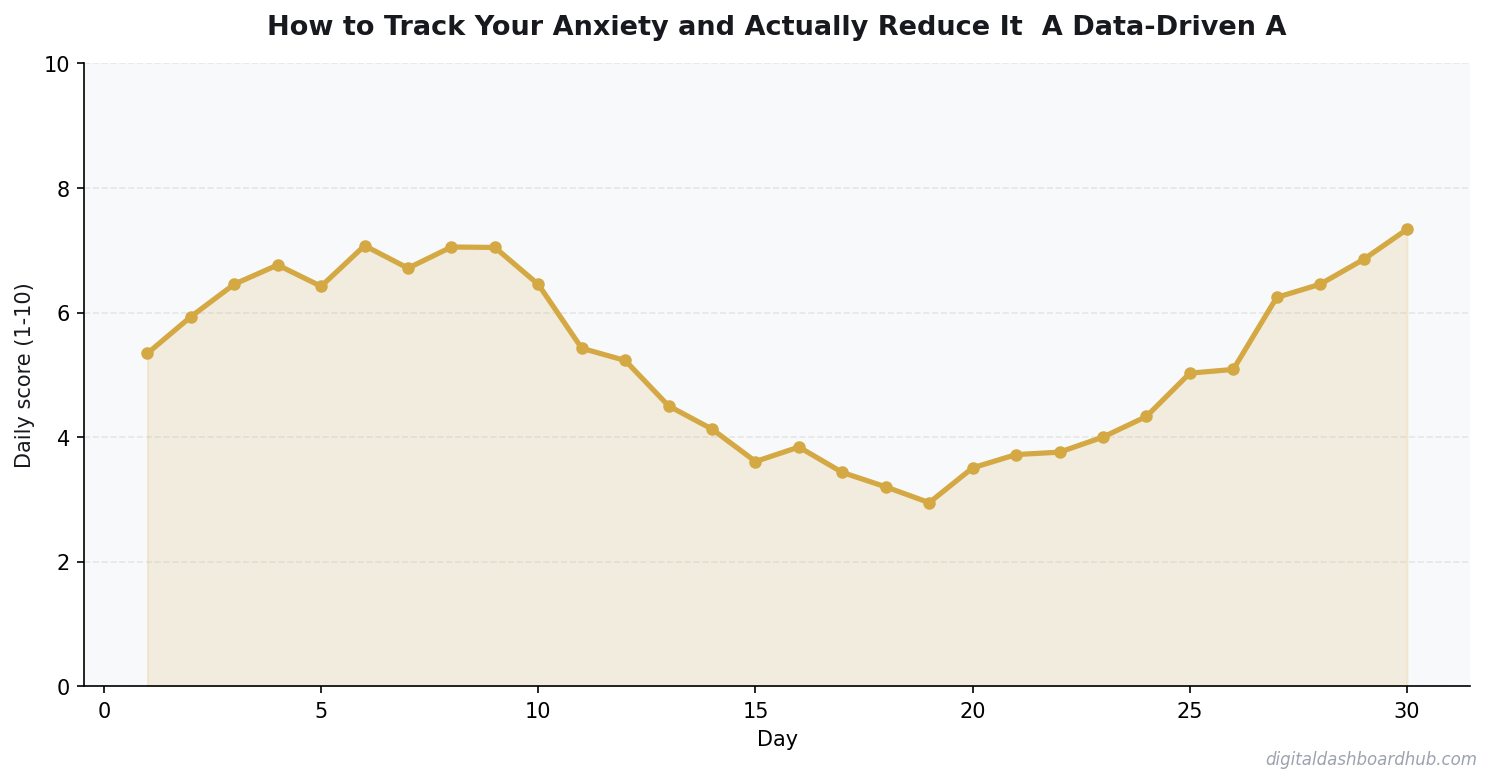
The goal this week is data collection, not data analysis. You’re building the habit of tracking, and you’re gathering baseline data to compare against later.
Weeks 2-3: Add Detail
Once the basic check-in habit is established, start adding triggers and symptoms to your logs. You don’t need to write paragraphs — a few words is enough. “Pre-meeting nerves, tight chest, 6/10” captures everything you need.
Also start logging your coping strategies. When anxiety hits, what do you do? Track it. Over these two weeks, you’ll naturally start building a library of strategies with effectiveness ratings.
Week 4: Your First Review
After four weeks, you have enough data for meaningful analysis. Review your logs and look for these patterns:
Time patterns: Is your anxiety consistently higher in the morning? Evening? Mid-afternoon? Time-of-day patterns often point to physiological factors (cortisol, blood sugar, caffeine timing) that are relatively easy to address.
Trigger clusters: Do certain categories of triggers appear repeatedly? If 60% of your high-anxiety entries involve work emails, that’s a clear signal about where to focus intervention efforts.
Strategy effectiveness: Which coping strategies consistently receive high effectiveness ratings? Double down on those. Which ones score low? Replace them.
Duration trends: Are your anxiety episodes getting shorter over the four weeks? For most people, the answer is yes — simply because the act of tracking introduces the metacognitive pause that speeds recovery.
Month 2+: Optimize and Experiment
With baseline data in hand, you can start making targeted changes and measuring their impact. Try one change at a time — this is important for isolating what works. If you change five things simultaneously, you won’t know which one made the difference.
Experiments to try: adjusting caffeine intake and tracking anxiety scores for two weeks, implementing a morning meditation practice and measuring its effect on morning anxiety ratings, changing your news consumption habits and watching for changes in health-related anxiety triggers, or adding regular exercise and tracking the correlation with overall anxiety levels.
Advanced Tracking Strategies
Correlation Analysis
The most powerful insight comes from tracking multiple variables and looking for correlations. Sleep quality, exercise, caffeine, alcohol, social interaction, screen time — all of these can influence anxiety. When you track them alongside your anxiety ratings, patterns emerge that are genuinely life-changing.
Many people discover that their anxiety is 50% worse on days they slept less than six hours. Or that two cups of coffee is fine but three triggers afternoon anxiety. Or that days with zero exercise consistently produce higher evening anxiety scores. These are personal, data-driven insights that no general advice article can give you.
Trend Analysis
Looking at weekly averages over months reveals the big picture. Is your overall anxiety trending down? Plateauing? Spiking during certain periods? Trend data helps you evaluate whether your overall approach is working and when to make adjustments.
Pre-Event Tracking
If you have a known anxiety trigger coming up (a presentation, a medical appointment, a social event), track your anxiety in the days leading up to it. Most people find that anticipatory anxiety peaks one to two days before the event and drops sharply once the event actually begins. Seeing this pattern in your data helps you reality-check future anticipatory anxiety with evidence.
Building Your Digital Anxiety Dashboard
Paper journaling works, but a digital anxiety tracker offers capabilities that paper can’t: automatic trend calculation, correlation analysis, visual charts that make patterns immediately obvious, and the ability to track multiple variables without creating a new spreadsheet template each month.
The Anxiety Management Tracker on Digital Dashboard Hub gives you a clean, private dashboard for logging anxiety levels, triggers, symptoms, and coping strategies. View daily, weekly, and monthly trends at a glance. See correlations between your anxiety and lifestyle factors. Build a personalized coping toolkit ranked by effectiveness. All without sharing your data with anyone.
Anxiety doesn’t have to be a mystery. When you track it, it becomes a problem — and problems have solutions.
Ready to take control of your anxiety with data? Try the Anxiety Management Tracker free for 14 days at app.digitaldashboardhub.com/signup — no credit card required. Your patterns are already there. You just need to see them.
Related articles: How Journaling Rewires an Anxious Brain, Sleep Tracking Changed My Life, Meditation for Beginners
Disclaimer: This article is for informational purposes only and does not constitute professional advice. Always consult with a qualified professional for your specific situation.
Keep reading (related guides):
- Free ADHD Impulse Spending Tracker — Try It Now
- ADHD Impulse Spending Tracker: The Free Visual Dashboard Built for Your Brain
- Nervous System Regulation Tracker: The Visual Dashboard That Helps You Understand Your Bodys Stress Signals
- I Tracked My Nervous System for 90 Days — Heres What I Learned About My Stress, Sleep, and Sanity
- Bakery Revenue Calculator

Andy Gaber is the founder of Digital Dashboard Hub, a suite of 255+ interactive financial, productivity, and wellness tools. He built DDH after getting frustrated with financial apps that gave outputs without context. Follow along for tool tutorials, revenue analytics breakdowns, and honest takes on personal finance.