The calorie deficit math is simple. The execution is where most people crash and burn — not because they lack willpower, but because they’re trying to maintain a deficit that’s too aggressive without a system that makes it sustainable. Counting every calorie manually, every day, forever, is a recipe for burnout and binge cycles. You need a smarter approach.
Here’s what actually works: calculate your numbers once, build a loose tracking system around realistic targets, and use weekly averages instead of daily obsession. Most successful long-term weight loss doesn’t look like perfect daily tracking. It looks like consistent weekly patterns with built-in flexibility.
Calorie deficit weight loss works — but the math confuses most people. This calculator does it for you: enter your current weight, goal, and activity level, and it tells you exactly how much of a calorie deficit you need without turning every meal into a math problem.
What Is Calorie Deficit Math — and How Much Do You Actually Need?
Your deficit starts with your Total Daily Energy Expenditure (TDEE) — the total calories you burn in a day including all activity. This requires two calculations:
Step 1: Calculate Basal Metabolic Rate (BMR)
The Mifflin-St Jeor equation (most accurate for most people):
- Men: BMR = (10 × weight in kg) + (6.25 × height in cm) − (5 × age) + 5
- Women: BMR = (10 × weight in kg) + (6.25 × height in cm) − (5 × age) − 161
Step 2: Apply Activity Multiplier
What a Real Calorie Deficit Looks Like in Practice
Let’s use real numbers. A 5’6″ woman, 165 lbs, moderately active (desk job, 4 workouts/week), age 34. Her TDEE (total daily energy expenditure) is approximately 2,050 calories. A 500-calorie daily deficit puts her at 1,550 calories. At that sustained deficit, she’d lose roughly 1 lb/week — which means 20 lbs in 20 weeks, or about 5 months.
But here’s what the math doesn’t account for: metabolic adaptation. At around weeks 6-10, the body starts to adjust. TDEE drops as body weight drops (lighter bodies burn fewer calories) and in some cases as the body becomes more efficient. That 2,050 TDEE slowly becomes closer to 1,950. If you haven’t recalculated and adjusted your intake, your “500 calorie deficit” has shrunk to a 400-calorie deficit — and the scale stalls. This isn’t a plateau caused by failure. It’s physics, and it’s fixable if you know to expect it.
The Biggest Mistake People Make with Calorie Deficits
Going too aggressive. A 1,000+ calorie daily deficit feels like faster results — and initially, it is, because you’re losing water weight and glycogen alongside fat. But sustained aggressive deficits (eating below 1,200-1,400 calories for most people) trigger muscle loss, hormonal disruption, and metabolic adaptation that makes the deficit progressively less effective.
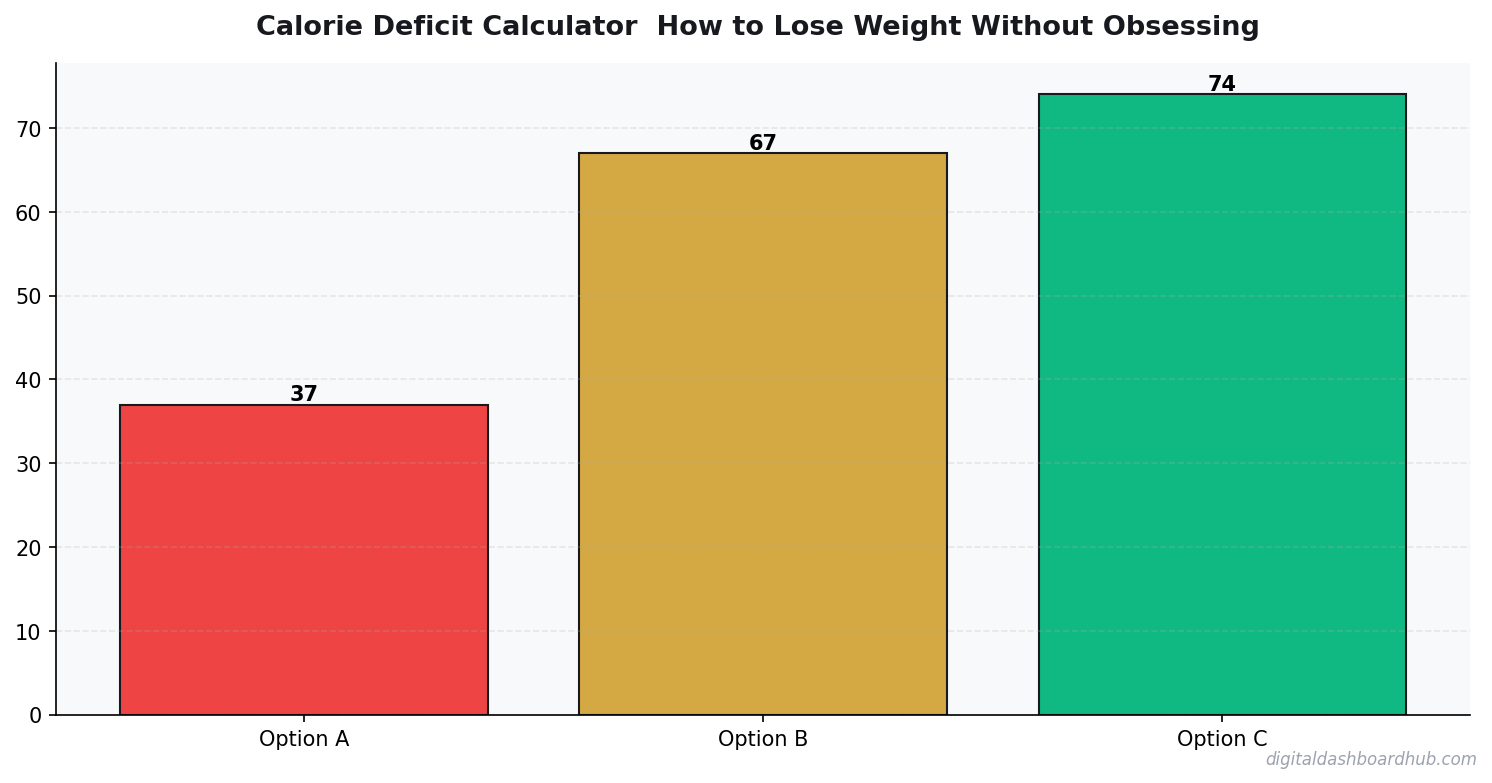
The research is fairly consistent here: a 500-600 calorie daily deficit, sustained over time with adequate protein (0.7-1g per lb of bodyweight) and strength training to preserve muscle, outperforms aggressive restriction in total fat loss over any 16-week period. Not because the math works out differently, but because it’s sustainable — and you actually stick to it.
Common Mistakes That Sabotage Calorie Deficit Success
Underestimating calorie intake. Self-reported calorie tracking is notoriously inaccurate — studies consistently show people underreport by 20-40%. If the scale isn’t moving despite “sticking to your calories,” the most likely explanation is that you’re eating more than you think you are. Food scales are annoying. They’re also the only thing that actually tells you what you’re eating.
Overestimating calories burned from exercise. Calorie estimates on cardio equipment are wildly inaccurate — often overstated by 30-50%. Eating back exercise calories as reported by a treadmill is a reliable way to erase your deficit. Use exercise for health and body composition, not as a calorie-earning mechanism.
Not accounting for non-exercise activity. NEAT (non-exercise activity thermogenesis) — fidgeting, walking, standing, general movement — can vary by 300-600 calories/day between people doing the same workouts. Someone who sits completely still in the 23 hours outside the gym burns dramatically fewer calories than someone who walks, stands, and moves throughout the day. You can’t fully measure NEAT, but you can increase it deliberately by adding steps.
How to Adjust When the Scale Stops Moving
The plateau is real and it has a name: metabolic adaptation. As you lose weight, your body adjusts in two ways. First, a lighter body simply burns fewer calories at rest — it costs less energy to maintain 150 lbs than 170 lbs. Second, metabolic rate can adaptively decrease beyond what weight loss alone explains, particularly with aggressive restriction. Your body is very good at trying to maintain itself.
When the scale stalls for 2-3 weeks, you have four options: reduce calories further, increase activity, take a diet break (returning to maintenance calories for 1-2 weeks to reset adaptive thermogenesis), or do nothing and accept a slower rate of loss. The diet break option is underused and backed by reasonable evidence — periods of maintenance eating appear to partially restore metabolic rate and improve subsequent fat loss compared to continuous restriction. It’s not giving up; it’s a deliberate tactical reset.
The one thing you should not do at a plateau: drastically cut calories again. If you’ve been eating 1,500 calories and the scale has stalled, dropping to 1,200 is a short-term solution with diminishing returns. You have less room to reduce further, the risk of muscle loss increases, and sustainability drops. Add 1,500-2,000 more daily steps before you change your food intake.
Protein: The Variable That Changes Everything
Protein intake during a calorie deficit is arguably more important than the size of the deficit itself. Protein does three things that directly support fat loss: it preserves muscle mass (so the weight you lose is fat, not muscle), it has the highest thermic effect of any macronutrient (you burn 20-30% of protein calories just digesting it), and it keeps you fuller longer than equivalent calories from carbs or fat.
The research-supported target: 0.7-1.0 grams of protein per pound of body weight while in a calorie deficit. For a 165 lb person, that’s 115-165g/protein per day. Most people eating a standard Western diet consume 60-80g/day and wonder why they’re hungry and losing muscle alongside fat.
Practical sources that make hitting protein targets manageable: Greek yogurt (17-20g/serving), cottage cheese (14g/half cup), chicken breast (31g/4 oz), eggs (6g each, usually eaten in multiples), protein powder (20-25g/scoop). Build your meals around protein, then fill in carbs and fats around the protein target. This single change — prioritizing protein within a calorie budget — has more impact on body composition outcome than almost any other dietary adjustment.
Exercise and Calorie Deficits: What Actually Works Together
Cardio burns calories in the moment. Strength training changes your body composition in a way that increases your resting calorie burn over time. Both are useful in a fat loss phase — but they serve different purposes, and treating them as interchangeable is a mistake.
Cardio during a deficit: 3-4 sessions/week of moderate-intensity work (30-45 minutes, zone 2 heart rate) is sufficient for the metabolic and health benefits without adding so much additional calorie demand that hunger becomes unmanageable. More cardio during a deficit often backfires because it increases appetite and fatigue, making adherence harder.
Strength training during a deficit: 2-3 sessions/week of resistance training is enough to meaningfully preserve muscle mass. You’re not in a phase for maximum muscle gain — you’re defending what you have. Compound movements (squats, hinges, pressing, pulling) with progressive overload are the priority. Muscle mass is metabolically active tissue. Preserving it during fat loss means your baseline calorie burn stays higher throughout the process and your body composition outcome — the actual ratio of fat to muscle — is dramatically better than with cardio-only approaches.
Keep reading (related guides):
- Sinking Fund Savings Goal Planner: The Free Visual Dashboard That Kills Surprise Expenses
- Workout Progress Tracker: The Method That Finally Kept Me Consistent
- I Tracked My Nervous System for 90 Days — Heres What I Learned About My Stress, Sleep, and Sanity
- ADHD Daily Routine Planner: How to Build Structure That Works With Your Brain (Not Against It)
- Bakery Revenue Calculator
255+ interactive tools for your money, time, and health.
Full dashboard access · Stripe-secure checkout · Cancel anytime
Keep Reading
- I Tested 9 Expense Tracker Apps for 3 Months — Here’s What Actually Worked
- How to Regulate Your Nervous System: 8 Steps to Move From Chronic Stress to Calm
- I Tracked My Nervous System for 90 Days — Here’s What I Learned About My Stress, Sleep, and Sanity

Andy Gaber is the founder of Digital Dashboard Hub, a suite of 255+ interactive financial, productivity, and wellness tools. He built DDH after getting frustrated with financial apps that gave outputs without context. Follow along for tool tutorials, revenue analytics breakdowns, and honest takes on personal finance.