I’ve started and quit workout programs more times than I can count. Not because I lacked motivation — I had plenty of that for the first three weeks. I quit because I couldn’t tell if anything was working. The scale didn’t move. I didn’t look different. And without visible progress, the whole effort started feeling pointless. What finally changed wasn’t my workout program. It was how I tracked it.
Once I could see that I was squatting 20 more pounds than eight weeks ago, that my resting heart rate had dropped 8 bpm, that I’d added 15 minutes to my weekly cardio without it feeling harder — the motivation problem disappeared. Progress drives motivation more than motivation drives progress. You just have to measure it.
What to Actually Track in a Workout Log
Most people’s workout tracking looks like: “did I go to the gym? yes/no.” That’s attendance tracking, not progress tracking. Attendance matters, but it tells you nothing about whether the training stimulus is producing adaptation.
The five metrics worth tracking for any resistance training program:
- Weight moved per set (load × reps). Record the actual working weight for your main lifts every session. Your squat, deadlift, bench, overhead press, and row — those five numbers plotted over 8 weeks tell you more than any body-composition scale.
- Total weekly volume. Sum sets × reps × load across lifts for a given muscle group. Progressive overload works on total volume over weeks, not PRs on any one day.
- Session RPE (1-10). A 7/10 squat session that felt like 8/10 three weeks ago at the same weight is genuine adaptation. Subjective but trackable.
- Resting heart rate. Take it the same time every morning. A steady 3-8 bpm drop over 8-12 weeks is a clean signal that cardiovascular base is improving.
- Weekly cardio minutes at target zone. Not total gym time — actual minutes in your training heart-rate zone. This is the number that shifts your VO2 max over time.
How Often to Review the Data
Daily logging, weekly review, monthly analysis. Logging a session takes 90 seconds — use a phone note template. Weekly review is where you catch trends: did squat load increase? Is resting heart rate stable or drifting up (a fatigue or poor-sleep signal)? Monthly is where you decide whether the program is working or needs adjustment.
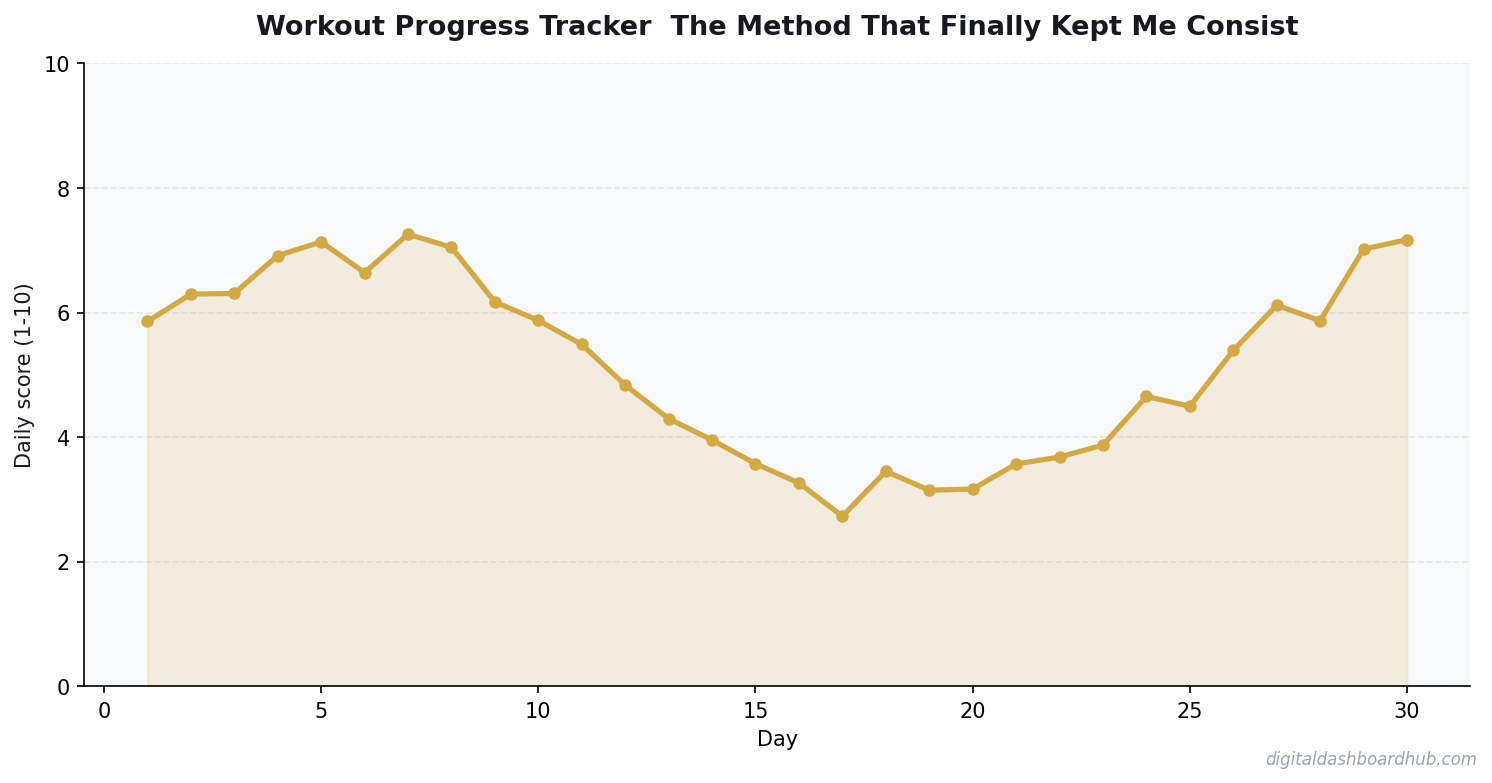
Most people review too often and react to noise. Two bad days in a row doesn’t mean the program is broken. Two bad weeks might. Pattern-recognition beats day-to-day reactions.
What Progress Looks Like at 30, 60, and 90 Days
At 30 days, expect small visible load increases (2-5% on main lifts), maybe 1-2 bpm lower resting heart rate, and a clearer sense of which sessions felt strong vs drained. At 60 days, main lifts should be up 5-10% with clean form. At 90 days, the scale may or may not have moved — but lean mass, strength, and cardiovascular fitness will have measurably improved. That is what a working program looks like on paper.
If your tracker shows no change after 60 days of consistent logging, something is wrong with the program — not your effort. Common culprits: too much volume and not enough recovery, wrong rep ranges for your goal, insufficient protein or calories for adaptation. The data gives you permission to change the variables instead of blaming yourself.
Use a Real Tracker, Not Memory
Memory is terrible at progress tracking. You will forget what you squatted last Wednesday by Friday. Write it down. A notes app, a spreadsheet, a dedicated tracker — whatever you’ll open every session. The format matters less than the habit. When you walk into the gym, you should know exactly what you did last time and what you need to do today to beat it by a rep or a pound.
Why Body-Weight Changes Alone Lie to You
The scale is the worst single metric for workout progress. Bodyweight swings 2-5 pounds a day on normal food and fluid variation. Water retention from a hard leg day can mask fat loss for 3-5 days. Adding 2 pounds of lean mass while losing 2 pounds of fat shows zero change on the scale — and you look and feel noticeably different. When people quit programs because “the scale isn’t moving,” they’re almost always trusting the wrong data point.
A real progress-tracking system demotes bodyweight to one of 6-8 metrics, not the headline number. Tape measurements (waist, hips, thigh, chest) every two weeks tell you more about body composition change than a daily weigh-in ever will. Progress photos every 4 weeks at the same time of day, same lighting, same poses, make visual change obvious that day-to-day mirror checks miss. And the strength log — squat, deadlift, bench, overhead press, row — tells you more about what the training is actually doing than any tape or scale measurement.
The Strongest Correlates of Long-Term Consistency
The people who stick with workout programs for years share a small set of habits that the data repeatedly shows matter more than program design: they log every session (even the bad ones), they review weekly for trend direction rather than daily for drama, they update their program every 6-8 weeks based on what the log shows (not on boredom), and they sleep more than 7 hours on average. That last one is underrated — sleep deprivation is the single biggest suppressor of strength and endurance adaptation. Your tracker should include sleep hours, because without them the rest of the data is harder to interpret.
The inverse is also true: the people who quit share a pattern too. They track only when they feel good about a session. They react to individual workout-to-workout noise instead of 4-week trends. They redesign the program every 3 weeks because it “isn’t working,” which prevents any program from actually working. And they don’t track sleep or recovery, so when fatigue accumulates, the data gives them no warning.
How to Actually Use the Data to Adjust Your Program
Every 8 weeks, pull the log and answer three questions. First: are my main lifts trending up, flat, or down? If up, the program is working — keep it. If flat for 3+ weeks, the progressive overload has stalled — increase volume modestly (add a set or a second session per muscle group) or introduce a deload week followed by a small load increase. If down, something is wrong with recovery — sleep, stress, or nutrition — more training volume is not the answer.
Second: is my resting heart rate stable, trending down, or trending up? Down is adaptation. Stable is fine. Trending up by 5+ bpm over 4 weeks is a fatigue signal — take a lower-intensity week and reassess. Third: are my sleep hours and perceived exertion scores matching the training load? If RPE is creeping up on the same workouts week over week at the same weights, the program is asking more of your nervous system than it’s recovering from. Back off before it becomes an injury.
Related Reading on Tracking and Habits
Workout tracking fits inside a larger family of nervous system regulation habits — sleep, recovery, and stress modulation all directly affect strength adaptations. If you want more on the pattern of “track the signals, not the symptoms,” the 90-day nervous system experiment walks through exactly that. And for general expense tracking habits that show up in the same kind of weekly review, the best expense tracker apps review has the methodology applied to money.
What to Do When Progress Stalls
Every program hits a plateau. The question is whether you have the data to know why. A stall with dropping resting heart rate (improving fitness) and steady RPE suggests you need more volume or a slight increase in training frequency. A stall with climbing resting heart rate and rising RPE suggests you need recovery, not more work. Same stall, opposite solutions — and the only way to tell which is which is to have been logging sleep, RPE, and resting heart rate alongside the lift numbers. Without that data you’re guessing. With it, the adjustment is usually obvious within a week of review.
The second-most-common stall cause is nutritional: not eating enough protein (0.7-1.0g per pound of bodyweight is a reasonable range for lifters), not eating enough total calories during a strength-focused block, or not timing carbs around workouts when training volume is high. If the log shows your lifts flatlining despite good sleep and reasonable RPE, the next variable to audit is the plate at dinner, not the rep range in the program.
Keep reading (related guides):
- Free Sinking Fund Calculator — Try It Now
- Free Menopause Symptom Tracker — Try It Now
- Nervous System Regulation Tracker: The Visual Dashboard That Helps You Understand Your Bodys Stress Signals
- I Owed $47,000 in Taxes and Had $11,000 in the Bank: How I Rebuilt My Freelance Finances From the Ground Up
- Sinking Fund Savings Goal Planner: The Free Visual Dashboard That Kills Surprise Expenses
255+ interactive tools for your money, time, and health.
14-day trial · Stripe checkout · Cancel anytime

Andy Gaber is the founder of Digital Dashboard Hub, a suite of 255+ interactive financial, productivity, and wellness tools. He built DDH after getting frustrated with financial apps that gave outputs without context. Follow along for tool tutorials, revenue analytics breakdowns, and honest takes on personal finance.