ADHD brains and impulse spending go together like coffee and regret. Whether it’s that “perfect” Amazon find at 2 AM or the third coffee subscription this month, impulse purchases can derail your financial goals before you even realize what happened.
This free interactive impulse spending tracker helps you see the real patterns behind your spending. Log your purchases, rate the impulse level, and watch your spending patterns emerge. Understanding your triggers is the first step to changing them.
Limited to 5 entries on the free version — unlock unlimited tracking and get detailed spending analytics in our full version.
ADHD impulse spending isn’t about willpower — it’s about dopamine. Your brain seeks immediate reward, and buying things delivers it instantly. This free tracker helps you see the pattern: when it happens, what triggers it, and how much it’s actually costing you.
Why Does ADHD Cause Impulse Spending — and What Can You Do About It?
It’s not a willpower problem. ADHD brains have structural differences in the prefrontal cortex — the part responsible for impulse control, future-thinking, and delaying gratification. When a dopamine-triggering purchase is right in front of you, the “wait, is this in my budget?” check that neurotypical brains run somewhat automatically is harder to access quickly. This isn’t a character flaw. It’s neurobiology.
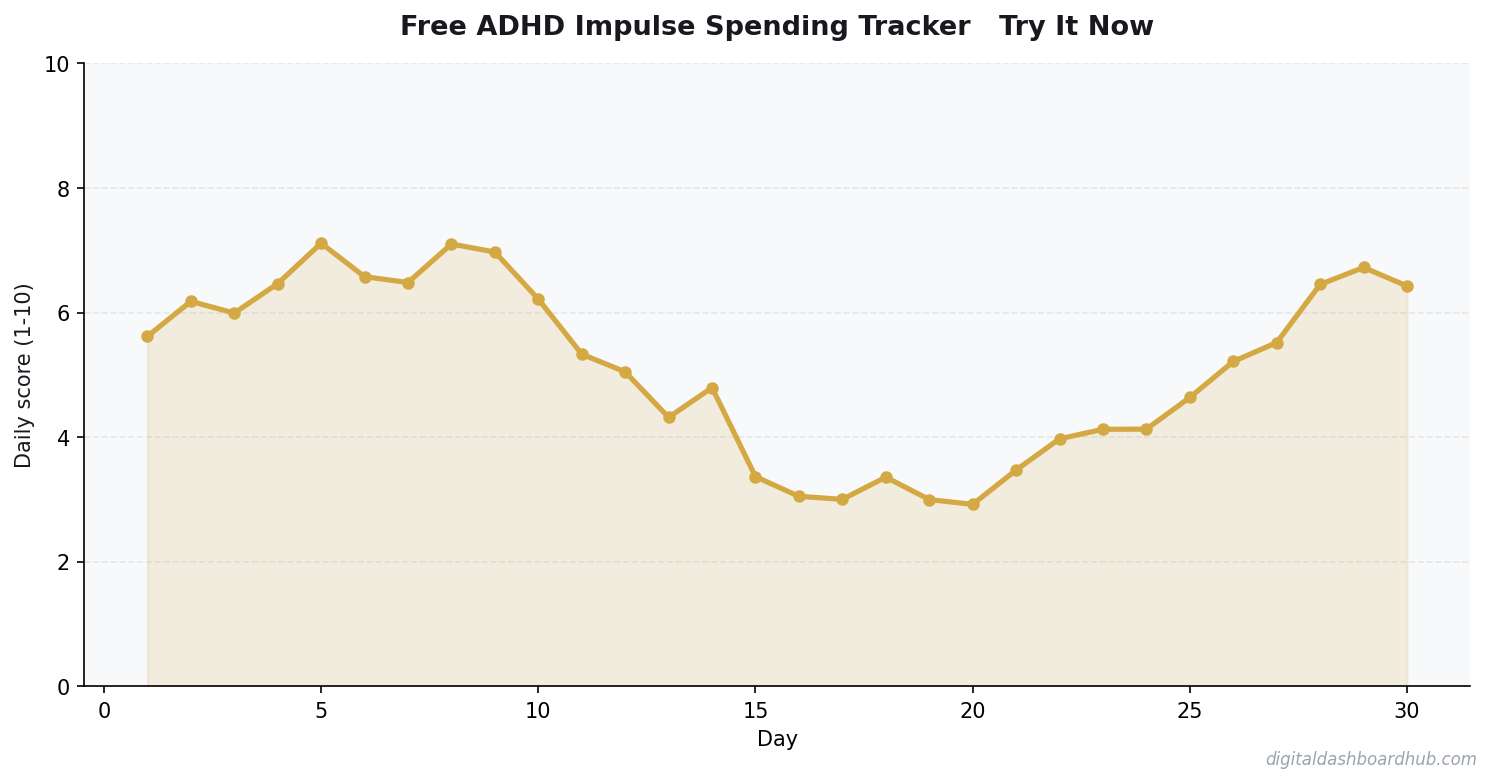
Line chart showing a 30-day tracking pattern with daily scores trending over time.
The practical consequence: ADHD adults overspend on impulse purchases at 2-3x the rate of their neurotypical peers, on average. Many report spending $200-$600/month on purchases they genuinely regret within a week. Over a year, that’s $2,400-$7,200 not going toward debt payoff, savings, or anything you actually planned for.
Tracking doesn’t eliminate the impulse. But it creates a pause — and that pause is the entire mechanism. When you have to log a purchase immediately, the act of categorizing it makes the spending visible and real. Over time, the pattern data tells you what triggers you. Amazon at 11pm on weekdays. Certain stores. Boredom vs. stress spending. You can’t change a pattern you can’t see.
How to Actually Use an Impulse Spending Tracker
Log every unplanned purchase within 24 hours — ideally the moment you buy. Include the category (clothing, tech, food/dining, hobby, household), the amount, and a one-word trigger if you can identify it (bored, stressed, excited, scrolling). Don’t judge it. Just log it.
Review weekly. Look for patterns, not individual purchases. The purchase of a $24 item isn’t the insight — the fact that you’ve made 11 unplanned food purchases this month totaling $290 is the insight. That points to a meal planning gap, not a snack problem.
Use a waiting period rule for anything over a threshold you set (commonly $25-$50 for ADHD budgets). Add to cart or a list, wait 48-72 hours, revisit. A significant percentage of impulse items you wanted urgently on a Tuesday are items you genuinely don’t want on Thursday. Let the data prove that to you personally.
What “Good” Looks Like After 30 Days
You won’t eliminate impulse spending in a month. That’s not the goal. The realistic 30-day outcome: you know your average monthly impulse total, you’ve identified your top 2-3 trigger categories, and you’ve had at least 3-5 moments where you thought about buying something and didn’t, because the tracker made the habit visible. That’s real progress. Build from there.
The 48-Hour Rule: How to Fight Impulse Spending With Friction
The most practical tactical intervention for ADHD impulse spending is the waiting period. The mechanism: for any non-grocery purchase over a set threshold (choose your own number — $25 and $50 are common starting points), you add it to a list or a cart but don’t buy it for 48 hours.
The 48-hour window works because ADHD dopamine spikes are genuinely short-lived. The excitement that made something feel essential at 9pm on a Tuesday is real — but it typically fades to “I guess I didn’t really need that” by Thursday morning. Research on impulsive purchasing shows that 60-70% of intended impulse buys are never completed when a mandatory waiting period is introduced. You’re not fighting the impulse — you’re just outlasting it.
The list is important. You’re not saying no, you’re saying “not yet.” Saying no creates resistance. The ADHD brain interprets “no” as a challenge. “I’ll add it to my list and check back Thursday” is psychologically very different from “I can’t buy that.” Most of the list doesn’t survive to Thursday. A few things do — and those are the purchases worth making.
Separating Emotional Categories From Budget Categories
Standard budget categories (clothing, dining, entertainment) tell you where the money went but not why. Adding an emotional layer to your impulse spending log — even just a one-word tag — reveals the behavioral pattern beneath the transaction data.
Common ADHD spending trigger categories:
Boredom spending: Usually late evening, online, browsing without intent. The purchases are often random — things you didn’t know you “wanted” until you saw them on a feed.
Stress relief spending: Often food-related, but also shopping as a coping mechanism. Happens after difficult work days, arguments, or anxiety spikes.
Novelty seeking: New hobby equipment, gear for interests you’ll have for 3 weeks, the latest version of a product you already own.
Social spending: Keeping up with plans, impulse restaurant choices, buying things to impress people who don’t notice.
Once you know your trigger categories, you can address the underlying behavior — not just the spending symptom. Boredom spending? Identify 3 free or low-cost activities you can default to when that itch hits. Stress spending? Exercise is genuinely the better dopamine hit and it doesn’t cost $80. Novelty spending? Create a “try before you buy” rule — borrow or rent before purchasing hobby gear.
ADHD-Specific Budget Structures That Work Better
The envelope system (physical cash for different categories) is old-school and genuinely effective for ADHD. There’s something about physical cash — seeing it, handling it, watching it run out — that creates spending friction that a debit card swipe simply doesn’t. If you’re struggling with abstract digital budgeting, try a hybrid: take out $200 cash for discretionary spending each week and stop when it’s gone.
Cashflow timing matters a lot. ADHD brains are notoriously poor at “saving” money that’s visibly sitting in a checking account. Automate savings and sinking fund contributions to transfer the same day as each paycheck. What you don’t see, you don’t spend. This isn’t a workaround — it’s the primary mechanism. You’re designing your financial system to succeed without relying on in-the-moment willpower.
The goal isn’t a perfect month. The goal is a better month than last month. Tracking, waiting periods, and automation each reduce impulse spending by 10-20% independently. Stack all three and the cumulative effect is significant — often $200-$400/month in recaptured spending that can go toward meaningful goals instead.
The Waiting-Period Rule, In Practice
A waiting period is the single highest-leverage intervention for ADHD impulse spending. The mechanics: any non-grocery purchase over your chosen threshold (commonly $25, $50, or $100) goes on a list, not into your cart. You revisit the list 48-72 hours later and decide then. The dopamine hit that convinced you the item was essential at 9pm Tuesday has typically faded to “I guess I didn’t really need that” by Thursday morning.
Research on impulsive purchasing consistently shows 60-70% of intended impulse buys are never completed when a mandatory waiting period is introduced. You’re not fighting the impulse — you’re outlasting it. The list matters: saying “not yet” is psychologically different from saying “no.” The ADHD brain hears “no” as a challenge. “I’ll revisit this Thursday” is neutral — and most items don’t survive to Thursday.
Pairing the Tracker With Envelope Budgeting
Once you know your average monthly impulse spend, the next move is putting a hard cap on it. Envelope budgeting works surprisingly well for ADHD brains because it makes spending tangible. Set a weekly cash allowance for discretionary spending — $100 to $300 depending on your budget — and stop when the envelope is empty. You can’t impulse-buy what you can’t see money for.
Cashflow timing matters too. ADHD brains are notoriously poor at “saving” money sitting visibly in a checking account. Automate savings and sinking-fund contributions to transfer the same day your paycheck lands. What you don’t see, you don’t spend. This is not a workaround — it’s the primary mechanism. Design the system so it succeeds without asking your prefrontal cortex to do real-time willpower work.
Andy Gaber is the founder of Digital Dashboard Hub, a suite of 255+ interactive financial, productivity, and wellness tools. He built DDH after getting frustrated with financial apps that gave outputs without context. Follow along for tool tutorials, revenue analytics breakdowns, and honest takes on personal finance.