PCOS affects your entire body, not just your reproductive system. From energy crashes to mood swings to bloating that makes your favorite jeans unwearable, the symptoms are real and interconnected.
But here’s what most PCOS tracking tools miss: they don’t help you connect the dots between your symptoms. This free interactive dashboard lets you log energy, bloating, mood, and more to reveal the patterns your healthcare providers need to see.
You’ve been logging symptoms for a few weeks and you’re looking at a pattern. High symptom days clustering around your expected cycle dates. Energy crashes that seem to hit regardless of sleep. Acne flares that don’t correlate with anything obvious. This data is valuable — but it requires interpretation, not panic.
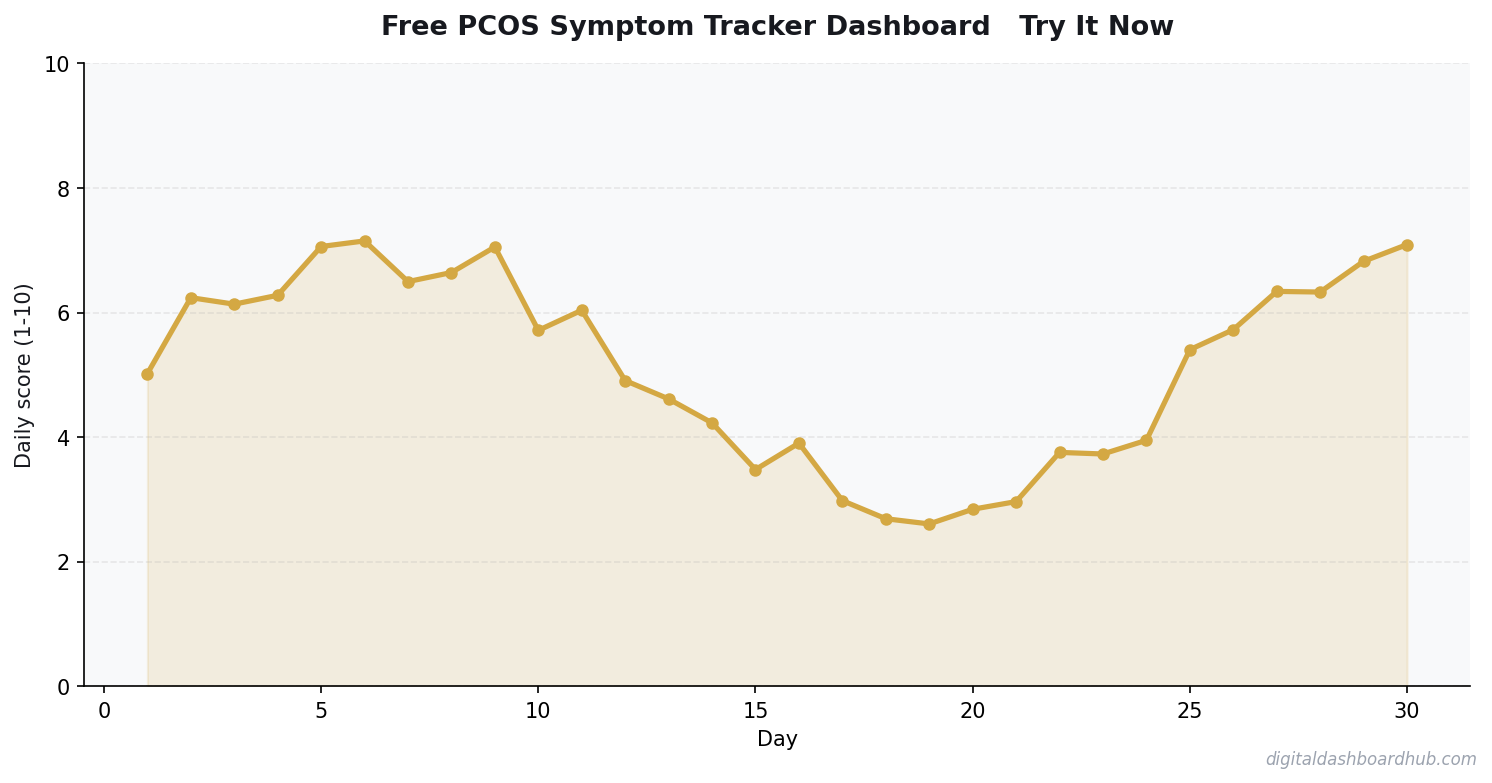
Line chart showing a 30-day tracking pattern with daily scores trending over time.
PCOS symptoms are highly individual. Two people with the same diagnosis can have almost entirely different symptom profiles. One person’s primary complaint is irregular cycles; another’s is metabolic — weight changes, insulin resistance, blood sugar swings. Tracking helps you understand your personal presentation, which is the foundation for having a productive conversation with your gynecologist or endocrinologist.
When your logged symptoms consistently score 7-8 out of 10 severity over multiple weeks, that’s the signal to escalate. Not because any single day is an emergency, but because chronic high-severity symptom loading indicates your current management plan isn’t working — and you now have documentation to make that case clearly to your provider.
How to Read Your Symptom Patterns
PCOS management is heavily tied to cycle phase for those with any cyclical activity — even irregular cycles follow patterns worth tracking. Luteal phase (the roughly 2-week window before your period) is typically when symptom burden is highest for most PCOS presentations. If your data shows a consistent symptom spike in a predictable window, you can use that to plan proactively: adjusting diet timing, exercise intensity, stress load, and supplement protocols during the highest-burden days.
Consistent acne flares: Often androgenic — worth discussing with your provider whether anti-androgen therapy or specific dietary shifts (lower glycemic load) could help.
Energy crashes in the afternoon: Common in PCOS with insulin resistance. Blood sugar management — specifically, lower-carb meals before the crash window — often helps more than caffeine.
Sleep disruption logged consistently: Elevated androgens affect sleep architecture in some PCOS presentations. If you’re tracking poor sleep alongside other symptoms, bring that specific pattern to your provider.
Mood/anxiety spikes: PCOS is associated with higher rates of anxiety and depression, partly hormonal and partly the ongoing stress of managing a chronic condition. Track it, name it, and discuss it — it’s a legitimate part of your care.
The Most Important Thing the Tracker Can Do
PCOS management is a long game. The tracker’s highest value isn’t the first month — it’s the first year. When you can show your provider 6 months of symptom data around a medication change, a dietary intervention, or a new exercise protocol, you’re having a data-driven conversation instead of a feelings-based one. That changes the quality of your care.
Building a PCOS Symptom Tracking Habit That Works
The single biggest challenge with chronic condition tracking is consistency. Five days of good data followed by a 2-week gap is nearly useless for pattern recognition. The data you need spans cycles — plural — and requires daily (or near-daily) entries to be interpretable.
Anchoring the tracking habit to something you already do every day is the practical solution. Morning routine works well for PCOS tracking: same time, same context, 90 seconds. Log last night’s sleep quality, current energy level, skin status, and any notable symptoms. The first entry of the day is observational — how do I feel right now and how did I sleep? Add a second evening entry if you have afternoon symptoms worth capturing.
The goal is completeness, not precision. A “3/10 fatigue, slight bloating, slept 7 hours” entry logged every day beats a detailed 10-field entry logged sporadically. Let the tracker work with the data you actually give it.
Connecting Your PCOS Data to Lifestyle Variables
PCOS symptoms are significantly modifiable by lifestyle — more so than many chronic conditions. The research on dietary pattern (specifically lower glycemic index), exercise type (resistance training plus moderate cardio), sleep quality, and stress management all show meaningful symptom impact. Tracking lets you see your personal response to these interventions rather than relying entirely on population-level averages.
Start by tracking one lifestyle variable alongside your symptoms for 4-6 weeks. Sleep is the easiest starting point — log hours slept and a sleep quality score, then look for the correlation with next-day energy and symptom burden. Most PCOS patients see a clear relationship: below 7 hours consistently correlates with worse fatigue, worse mood, and often worse metabolic symptoms. That’s your personal data confirming what the research says, which is more motivating than the research alone.
Dietary pattern is worth tracking but harder to operationalize. Rather than full food logging (exhausting, not sustainable), try a simple carb-load score: did today’s meals skew high-GI (white bread, pasta, sugar, juice), moderate-GI (mixed), or low-GI (whole grains, vegetables, proteins, fats)? Correlate that with next-day energy and inflammation-adjacent symptoms over 6 weeks. Most people with insulin-resistant PCOS see a pattern that makes the dietary change feel like their own discovery, not an external prescription.
When to Escalate Based on Your Tracking Data
PCOS is managed, not cured — and management requires periodic reassessment. Your tracker data is the most valuable input you have for those reassessment conversations.
Signals that suggest your current management approach needs revisiting:
Cycle irregularity worsening over 3+ months without an obvious lifestyle explanation (significant stress, weight change, travel disruption)
Metabolic symptoms (unexplained weight gain, increased fatigue, blood sugar-adjacent energy crashes) increasing in frequency or severity
Skin or hair changes (acne worsening, hair thinning accelerating) that correlate with other symptom spikes
Mental health metrics (mood, anxiety) trending downward over 4+ weeks
Bring 3-6 months of tracking data to that appointment, not just a verbal summary. The pattern is in the data. A provider who can see your symptom trends over time gives you better care than one who’s working from a 10-minute memory reconstruction.
What a Doctor-Ready PCOS Log Looks Like
Endocrinologists and gynecologists consistently say the same thing: a patient who walks in with 30-60 days of tracked data gets faster, more targeted treatment than one who walks in with a 10-minute memory reconstruction. The log they want to see isn’t exhaustive — it’s structured. Date, daily energy score (1-10), daily mood score (1-10), bloating severity, cycle day, any pain (with location and severity), sleep quality, and a single-line note for anything unusual. Eight data points a day, under sixty seconds to log.
Done for even six weeks, that log reveals patterns that patients and doctors both miss in the room: energy crashes clustered on specific cycle days, mood dips that track with ovulation, bloating that spikes after specific foods. Those patterns are what your doctor needs to decide whether the next step is hormone testing, a metformin trial, inositol, a change in diet, or something else. “I feel bad most of the time” gives you a shrug. Six weeks of log data gives you a plan.
Why Symptom Clusters Matter More Than Individual Symptoms
PCOS is a syndrome, not a disease — meaning it’s diagnosed by a pattern of symptoms rather than a single test. Bloating alone is a GI issue. Bloating plus acne plus hair thinning plus irregular periods is a hormonal pattern that points at PCOS. The individual symptoms look like unrelated complaints; clustered, they tell a specific story.
That’s why tracking across categories matters. Logging only “energy” or only “bloating” misses the cluster. Tracking 6-8 symptoms together over weeks gives you a view of the PCOS phenotype you have (insulin-resistant, adrenal, inflammatory, or post-pill) — and each phenotype responds to different interventions. You can’t self-diagnose a phenotype from a single tracked symptom. You can make an educated guess after 6-8 weeks of clustered logs and bring that guess to a doctor for confirmation.
Andy Gaber is the founder of Digital Dashboard Hub, a suite of 255+ interactive financial, productivity, and wellness tools. He built DDH after getting frustrated with financial apps that gave outputs without context. Follow along for tool tutorials, revenue analytics breakdowns, and honest takes on personal finance.