
The Trades Are Paying More Than Ever — But Which One Pays You the Most?
The dashboard below loads instantly in your browser. Plug in your numbers, see your answer. No signup to try the basics.
Running a SaaS business means I track these numbers obsessively. Here’s what the data actually shows:
The median electrician in the U.S. earned $65,280 in 2025. The median plumber earned $63,490. HVAC technicians? $57,320. Those numbers are up 12-18% from 2020, and they’re climbing faster than most white-collar salaries.
But median salary is a terrible way to choose a career. It doesn’t tell you how long it takes to get there, what the ceiling looks like, how much overtime is available, or what the path to $100K+ actually requires. Those details matter more than the average, and they’re wildly different between these three trades.
This is a step-by-step guide to choosing the right trade based on earning potential, apprenticeship requirements, certification paths, and the actual work involved — not just the salary headline.
Step 1: Understand What Each Trade Actually Pays (Entry to Master)
Forget the median. Here’s the salary progression from day one through master-level certification, based on 2026 Bureau of Labor Statistics data and trade union rate sheets:
Electricians have the highest ceiling at every stage. But HVAC has the fastest entry — you can be a licensed technician in 2 years in most states, while electrical and plumbing apprenticeships typically require 4-5 years. If speed to earning matters, HVAC gets you to a livable wage faster.
Step 2: Factor in the Apprenticeship Path
All three trades require an apprenticeship, but the structure differs significantly. Understanding these differences before you commit saves years of frustration.
Electrical apprenticeship: Typically 4-5 years, 8,000-10,000 hours of on-the-job training plus 576+ classroom hours. Union apprenticeships (IBEW) are competitive but pay from day one, often starting at $20-$22/hour with full benefits. Non-union programs vary in quality. You’ll study the National Electrical Code extensively — it’s essentially your bible for the rest of your career. The journeyman exam is considered the hardest of the three trades.
Plumbing apprenticeship: 4-5 years, 8,000-10,000 hours on-the-job plus 246+ classroom hours (varies by state). Union programs through the UA (United Association) are excellent and include benefits from day one. The work is more physically demanding than electrical — you’ll be crawling under houses, digging trenches, and working in tight spaces. The journeyman exam is difficult but more practical than theoretical compared to electrical.
HVAC training: Here’s where HVAC differs. Many techs enter through a 6-month to 2-year technical school program, then complete on-the-job training. You can hold an EPA Section 608 certification (required to handle refrigerants) within months. Some states don’t require a state license for HVAC work at all, though most require registration or certification. The path to working independently is shorter, but the ceiling without advanced certifications is lower.
Step 3: Evaluate the Work Itself (Not Just the Pay)
This is the step most career guides skip, and it’s the reason people wash out of trades. The daily work is drastically different, and your physical tolerance, personality, and interests should drive this decision as much as salary.
Electricians do precision work. You’re reading blueprints, calculating loads, running wire through walls and conduit, and troubleshooting systems that can kill you if you make a mistake. The work is less physically brutal than plumbing but requires more sustained mental focus. If you’re detail-oriented and comfortable with math, electrical tends to be a good fit.
Plumbers do physical work. You’re cutting and joining pipe, working with drainage systems, dealing with — let’s be honest — sewage and water damage. The work is hard on your body, especially your knees and back. But plumbers also have the most recession-proof demand: pipes break in every economy. If you don’t mind getting dirty and prefer tangible problem-solving, plumbing fits.
HVAC techs work in extremes. You’re on rooftops in July and in crawlspaces in January. The seasonal demand swings are significant — summer and winter are slammed, spring and fall slow down. If you like variety (you’ll work on different systems every day), can handle temperature extremes, and want a shorter training runway, HVAC is worth considering.
Step 4: Look at the Demand Forecast
The Bureau of Labor Statistics projects job growth through 2032 for all three trades. The numbers favor electricians, but all three are growing faster than average:
Electricians: 11% growth (much faster than average), driven by EV charging infrastructure, solar installation, and data center construction. The electrification of everything is the single biggest tailwind any trade has right now.
Plumbers: 6% growth (faster than average), driven by aging housing stock, new construction, and water infrastructure replacement. There’s a massive wave of pipe replacement coming in cities with pre-1980 water systems.
HVAC: 6% growth (faster than average), driven by heat pump adoption, commercial building upgrades, and climate-driven demand for cooling systems. The Inflation Reduction Act’s heat pump incentives have created a mini-boom in HVAC installations.
How the DDH Career Salary Calculator Handles This
Choosing a trade involves dozens of variables: starting pay, progression speed, overtime rates, benefits value, cost of training, geographic pay differences, and whether you plan to go into business for yourself. Comparing three trades across all these variables is exactly the kind of multi-factor decision that kills you with spreadsheet fatigue.
The DDH Career Salary Calculator lets you input your state, your current age, and the trade you’re considering, then models your lifetime earnings from apprentice through master or business owner. It includes regional pay adjustments, union vs. non-union rates, and overtime projections based on industry averages.
The output I find most useful is the 10-year cumulative earnings comparison. Because HVAC has a shorter training path, the cumulative earnings over the first 5 years can actually exceed electrical — even though the hourly rate is lower — because you’re earning journeyman wages two years sooner. By year 10, electrical catches up and eventually surpasses both. Seeing that crossover point helps you decide whether the faster start matters more than the higher ceiling.
Step 5: Consider the Path to Business Ownership
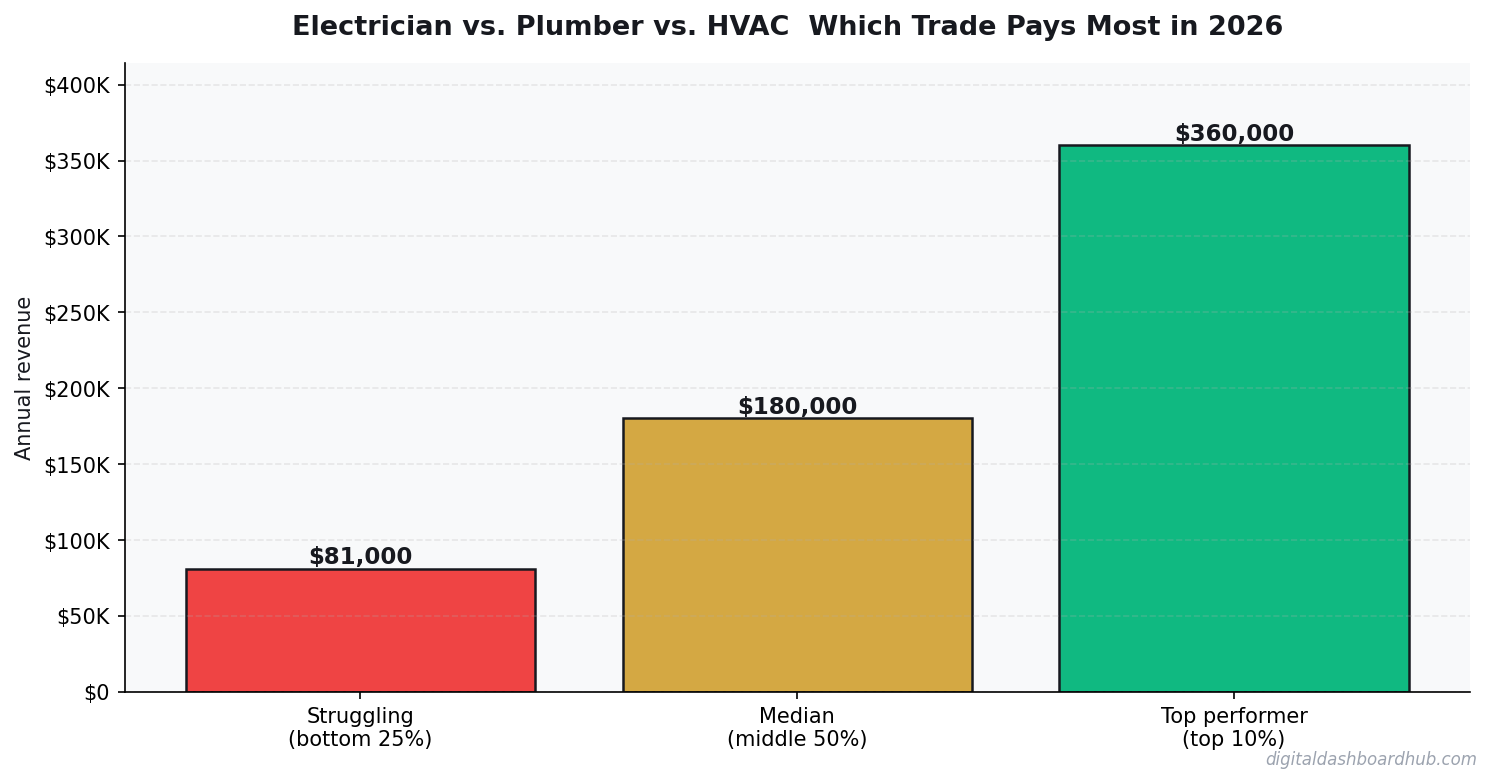
The real money in trades is in owning the business, not working the tools. A master electrician doing residential work might earn $90,000-$120,000 a year. An electrical contractor with a crew of four can gross $600,000-$1,000,000 with owner compensation of $150,000-$250,000.
The barrier to starting a trade business varies. Electrical contractors typically need a master license (8+ years), a contractor’s license, bonding, and insurance. Plumbing is similar. HVAC has lower barriers in many states — some allow you to start a company with just an EPA certification and a business license.
Here’s the business ownership comparison:
HVAC businesses have the strongest recurring revenue model because maintenance contracts (biannual system tune-ups) create predictable income. Plumbing has some recurring potential through drain maintenance contracts. Electrical work is mostly project-based, which means feast-or-famine revenue cycles.
Step 6: Factor in Geographic Pay Differences
Where you work matters almost as much as which trade you choose. An electrician in San Francisco earns roughly double what an electrician in rural Mississippi earns — but the cost of living difference absorbs most of that gap.
The best-paying metros for trades work (adjusted for cost of living) tend to be mid-sized cities with strong construction markets: places like Austin, Nashville, Raleigh, and Denver where demand is high but living costs haven’t fully caught up to wages yet. The worst-adjusted pay is typically in the highest-cost metros (NYC, SF, LA) where wages are high on paper but housing costs eat the premium.
Union vs. non-union matters enormously here too. IBEW (electrical) and UA (plumbing) union rates in major metros can be 30-50% higher than non-union rates in the same city, plus benefits worth another $15-$25/hour. In cities like Chicago, Boston, and New York, union electricians earn $55-$70/hour on the check with another $30+ in benefits.
Mid-Article Bonus: The Overtime Factor Nobody Mentions
Base hourly rates are only part of the story. In all three trades, overtime is common and significantly boosts annual earnings. Time-and-a-half on a $40/hour base rate is $60/hour. Ten hours of weekly overtime is an extra $31,200 per year.
HVAC has the most overtime opportunity in summer and winter, when systems fail and customers pay premium rates for emergency service. Electrical overtime peaks during construction booms. Plumbing overtime is the most consistent — pipes don’t wait for convenient hours to burst.
If you’re the kind of person willing to work 50-55 hour weeks, plumbing and HVAC offer the most consistent OT opportunities. If you want a more predictable 40-hour week, electrical residential work tends to be more 9-to-5.
Making the Decision: Which Trade Is Right for You?
Choose electrical if: you’re patient enough for a 4-5 year apprenticeship, you want the highest earning ceiling, you’re good with math and details, and you’re excited about the EV/solar/electrification boom.
Choose plumbing if: you want recession-proof demand, you don’t mind physical work, you like solving tangible problems, and you value the combination of high pay with the most stable demand cycle.
Choose HVAC if: you want the fastest path to earning, you’re interested in starting a business sooner, you like variety in your daily work, and you’re comfortable with seasonal demand fluctuations.
There’s no wrong answer. All three trades pay more than the median U.S. income, offer paths to six figures, and face labor shortages that will keep wages rising for the foreseeable future. The right answer is the one that matches your timeline, temperament, and goals.
Do This First
Step 1: Contact your local IBEW (electrical), UA (plumbing), or SMWIA/UA (HVAC) union hall and ask about apprenticeship openings. Union programs are free and pay you from day one.
Step 2: Shadow a professional for a day in your top choice. One day of watching the actual work will tell you more than 100 hours of research.
Step 3: Run your 10-year earnings projection on the DDH Career Salary Calculator to compare all three trades with your specific location, timeline, and business ownership goals.
- Side Hustle Income & Tax Tracker (Free Tool)
- Freelancer Finance Dashboard
- The Side Hustle Tax Trap: Track Every Dollar
Keep reading (related guides):
255+ interactive tools for your money, time, and health.
Full dashboard access · Stripe-secure checkout · Cancel anytime

Andy Gaber is the founder of Digital Dashboard Hub, a suite of 255+ interactive financial, productivity, and wellness tools. He built DDH after getting frustrated with financial apps that gave outputs without context. Follow along for tool tutorials, revenue analytics breakdowns, and honest takes on personal finance.