The FIRE Number Everyone Quotes Is Wrong
Enter your own numbers in the interactive tool below and get a real-time read. The dashboard version adds saved scenarios, history, and full feature access.
About this article: I’m Andy, founder of Digital Dashboard Hub. I built DDH’s 255 free interactive tools to solve the specific financial, productivity, and wellness tracking gaps I kept seeing — starting with the problem this article covers. The free tool below is available without signup and works instantly. Try it and see your numbers in real time.
The Takeaway
In This Article
- The FIRE Number Everyone Quotes Is Wrong
- Step 1: Map Your Real Annual Spending (Not Your Guessed Spending)
- Step 2: Choose a Safe Withdrawal Rate That Matches Your Timeline
- Step 3: The Healthcare Bridge Problem
- How the DDH Financial Independence Calculator Handles This
- Step 4: Sequence of Returns Risk — The Silent Portfolio Killer
- Step 5: Build Your Confidence Range, Not a Single Number
- Step 6: The Tax Layer Nobody Talks About
- The Inflation Adjustment Most People Forget
- Bonus: The “One More Year” Trap
- Three Steps to Get Started
- Keep Reading
My recommendation: use 3.25-3.5% if you’re targeting FIRE before 50. It gives you a cushion without requiring an absurdly large portfolio.
Go ahead, Google “how to calculate your FIRE number.” You’ll get the same answer everywhere: multiply your annual expenses by 25. Done. You’re financially independent.
Reality Check
Most online calculators oversimplify. This one includes variables that actually affect your outcome.
Except you’re not. That rule assumes a 4% safe withdrawal rate, which assumes a 30-year retirement, which assumes you’re retiring at 65 like everyone else. If you’re chasing FIRE at 35, you’re looking at a 50-60 year retirement. The 4% rule wasn’t built for that.
I spent three months rebuilding my FIRE calculation from scratch after realizing the shortcut version had me underfunded by about $400,000. Here’s the actual process — every step, every variable, every trap.
Step 1: Map Your Real Annual Spending (Not Your Guessed Spending)
Most people skip this step or half-ass it. They pull a number from memory — “I spend about $50K a year” — and multiply by 25 to get $1.25 million. That number is fiction.
You need 12 months of actual spending data. Not a budget. Not what you think you spend. What you actually spent. Pull your bank statements, credit card statements, and cash withdrawals for the last full calendar year.
Break it into categories that matter for FIRE planning:
Notice what happened there. The “I spend $50K” guess turned into $63,300 in post-FIRE spending once healthcare, taxes, and lifestyle inflation were accounted for. That’s a 26% difference — which translates to roughly $325,000 more needed in your portfolio.
Step 2: Choose a Safe Withdrawal Rate That Matches Your Timeline
The 4% rule comes from the Trinity Study, which tested portfolio survival over 30-year periods. If you’re retiring at 40, you need your portfolio to survive 50+ years. That changes the math significantly.
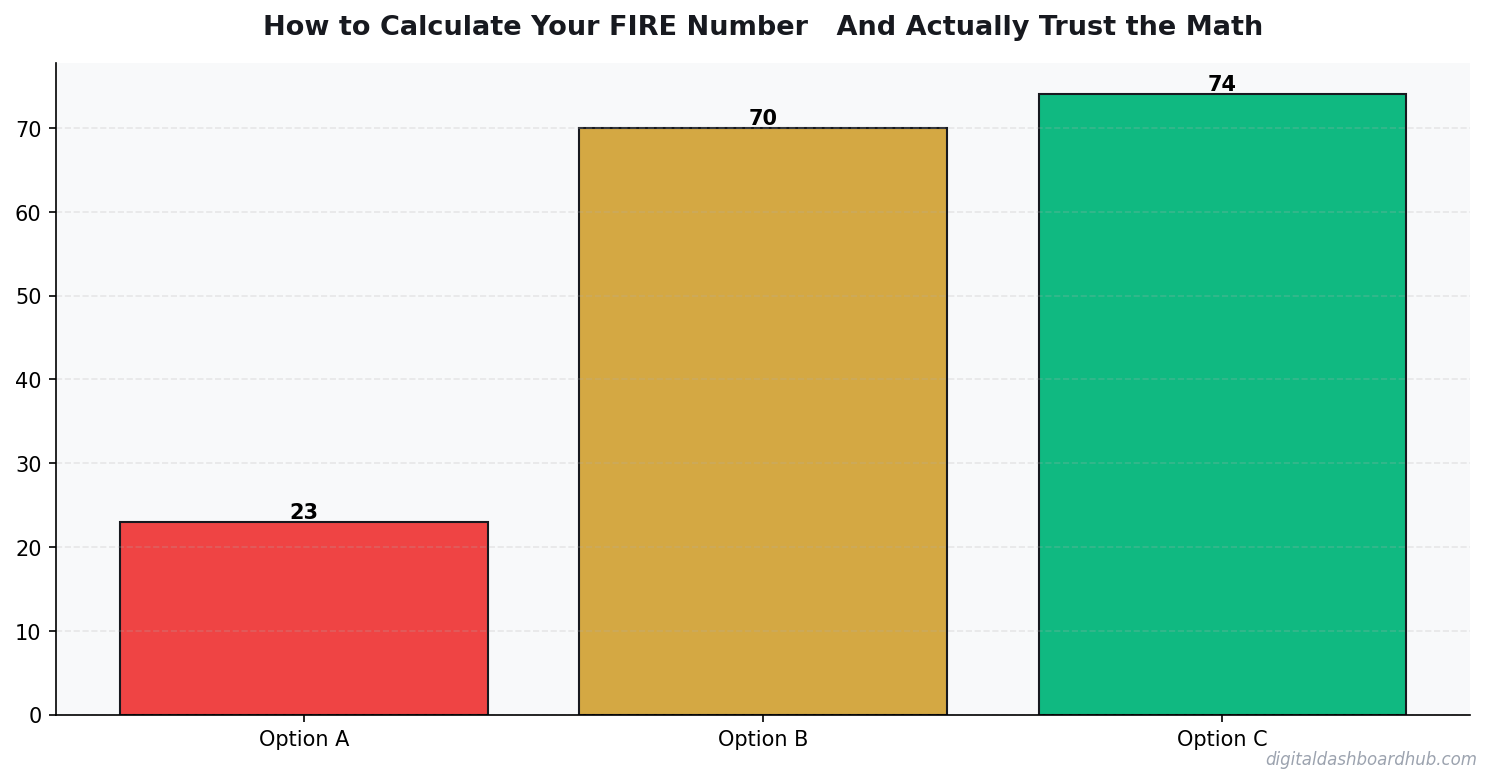
My results showed the research actually shows when you extend the timeline:
The difference between retiring at 65 and retiring at 35 is over $500,000 in additional portfolio needed — just from the withdrawal rate adjustment. This is why the “multiply by 25” shortcut is dangerous for early retirees.
My recommendation: use 3.25-3.5% if you’re targeting FIRE before 50. It gives you a cushion without requiring an absurdly large portfolio.
Step 3: The Healthcare Bridge Problem
This is the variable that blows up more FIRE plans than market crashes. If you’re retiring before 65, you don’t have Medicare. You’re buying insurance on the open market or through the ACA.
Current ACA benchmark plan costs for a family of four in a mid-cost state run $1,200-$1,800/month before subsidies. ACA subsidies depend on your modified adjusted gross income, which means your withdrawal strategy directly affects your healthcare costs. Withdraw too much from pre-tax accounts and your subsidies disappear.
The smart play: structure your withdrawals to keep MAGI in the subsidy sweet spot (roughly $40,000-$80,000 for a family). This usually means heavy Roth conversions in the years before FIRE, and drawing from Roth accounts plus taxable account basis during early retirement.
Budget $12,000-$18,000/year for healthcare in your FIRE calculation if you’re retiring before 65. Adjust upward by 5-7% annually — healthcare inflation consistently outpaces general inflation.
How the DDH Financial Independence Calculator Handles This
I built the DDH FIRE Calculator specifically because every free calculator online uses the 25x shortcut and ignores healthcare, taxes, and spending changes.
The DDH version lets you set separate pre-FIRE and post-FIRE spending, choose your withdrawal rate based on timeline, model healthcare costs with their own inflation rate, and run Monte Carlo simulations against historical market data. You get a probability of success, not just a single number.
It also shows you the “flexibility threshold” — the spending level where your success rate drops below 90%. That number matters more than your target number because it tells you how much room you have if things go sideways.
Step 4: Sequence of Returns Risk — The Silent Portfolio Killer
Here’s something most FIRE calculators ignore entirely. Two retirees with identical portfolios, identical spending, and identical average returns can have wildly different outcomes based purely on the order their returns arrive.
If you retire and the market drops 30% in year one, your withdrawals eat into a smaller portfolio, and you never recover — even if the next 20 years are great. This is sequence of returns risk, and it’s the biggest threat to early retirees.
The standard mitigation strategies:
Cash buffer: Hold 2-3 years of expenses in cash or short-term bonds. During a downturn, draw from this buffer instead of selling equities at a loss. This alone improves portfolio survival rates by 10-15%.
Flexible spending: Build a spending plan with a floor (non-negotiable expenses) and a ceiling (full desired spending). In down years, cut to the floor. Studies show that even modest flexibility — cutting spending by 10-15% during downturns — dramatically improves outcomes.
Bond tent: Increase your bond allocation to 40-50% in the 5 years before and after retirement, then gradually shift back to equities. This reduces the impact of a crash during the most vulnerable years.
Step 5: Build Your Confidence Range, Not a Single Number
Stop thinking of your FIRE number as one number. It’s a range.
Lean FIRE: The absolute minimum portfolio that covers your floor spending with a conservative withdrawal rate. For our example: $45,000 × 33.3 = $1,498,500.
Standard FIRE: Your full desired spending with your chosen withdrawal rate. $63,300 × 30.8 = $1,949,640.
Fat FIRE: Desired spending plus a 25% cushion for lifestyle upgrades, unexpected costs, or helping family. $79,125 × 30.8 = $2,437,050.
When I calculated my range, the gap between Lean and Fat FIRE was nearly $1 million. That sounds discouraging, but it’s actually freeing. Because it means I could pull the trigger on Lean FIRE years before Fat FIRE — and spend those years doing work I actually enjoy, earning just enough to cover the gap between lean and standard spending.
Step 6: The Tax Layer Nobody Talks About
Your FIRE number needs to account for taxes on withdrawals. This depends entirely on your account mix:
Traditional 401(k)/IRA: Every dollar withdrawn is taxed as ordinary income. If you need $63,300 in after-tax spending and your effective tax rate is 15%, you need to withdraw $74,470.
Roth IRA/401(k): Withdrawals are tax-free. $63,300 needed = $63,300 withdrawn.
Taxable brokerage: Only gains are taxed, and at long-term capital gains rates (0-20%). If your basis is 60% of your portfolio value, you’re only taxed on 40% of each withdrawal.
The ideal FIRE portfolio has money in all three buckets, giving you flexibility to manage your tax bill year by year. If your money is mostly in traditional accounts, add 12-22% to your withdrawal needs to cover the tax hit.
The Inflation Adjustment Most People Forget
Your FIRE number is in today’s dollars. If you’re 10 years from FIRE, you need to inflate it. At 3% average inflation, $1.95 million today becomes $2.62 million in 10 years.
But here’s the thing — your investments are also growing during those 10 years. So don’t just inflate your target; model the whole picture. What matters is the gap between your projected portfolio value at your FIRE date and your inflation-adjusted FIRE number.
This is where a real calculator beats napkin math. The DDH FIRE Calculator models inflation, portfolio growth, and contribution rates simultaneously so you can see your projected FIRE date — not just your FIRE number.
Bonus: The “One More Year” Trap
Once you calculate your real FIRE number and realize it’s higher than you expected, the temptation is to keep working “one more year” indefinitely. I’ve seen people with $3 million portfolios who can’t pull the trigger because what if.
The antidote is the flexibility framework. If you have Lean FIRE covered and some part-time income potential, you’re probably fine. The math doesn’t need to be perfect because you’re not dead — you can adjust. Cut spending. Earn some money. Move somewhere cheaper. The plan is a living document, not a carved stone.
Run your numbers through a Monte Carlo simulation. If you’re above 85% success rate with flexible spending, you’re in the zone. Waiting for 100% certainty means working until you die.
Three Steps to Get Started
Step 1: Pull 12 months of actual spending data and categorize it into pre-FIRE and post-FIRE columns. Be honest — especially about healthcare.
Step 2: Pick a withdrawal rate that matches your retirement timeline using the table above. Multiply your post-FIRE spending by the corresponding multiplier.
Step 3: Run your numbers through the DDH FIRE Calculator to get a Monte Carlo success rate and see exactly when you’ll hit your number at your current savings rate.
$0
To Get Started
Full access during your trial period
Keep Reading
- How Sinking Funds Saved Me From Financial Emergencies
- Freelancer Tax Guide 2026: What to Track All Year
- Side Hustle Tax Trap: Track Every Dollar
Keep reading (related guides):
- Never Work Again Calculator: The Exact Number by Age
- How Much Money You Need to Retire Early at 40, 45, and 50 (Real Numbers by Age)
- The FIRE Movement in 2026: How to Calculate Your Financial Independence Number
- Investment Portfolio Tracker: How to Know If Youre Actually Growing Wealth
- Bakery Revenue Calculator
Common FIRE Number Mistakes That Cost You Years
After running the numbers for dozens of people pursuing FIRE, the same four mistakes show up every time. Each one can push your real FIRE number up by $200,000 or more — or worse, let you retire early on a portfolio that quietly runs out in year 22.
1. Using your current spending, not your post-FIRE spending
Most people multiply their current expenses by 25 and call it done. But retired-you is a different spender. The commute, work wardrobe, and lunches out disappear. Healthcare explodes. Travel usually doubles in the first five years. Model your post-FIRE life line by line, then multiply.
2. Ignoring effective tax rates on withdrawals
A $60,000 retirement spend isn’t a $60,000 withdrawal. If you’re pulling from a traditional 401(k), that’s ordinary income. Brokerage gains get long-term capital gains treatment. Roth is tax-free. Most people underestimate required withdrawals by 10-18% because they forget to gross up for federal plus state taxes.
3. Treating returns as a straight line
The 4% rule comes from worst-case historical backtests, but plenty of people mentally run their plan on a smooth 7% annual return. Two bad years at the start of retirement can kill a portfolio that would have worked fine 10 years later. Run a Monte Carlo with at least 1,000 scenarios before you pull the trigger.
4. Forgetting one-time expenses
Roof replacements, HVAC systems, a car every 8-10 years, weddings, family help — these aren’t in your annual budget, but they hit your portfolio. Add a 5-10% annual buffer for lumpy expenses or build a dedicated sinking fund that isn’t counted in your 25x multiplier.
The two-number approach
Instead of a single FIRE number, calculate two: a Lean FIRE floor (covers every non-negotiable expense) and a Fat FIRE ceiling (covers the life you actually want). Between those two numbers, you have flexibility. Below the floor, you’re not done. Above the ceiling, you’re working for reasons that have nothing to do with money.
255+ interactive tools for your money, time, and health.
Full features for 14 days · Secure payment · Stop anytime

Andy Gaber is the founder of Digital Dashboard Hub, a suite of 255+ interactive financial, productivity, and wellness tools. He built DDH after getting frustrated with financial apps that gave outputs without context. Follow along for tool tutorials, revenue analytics breakdowns, and honest takes on personal finance.