freelancer-and-wondering-if-starting-an-agency-is-worth-the-pain”>You’re Hitting a Ceiling as a Freelancer and Wondering if Starting an Agency Is Worth the Pain
The dashboard below loads instantly in your browser. Plug in your numbers, see your answer. No signup to try the basics.
Key Takeaway
In This Article
- You’re Hitting a Ceiling as a Freelancer and Wondering if Starting an Agency Is Worth the Pain
- Year-by-Year Income Comparison
- The Solo Freelancer Path: Predictable, Capped, Comfortable
- The Agency Path: Pain First, Scale Later
- The Hidden Costs of Each Path
- The Third Path: The “Micro-Agency”
- The Decision Framework
- What to Do Now
Not everyone needs to choose between pure solo and a 10-person agency. The micro-agency model — you plus 1–3 trusted contractors — gives you scale without the overhead of employees.
Every successful freelancer faces this decision: stay solo and optimize for lifestyle, or hire people and optimize for revenue. Both paths are valid, but the financial trajectories are radically different — and the wrong choice for your personality can make you miserable regardless of the money.
Pro Tip
The numbers in this article come from real data — not projections or best-case scenarios.
I’ve modeled both paths over 5 years with realistic numbers so you can see exactly what each looks like before you make the leap.
Year-by-Year Income Comparison
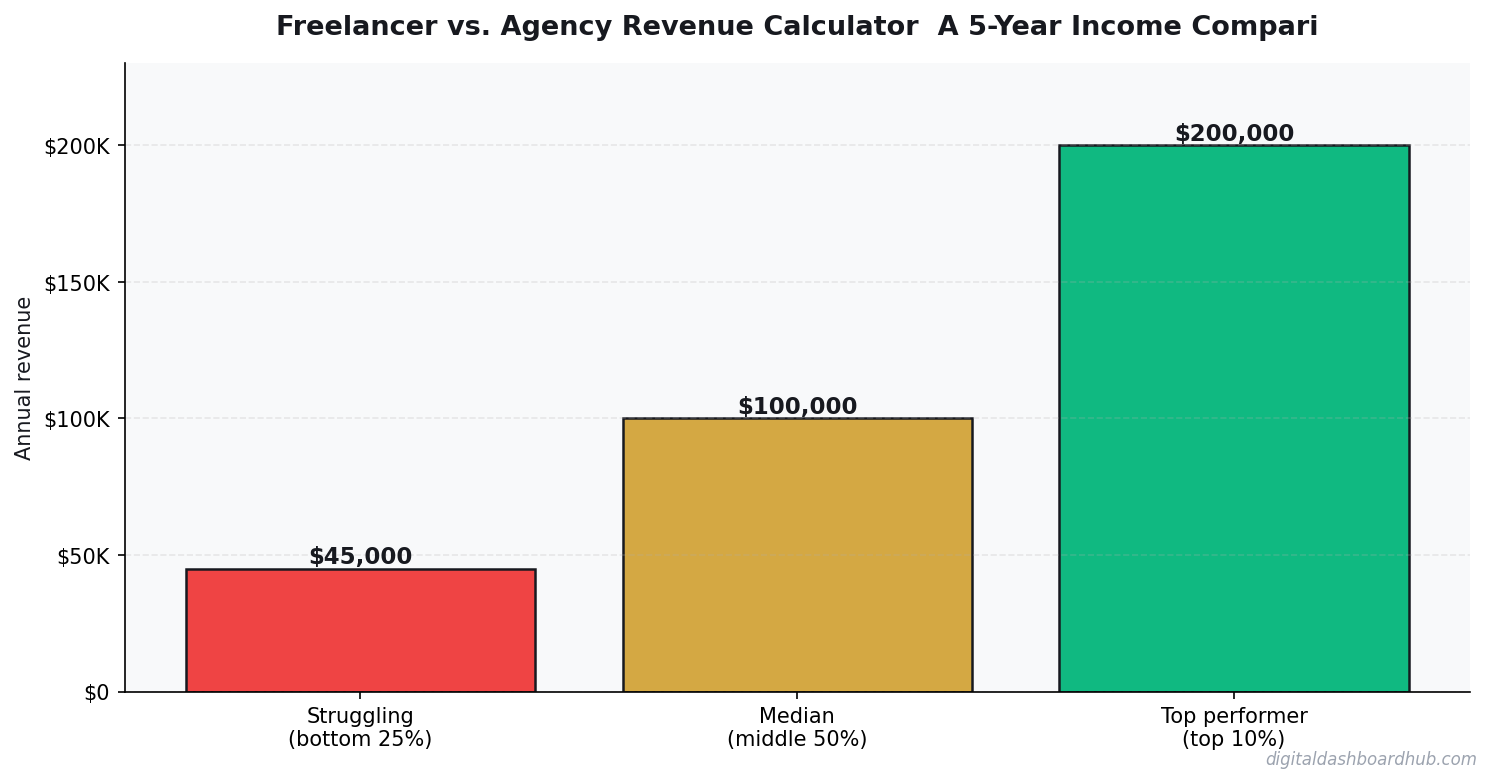
The crossover happens around Year 2–3. Before that, freelancing wins on both income AND hours. After that, the agency pulls ahead on income but demands more time — at least until you hire a manager to run operations.
Important: these are owner’s take-home figures, not gross revenue. The Year 5 agency is likely doing $500K–$800K in gross revenue, but after payroll, overhead, and taxes, the owner keeps $250K.
The Solo Freelancer Path: Predictable, Capped, Comfortable
How income grows
Freelancer income grows through three levers: raising rates, getting more efficient, and trading up to higher-value clients. A web developer starting at $100/hour who raises rates to $150 over 3 years and shifts from 30 to 25 billable hours/week (because they got faster) goes from $156K to $195K gross. After taxes and expenses: $100K–$130K take-home.
The ceiling
Solo freelancing has a hard cap: your hourly rate × your available hours. Even at $200/hour and 25 billable hours/week, you’re at $260,000 gross — and that’s elite-level pricing that few achieve. More realistically, the ceiling is $120K–$160K for most skilled freelancers.
What breaks the ceiling
Products (templates, courses, SaaS), retainers (predictable monthly revenue), and sub-contracting (hiring 1–2 people without becoming a full agency). The smartest freelancers combine client work ($80K) + retainers ($40K) + product revenue ($30K) = $150K with more stability than pure project work.
Model your specific growth. The freelancer vs. agency calculator lets you project both paths with your actual rates, hours, and growth assumptions.
The Agency Path: Pain First, Scale Later
Year 1: The Dip
You hire your first employee or contractor. Suddenly you’re doing the work AND managing, selling, invoicing, and hand-holding. Your effective hourly rate drops because you’re spending 20+ hours/week on non-billable work. Many agency founders make less in Year 1 than they did freelancing.
This is the “agency valley of death” and it kills most attempts. The key is having enough cash reserves (3–6 months of expenses) to survive the transition.
Year 2–3: Building the Machine
Your team of 2–4 people is handling most of the production. You’re focused on sales and client management. Revenue is growing because you can take on more projects simultaneously. But overhead is real: payroll, software, insurance, maybe office space.
The math: 3 employees each billing $8K/month in client work = $24K/month gross. Their salaries total $12K/month. Overhead: $4K/month. Your take before taxes: $8K/month = $96K/year. Plus whatever you bill directly.
Year 4–5: The Payoff
If you’ve built well, you now have 5–8 people, $40K–$80K/month in revenue, and systems that run without you touching every project. You’ve hired a project manager or ops person. Your role is sales, strategy, and relationship management — not production.
Owner’s take at this stage: $15K–$25K/month ($180K–$300K/year). And you’ve built an asset: an agency with recurring client revenue is worth 1–3x annual net profit if you ever want to sell.
The Hidden Costs of Each Path
Freelancer Hidden Costs
- No backup: You get sick, revenue drops to zero. No PTO, no sick days.
- Sales grind: You’re always 2–3 months from broke if you stop marketing.
- Isolation: Working alone gets lonely. Many freelancers underestimate this.
- No equity: Your business is you. It has zero resale value.
Agency Hidden Costs
- People management: HR issues, performance problems, people quitting at the worst time.
- Cash flow crunches: You pay employees on the 1st, but clients pay net-30. That gap is brutal early on.
- Liability: A client suing over a missed deadline is your problem, not your employee’s.
- Revenue concentration: If one client is 40%+ of revenue and they leave, you might need layoffs.
I built a 5-year financial model template that projects both freelancer and agency paths side by side, including taxes, overhead, and cash flow. Get it free with your trial.
The Third Path: The “Micro-Agency”
Not everyone needs to choose between pure solo and a 10-person agency. The micro-agency model — you plus 1–3 trusted contractors — gives you scale without the overhead of employees.
You handle sales and client relationships. Contractors handle production. You mark up their work 40–60% and keep the difference. At 3 contractors each billing $5K/month in your client work, your markup revenue: $6K–$9K/month on top of your own billable work.
Total income: $130K–$180K with minimal overhead increase. This is the path I see the most freelancers thrive on because it scales income without scaling headaches.
The Decision Framework
Choose freelancing if: you value time flexibility, dislike managing people, want location independence, and are happy in the $100K–$160K income range.
Choose an agency if: you enjoy building teams, want an asset with resale value, are targeting $200K+ income, and can survive 1–2 lean years during the transition.
Choose micro-agency if: you want more income without employees, enjoy collaboration, and want to stay hands-on with client work while adding revenue streams.
100%
Browser-Based
No downloads, no installs, works on any device
What to Do Now
- Model both paths. Open the freelancer vs. agency calculator and project your 5-year income under each scenario. The crossover point — when agency income surpasses freelance — is the most important number.
- Talk to 3 agency owners in your niche. Ask about Year 1 specifically. What they’d do differently. How long until it was “worth it.” Their answers will either excite you or confirm that solo is your path.
- Test with one subcontractor. Before hiring an employee, sub out one project to a contractor. See how you handle delegation, quality control, and margin management on a small scale.
Over 2,000 freelancers and business owners use our calculators to plan their growth. Start your free trial and map out your next 5 years with real data.
Keep reading (related guides):
- Mortgage Comparison Calculator: Find the Best Rate and Term
- How to Calculate Your Freelance Rate (So You Stop Undercharging)
- Freelancer Tax Guide 2026: What to Track All Year So April Doesnt Destroy You
- Freelance Quote Builder: Stop Undercharging (Free Calculator)
- Small Business Finance Basics: The Only 5 Numbers You Need to Track Weekly
Freelancer vs Agency: When the Math Flips
The freelancer-vs-agency comparison isn’t static. It depends entirely on revenue level and how you spend your time. Here are the three inflection points.
Under $200K: freelancer always wins
At $180K of freelance revenue working solo, you keep 65-75% after taxes and minimal overhead — call it $120K-$135K net. An agency doing the same $180K in revenue with one employee nets the owner maybe $60K. Freelancer wins by a mile until you can’t fulfill demand alone.
$200K-$500K: it’s a toss-up
A solo freelancer hits a wall around $250K-$300K — there are only so many hours to bill. An agency in this range is usually worse off because of employee overhead. The winning move in this zone is often a “productized freelance” model — fixed-price deliverables, no team.
$500K-$1.5M: agency starts winning
At $800K with 4-5 employees, a well-run agency nets owners $180K-$280K. At $800K as a solo freelancer, you’re not working — you’re dying. The math flips once team leverage exceeds team overhead, usually around $500K revenue with 3+ people.
$1.5M+: agency wins decisively
Above $1.5M, the agency model dominates — assuming it’s run well. Enterprise clients, recurring retainers, and productized services unlock 25-35% net margins on owner take-home that no solo freelancer can replicate, regardless of hourly rate.
The hidden variable: lifestyle
Freelancers trade income ceiling for freedom. Agency owners trade freedom for income ceiling. Before optimizing either model, decide which trade you actually want — otherwise you’ll keep making structural decisions that fight your real goals.
Quick FAQ: Freelancer vs Agency
At what revenue should I hire my first employee?
Don’t hire based on revenue — hire based on demand. Are you regularly turning down work? Working 55+ hours consistently? Paying yourself adequately while having at least $25K of reserves? If yes, you’re ready. If no, you’re not, regardless of your top-line number.
What’s the agency break-even point?
Most agencies break even on owner income at $350K-$450K in revenue with 2-3 employees. Below that, you’re earning less than you would solo. Above that, leverage starts paying off. Plan for 12-18 months of this awkward “worse than before” zone.
Is hybrid possible?
Absolutely, and often the best answer. Freelance at premium rates for your best clients, subcontract execution of commodity work to trusted collaborators, keep headcount near zero. This gets you to $200K-$400K net without the overhead of a real agency.
Should I niche down or go generalist?
Niche down at any revenue level. Specialists charge 30-70% more than generalists, close deals faster, and build referral networks faster. The argument for staying generalist is almost always “what if I miss a deal” — and the data shows niches close more deals, not fewer.
When do I know it’s time to sell?
When running the business is the thing you hate most about your week, AND you’ve built systems that can run without you, AND a valuation at 3-5x EBITDA would change your life. If all three are true, list it. If not, fix what’s broken first.
Choosing Between Freelancer and Agency
The right answer depends on what you’re actually optimizing for. These five diagnostic questions surface the real trade-offs before you commit to a model you’ll regret.
1. What does “success” look like in 5 years?
If success is “work 30 hours per week and earn $180K,” stay freelance. If success is “$500K owner income with an asset you can sell,” build an agency. Most people mix the answers and end up building something that serves neither goal.
2. How do you feel about managing people?
Agencies are people businesses. If hiring, coaching, firing, and performance management drains you, the agency path will burn you out even if the math works. Freelancers don’t manage people. Be honest about your temperament.
3. How reliable is your pipeline?
Agencies need predictable, multi-month pipeline to cover payroll. If your pipeline is lumpy — feast or famine — the agency model is dangerous because fixed costs don’t care about slow months. Freelancers can absorb lumpy pipeline more gracefully.
4. Are you willing to let go of execution?
The biggest psychological step in the agency transition is letting other people do the work and accepting that it’ll be different (sometimes worse) than if you did it yourself. Founders who can’t let go stay stuck in a “large freelancer” structure that never scales.
5. What’s your exit plan?
Freelancer “exits” are usually career changes, not sales. Agency exits can be 3-5x EBITDA sales to strategic or financial buyers. If an exit matters to you, that alone tips the decision toward agency — structured properly, the asset value compounds with the income.
255+ interactive tools for your money, time, and health.
Full dashboard access · Stripe-secure checkout · Cancel anytime
Keep Reading
- Freelancer Finance Dashboard: Track Income, Taxes, and Cash Flow
- Freelancer Tax Guide 2026
- The Side Hustle Tax Trap: Track Every Dollar

Andy Gaber is the founder of Digital Dashboard Hub, a suite of 255+ interactive financial, productivity, and wellness tools. He built DDH after getting frustrated with financial apps that gave outputs without context. Follow along for tool tutorials, revenue analytics breakdowns, and honest takes on personal finance.