Not all boat repair businesses are created equal. The ones making $200K+ per year aren’t working some secret playbook — they just have better numbers on 3-4 key metrics. This calculator shows you exactly which metrics move the needle most.
Use the Free Boat Repair Tool
The dashboard below loads instantly in your browser. Plug in your numbers, see your answer. No signup to try the basics.
Before DDH, I was doing this manually in spreadsheets. Here’s the faster way:
Boat Repair Revenue Calculator
Enter your numbers below — results update instantly
Want the full Boat Repair dashboard with expense tracking, break-even analysis, and growth projections?
What Boat Repair Owners Actually Take Home
A 2-3 bay marine repair shop grosses $25K-$50K/month in season. Parts markup (30-50%), labor billed at $95-$150/hr vs. tech cost of $25-$45/hr, and seasonal storage fees create layered revenue streams.
Winterization and spring commissioning are guaranteed revenue. Every boat needs it at the same time — this is your pricing power window.
Revenue vs. Reality
| Approach | Startup Cost | Time Investment | Revenue Potential | Best For |
|---|---|---|---|---|
| Solo operator | Low ($1K-$10K) | Full time | $60K-$200K/yr | Maximum margins, full control |
| Small team (2-5) | Medium ($10K-$50K) | Management + some fieldwork | $200K-$800K/yr | Scaling without losing control |
| DDH Revenue Tracker | Free trial | 5 min setup | N/A (profit tool) | Know your real numbers in real time |
The biggest line item? Skilled marine mechanic labor ($25-$45/hr) is scarce and expensive — finding and keeping good techs is the actual business challenge.
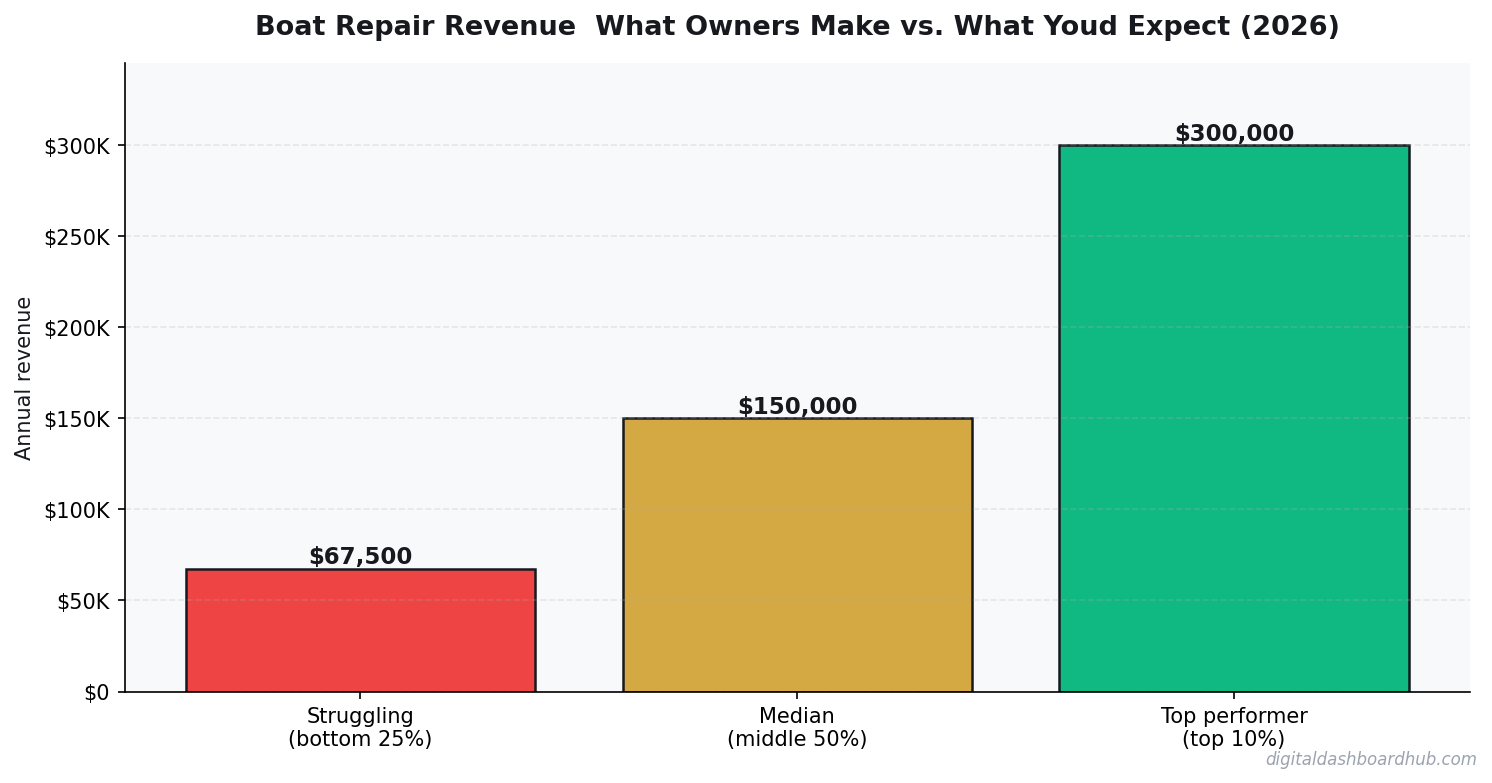
Adding winter storage (indoor at $40-$60/linear foot) creates passive income during your slowest months. 30 boats stored generates $8K-$15K/month with minimal labor.
The Most Common Financial Mistake
Not billing for diagnostic time. A complex engine issue can take 2-3 hours to diagnose. Eating that time costs $200-$400 per ticket.
Spring commissioning (March-May) and winterization (Sept-Nov) are peak. Summer is steady repairs. December-February is dead without storage income.
Unlock the Full Experience
How to Use This Calculator
Start by entering your actual numbers — not estimates. Pull from your bank statements, your POS system, or your accounting software. The difference between estimated and real inputs is usually the difference between “this looks fine” and “oh, that’s where the money is going.”
Then change one variable at a time. For boat repair, the lever that usually moves the needle most is adding winter storage (indoor at $40-$60/linear foot) creates passive income during your slowest months. Start there.
If you want to save these projections, track them month-over-month, or model different scenarios side by side, the full dashboard does all of that. Free 14-day trial, no credit card required.
Your Next Move
Related Tools and Articles
- ADHD Impulse Spending Tracker: The Free Visual Dashboard Built for Your Brain
- Zero-Based Budgeting: How to Give Every Dollar a Job (Template Inside)
- The Complete Guide to Building Habits That Actually Stick (Using a Digital Habit Tracker)
Common Questions About Boat Repair Revenue: What Owners Make vs. What You’d Expect (2026)
How long does it take to see results?
Most people see meaningful progress within 30-90 days when they apply these strategies consistently. The key is tracking your numbers from day one so you have a baseline to measure against.
What’s the biggest mistake people make?
Trying to do everything at once. Pick one or two strategies from this guide, implement them fully, then layer in additional tactics. Spreading yourself thin is the fastest way to see no results from any of it.
Do I need special tools or software?
Not necessarily to start — but the right tools eliminate hours of manual work. Our free calculators and trackers at Digital Dashboard Hub are a good starting point before you invest in paid software.
What a Real Boat Repair Shop Actually Makes: The Numbers
A 2-bay boat repair operation in coastal South Carolina — 2 certified marine mechanics plus the owner as lead tech. They run 3-4 jobs per week ranging from $800 engine tune-ups to $8,000 full engine replacements. Average job value: $3,200. At 3.5 jobs/week over 46 working weeks: $515,200 gross annually.
Parts and materials at 40%: $206,000. Two mechanic salaries at $52,000 each: $104,000. Shop rent ($2,800/month): $33,600. Tools, insurance, liability coverage (marine work requires serious coverage), shop consumables: $42,000. Owner net: approximately $129,000 — while doing the most technically skilled work in the shop themselves.
The shops clearing $200K+ have added winterization and storage contracts. Marina-adjacent shops that offer paid winter storage for 30-50 boats at $1,200-$2,500/boat can add $36,000-$125,000 in near-pure-margin revenue without adding a single mechanic.
The 3 Factors That Drive Boat Repair Revenue
1. Seasonal surge management. Pre-season (April-May) and post-season (October-November) are the highest-demand, highest-margin windows. A shop that can take on 20% more work during peak season — whether through temporary labor, outsourced subcontracts for non-engine work, or strategic scheduling — captures revenue that simply isn’t available in January. Waiting lists during peak season are margin opportunity, not just customer inconvenience.
2. Parts markup and supplier relationships. Marine parts carry significant markup potential — OEM parts typically see 25-40% margins, aftermarket 40-60%. Shops that develop direct relationships with distributors and stock commonly needed parts at all times eliminate the “parts delay” that kills scheduling efficiency.
3. Diagnostic billing vs. bundled rates. Many boat repair shops underprice diagnostic time because customers push back on paying to “just figure out what’s wrong.” But a thorough diagnostic on a complex engine problem takes 2-3 hours of skilled labor. Shops that charge appropriately for diagnostics ($150-$250/hour) are both more profitable and have fewer dispute-prone customers.
Common Mistakes That Kill Boat Repair Margin
Not charging for parts delays. When a job is paused waiting for a part on backorder, the boat is taking up bay space and the mechanic’s scheduling is disrupted. The customer doesn’t experience this as a cost, but it is one. Smart shops charge a storage fee for boats sitting longer than 72 hours waiting on owner decisions or part arrivals — typically $25-$50/day. It also creates the right incentive for owners to respond to update calls promptly.
The other overlooked margin item: job documentation. A mechanic who writes thorough notes on what they found, what they did, and what they recommended creates a record that’s valuable in three ways: it helps if there’s ever a warranty dispute, it informs the next technician who works on that boat, and it builds the service history that makes a boat more valuable at resale. Customers notice and pay for shops that document properly.
What the Numbers Don’t Tell You About Boat Repair
The revenue calculator gives you the top-line math. What it can’t capture: the seasonality of cash flow in a boat repair business is genuinely extreme. A shop in the upper Midwest might collect 70% of annual revenue between May and September. That means 5 months of strong cash inflow and 7 months of managed drawdown against fixed costs. The business works — but only if the owner plans for it explicitly rather than treating each slow month as a surprise.
Operators who build a winter service contract revenue stream significantly smooth this out. A $32,000 block of contracted annual service fees (40 boats × $800) collected in April and October doesn’t solve the problem entirely, but it changes the cash flow profile from “feast or famine” to “uneven but manageable.”
The other reality: marine mechanics are genuinely hard to find. A certified marine technician who’s good at their job and reliable has enormous leverage in the labor market. The shops that retain their best technicians — through competitive pay, clean facilities, regular equipment updates, and actually treating them like skilled professionals — have a durable competitive advantage that new competitors can’t easily replicate. Losing a star mechanic doesn’t just cost their salary; it can cost you their loyal customer base if they go independent nearby.
The boat repair business rewards technical excellence and punishes sloppy business operations in equal measure. Operators who track their numbers with the same diligence they apply to engine diagnostics build durable businesses. The ones who focus entirely on the craft and ignore the P&L eventually get surprised by a cash flow problem that the craft alone can’t solve.
Keep reading (related guides):
- Auto Mechanic Revenue: What Owners Make vs. What Youd Expect (2026)
- Boutique Revenue Calculator
- The Real Cost of Having a Baby: Year-by-Year Calculator (2026)
- Product Idea Scoring Matrix: Rate Your Next Idea Before You Waste 3 Months Building It
- A/B Testing Your Etsy Listings: How to Know Whats Actually Working
255+ interactive tools for your money, time, and health.
Full dashboard access · Stripe-secure checkout · Cancel anytime

Andy Gaber is the founder of Digital Dashboard Hub, a suite of 255+ interactive financial, productivity, and wellness tools. He built DDH after getting frustrated with financial apps that gave outputs without context. Follow along for tool tutorials, revenue analytics breakdowns, and honest takes on personal finance.