Three things you’re grateful for. That’s it. That’s the practice that neuroscience research says can measurably increase your happiness, improve your sleep, strengthen your relationships, and reduce symptoms of anxiety and depression. Three things, written down, most days of the week.
It sounds too simple to be real. And yet the research is robust, replicated, and compelling. Dr. Robert Emmons at UC Davis has spent over two decades studying gratitude, and his findings are consistent: people who regularly practice gratitude experience 25% more happiness, sleep 30 minutes more per night, exercise 33% more frequently, and report significantly lower levels of depression and stress.
But here’s what the gratitude gurus don’t tell you: most people who start a gratitude journal quit within three weeks. Not because gratitude doesn’t work, but because they’re doing it wrong. They write the same vague entries every day (“grateful for my family, my health, my home”), it starts feeling hollow and performative, and they abandon it convinced that gratitude journaling “isn’t for them.”
It is for them. And for you. But the approach matters enormously. This guide covers the evidence-based way to keep a gratitude journal — the way that actually changes your brain.
The Neuroscience of Gratitude
Understanding why gratitude works gives you the motivation to practice it correctly.
Neuroplasticity and the Gratitude Pathway
Your brain has a negativity bias — a well-documented evolutionary feature that makes you notice and remember threats, problems, and negative experiences more readily than positive ones. This bias kept your ancestors alive when the biggest threat was a predator in the bushes. In modern life, it keeps you anxious, stressed, and focused on what’s wrong rather than what’s right.
Gratitude practice actively counteracts this bias by strengthening neural pathways associated with positive processing. Every time you deliberately notice and record something good, you’re training your brain’s attention system to scan for positives. Over time — research suggests four to twelve weeks of consistent practice — this scanning becomes automatic. You don’t just feel grateful during journaling; you start noticing good things throughout your day, unprompted.
The Dopamine and Serotonin Connection
Expressing gratitude triggers the release of dopamine and serotonin — two neurotransmitters directly responsible for feelings of happiness and well-being. These are the same chemicals targeted by many antidepressant medications. Gratitude practice doesn’t replace medication for people who need it, but it does activate the same neural reward pathways through a behavioral rather than pharmacological mechanism.
The Prefrontal Cortex Activation
When you practice gratitude, neuroimaging studies show increased activity in the medial prefrontal cortex — the brain region associated with learning, decision-making, and emotional regulation. This activation persists beyond the journaling session itself, suggesting that gratitude practice strengthens the brain’s overall capacity for emotional regulation.
Why Most Gratitude Journals Fail (And How to Fix Yours)
Problem 1: Vague, Repetitive Entries
Writing “I’m grateful for my family” every day is technically gratitude, but it stops working quickly. Your brain habituates to repeated stimuli — the same entry, day after day, stops triggering the neural response that makes gratitude practice effective.
The fix: Specificity and novelty. Instead of “grateful for my family,” write “grateful that my daughter left a sticky note in my lunch bag today with a drawing of us at the beach.” The specificity activates deeper emotional processing. The novelty prevents habituation. Challenge yourself to never repeat the same entry twice.
Problem 2: Obligatory Timing
Many people journal first thing in the morning because some blog told them to. For some people, morning works. For others, trying to generate genuine gratitude when you’re groggy and coffee-deprived feels forced and produces shallow entries.
The fix: Journal when you feel it. Many researchers actually recommend evening journaling because you have a full day of experiences to draw from. But the best time is whenever you naturally notice something worth recording. Some people keep a running note on their phone and transfer entries to their journal at the end of the day.
Problem 3: All-or-Nothing Perfectionism
Miss a day and the whole practice collapses. “Well, I already broke the streak, might as well stop.”
The fix: Aim for five days a week, not seven. Research shows that gratitude practiced three to five times per week is actually more effective than daily practice. Daily practice can lead to habituation and reduced impact. Give yourself permission to skip days without guilt.
Problem 4: Only Tracking the Big Stuff
People wait for big, obvious things to be grateful for — a promotion, a vacation, a major milestone. But life’s big moments are rare. The small moments are where gratitude practice gets its power.
The fix: Go micro. The warmth of your coffee cup. The way sunlight hit the trees on your commute. A stranger holding a door. The satisfaction of crossing something off your task list. Micro-gratitude entries train your brain to find value in ordinary moments — and ordinary moments make up 99% of your life.
The Evidence-Based Gratitude Journal Framework
The Three-Entry Method (With Depth)
Write three entries per session. For each entry, capture the specific thing you’re grateful for, why it matters to you, and what you contributed to make it happen (when applicable). This third element is important — it connects gratitude to personal agency, which amplifies the psychological benefits.
Example: “Grateful for the conversation I had with Marcus at lunch today. He shared a perspective on my project that I hadn’t considered, and it’s going to save me weeks of work going in the wrong direction. I’m glad I asked him for his honest opinion instead of just looking for validation.”
The Category Rotation System
To prevent repetitive entries, rotate through different gratitude categories: relationships, personal accomplishments, simple pleasures, challenges that taught you something, things about your body that work well, aspects of your environment you appreciate, and opportunities you have access to.
Assign each day of the week a category focus. Monday is relationships. Tuesday is accomplishments. Wednesday is simple pleasures. This structure ensures variety while making the prompt easier to answer.
Try Our Free Wellness Dashboard
Track your numbers automatically with our interactive cloud dashboard. No spreadsheet skills needed.
The Contrast Technique
When you’re having a genuinely terrible day and gratitude feels impossible, use the contrast technique. Instead of forcing positivity, acknowledge the difficulty and find gratitude within it or adjacent to it. “Today was brutal. My presentation bombed. But I’m grateful that my colleague checked in on me afterward without me having to ask.” The contrast between the difficulty and the small kindness makes the gratitude more genuine and more impactful.
Weekly Reflection Reviews
Set aside ten minutes each week to read through your entries. This review process reactivates the positive neural pathways created during initial journaling and often reveals patterns you missed in the moment. You might notice that your happiest entries consistently involve connection with specific people, movement and nature, creative expression, or helping others. These patterns become a happiness roadmap — a data-driven guide to what actually makes your life good.
Tracking Your Gratitude Practice
A digital gratitude tracker adds several dimensions that paper journals can’t provide. Streak tracking shows your consistency over time. Mood correlation lets you see how your emotional state connects to your gratitude practice. Category analytics reveal which types of gratitude produce the strongest positive response. And trend analysis shows whether your overall happiness and well-being are improving over weeks and months of practice.
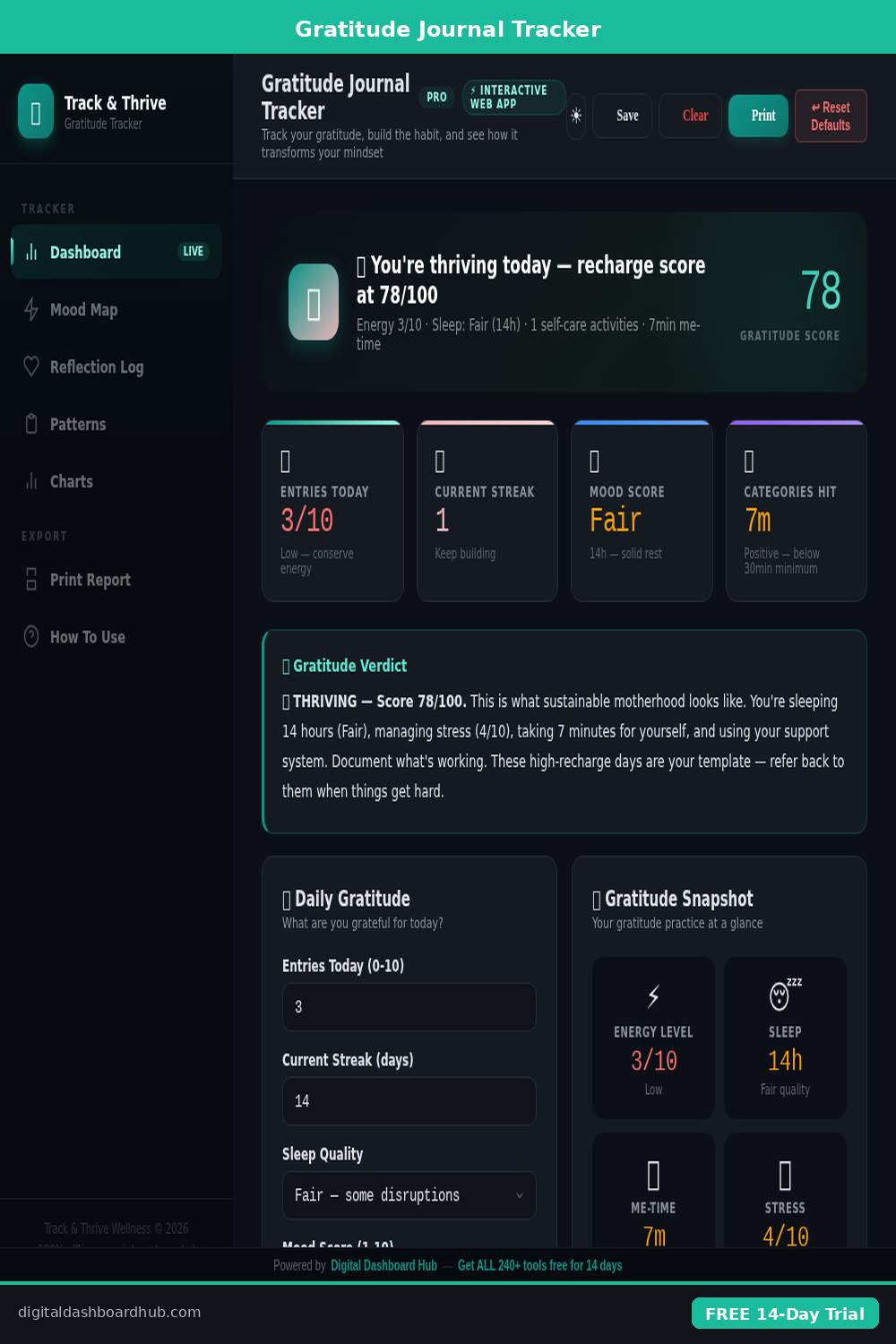
The Gratitude Journal Tracker on Digital Dashboard Hub combines the simplicity of a journal with the analytical power of a dashboard. Log your daily entries, rate your mood, track your consistency streaks, and view weekly and monthly insights about your gratitude practice. See which categories produce the strongest positive impact. Share milestone achievements (100-day streak!) with accountability partners. All in a clean, calming interface designed to make the practice feel good, not obligatory.
Gratitude isn’t about ignoring problems or pretending life is perfect. It’s about training your brain to see the full picture — the difficulties and the gifts, the challenges and the small moments of beauty that exist alongside them.
Three entries. Five days a week. The compound effect is extraordinary.
Ready to start rewiring your brain for happiness? Try the Gratitude Journal Tracker free for 14 days at digitaldashboardhub.com/trial — no credit card required. Your brain is already noticing good things. Give it a place to remember them.
Related articles: Gratitude Journaling: The 5-Minute Practice, The Complete Guide to Building Habits, How to Build a Meditation Practice That Sticks
Get Free Wellness Tools & Resources
Join our newsletter for exclusive templates, calculators, and expert tips delivered weekly.
Disclaimer: This article is for informational purposes only and does not constitute professional advice. Always consult with a qualified professional for your specific situation.