You know you’re stressed. Everyone knows they’re stressed. Saying “I’m stressed” in 2026 is like saying “I breathe air” — it’s so universal it’s almost meaningless. But here’s the problem with treating stress as a binary state (stressed/not stressed): it prevents you from understanding the specific mechanics of your stress response, which is exactly the information you need to manage it effectively.
Stress isn’t one thing. Your body’s stress response is a complex cascade of hormonal, neurological, and physiological changes that vary in intensity, duration, trigger, and impact. The low-grade tension you feel before a meeting is physiologically different from the acute stress of a conflict with your partner, which is different from the chronic stress of financial uncertainty. They feel different, they affect your body differently, and they require different management strategies.
When you start tracking stress systematically — measuring not just whether you’re stressed but how stressed, what triggered it, how it manifests in your body, how long it lasts, and what helps it resolve — stress transforms from an amorphous cloud of “everything is too much” into a set of specific, manageable problems.
Why Stress Tracking Works
Before DDH, I was doing this manually in spreadsheets. Here’s the faster way:
The Awareness Gap
Most people dramatically underestimate their stress levels until they experience a health consequence — a panic attack, insomnia, digestive problems, chronic pain, or worse. The body accumulates stress like a bank account accumulates overdraft fees: silently, incrementally, and with compounding consequences.
Tracking creates awareness before consequences force awareness. When you see your stress scores creeping up over two weeks, you can intervene before your body sends emergency signals.
Pattern Recognition
Stress feels random from the inside. Tracking reveals that it’s remarkably patterned. You might discover that your stress spikes every Sunday evening (anticipatory anxiety about Monday), drops on Wednesdays (your lightest meeting day), and peaks during the first week of each month (when reports are due). These patterns are invisible without data, and invisible patterns can’t be addressed.
Intervention Effectiveness
Without tracking, you try stress management techniques and evaluate them by feel, which is unreliable when you’re stressed (stress distorts perception). With tracking, you can measure whether yoga actually lowers your stress scores more than running does, whether meditation is more effective in the morning or evening, and whether that breathing app is doing anything at all. Data-driven stress management replaces guesswork with evidence.
What to Track in Your Stress Dashboard
Stress Level (1-10)
Rate your current stress level two to three times daily. Consistency matters more than precision — the same person rating stress at the same times each day generates reliable trend data even if the individual ratings are imperfect. Morning, midday, and evening check-ins capture the daily stress arc.
Physical Symptoms
Stress manifests physically before you consciously register it. Track common stress symptoms: muscle tension (shoulders, jaw, neck, lower back), headaches, digestive issues (nausea, stomach pain, changes in appetite), sleep disruption, fatigue, rapid heartbeat or chest tightness, skin changes (breakouts, rashes), and changes in breathing patterns.
Over time, you’ll identify your personal stress signature — the specific physical symptoms that appear first when stress escalates. This early warning system lets you intervene before stress reaches critical levels.
Triggers
Log what caused or contributed to each stress spike. Categories might include work demands, interpersonal conflict, financial concerns, health worries, time pressure, unexpected changes, decision overload, and information overwhelm (news, social media).
Coping Strategies and Effectiveness
When stress hits, what do you do? And does it work? Track every stress management strategy you use and rate its effectiveness on a 1-10 scale. After a few weeks, you’ll have a personalized toolkit ranked by actual effectiveness rather than theoretical appeal.
Recovery Time
How long does it take your stress level to return to baseline after a spike? This metric is as important as the spike itself. Quick recovery (stress drops within thirty minutes to an hour) indicates good stress resilience. Slow recovery (stress remains elevated for hours or days) indicates depleted capacity that needs attention.
Building Your Stress Management Practice
| Option | Cost | Time Investment | Customizable? | Best For |
|---|---|---|---|---|
| DIY approach | Free | High | Fully | Those with time to build from scratch |
| Generic tool | $5-$50/mo | Medium | Limited | Standard use cases |
| DDH Free Tool | Free trial | 5-10 min setup | Yes | Getting real answers without spreadsheet hell |
Phase 1: Baseline and Observation (Weeks 1-2)
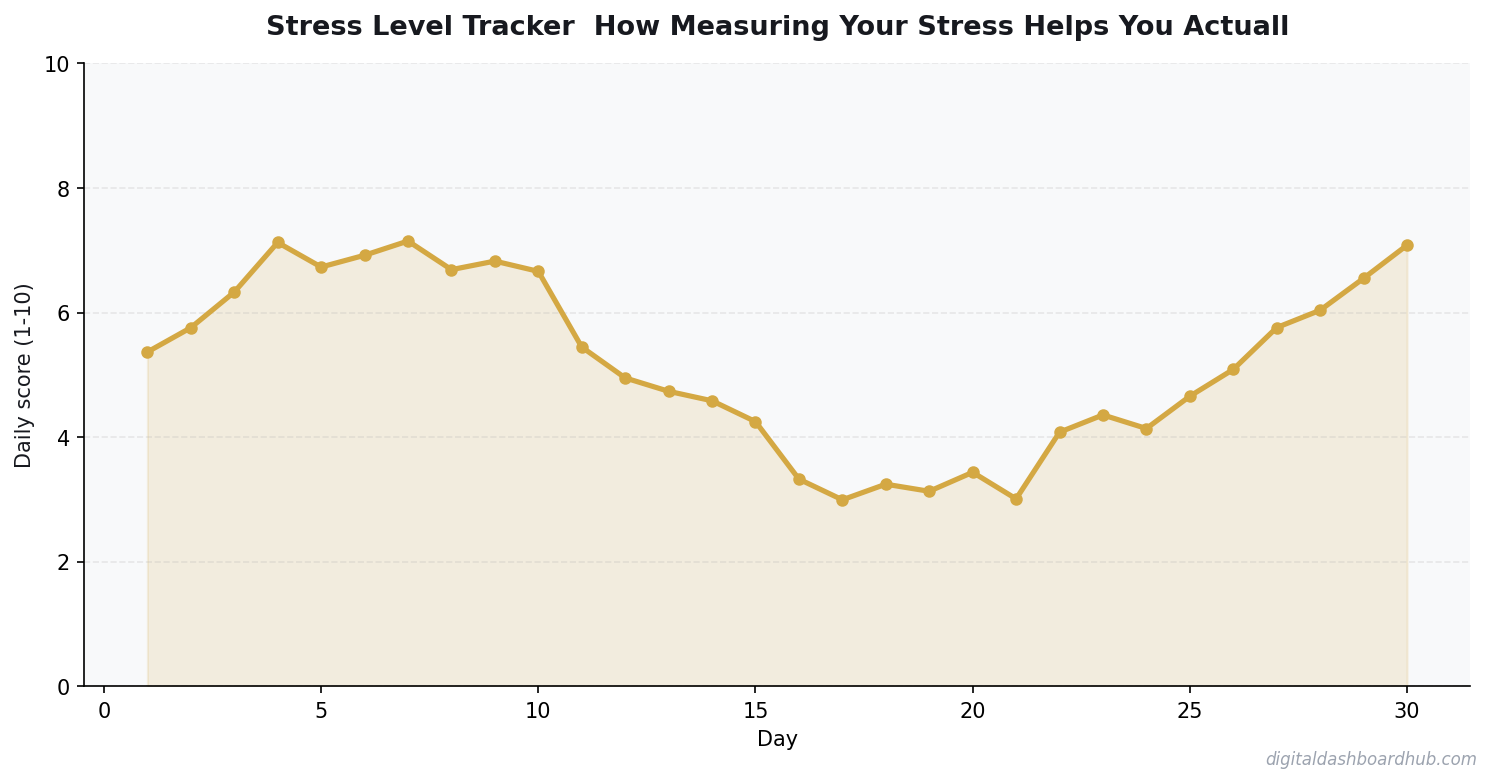
Track without trying to change anything. Capture your natural stress patterns, triggers, and responses. This baseline becomes the benchmark for measuring improvement.
Phase 2: Targeted Intervention (Weeks 3-6)
Based on your baseline data, identify your top two or three stress triggers and implement one targeted intervention. If your biggest trigger is work deadlines, try timeboxing techniques. If it’s interpersonal conflict, explore communication frameworks. If it’s financial stress, build a financial dashboard. Track the intervention’s impact on your stress scores.
Phase 3: System Building (Month 2+)
Build a comprehensive stress management system based on your tracking data. Stack interventions that work, eliminate those that don’t, and create preventive routines for predictable stress patterns. Your dashboard should show overall stress trending downward and recovery time getting shorter.
The Compound Effect of Stress Tracking
The most powerful aspect of stress tracking isn’t any single insight — it’s the compound effect of sustained awareness. When you track stress daily for three months, you develop an intuitive understanding of your stress response that persists even when you stop logging every detail. You notice tension building before it becomes overwhelming. You recognize triggers in real time. You reach for effective coping strategies automatically.
This is stress literacy — and it’s one of the most valuable health skills you can develop.
The Stress Management Tracker on Digital Dashboard Hub gives you a comprehensive stress monitoring dashboard. Track stress levels, physical symptoms, triggers, and coping strategies. View daily, weekly, and monthly trends. Identify your personal stress patterns and measure the effectiveness of your management strategies. All in a private, clean interface designed to reduce stress, not add to it.
You can’t manage what you don’t measure. Start measuring.
Ready to understand and reduce your stress? Try the Stress Management Tracker free for 14 days at app.digitaldashboardhub.com/signup — no credit card required. Your stress patterns are already there. Let’s make them visible.
Related articles: [The Best Stress Relief Techniques Backed by Science], [How Chronic Stress Affects Your Health], [Burnout vs. Stress: How to Tell the Difference]
Get Free Wellness Tools & Resources
Join our newsletter for exclusive templates, calculators, and expert tips delivered weekly.
Disclaimer: This article is for informational purposes only and does not constitute professional advice. Always consult with a qualified professional for your specific situation.
Related resources from Digital Dashboard Hub:
- Migraine Frequency Tracker: Log Attacks, Triggers, and Medications That Work
- Nervous System Regulation Toolkit: Track Your Stress Response and Calm Down Faster
- Burnout Recovery Dashboard: Track Your Way Back From Running on Empty
When Your Stress Numbers Look Bad: What to Actually Do
Most stress trackers tell you you’re stressed. Helpful. Here’s what to do when your logged numbers are trending up for 5+ days in a row:
First, look for the inflection point. When did the score start climbing? Not the peak — the first day it went up. That’s usually the actual cause. If stress spiked on a Tuesday three weeks ago and has been elevated since, something changed that Tuesday. Bad meeting, overcommitment, a relationship thing. Fixing the pattern means naming the origin.
Second, check your sleep data alongside stress. In almost every case I’ve tracked, elevated stress scores precede sleep disruption by 2–3 days. By the time your sleep is wrecked, you’re already in a stress spiral. The intervention window is the first uptick, not when you’re already exhausted.
Patterns That Mean Something (And Some That Don’t)
A single high-stress day means almost nothing. Everyone has bad days. What matters is the slope over 7 days, and whether you’re returning to baseline or plateauing at a new high level.
Pattern to take seriously: Stress scores that are consistently 2–3 points above your personal baseline for 10+ consecutive days. That’s your body signaling a load it can’t absorb. This isn’t something you meditate your way out of in one session — it requires a structural change (workload, sleep schedule, a conversation you’ve been avoiding).
Pattern you can ignore: Stress spikes that recover within 48 hours. That’s normal acute stress response. Your nervous system is doing its job. Log it, note the trigger, move on.
The Number That Actually Predicts Burnout
I’ve talked to a lot of people who hit burnout without seeing it coming. Looking back at their data, there’s almost always one signal they missed: the gap between perceived stress and recovery time widened over weeks. Early on, a stressful day meant one bad night. Later, a stressful day meant three bad nights. When recovery takes 3x longer than it used to, something systemic is wrong.
Track not just stress level, but how quickly you return to your baseline the following day. That ratio — stress intensity divided by recovery time — is the metric that actually matters. If it’s growing, you need to address the load, not just the symptoms.
Keep reading (related guides):
- Free Sinking Fund Calculator — Try It Now
- Free Menopause Symptom Tracker — Try It Now
- Nervous System Regulation Tracker: The Visual Dashboard That Helps You Understand Your Bodys Stress Signals
- I Owed $47,000 in Taxes and Had $11,000 in the Bank: How I Rebuilt My Freelance Finances From the Ground Up
- Free ADHD Impulse Spending Tracker — Try It Now
255+ interactive tools for your money, time, and health.
Full dashboard access · Stripe-secure checkout · Cancel anytime

Andy Gaber is the founder of Digital Dashboard Hub, a suite of 255+ interactive financial, productivity, and wellness tools. He built DDH after getting frustrated with financial apps that gave outputs without context. Follow along for tool tutorials, revenue analytics breakdowns, and honest takes on personal finance.