Let's be honest: if one more person told you to "just relax" or "take a bath," you might lose it.
The bubble bath industry has built an empire on the assumption that stress is something you can simply bubble away. But you know that's not how it works. Real stress is stubborn. It lives in your chest, hijacks your sleep, and follows you from work into your personal life. And surface-level advice? It might feel good for 20 minutes, but it doesn't actually reduce stress.
The problem with most stress management advice is that it's generic. It treats everyone's stress like it's the same—as if the thing that overwhelms a high-powered executive is identical to what drains a parent juggling a million responsibilities. Spoiler alert: it's not.
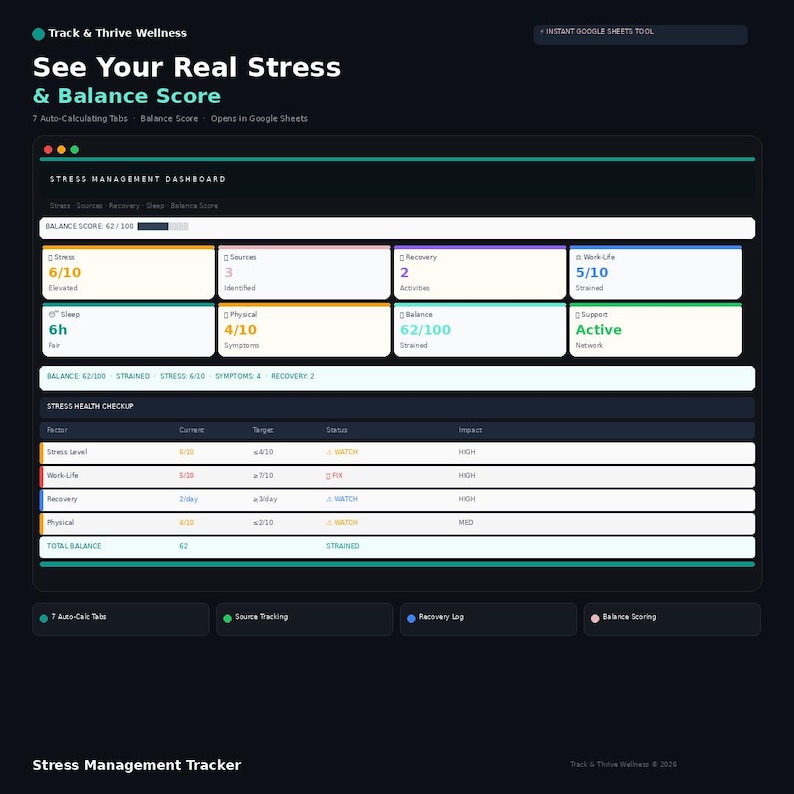
What actually works is personalization backed by data. And the good news? You don't need expensive therapy or pharmaceutical interventions to build a stress management system that actually works for you. You need to understand your stress, track it, test solutions, and measure what works. That's the approach this article covers.
Why Generic Stress Advice Fails (And Why You're Not Broken)
Before we talk about what works, let's understand why so much stress advice falls flat on its face.
Most mainstream stress management tips follow a pattern. They're positive, they're simple, and they completely ignore your actual life. "Practice gratitude." "Do yoga." "Get more sleep." These suggestions aren't wrong, but they're incomplete. They're like telling someone with a leaky roof to open their windows more—technically not harmful, but it misses the actual problem.
Here's the real issue: stress isn't uniform. Your nervous system doesn't respond the same way to:
- A tense meeting with your boss
- Financial uncertainty
- Social pressure
- Sleep deprivation
- Caffeine overload
- Physical exhaustion
Yet most advice treats stress like a single problem with a single solution.
The second problem is that generic advice doesn't address causation. It treats stress as something to manage after it shows up, not something to prevent by understanding what triggers it in the first place. You can take all the bubble baths in the world, but if you haven't addressed the actual stressor, the stress returns the moment you get out of the water.
This is where data transforms stress management from guessing to knowing. When you write down what triggered your stress—not vaguely, but specifically—patterns emerge that you couldn't see otherwise.
Maybe you thought you were stressed about work, but the data shows you're consistently most stressed on days when you skip breakfast and have back-to-back meetings. Maybe you assumed you needed to meditate more, but your tracking reveals that 15 minutes of walking outdoors reduces your stress faster than 30 minutes of sitting in silence.
The act of recording your stress serves two critical functions:
- It forces specificity. Your brain is great at vague narratives ("I'm so stressed") but terrible at identifying patterns. Writing it down demands details.
- It creates accountability to data. Your feelings might be inconsistent; the data won't lie.
Identifying Your Stress Triggers: The Power of Writing It Down
You can't manage what you don't measure. And you can't change what you don't understand.
Start with a simple tracking system. You don't need anything fancy—a spreadsheet works perfectly. For each day, record:
- What time stress occurred (timing patterns matter)
- What triggered it (be specific—not "work," but "that 3 PM client call" or "email from my manager")
- Stress intensity (1-10 scale)
- Physical symptoms (racing heart, tension, jaw clenching, etc.)
- What happened right before (sleep quality last night, meals, caffeine intake, other stressors)
- What you did about it (or didn't do)
Track for at least two weeks. Three weeks is better. Why? Because stress patterns often repeat weekly, and you need enough data to see them.
One of our most effective tools for this is the Stress Management Spreadsheet Daily, which is specifically designed to capture these data points without overwhelming you with too many fields.
After two weeks of tracking, review your data looking for patterns:
- Time patterns: Are you consistently more stressed at certain times of day? (3-5 PM slump? Morning chaos?)
- Trigger patterns: What three triggers show up most frequently?
- Physical signature patterns: Does your stress always show up as tension, or does it vary?
- Lifestyle patterns: Are you more stressed on days you skip meals, sleep poorly, or consume extra caffeine?
- Escalation patterns: Which stressors lead to compounding stress later in the day?
Most people discover they're stressed by a combination of factors, not a single cause. You're not stressed because of the email. You're stressed because you got poor sleep last night, had three coffees with minimal food, and the email is the final straw.
This distinction changes everything about how you approach stress management.
Evidence-Based Stress Management Techniques: Beyond the Bubble Bath
Now that you understand your triggers, you need tools that actually address your nervous system's activation state. These aren't feel-good suggestions. They're physiologically validated techniques with measurable outcomes.
Heart Rate Variability (HRV) Monitoring
Your heart doesn't beat at a perfectly constant rate. The variation between beats is called heart rate variability, and it's a direct measurement of your nervous system's state. Higher HRV indicates a more resilient, less stressed nervous system. Lower HRV indicates you're in a more activated, stressed state.
The practical application: Use an HRV app or device (many fitness trackers include this) to measure your baseline. Track it daily. When your HRV drops, it's an early warning system that your stress is climbing—often before you consciously feel it. This transforms stress management from reactive (responding after you're stressed) to proactive (intervening when you're starting to get stressed).
Progressive Muscle Relaxation (PMR)
This isn't meditation. It's a practical technique where you systematically tense and release muscle groups throughout your body. The science is straightforward: your nervous system can't be both tense and relaxed. By intentionally relaxing your muscles, you send signals to your brain that reduce stress activation.
- Start with your feet. Tense all the muscles for 5 seconds, then release.
- Move up through your legs, torso, arms, and face.
- Notice the difference between the tense and relaxed states.
- Practice regularly—even 10 minutes daily makes a difference.
The advantage over general "relaxation" advice: it gives your nervous system a concrete task and creates measurable progress. You can objectively feel yourself getting more effective at relaxation.
Cognitive Restructuring
Some stress lives entirely in your thinking patterns. Not all stress, but a significant portion. Cognitive restructuring is a technique from cognitive behavioral therapy where you identify catastrophizing thoughts and replace them with more accurate ones.
- Automatic thought: "I made a mistake in that presentation. Everyone noticed. This will tank my career."
- Realistic thought: "I made a small mistake. Most people didn't notice. I'll improve for next time, and this won't impact my career."
The key is that restructuring isn't positive thinking fantasy. It's replacing catastrophic thinking with accurate thinking. Your brain loves to jump to worst-case scenarios; restructuring brings it back to what's actually likely.
Our CBT Worksheet Tracker Spreadsheet is designed to help you systematically track and practice this technique.
Breathwork: The Fastest Stress Reset
Your breath is the one automatic system you can consciously control. Box breathing is one of the most evidence-backed techniques:
- Inhale for 4 counts
- Hold for 4 counts
- Exhale for 4 counts
- Hold for 4 counts
- Repeat 4-5 times
This activates your parasympathetic nervous system—the "rest and digest" system. Unlike meditation (which requires a calm mind), breathwork works because you're focused on the breath. It gives your stress-spiraling mind something concrete to do.
The best part: it takes less than 3 minutes and creates measurable changes in heart rate and stress hormones.
Building Your Personalized Stress Management System
You now have understanding (your triggers) and tools (evidence-based techniques). The final piece is building a system that actually sticks.
Don't adopt all five stress techniques at once. Instead:
- Week 1-2: Master one technique. Practice daily. Track your stress levels.
- Measure the impact: Did this technique measurably reduce your stress?
- Week 3-4: Add one more technique. Test it the same way.
- Build your stack: Over time, you'll have 3-4 techniques that work specifically for your nervous system, triggered by your specific stressors.
For example, you might discover:
- Morning box breathing helps you start calm and prevents escalation later
- PMR works great when stress manifests as physical tension
- Cognitive restructuring is your go-to for work-related catastrophizing
- An evening meditation practice (guided, not silent) helps you sleep better
This isn't generic advice. This is your stress management system.
The reason most stress management plans fail is that they're too complex. You can't maintain a 90-minute daily wellness routine if you have a full life. But you can maintain five techniques that take 3-15 minutes each, triggered when you actually need them.
Use your stress tracking to set specific "if-then" rules:
- If you notice your HRV has dropped 5+ points, do box breathing
- If you catch yourself catastrophizing, use cognitive restructuring
- If physical tension is high, do PMR
- If you haven't meditated in three days, your sleep suffers (use the Meditation Practice Spreadsheet Session to track this)
Track what actually works. Measure stress levels before and after each intervention. Over time, you'll have an empirical stress management system instead of a hope-based one.
The Data Transforms Everything
Here's what happens when you stop guessing and start measuring:
You discover that your 6 AM stress isn't about "being anxious." It's about the fact that you're checking email before breakfast, your cortisol is naturally elevated in the morning, and you're caffeine-loading on an empty stomach.
You realize that the meditation app everyone recommended doesn't work for you, but 15 minutes of walking does—because you need movement more than stillness.
You notice that poor sleep isn't just a symptom of stress; it's a cause. And tracking this connection motivates you to protect your sleep because you see the immediate impact on next-day stress levels.
You find that you're not actually as stressed as you thought you were—you're just stressed at specific times and triggers, and those are fixable.
Include your partner or accountability buddy: Share your stress tracking with someone. Research shows that tracking feels more real when someone else can see it. You're not just managing stress in isolation; you're managing it with evidence.
The Email Hook: Get Your Free Stress Trigger Identification Worksheet
The first step is always awareness. We've created a free Stress Trigger Identification Worksheet that walks you through the process of identifying your top five stress triggers in just 15 minutes.
Get the free worksheet and join the Track & Thrive community. We'll send you the worksheet plus weekly strategies for building your personalized stress management system.
You'll also get access to templates for Anxiety Management Spreadsheet Daily and learn how to adapt them to your specific needs.
Your Action Plan: Start Measuring This Week
You don't need a therapist, a month-long retreat, or a complete lifestyle overhaul to reduce stress. You need data, tools, and personalization.
- Choose your tracking method (spreadsheet or app)
- Start recording your stress triggers and intensity levels
- Pick one evidence-based technique to test (we recommend starting with box breathing—it takes 3 minutes)
- Measure how your stress level changes after using the technique
After two weeks of data, you'll see patterns that took you years to understand intuitively. After a month, you'll have the foundation of a personalized system that actually works.
The best part? You're not managing stress anymore. You're solving it—one data point at a time.
Start building your data-driven stress management system. Download our free Stress Trigger Identification Worksheet and join the Track & Thrive Wellness community. We'll guide you through the process and show you exactly how to measure what works for your stress.
(#email-signup)
Because stress management shouldn't be a mystery. It should be science.
Ready to take control? Digital Dashboard Hub gives you 255+ interactive tools — budgets, trackers, calculators — all in one place.
Start your free 14-day trial →