# Zero-Based Budgeting: How to Give Every Dollar a Job (Template + Guide)
—
You've tried budgeting before. You downloaded an app, maybe opened a spreadsheet, typed in your income, listed a few expenses… and then life happened. The car needed brakes. Your friend's birthday dinner ran $90. That "one thing" from Amazon turned into four things. By the end of the month, you had no idea where half your paycheck went — and the budget you made on the 1st was a distant memory by the 15th.
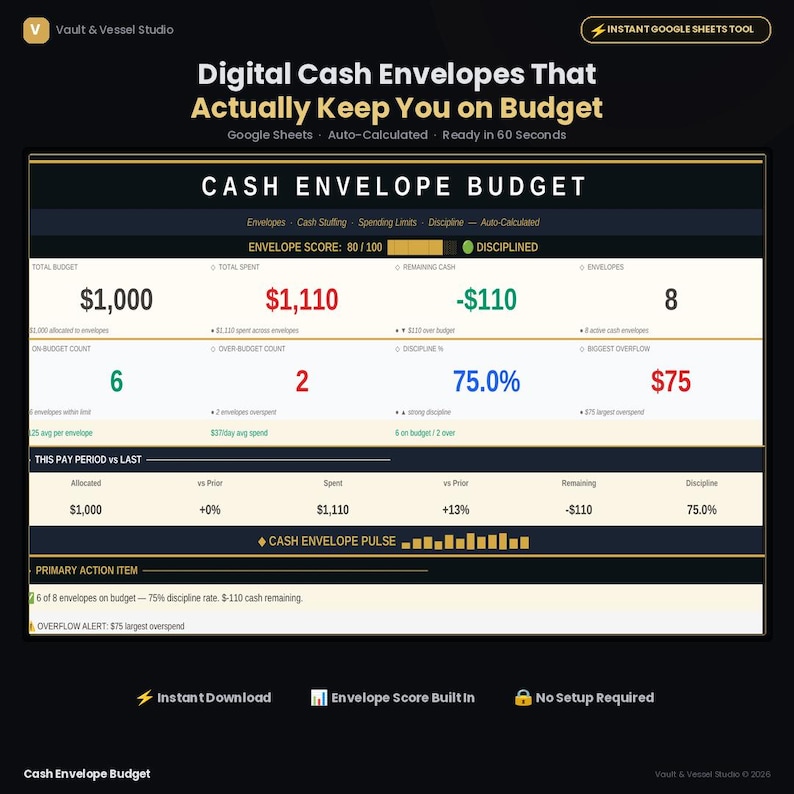
Cash Envelope Budget Template
Digital cash stuffing in Google Sheets — assign every dollar a job with envelope categories & tracking
Here's why that happened: **most budgets are backward.** They track where your money went *after* the fact. That's not a budget — that's an autopsy.
Zero-based budgeting flips the entire model. Instead of looking backward, it looks forward. Instead of tracking where money disappeared to, it tells every single dollar where to go *before* you spend it. And when you do it right, that sense of "where did my money go?" vanishes — because you already know.
## What Is Zero-Based Budgeting?
Zero-based budgeting is simple in concept: **your income minus your expenses equals exactly zero.** That doesn't mean you spend everything recklessly — it means every dollar has a specific assignment before the month begins. Some dollars are assigned to rent. Some to groceries. Some to savings. Some to fun. But no dollar sits in your account without a purpose, because purposeless dollars are the ones that vanish.
The "zero" in zero-based budgeting doesn't mean zero in your bank account. It means zero unassigned dollars. Every dollar has a job.
This method was originally developed for corporate accounting in the 1970s by Peter Pyhr at Texas Instruments. But the personal finance version — popularized in the decades since — is far more practical and far less corporate. At its core, it forces a simple question every month: "Given what I earn and what matters to me, where should this money go?"
## Why Zero-Based Budgeting Works When Other Methods Don't
Most budgeting methods fail for one of three reasons. Zero-based budgeting addresses all three.
### It Eliminates the "Leftover" Problem
The 50/30/20 rule says 50% on needs, 30% on wants, 20% on savings. That's fine as a guideline, but it doesn't tell you *which* needs, *which* wants, or what to do when your needs eat up 65% instead of 50%. You end up with a vague category labeled "wants" and no clarity about whether that $14 latte habit fits inside it or not.
Zero-based budgeting doesn't deal in percentages. It deals in dollars. You list every single expense by name, assign a dollar amount, and when the total matches your income, you're done. There's no ambiguous "leftover" pool that tempts you to overspend.
### It Forces a Monthly Reset
Your life doesn't look the same every month. December has gifts. April has taxes. August has back-to-school supplies. A birthday month costs more. A month where you're staying home costs less.
Zero-based budgeting isn't a template you set once and forget. You rebuild it every single month — or at least adjust it. That monthly reset forces you to look at what's actually coming and plan for it, instead of being blindsided by expenses you knew about but didn't account for.
### It Creates Intentional Spending
Here's the psychological shift that makes this method stick: when every dollar has an assignment, spending money *feels different.* Going out to dinner doesn't trigger guilt if you budgeted $200 for dining out. Buying that thing you want doesn't create anxiety if it's coming from your "fun money" category. You stop feeling deprived because you're spending according to a plan you made — not reacting to impulses and then regretting them.
**Intentional spending is the opposite of restrictive budgeting.** You're not telling yourself "no." You're telling yourself "yes, and I already planned for it."
## How to Set Up Your Zero-Based Budget: Step by Step
### Step 1: Calculate Your Total Monthly Income
Start with what's actually hitting your bank account — not your gross salary. If you earn a predictable paycheck, this is simple: add up your net (after-tax) deposits for the month. If your income varies (freelancers, gig workers, commission-based), use your lowest reasonable month from the past three to six months as your baseline. You can always assign extra income later — but building your plan on a conservative number prevents overspending in lean months.
Include everything: primary job, side hustle income, regular transfers from a partner, recurring reimbursements. If it shows up in your account and you can count on it, it's income.
### Step 2: List Every Expense Category
This is where most people rush and then wonder why their budget doesn't work. Slow down. You need *every* category, including the ones that are easy to forget. Start with the non-negotiables and work outward.
**Fixed expenses** (same amount each month): rent or mortgage, car payment, insurance, subscriptions, minimum debt payments, daycare or tuition.
**Variable necessities** (amount fluctuates but you can't skip them): groceries, gas or transportation, utilities, phone, internet, medical co-pays, pet care.
**Sinking funds** (irregular expenses you can predict): car maintenance, annual subscriptions, holiday gifts, clothing replacement, home repairs, vet visits, travel.
**Lifestyle and discretionary**: dining out, entertainment, hobbies, personal care, coffee shops, "fun money."
**Financial goals**: extra debt payments, emergency fund contributions, retirement savings above employer match, investment contributions, house down payment fund.
### Step 3: Assign Every Dollar
Now comes the core of zero-based budgeting. Starting at the top of your category list, assign dollar amounts until your income is fully allocated. Fixed expenses go first — those aren't negotiable. Then variable necessities. Then sinking funds (divide annual costs by 12 to get a monthly contribution amount). Then financial goals. Then discretionary spending.
If you run out of income before you run out of categories, you have a clarity you didn't have before: you can now see exactly which categories need to shrink. That's not failure — that's the budget doing its job. It's showing you reality instead of letting you pretend everything fits.
If you have dollars left after all categories are funded, assign those too. Maybe they go to an extra debt payment. Maybe they go to your emergency fund. Maybe they go to your vacation sinking fund. But they go *somewhere specific* — because a dollar with no assignment will spend itself.
**The goal: Income – All Assigned Expenses = $0.**
### Step 4: Track Spending Against Your Plan
A zero-based budget is only as good as your follow-through. You need a system to track what you're actually spending in each category throughout the month. This doesn't have to be obsessive — a weekly check-in works for most people. But it has to happen.
When a category runs dry, you have two options: stop spending in that category, or move money from another category to cover it. Both are valid. What's not valid is ignoring the overspend and hoping it works out. The whole point of this method is awareness, and awareness only works if you're looking.
### Step 5: Review and Adjust Monthly
At the end of each month, review what worked and what didn't. Did you consistently under-budget groceries? Adjust next month. Did you overestimate your gas expenses? Redirect those dollars. Did an unexpected expense blow up a category? Build a sinking fund for that category going forward.
The first two to three months of zero-based budgeting are calibration. Don't expect perfection. Expect clarity — and use that clarity to make each subsequent month tighter and more accurate.
## Common Zero-Based Budgeting Mistakes (and How to Avoid Them)
### Mistake #1: Forgetting Irregular Expenses
The budget looks perfect on paper because you accounted for all your monthly bills. Then your car registration comes due, or your kid needs new shoes, or your annual Amazon Prime charge hits. These aren't emergencies — they're predictable expenses you didn't plan for.
**The fix:** Create sinking fund categories for every irregular expense you can predict. Car maintenance, medical expenses, gifts, clothing, home repairs, annual subscriptions. Divide the annual cost by 12 and fund it monthly. When the expense hits, the money is already there.
### Mistake #2: Making It Too Restrictive
If your budget has $0 allocated for anything enjoyable, you'll hate it and quit within two weeks. A zero-based budget isn't a punishment. It's a framework.
**The fix:** Budget for fun. Seriously. Give yourself a discretionary category — even if it's $50. That money is yours to spend on whatever you want with zero guilt. The psychological permission this creates is worth far more than the $50.
### Mistake #3: Not Accounting for Variable Income
If you're a freelancer, gig worker, or commission earner, a single monthly income number might not exist. Budgeting on your best month leads to overspending. Budgeting on your worst month feels impossible.
**The fix:** Budget on your lowest realistic month. When you earn more than that baseline, create a priority list for extra income: first to your buffer fund (one month of expenses saved), then to financial goals, then to lifestyle upgrades. This way you're never overspending on a lean month, and windfalls have a plan instead of evaporating.
### Mistake #4: Treating the Budget as a One-Time Setup
A zero-based budget isn't something you build in January and coast on all year. Life changes every month, and your budget needs to change with it.
**The fix:** Schedule a 20-minute "budget meeting" with yourself (or your partner) before each month starts. Look at what's coming — birthdays, trips, irregular bills, changes in income — and rebuild accordingly.
## The Tools That Make Zero-Based Budgeting Actually Work
A zero-based budget on paper or in a blank spreadsheet requires manual math and constant updating. That's why most people quit — not because the method doesn't work, but because the tool creates too much friction.
The **[50/30/20 Budget Calculator](https://www.etsy.com/listing/4475927242/503020-budget-calculator-needs-wants)** is an interactive web app that lets you input your income and allocate it across needs, wants, and savings with real-time visualizations. It's a perfect starting point for zero-based budgeting because it gives you the framework and the math — you just fill in your numbers and see exactly where every dollar lands.
For a full spreadsheet-based system, the **[Biweekly Budget Template for Google Sheets](https://www.etsy.com/listing/4475905902/biweekly-budget-template-google-sheets)** is built for people who get paid every two weeks and want to allocate each paycheck independently. It handles the paycheck-to-paycheck planning that makes zero-based budgeting work for biweekly earners.
If you prefer the cash envelope system — a physical or digital version of zero-based budgeting where each spending category gets its own "envelope" of funds — the **[Cash Envelope Budget for Google Sheets](https://www.etsy.com/listing/4475907708/cash-envelope-budget-google-sheets-cash)** digitizes the entire process. Track your envelopes, see what's left in each category, and know instantly when a category is running low.
And once your budget is running and you're starting to build savings, the **[Savings Goal Tracker](https://www.etsy.com/listing/4475891313/savings-goal-tracker-google-sheets)** helps you visualize progress toward specific goals — emergency fund, vacation, down payment, whatever matters to you. Seeing that progress bar fill up is a powerful motivator to keep sticking with the plan.
For the bigger financial picture, pair your budget with the **[Net Worth Tracker](https://www.etsy.com/listing/4476000624/net-worth-tracker-and-dashboard-assets)** to see how your zero-based budgeting is impacting your overall financial position month over month.
## What Zero-Based Budgeting Looks Like in Practice
Let's walk through a real example. Say your household brings in $5,200/month after taxes.
You sit down on the last Sunday of the month and build next month's budget. Rent: $1,400. Car payment: $350. Insurance: $180. Utilities: $150. Groceries: $500. Gas: $200. Phone: $80. Internet: $60. Minimum debt payments: $300. Subscriptions: $45. That's $3,265 in non-negotiables.
Remaining: $1,935. You allocate $200 to sinking funds (car maintenance, gifts, clothing). $400 to extra debt payment. $300 to emergency fund. $200 to dining out. $100 to entertainment. $100 to personal care. $100 to "fun money." That's $1,400.
Remaining: $535. You put $300 toward your vacation fund, $135 toward your house down payment savings, and $100 toward next month's buffer. Total allocated: $5,200. Remaining: $0.
Every dollar has a job. You know exactly what you can spend on dining out this month. You know your debt is getting an extra $400 attack. You know your emergency fund is growing by $300. There's no guessing, no anxiety, and no mystery about where the money went.
## Your Next Step
Don't overcomplicate this. Your first zero-based budget doesn't need to be perfect. It needs to exist. Grab the **[Monthly Budget Planner](https://www.etsy.com/listing/4475072153/monthly-budget-planner-google-sheets)** and plug in your real numbers for next month. See what it looks like when every dollar has a job. Make adjustments as you go. By month three, you'll wonder how you ever managed money without it.
—
### Download Our Free Zero-Based Budget Starter Kit
**Ready to give every dollar a job but want a quick-start framework?** We put together a free Zero-Based Budget Starter Kit that includes a category checklist (so you don't forget anything), a step-by-step setup walkthrough, and a monthly budget reset template you can use every single month.
👉 **[Download the Free Zero-Based Budget Starter Kit](#signup)** — No spam, just the starter kit delivered straight to your inbox.
—
*
This article is for informational purposes only and does not constitute financial advice. Every financial situation is unique. Consider consulting with a financial advisor for guidance specific to your circumstances.*