Introduction: Why Your Thyroid Matters (And Why Nobody Talks About It Enough)
Enter your own numbers in the interactive tool below and get a real-time read. The dashboard version adds saved scenarios, history, and full feature access.
Your thyroid is tiny—about the size of a butterfly—but its impact on your life is enormous. This small gland in your neck produces hormones that regulate your metabolism, energy levels, mood, temperature regulation, and even how your hair grows. When something goes wrong with your thyroid, it doesn’t just affect one thing. It affects everything.
If you’ve been diagnosed with a thyroid condition, you’ve probably experienced this firsthand. Maybe you’re exhausted no matter how much you sleep. Perhaps you’ve gained weight despite eating well and exercising. You might be dealing with hair loss, brain fog, mood swings, or an inability to regulate your body temperature. These aren’t character flaws or laziness—they’re legitimate physiological symptoms that deserve attention and proper management.
The good news? Thyroid symptom tracking is one of the most powerful tools you have to take control of your health. By systematically logging your symptoms, lab values, and how you feel day-to-day, you create a clear picture of your condition. This data helps you notice patterns, communicate more effectively with your doctor, and make informed decisions about your treatment plan.
In this guide, we’ll walk you through everything you need to know about tracking thyroid symptoms—from understanding what conditions to monitor, to what information matters most, to practical methods you can implement today.
Understanding Thyroid Conditions: Hypothyroidism vs. Hyperthyroidism
Before you can track your thyroid health effectively, it helps to understand what’s actually happening in your body. Thyroid conditions come in two main varieties, each with distinct characteristics and symptoms.
Hypothyroidism: When Your Thyroid Isn’t Doing Enough
Hypothyroidism occurs when your thyroid doesn’t produce enough hormones. This is the most common thyroid condition, affecting millions of people worldwide—especially women. When you don’t have enough thyroid hormone, your entire metabolism slows down.
Common causes of hypothyroidism include:
– Hashimoto’s thyroiditis (an autoimmune condition)
– Iodine deficiency
– Post-thyroid surgery or radioactive iodine treatment
– Certain medications
– Pregnancy and postpartum changes
The most common symptom? Fatigue that feels disproportionate to your actual activity level. Many people describe it as feeling like you’re moving through molasses, even after eight hours of sleep.
Hyperthyroidism: When Your Thyroid Is Overdoing It
Hyperthyroidism is the opposite—your thyroid produces too much hormone, speeding up your metabolism into overdrive. While less common than hypothyroidism, it can feel just as disruptive.
Common causes include:
– Graves’ disease (autoimmune)
– Thyroiditis (inflammation)
– Thyroid nodules that overproduce hormone
– Certain medications or supplements
With hyperthyroidism, you might feel wired, anxious, or unable to sit still. You might lose weight despite eating normally, experience heart palpitations, or feel constantly hot.
The key insight: Both conditions have overlapping symptoms (like mood changes and fatigue), which is why precise tracking and lab work are so important. You can’t manage what you don’t measure.
The Symptoms Worth Tracking
| Tracking Method | Setup | Data Quality | Doctor-Shareable? | Best For |
|---|---|---|---|---|
| Paper journal | Immediate | Inconsistent | Sometimes | Low-tech preference |
| Generic health app | 5 min | Medium | Export only | Basic logging |
| DDH Symptom Tracker | 5 min | High (structured fields) | Yes — generates patterns | Chronic conditions, complex symptom tracking |
[IMAGE: Thyroid symptom tracker dashboard screenshot]
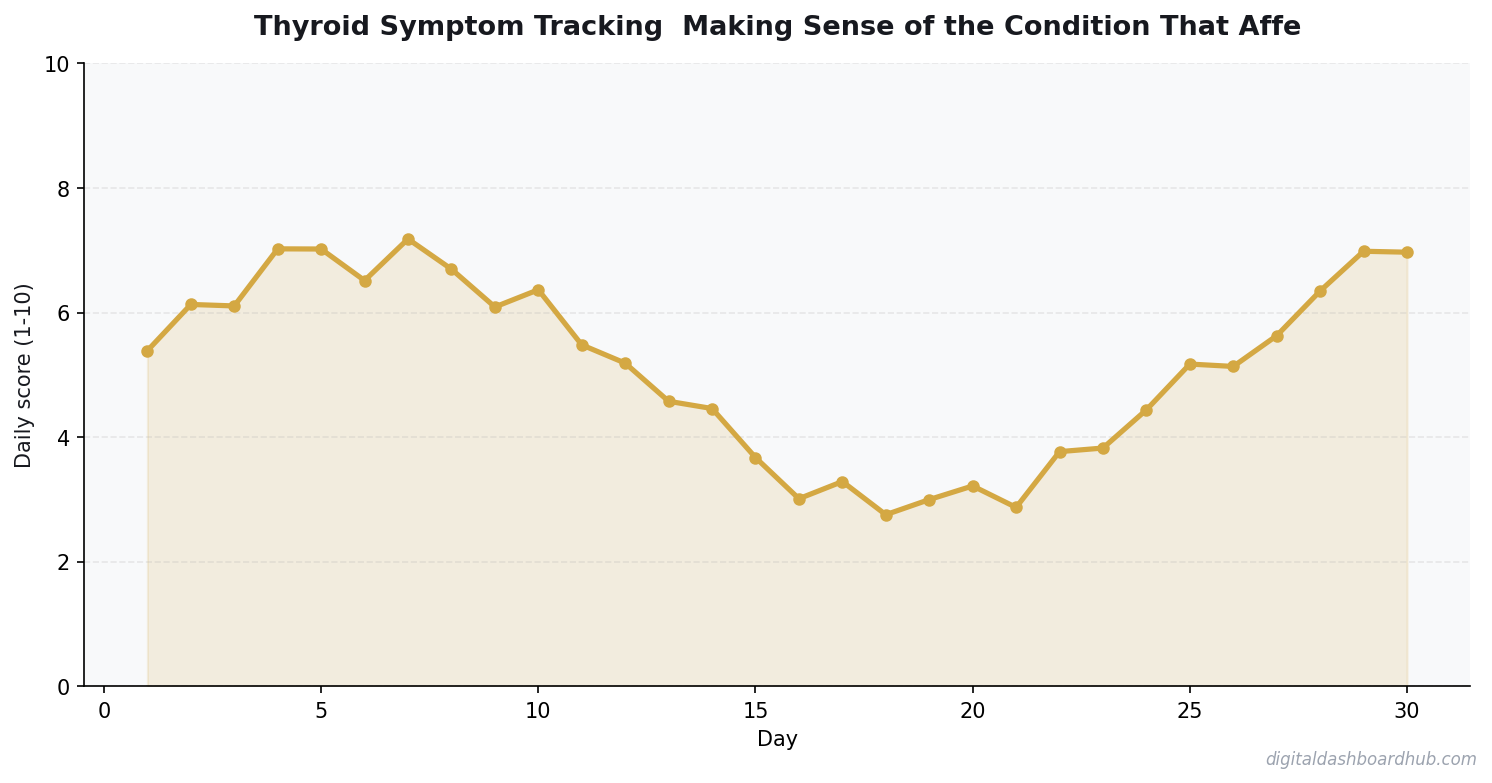
When you have a thyroid condition, symptoms don’t always announce themselves clearly. Some days you feel fine; other days you’re exhausted for no apparent reason. This is where a thyroid symptom journal becomes invaluable. By logging your symptoms consistently, you’ll start to see patterns that you—and your doctor—can use to optimize treatment.
Here are the key symptoms to track:
Energy Levels and Fatigue
This is perhaps the most noticeable symptom for people with hypothyroidism. Track:
– How you felt when you woke up (rested vs. exhausted)
– Energy dips throughout the day
– Whether you needed caffeine and how much
– Your capacity for exercise or activity
Rate these on a scale of 1-10 for easy comparison over time.
Weight Changes
Your thyroid affects your metabolism directly. Log:
– Your weight (weekly, not daily)
– Changes in how your clothes fit
– Appetite level
– Cravings or changes in food preferences
– Whether weight changes seem proportional to your diet and exercise
Hair Loss or Unusual Hair Growth
Thyroid hormones regulate hair growth cycles. Track:
– Amount of hair loss (in shower, on pillow, in brush)
– Changes in hair texture or thickness
– Eyebrow thickness (a surprisingly accurate thyroid indicator)
– Any unusual hair growth in unexpected places
Mood and Mental Health
Thyroid hormones significantly impact neurotransmitters. Monitor:
– General mood throughout the day
– Anxiety or panic symptoms
– Brain fog or difficulty concentrating
– Memory issues
– Emotional sensitivity or mood swings
Temperature Sensitivity
Your thyroid regulates how your body handles temperature. Track:
– Whether you feel cold when others don’t (or vice versa)
– Night sweats
– Hot flashes
– How quickly you heat up or cool down during exercise
Digestion and Metabolism
Thyroid hormones affect your entire GI system. Log:
– Constipation or diarrhea
– Bloating or gas
– Changes in appetite
– Heartburn or reflux
Muscle and Joint Issues
Some people experience:
– Muscle aches or weakness
– Joint pain or stiffness
– Carpal tunnel symptoms
Sleep Quality
Track:
– How many hours you slept
– Sleep quality (restful vs. restless)
– Whether you woke frequently
– How you felt after sleep
Lab Values to Monitor: Understanding the Numbers
[IMAGE: Lab results document with key values highlighted]
Lab work is absolutely crucial for thyroid management. Your doctor uses lab values to diagnose your condition and adjust your medication, but you should understand what these numbers mean. When you track them over time, you’ll see how your body responds to treatment changes.
TSH (Thyroid-Stimulating Hormone)
What it is: A hormone produced by your pituitary gland that signals your thyroid to produce more hormone.
What to know: TSH is often the only test conventional doctors run, but it doesn’t tell the whole story. The “normal” range is wide, and optimal levels differ from person to person. Many thyroid patients feel better with TSH levels below 2.5.
For hypothyroidism: You want a lower TSH (usually 0.5-2.5).
For hyperthyroidism: You want a higher TSH (usually 0.5-2.5, but higher than usual for your condition).
Free T4 (Free Thyroxine)
What it is: The active thyroid hormone available in your bloodstream.
What to know: This is more useful than Total T4 because it measures the hormone your body can actually use. If you’re taking thyroid replacement medication (like levothyroxine), Free T4 should be stable or in the mid-to-upper range of normal for you to feel well.
Track: How you feel in relation to your Free T4 levels.
Free T3 (Free Triiodothyronine)
What it is: Another active thyroid hormone, more potent than T4.
What to know: Many thyroid patients feel better when Free T3 is optimized. Some people don’t convert T4 to T3 efficiently, which is why this test matters.
Track: Whether you feel better when T3 is in the upper-normal range versus lower-normal range.
TPO Antibodies (Thyroid Peroxidase)
What it is: An antibody your immune system produces if you have autoimmune thyroid disease (Hashimoto’s or Graves’).
What to know: If these are elevated, you have autoimmune thyroiditis. Understanding this helps explain your symptoms and might prompt dietary or lifestyle changes.
Track: Whether antibody levels change over time and what correlates with improvements.
Thyroglobulin Antibodies
What it is: Another autoimmune marker in Hashimoto’s disease.
What to know: About 80% of Hashimoto’s patients have elevated TPO, and about 50% have elevated thyroglobulin. Track both if you have autoimmune thyroiditis.
Additional Important Tests
Depending on your situation, your doctor might also order:
– Iron/Ferritin: Essential for thyroid hormone production and conversion
– B12 and Folate: Low levels worsen fatigue
– Vitamin D: Deficiency is common in thyroid patients
– Magnesium: Important for TSH suppression and overall health
– Selenium: Required for thyroid hormone conversion
How Tracking Improves Your Relationship With Your Doctor
[IMAGE: Patient showing symptom tracker to doctor in office]
One of the most frustrating experiences for thyroid patients is explaining their symptoms to healthcare providers who seem skeptical or dismissive. “Your labs look fine,” they say. “You’re just tired. Everyone gets tired.”
But when you walk into your appointment with organized, detailed tracking data, everything changes.
You Become a Credible Source of Information
Doctors make decisions based on symptoms plus lab work. If you say “I’ve been exhausted,” that’s subjective. But when you say “My energy level, rated on a scale of 1-10, has been 3-4 for the past three weeks, with a dip every Tuesday and Thursday,” that’s data. That’s concrete.
When you track symptoms alongside lab results, you create an undeniable pattern. You can show your doctor: “My TSH was 3.2 last month, and I felt like this. Now it’s 2.8, and I feel like this.” This demonstrates that your subjective experience correlates with objective measurements.
You Help Your Doctor Identify Patterns
Some thyroid symptoms have clear triggers:
– A food sensitivity that causes thyroid-related symptoms
– A medication timing issue (are you taking medication at the optimal time?)
– A nutrient deficiency that needs supplementation
– A specific time of day or menstrual cycle phase when symptoms worsen
Without tracking, these patterns remain invisible. With it, they become obvious.
You Can Request Appropriate Treatment Adjustments
If you show your doctor that you feel significantly better when your Free T3 is in a certain range, you can request medication adjustments that target that outcome. If your tracking shows that you’re having frequent flare-ups despite medication, you can advocate for additional testing or treatment modifications.
You Advocate for Yourself More Effectively
Thyroid patients often struggle with medical gaslighting—having their legitimate symptoms dismissed or attributed to mental health. When you present organized data, you position yourself as someone who has done their research and is invested in their own care. This shifts the dynamic from patient asking for sympathy to patient presenting evidence.
Practical Thyroid Tracking Methods
Now that you understand what to track, let’s talk about how to track it. You have several options, and the best one is the one you’ll actually use consistently.
Option 1: The Spreadsheet Approach
A thyroid symptom journal spreadsheet gives you maximum flexibility and ability to notice trends. You can:
– Create columns for date, time, symptoms, meals, medications, stress level, and lab values
– Use color-coding (green for good days, yellow for okay, red for difficult)
– Add formulas to average your energy levels or track patterns
– Include notes about what you ate, how you exercised, and external stressors
This works best if you’re comfortable with spreadsheets and enjoy data analysis. The investment upfront is small, but the payoff is huge—you’ll be able to spot patterns that a simple symptom tracker can’t reveal.
A hypothyroidism tracking spreadsheet (or equivalent for hyperthyroidism) helps you keep all your health information in one organized place. Many thyroid patients find that similar tracking principles help with other chronic conditions, too. If you’re managing multiple health concerns, you might appreciate how a comprehensive health tracker helps you see connections between different symptoms.
Option 2: The Health App Approach
Apps like Apple Health, MyFitnessPal, or condition-specific apps let you log symptoms quickly and easily. Benefits:
– Easy to access from your phone
– Can set reminders to log symptoms
– Built-in graphing features
– Portable and convenient
Downsides:
– Less customization
– May not track all the specific values you care about
– Data privacy concerns
Option 3: The Bullet Journal Approach
A low-tech option that works well for many people. You can:
– Use a physical notebook dedicated to thyroid tracking
– Create a simple daily or weekly log
– Include space for notes about how you felt
– Keep all information in one place that you can bring to doctor appointments
Benefits:
– Tactile and engaging
– No technology required
– Can be more memorable
Downsides:
– Harder to spot trends in large datasets
– Can’t easily search or sort
– Less portable
Option 4: The Hybrid Approach
Many people use a combination: daily logging in a spreadsheet or app, weekly summaries in a journal, and monthly reviews where they look for patterns.
What to Log Daily, Weekly, and Monthly
To avoid overwhelm, categorize your tracking by frequency:
Daily Logging (Takes 5-10 Minutes)
- Energy level (1-10 scale)
- Mood (1-10 scale, plus any notable emotions)
- Sleep hours and quality
- Exercise/activity level
- Meals (especially if testing food sensitivities)
- Medications taken and times
- Stress level (1-10)
- One or two symptoms that stand out
Weekly Logging (Takes 10-15 Minutes)
- Weight (same day, same time each week)
- Hair loss observation
- Summary of how the week felt overall
- Any changes in medication or dosage
- Significant life events or stressors
- Diet changes or new foods tried
Monthly Logging (Takes 20-30 Minutes)
- Review the entire month’s data
- Note patterns you’ve observed
- Compare how you felt this month vs. last month
- Note any correlations between symptoms and external factors
- Prepare notes/questions for your doctor
- Plan any adjustments you want to discuss
Pro tip: Set phone reminders for your daily logging time. Choose a time that fits naturally into your routine—maybe with breakfast, at lunch, or before bed.
Beyond Symptom Tracking: The Bigger Picture
While symptom and lab tracking is crucial, remember that thyroid health exists within a broader context. Many thyroid patients benefit from also monitoring:
Stress Levels and Mental Health
Stress absolutely impacts thyroid function. High cortisol levels can worsen both hypothyroidism and hyperthyroidism symptoms. If you’re managing thyroid disease alongside anxiety or other mental health challenges, consider adding a stress-tracking component to your routine. Tools like a stress management spreadsheet can help you identify whether stress is exacerbating your physical symptoms.
For those dealing with anxiety specifically, tracking how your thyroid symptoms correlate with anxiety patterns can be enlightening. An anxiety management spreadsheet designed for daily tracking helps you see whether your anxiety is thyroid-related, environmental, or a combination of factors.
Related Health Conditions
Thyroid disease often coexists with other endocrine and metabolic conditions. Women with PCOS (polycystic ovary syndrome), for example, frequently have thyroid issues. If you’re managing multiple conditions, using a unified tracking system helps you understand how they interact. Many thyroid patients also manage conditions like PCOS, and comprehensive tools like a PCOS management spreadsheet or PCOS symptom tracker demonstrate how interconnected our health systems truly are.
Lifestyle Factors
Your thyroid doesn’t exist in isolation. Track how the following affect your symptoms:
– Sleep quality and quantity
– Exercise type and intensity
– Nutrition (especially iodine, selenium, zinc, iron)
– Stress and relaxation
– Caffeine and alcohol intake
– Medication timing
Some thyroid patients benefit from adding meditation or mindfulness practice to their routine. A meditation practice spreadsheet can help you track whether regular meditation correlates with better thyroid symptom management.
If you’re managing thyroid disease alongside ADHD or other neurodevelopmental conditions, you might appreciate a comprehensive ADHD life management tracker that helps you organize all aspects of your health simultaneously.
Common Tracking Mistakes to Avoid
As you build your tracking practice, watch out for these common pitfalls:
Mistake #1: Logging Only When You Feel Bad
Many people naturally document their worst days but forget to log good days. This creates a skewed picture. Make sure to log consistently, even on good days. That’s when you’ll spot the patterns that led to the improvement.
Mistake #2: Being Too Vague
“I felt bad today” tells you nothing. Instead: “Energy level 2/10, constipated, anxiety spiked around 3 PM, cold even though it was 72 degrees.” Specificity is power.
Mistake #3: Not Connecting Symptoms to Context
Always note what might have contributed to how you felt. Did you sleep poorly? Skip your medication? Eat a new food? Experience stress? These connections are crucial.
Mistake #4: Ignoring Your Data
The worst thing you can do is track meticulously and then never review it. Set aside time monthly to actually look at what you’ve logged and identify patterns.
Mistake #5: Changing Multiple Variables at Once
If you start new medication, change your diet, start exercising, and begin meditation simultaneously, you won’t know what’s helping. Make one significant change at a time when possible, so you can clearly see its impact.
Mistake #6: Comparing Your Numbers to Someone Else’s
Your optimal TSH might be different from your friend’s. Your best Free T4 level might not match online forums. Track trends in your data, not against external standards.
Preparing for Your Doctor Appointments
When you have solid tracking data, your doctor appointments become infinitely more productive.
Before Your Appointment:
- Review your logs and note 3-5 key patterns or concerns
- List any questions or symptoms you want to address
- Prepare a one-page summary of major trends (not every single data point)
- Bring your tracking system or a printout
- Note any changes in medications or supplements you’re taking
During Your Appointment:
- Share your data in an organized way
- Connect your subjective experience to objective measurements
- Ask specific questions about how to optimize your treatment
- Discuss whether you want to try medication adjustments
- Ask for more frequent labs if you’re struggling to stabilize
- Get copies of all lab results to track yourself
After Your Appointment:
- Continue logging as instructed
- If medication changes, note the date clearly
- Track specifically how you feel after any adjustments
- Schedule a follow-up to assess whether changes helped
The Emotional Component: Why Tracking Helps Mentally Too
There’s something deeply validating about documenting your symptoms. When you spend weeks feeling like your concerns are being dismissed, the act of meticulously tracking and organizing data does more than just create medical records—it validates your experience. You’re literally proving that something is real, that it’s measurable, that it matters.
Thyroid disease is invisible. Many days you look fine while feeling terrible. Tracking gives you permission to trust yourself. You’re not crazy. You’re not lazy. Your fatigue is real, and you have the data to prove it.
Additionally, when you review your tracking over weeks and months, you’ll likely find that your situation has improved more than you realized. You might notice that while you’re not “cured,” you feel significantly better than you did three months ago. That progress, when documented, is powerful and motivating.
About Track & Thrive Wellness
Track & Thrive Wellness is dedicated to helping people with chronic health conditions take control of their health through organized tracking and data-informed decision-making. We believe that you deserve healthcare that listens to you, and that happens most effectively when you have clear, compelling data about your own body and health.
Our philosophy is simple: understanding your health starts with measuring it accurately and consistently. Whether you’re managing thyroid disease, hormonal conditions, mental health challenges, or multiple intersecting health concerns, our tools are designed to help you become your own best health advocate.
Your Free Resource: The Thyroid Symptom & Lab Tracker
Ready to start tracking? We’ve created a comprehensive Thyroid Symptom & Lab Tracker specifically designed for people managing thyroid disease. This tracker includes:
- Daily symptom logging templates
- Weekly health summary sections
- A lab value tracking spreadsheet where you can record all your test results
- Instructions for identifying your personal patterns
- A communication guide for doctor appointments
- Space for tracking medications and dosages
This valuable resource is absolutely free. Just enter your email below, and we’ll send it directly to your inbox.
[EMAIL CAPTURE: Get our free Thyroid Symptom & Lab Tracker]
When you sign up, you’ll also receive our ongoing emails with thyroid management tips, new articles, and early access to new Track & Thrive Wellness resources—all designed to help you feel better and manage your condition more effectively.
Final Thoughts: Take Control of Your Health
Thyroid disease is manageable. Not always easy, not always linear, but manageable. The difference between thyroid patients who feel out of control and those who feel empowered often comes down to one thing: information.
When you know what to track, you stop being a passive patient waiting for answers. You become an active participant in your healthcare. You gather evidence. You spot patterns. You ask informed questions. You advocate for yourself effectively.
Thyroid symptom tracking might seem like a small thing—just numbers and notes on a spreadsheet or in a journal. But over time, it transforms your relationship with your body and your health. It turns confusion into clarity. It turns dismissed concerns into undeniable facts. It turns a vague sense of “something’s wrong” into specific, addressable issues.
Start tracking today. Choose a method that resonates with you. Commit to logging for just one month. At the end of that month, review your data. You might be surprised what you discover about your own body.
Your thyroid is small, but you’re powerful—especially when you have data on your side.
Further Resources and Reading
- American Thyroid Association (ATA) — for evidence-based thyroid information
- Thyroid Patient Advocacy Foundation — for community support and education
- Your doctor or endocrinologist — for personalized guidance specific to your situation
- The thyroid tracking community online — for tips, support, and shared experiences
Ready to take the next step? Download your free Thyroid Symptom & Lab Tracker and start building the data that will transform your healthcare experience.
[EMAIL CAPTURE CTA: Get the Free Tracker]
Keep reading (related guides):
- How Much Does Therapy Cost in 2026? A State-by-State Breakdown
- Free ADHD Impulse Spending Tracker — Try It Now
- Blood Pressure Tracker: The Daily Logging Habit That Can Save Your Life
- My Anxiety Spiraled Out of Control — A Tracking System That Pulled Me Back
- Debt Snowball vs Avalanche Calculator: Which Method Saves You More Money
255+ interactive tools for your money, time, and health.
Full features for 14 days · Secure payment · Stop anytime
Keep Reading
- I Tested 9 Expense Tracker Apps for 3 Months — Here’s What Actually Worked
- How to Regulate Your Nervous System: 8 Steps to Move From Chronic Stress to Calm
- I Tracked My Nervous System for 90 Days — Here’s What I Learned About My Stress, Sleep, and Sanity

Andy Gaber is the founder of Digital Dashboard Hub, a suite of 255+ interactive financial, productivity, and wellness tools. He built DDH after getting frustrated with financial apps that gave outputs without context. Follow along for tool tutorials, revenue analytics breakdowns, and honest takes on personal finance.