therapy-the-price-tag-is-what-s-stopping-you”>You Already Know You Need Therapy — the Price Tag Is What’s Stopping You
The dashboard below loads instantly in your browser. Plug in your numbers, see your answer. No signup to try the basics.
What to Remember
In This Article
Most therapists recommend starting weekly, then stepping down to biweekly after 3-6 months. A realistic first-year budget with insurance: $1,500-$2,500. Without insurance: $4,000-$8,000.
Let’s skip the “mental health is important” speech. You know it is. The real barrier is staring at your bank account and wondering if you can afford $200 a week on top of rent, groceries, and the student loans that never seem to shrink. So let’s talk actual numbers.
Real Talk
The difference between people who hit their targets and those who don’t? They measure weekly, not yearly.
Therapy costs in 2026 range from $80 to $350 per session depending on where you live, what kind of therapist you see, and whether insurance covers any of it. That’s a massive range, and most people have no idea where they fall until they’re already sitting in an intake session getting quoted a number that makes their anxiety worse.
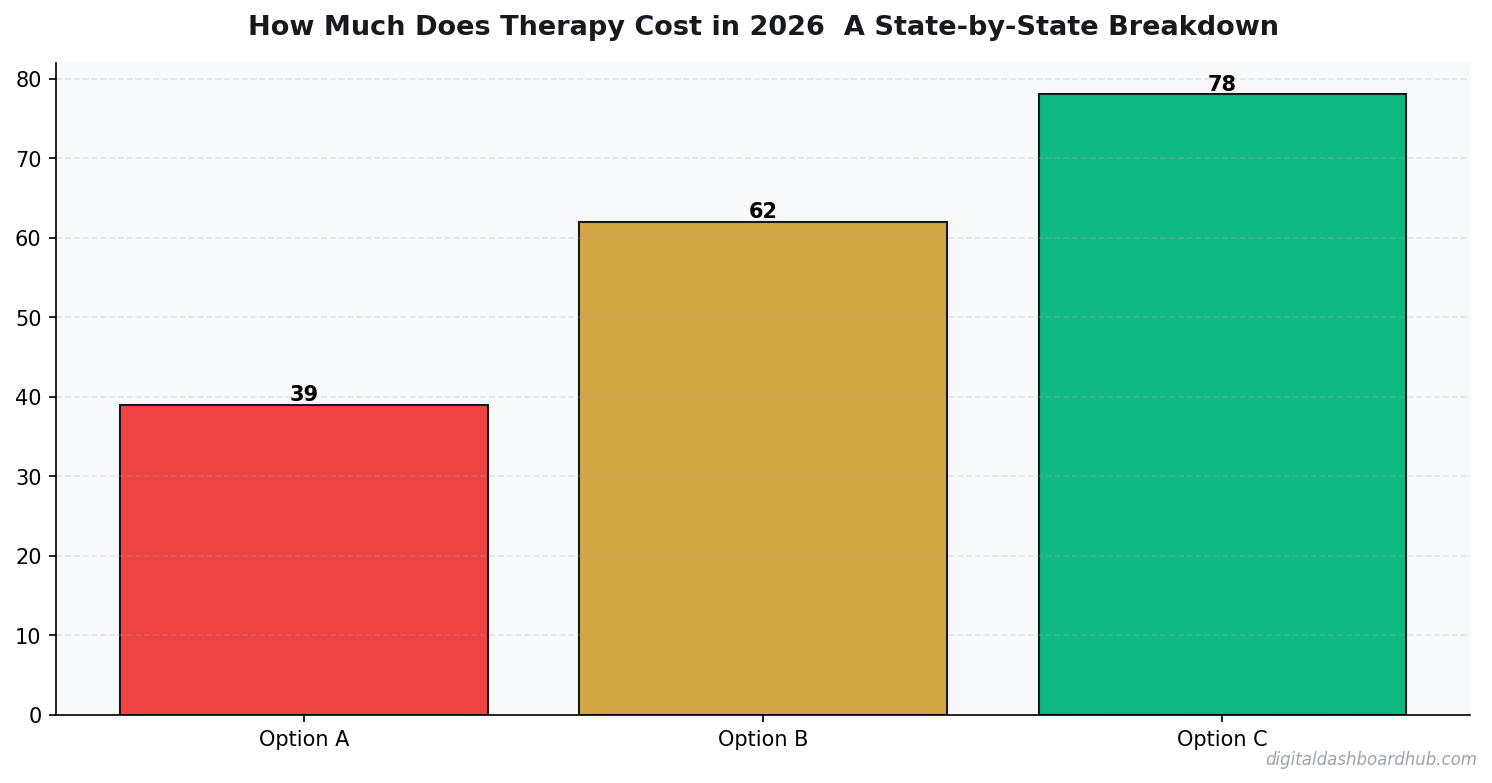
State-by-State Therapy Costs (2026 Averages)
These are average per-session rates for a licensed therapist (LCSW, LPC, or psychologist) based on 2025-2026 data from therapy directories and insurance filings:
Pattern: coastal and metro areas run 40-60% higher than the Midwest and rural South. New York City therapists regularly charge $250+ per session. A therapist in rural Ohio might charge $100.
The Four Ways to Pay for Therapy
Each has trade-offs most people don’t consider until they’re already committed:
The Insurance Trap Nobody Mentions
Using insurance for therapy means a mental health diagnosis goes on your permanent medical record. For most people, that’s totally fine. But if you’re in certain professions — military, law enforcement, aviation, some government positions — a diagnosis like “major depressive disorder” can affect your career. Something to consider, not panic about.
The other insurance catch: most plans cap sessions. Many cover 20-30 sessions per year. If you’re going weekly, that runs out by July. After that, you’re paying full freight anyway.
Annual Therapy Cost Estimates
The takeaway a year of therapy actually looks like at different frequencies:
Most therapists recommend starting weekly, then stepping down to biweekly after 3-6 months. A realistic first-year budget with insurance: $1,500-$2,500. Without insurance: $4,000-$8,000.
Want to map out your actual therapy costs alongside the rest of your budget? Our health expense calculators help you plan for recurring costs like therapy, prescriptions, and out-of-pocket maximums — so the financial stress doesn’t cancel out the mental health gains.
How to Lower Your Therapy Costs
Real options that real people use:
- Ask about sliding scale directly. Many private practice therapists offer 2-5 sliding scale slots. You won’t see it advertised — you have to ask.
- Use your HSA/FSA. Therapy is an eligible expense. If your employer offers an HSA, you’re paying with pre-tax dollars — effectively a 25-35% discount.
- Try online platforms. BetterHelp and Talkspace run $65-$100/week for unlimited messaging plus weekly sessions. Not ideal for everyone, but 50-70% cheaper than in-person.
- Check university training clinics. Graduate students supervised by licensed psychologists. Sessions run $20-$50. Quality varies, but many are excellent.
- Open Path Collective. Membership ($65 lifetime fee) gets access to therapists charging $30-$80 per session. Legitimate resource.
Real-Time
Calculations
Results update as you type your numbers
Three Steps to Get Started
- Call your insurance today. Ask: “How many outpatient mental health sessions are covered per year, and what’s my copay for an in-network therapist?” Write down the exact numbers.
- Budget for it monthly. Take your expected per-session cost, multiply by your planned frequency, and set that money aside like a bill — because it is one.
- Start looking. Psychology Today’s directory lets you filter by insurance, specialty, and sliding scale. Search your zip code and reach out to 3-5 therapists today. Waitlists are real, so start now even if you’re not ready for another month.
Hundreds of users track healthcare costs and personal budgets with Digital Dashboard Hub. Start your free trial and build a budget that actually accounts for the things that matter.
What Therapy Actually Costs State by State: Real 2026 Numbers
National averages mask 3x differences across states. Here’s what a 50-minute session with a licensed therapist (LCSW or LPC) actually costs out-of-pocket in 2026 if you’re paying without insurance:
- California (San Francisco): $225–$300/session. Many therapists have waitlists.
- New York (Manhattan): $200–$280/session. Outer boroughs: $150–$200.
- Texas (Austin): $130–$175/session. Rural Texas: $80–$120.
- Ohio (Columbus): $100–$140/session. Some sliding scale to $60.
- Tennessee (Nashville): $110–$160/session.
- Online-only therapists (any state): $70–$120/session via platforms like Open Path Collective.
The online option is the most underused cost lever. For most therapy modalities — CBT, talk therapy, DBT skills — the research shows telehealth outcomes are equivalent to in-person for non-severe presentations. If cost is a barrier, online therapy at $80/session vs. $180/session is a real decision worth making.
How to Actually Use Insurance for Therapy (Most People Don’t Know This)
If your insurance includes mental health benefits (required under the Mental Health Parity Act), your out-of-pocket cost may be $20–$60/session after deductible — but accessing it requires finding in-network providers, which is often hard. The workaround: ask your therapist for a “superbill” (an itemized receipt with diagnostic and procedure codes). Submit it to your insurance yourself for out-of-network reimbursement. Many PPO plans reimburse 50–80% of out-of-network costs after deductible — reducing a $180 session to effectively $36–$90. Most patients never ask about this.
One cost most therapy cost guides miss: the “getting started” gap. Many people spend months in therapist-matching mode — trying a first session, it doesn’t click, waiting 3–4 weeks for the next available appointment elsewhere. That cycle costs money in session fees and time in mental health limbo. If you’re price-sensitive, look for group therapy as a parallel option. Group CBT for anxiety or depression typically runs $40–$75/session and the research outcomes are surprisingly comparable to individual therapy for many presentations.
One cost most therapy cost guides miss: the finding-a-fit gap. Many people spend months in therapist-matching mode — trying a first session, it doesn’t click, waiting 3–4 weeks for the next available appointment elsewhere. That cycle costs money in session fees and time in mental health limbo. If you’re price-sensitive, community mental health centers offer sliding scale services at $0–$40/session based on income. They have waitlists too, but the wait is often worth it for the dramatically lower ongoing cost.
Keep reading (related guides):
- How to Save $10,000 in 6 Months: A Realistic Plan That Actually Works
- Therapy Costs in 2026: In-Network vs. Out-of-Pocket vs. Online (State-by-State Data)
- Youre Probably Wasting $200/Month on Subscriptions You Forgot About (Heres How to Find Them)
- Bakery Revenue Calculator
- Boutique Revenue Calculator
255+ interactive tools for your money, time, and health.
Full dashboard access · Stripe-secure checkout · Cancel anytime
Keep Reading
- How Sinking Funds Saved Me from Financial Emergencies
- Why Traditional Budgets Fail ADHD Brains
- Sinking Fund Savings Goal Planner (Free Tool)
Common Questions About How Much Does Therapy Cost in 2026? A State-by-State Breakdown
How long does it take to see results?
Most people see meaningful progress within 30-90 days when they apply these strategies consistently. The key is tracking your numbers from day one so you have a baseline to measure against.
What’s the biggest mistake people make?
Trying to do everything at once. Pick one or two strategies from this guide, implement them fully, then layer in additional tactics. Spreading yourself thin is the fastest way to see no results from any of it.
Do I need special tools or software?
Not necessarily to start — but the right tools eliminate hours of manual work. Our free calculators and trackers at Digital Dashboard Hub are a good starting point before you invest in paid software.

Andy Gaber is the founder of Digital Dashboard Hub, a suite of 255+ interactive financial, productivity, and wellness tools. He built DDH after getting frustrated with financial apps that gave outputs without context. Follow along for tool tutorials, revenue analytics breakdowns, and honest takes on personal finance.