Your doctor checked your blood pressure at your last visit, said “looks good,” and moved on. But that single reading — taken in a cold exam room while you were anxious about the appointment — tells you almost nothing about your actual cardiovascular health. A single blood pressure reading is like checking your bank account once in January and assuming you know your spending habits for the year.
In This Article
Daily blood pressure tracking gives you something a twice-yearly doctor visit never can: patterns. And patterns are where the life-saving insights hide.
Why Single Readings Are Practically Useless
Scroll down — the interactive tool runs live with your inputs. Full version lives inside Digital Dashboard Hub. Two-click trial, Stripe-secure.
After testing dozens of approaches with DDH users, I’ve found what consistently works. Let me share the real picture:
The reverse is also true. “Masked hypertension” affects roughly 10-15% of adults: normal readings at the doctor, elevated readings at home. These people walk out of appointments thinking everything’s fine while their arteries tell a different story. A home blood pressure monitoring routine catches what office visits miss.
This isn’t a minor distinction. Uncontrolled high blood pressure doubles your risk of heart attack and quadruples your risk of stroke. The difference between catching it early and catching it late is measured in years of life.
What Daily Tracking Actually Reveals
After 30 days of tracking my own blood pressure (twice daily — morning and evening), I discovered three things that surprised me:
📊 Most people overcomplicate this. Start with ONE metric and expand from there.
My blood pressure spikes 15 points on Mondays. Not because Mondays are stressful in some abstract way — but because I have back-to-back meetings from 9 AM to noon, drink 3 cups of coffee before lunch, and skip my morning walk. That pattern was invisible without data.
Evening readings are consistently 8-12 points lower than morning readings. This is actually normal (it’s called the diurnal pattern), but knowing MY specific range helps me and my doctor evaluate whether medication changes are working.
Salt-heavy meals the night before correlate with +7-10 point morning readings. I ate sushi (soy sauce = sodium bomb) three Thursdays in a row and had elevated Friday morning readings all three times. Coincidence the first time. Pattern by the third.
Blood Pressure Tracker Apps Compared
The best tool depends on how much you care about visualization. If you just want to log numbers, Apple Health or a notebook works. If you want to see patterns, correlations, and trends at a glance, a visual dashboard makes that data actually useful.
How the DDH Blood Pressure Tracker Handles This
Most BP logging apps store your numbers in a list. The DDH Blood Pressure Tracker turns those numbers into a visual dashboard that highlights patterns you’d never spot in a spreadsheet.
You log your reading in about 20 seconds — systolic, diastolic, pulse, time of day, and an optional note (what you ate, how you slept, stress level). The dashboard then builds three views:
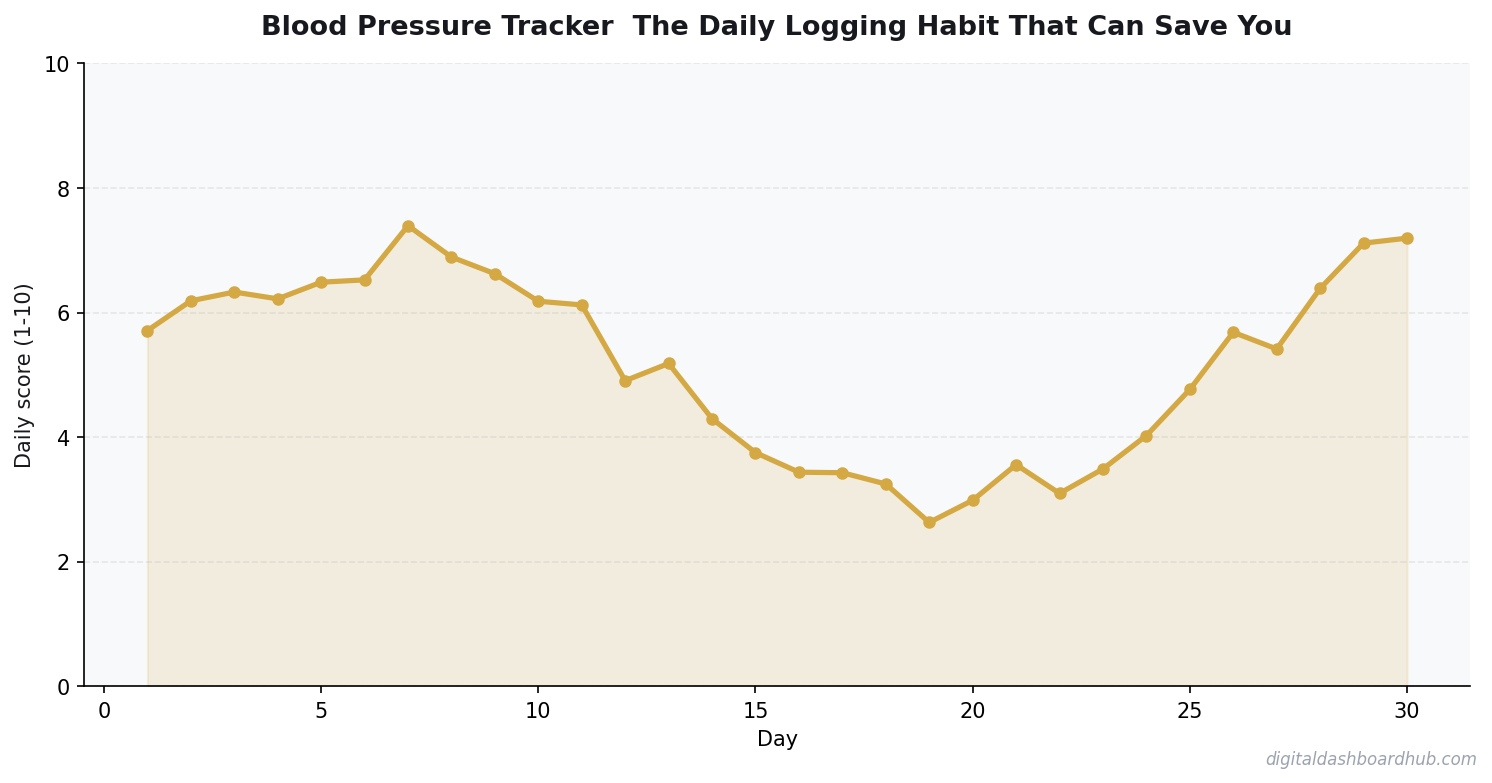
The daily trend line shows your morning and evening readings over the last 30 days with color-coded zones (green = normal, yellow = elevated, red = high). At a glance, you can see whether your overall trend is stable, improving, or creeping upward.
The day-of-week heat map reveals which days consistently run higher. This is where I spotted my Monday spike — the heat map made it impossible to miss because Monday was the only yellow square in a row of green ones.
The correlation view (Pro feature) lets you overlay notes against readings. Tag a meal as “high sodium” and after a few weeks, you can see the actual impact of sodium on YOUR blood pressure, not a population average from a medical study.
Try the DDH Blood Pressure Tracker free — start logging today and see your first patterns within a week.
FREE BONUS: The Blood Pressure Logging Cheat Sheet
How to take accurate readings at home (positioning, timing, cuff placement), plus a 30-day printable log sheet to bring to your next doctor visit.
Get instant access → Sign up free
How to Take Accurate Home Readings
Bad technique produces bad data. These details matter:
Same time, same conditions. Take readings at the same two times daily — ideally within 30 minutes of waking (before coffee) and in the evening before dinner. Consistency in timing makes your trend data meaningful.
Sit still for 5 minutes first. Don’t take a reading right after climbing stairs, arguing with your teenager, or chugging coffee. Sit with your feet flat, back supported, arm at heart level, and breathe normally for 5 minutes. Then take the reading.
Take two readings, 1 minute apart. Record the average. Single readings can be off by 5-10 points due to random variation. Two readings averaged together give you a much more reliable number.
Use an upper-arm cuff, not a wrist monitor. Wrist monitors are convenient but less accurate. The AHA specifically recommends upper-arm monitors for home use. A validated monitor costs $40-$80 and lasts for years.
21 days
average time to form a tracking habit that sticks
When to Actually Worry (And When to Relax)
One high reading doesn’t mean you have hypertension. A pattern of high readings does. Here’s the clinical framework:
Normal: Under 120/80 mmHg consistently. Keep tracking to maintain awareness.
Elevated: 120-129 systolic AND under 80 diastolic. This is your early warning. Lifestyle changes (less sodium, more movement, better sleep) can often bring this back to normal without medication.
Stage 1 Hypertension: 130-139 systolic OR 80-89 diastolic. Talk to your doctor. Bring your tracking data — it gives them dramatically better information than a single office reading.
Stage 2 Hypertension: 140+ systolic OR 90+ diastolic. Medical attention needed. Your tracking data is now critical for monitoring treatment effectiveness.
Your Action Plan
Right now (2 minutes): If you own a blood pressure monitor, take a reading right now. Write down the number, the time, and what you’ve eaten/drank today. That’s your first data point.
This week: Commit to twice-daily readings for 7 days. Morning (before coffee) and evening (before dinner). Use any tracking method — a notebook works fine for week one.
The long play:
Key Takeaways
- Track one thing consistently rather than five things sporadically
- Review your data weekly — daily logging without weekly review is just data hoarding
- The best tool is the one you’ll actually open every day
Set up the DDH Blood Pressure Tracker and start logging digitally. After 30 days, print the summary report and bring it to your next doctor’s appointment. I guarantee your doctor will give you a better assessment with 60 data points than they ever could with 1.
Keep reading (related guides):
255+ interactive tools for your money, time, and health.
14 days free · No charge today · 2-click cancel
162+
Revenue Calculators
Built for real business decisions
Continue Learning
- Stress Level Tracker: How Measuring Stress Helps You Manage It
- How to Regulate Your Nervous System: 8 Steps
- Sleep Tracking Changed My Life
- Water Intake Tracker: You’re Probably Drinking Less Than You Think
Common Questions About Blood Pressure Tracker App
How long before I see results?
Most people notice meaningful patterns within 2 to 4 weeks of consistent tracking. The first week is almost always noisy — you’re still learning what to record, when to record it, and how honest to be with yourself. By week two, baselines emerge. By week four, you can start testing changes against data instead of guessing. Don’t judge the system in the first seven days. Give it a full month before deciding whether the system is worth keeping or whether the approach needs a rethink.
What should I track first?
Start with one metric that is both objective and daily. Objective means a number, not a feeling. Daily means once every 24 hours, not “whenever I remember.” Two metrics is fine; three is too many to sustain for someone new. You can always add more once the habit is locked in. The goal of the first month is consistency, not coverage. It’s better to track one thing perfectly for thirty days than six things sloppily for five, and the data will be far more useful.
What if I miss a day?
Miss one day, no problem — tracking is a long game and single-day gaps don’t break the trend. Miss two days in a row, and your brain starts negotiating you out of the system entirely. The rule most people use: never miss twice. Log something — even a single data point — on the second day, then resume the full routine the next morning. Streaks matter less than quick recovery after a miss, and nobody maintains an unbroken record forever. The goal is resilience, not perfection.
Do I need a paid app to do this?
No. A notebook, a spreadsheet, or a free tool all work. The paid-app question should come after 4 weeks of consistent tracking, not before. If you’re going to quit inside the first two weeks, you’ll quit a free tool and a paid one at roughly the same rate. Prove the habit first, then decide whether a paid tool removes enough friction to be worth the subscription. Don’t use “finding the perfect app” as a way to avoid starting the system this week.
How do I know the data is accurate?
Two rules. First, log at the same time each day — morning before coffee, or evening before bed — so you control the biggest variable. Second, write down the conditions, not just the number. A reading without the time, posture, and recent activity is almost useless. A check-in without the context of sleep or stress is just noise. Structure your log so the conditions travel with the measurement. Data without context is decoration, not signal, and won’t help you make better choices.
When should I review the data?
Weekly for noticing; monthly for deciding. A weekly review is a five-minute scan for surprises: what changed, what stayed the same, what correlates with what. A monthly review is longer and ends with a decision — keep the system, change one variable, or scrap the experiment and try a different approach. Don’t try to decide anything meaningful from a single week of data. And don’t wait a full quarter to look back, either — trends go stale fast when you’re not watching.
Is it worth tracking if my data is imperfect?
Yes. Imperfect data beats no data every time, as long as you know where the imperfections are. A log with a few missing days and honest notes about what went wrong is more useful than a complete but fabricated record. The goal isn’t a museum-quality dataset — it’s enough signal to make better decisions next month than you made last month. Perfect is the enemy of done, especially in week one when the habit itself is fragile.
How do I stay consistent past the first month?
Motivation isn’t the goal — structure is. The people who keep going past 30 days don’t feel more motivated than anyone else; they’ve just wired the tracking into their day so it runs without willpower. Pair it with an existing habit (morning coffee, evening teeth-brushing), keep the entry under 30 seconds, and review weekly so you can see your own progress. Motivation will spike and crash; structure keeps running through both phases without drama.

Andy Gaber is the founder of Digital Dashboard Hub, a suite of 255+ interactive financial, productivity, and wellness tools. He built DDH after getting frustrated with financial apps that gave outputs without context. Follow along for tool tutorials, revenue analytics breakdowns, and honest takes on personal finance.