You told yourself you’d stop. Again. And then the notification pinged, the dopamine hit, and suddenly there’s another $47 charge on your card for something you don’t even remember wanting five minutes ago.
If you have ADHD, this isn’t a willpower problem — it’s a neurological pattern. Your brain processes reward signals differently, and traditional budgeting apps that just show you a pie chart of your overspending are about as helpful as telling someone with glasses to “just squint harder.” You need an ADHD impulse spending tracker built for how your brain actually works.
I’m Andy, the founder of Digital Dashboard Hub. I built these tools for creators and ADHD users because generic productivity apps weren’t designed for how our brains actually work.
Why ADHD Brains Blow Through Budgets
Here’s what most finance gurus won’t tell you: impulse spending in ADHD isn’t about being irresponsible. Research from the Journal of Attention Disorders shows that adults with ADHD are 3-4x more likely to report compulsive buying behaviors compared to neurotypical adults. The prefrontal cortex — the part of your brain that says “wait, do I actually need this?” — is literally underperforming.
So when you open Mint or YNAB and see a category labeled “Shopping: $412 over budget,” your brain doesn’t process that as useful feedback. It processes it as shame. And shame triggers more dopamine-seeking behavior. More spending. Worse spiral.
The fix isn’t another budget column. It’s a visual, dopamine-friendly system that works WITH your ADHD instead of against it.
What the DDH ADHD Impulse Spending Tracker Does Differently
This isn’t a spreadsheet with conditional formatting slapped on it. The ADHD Impulse Spending Tracker is an interactive dashboard purpose-built for neurodivergent brains, and here’s what makes it actually work:
The Impulse Pause System. Before you log a purchase, the tracker asks you three rapid-fire questions: “Did you plan this?” / “Can you return it?” / “Would you buy it again tomorrow?” This 10-second micro-intervention creates just enough friction to break the autopilot cycle — without making you feel like garbage about it.
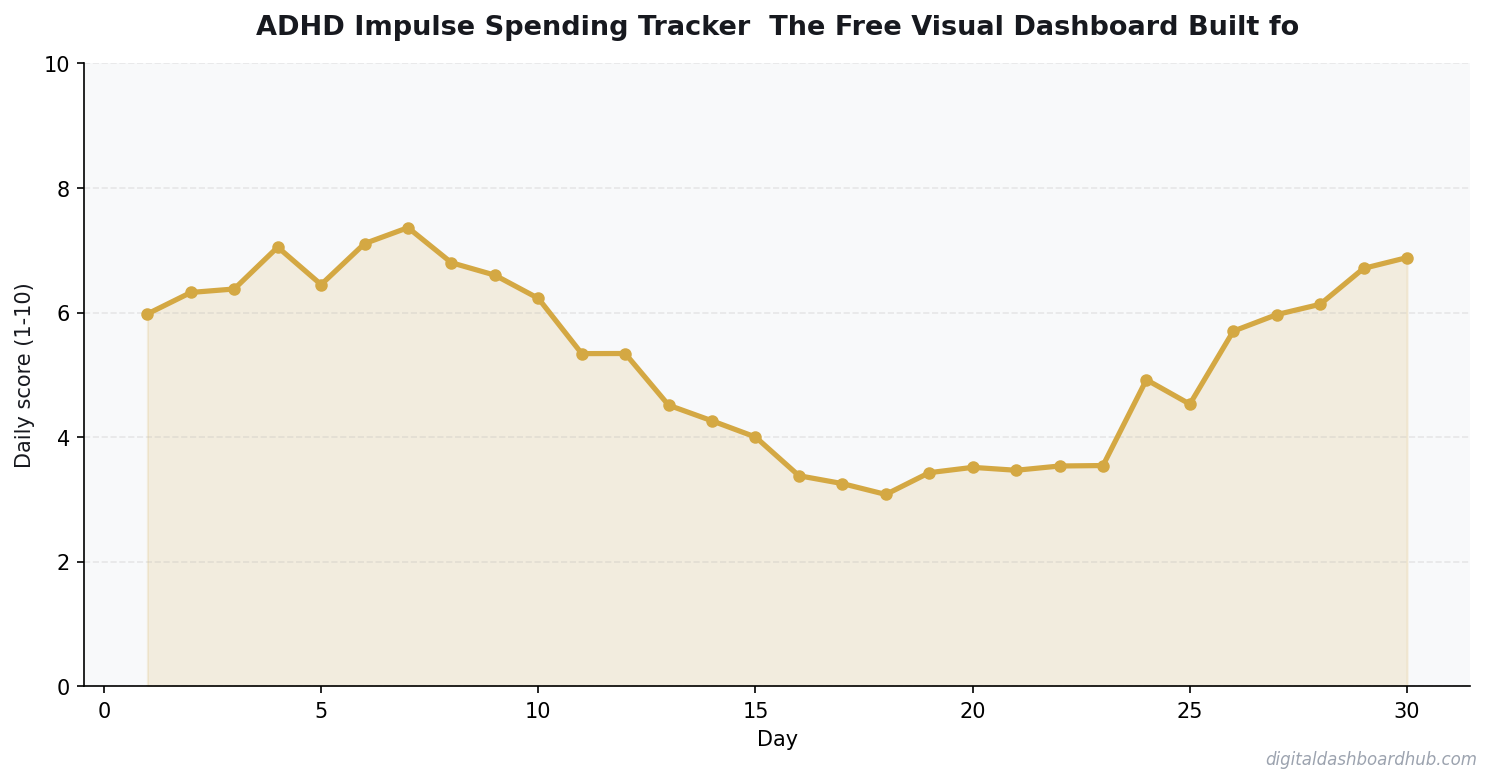
Dopamine-Friendly Visual Progress. Instead of red “over budget” warnings that trigger shame spirals, you get animated progress bars, color-coded spending categories with emoji labels, and a Financial Impulse Score that tracks your trend over time. Watching that score climb from 54 to 72 over three weeks is the kind of visible progress ADHD brains crave.
The Spending Heatmap. See exactly when your impulse purchases cluster — time of day, day of week, even which apps or stores trigger the most unplanned spending. Most people discover they have 2-3 specific “danger windows” and one or two trigger environments they’d never noticed.
Category-Level Impulse Tracking. Not all impulse spending is created equal. A $4 coffee isn’t the same as a $200 Amazon binge. The tracker separates impulse spending by category so you can see WHERE the real damage happens — and focus your energy there instead of white-knuckling every single purchase.
The Win Log. Every time you log a “considered but didn’t buy” entry, the tracker calculates your cumulative savings and celebrates it. ADHD brains need immediate positive feedback to build new habits. The Win Log gives you that dopamine hit from NOT spending — which is the whole game.
How It Works — 60 Seconds to Set Up
Step 1: Open the dashboard and set your monthly spending target. Don’t overthink it — your best guess is fine.
Step 2: Customize your spending categories. The defaults cover the usual suspects (Amazon, food delivery, subscriptions, “random stuff at Target”), but you can rename them to match your actual patterns.
Step 3: Start logging. Every purchase gets a quick tag: Planned, Impulse, or Needs. Takes about 5 seconds per entry. The dashboard does the rest — calculating your impulse ratio, updating your score, and building your heatmap in real time.
Within one week, you’ll have a clearer picture of your spending patterns than most people get from a year of traditional budgeting.
Who This Is For
This tracker was built for people who:
- Have tried “regular” budget apps and felt worse, not better
- Know they overspend but can’t pinpoint exactly where or why
- Want a system that doesn’t rely on shame, guilt, or willpower
- Need visual feedback and quick wins to stay motivated
- Have ADHD (diagnosed or suspected) and want a finance tool that respects how their brain works
It also works well for anyone with impulsive spending patterns, even without an ADHD diagnosis. The psychology behind the Pause System and Win Log applies broadly.
What’s Included
| Feature | Basic Budget App | DDH ADHD Impulse Tracker |
|---|---|---|
| Impulse vs. Planned tagging | No | Yes — every entry |
| Pause prompts before logging | No | Yes — 3-question system |
| Spending heatmap | No | Yes — time + trigger mapping |
| Win Log for resisted purchases | No | Yes — cumulative savings |
| Visual progress (not shame) | Red warnings | Color-coded score + progress bars |
| ADHD-specific design | No | Built for neurodivergent brains |
| Price | $8-15/mo | Free to try |
FREE BONUS: The ADHD Spending Trigger Worksheet
A printable one-page worksheet to identify your top 5 impulse spending triggers and build a personalized “pause plan” for each one. Takes 10 minutes and most people are shocked by what they discover.
Get instant access when you sign up below.
Try the ADHD Impulse Spending Tracker
If you’ve been beating yourself up about spending — stop. Your brain is wired differently, and you deserve a tool that actually works with that wiring instead of pretending it doesn’t exist.
Try it free and see your real impulse spending data in 60 seconds → app.digitaldashboardhub.com/signup
Available as a Google Sheets dashboard and interactive web app. Also on Etsy.
Keep Reading
- ADHD and Money: Why Your Brain Makes Budgeting So Hard
- ADHD Systems That Actually Work
- Goal-Setting for Creators: A Framework That Actually Works
What Your Spending Data Actually Tells You
Most spending trackers show you totals. This one is designed to show you patterns — specifically, the relationship between your emotional state and your wallet. That’s where ADHD impulse spending lives.
When you log consistently for 2-3 weeks, look for these patterns: Do your impulse purchases cluster on certain days of the week? Most people with ADHD see spikes on Fridays (dopamine-seeking at end of work week) and Sundays (anxiety about the week ahead). If that’s you, those are the windows to put friction in place.
Also look at the hour of day. Late-night scrolling-and-buying is the most common impulse pattern — 9pm-midnight is peak “add to cart” time for adults with ADHD. One rule: no purchases after 9pm that weren’t planned before 6pm. That single constraint cuts most late-night impulse spend without requiring willpower.
When Your Numbers Look Bad: What To Actually Do
If your impulse spending is running higher than your target, don’t beat yourself up — your brain is doing exactly what it’s designed to do. Dopamine-seeking through purchasing is a regulatory response, not a character flaw. Here’s what actually works:
- Add a 24-hour rule to your cart: Anything non-essential goes in the cart, but you can’t check out until the next day. About 60% of items get abandoned by morning.
- Identify your trigger states: Boredom, stress, and anxiety are the top three. When you feel one of those states, name it out loud. The act of labeling the emotion short-circuits the automatic purchase response for many people.
- Use visual spending data as a pattern interrupt: Seeing your weekly spend chart go red is surprisingly effective for ADHD brains. Numbers on a screen register differently than a vague sense of “I probably spent too much.”
The Pro Move Most ADHD Spending Guides Miss
Separate your “fun money” into a dedicated account — a second checking account with a specific monthly deposit. $200, $300, whatever you’ve agreed with yourself. Impulse purchases come out of that account only. When it’s gone, it’s gone. This works because it converts an abstract budget into a visible, finite resource. ADHD brains respond to visible limits far better than internal willpower-based rules.
What Your Spending Data Actually Tells You
Most spending trackers show you totals. This one is designed to show you patterns — specifically, the relationship between your emotional state and your wallet. That’s where ADHD impulse spending lives.
When you log consistently for 2-3 weeks, look for these patterns: Do your impulse purchases cluster on certain days of the week? Most people with ADHD see spikes on Fridays (dopamine-seeking at end of work week) and Sundays (anxiety about the week ahead). If that’s you, those are the windows to put friction in place.
Also look at the hour of day. Late-night scrolling-and-buying is the most common impulse pattern — 9pm-midnight is peak “add to cart” time for adults with ADHD. One rule: no purchases after 9pm that weren’t planned before 6pm. That single constraint cuts most late-night impulse spend without requiring willpower.
When Your Numbers Look Bad: What To Actually Do
If your impulse spending is running higher than your target, don’t beat yourself up — your brain is doing exactly what it’s designed to do. Dopamine-seeking through purchasing is a regulatory response, not a character flaw. Here’s what actually works:
- Add a 24-hour rule to your cart: Anything non-essential goes in the cart, but you can’t check out until the next day. About 60% of items get abandoned by morning.
- Identify your trigger states: Boredom, stress, and anxiety are the top three. When you feel one of those states, name it out loud. The act of labeling the emotion short-circuits the automatic purchase response for many people.
- Use visual spending data as a pattern interrupt: Seeing your weekly spend chart go red is surprisingly effective for ADHD brains. Numbers on a screen register differently than a vague sense of “I probably spent too much.”
The Pro Move Most ADHD Spending Guides Miss
Separate your “fun money” into a dedicated account — a second checking account with a specific monthly deposit. $200, $300, whatever you’ve agreed with yourself. Impulse purchases come out of that account only. When it’s gone, it’s gone. This works because it converts an abstract budget into a visible, finite resource. ADHD brains respond to visible limits far better than internal willpower-based rules.
Disclaimer: This tool is for informational and educational purposes only. It is not a substitute for professional financial advice or medical treatment for ADHD. Consult a qualified professional for personalized guidance.
Keep reading (related guides):
- Free Sinking Fund Calculator — Try It Now
- Free Menopause Symptom Tracker — Try It Now
- Nervous System Regulation Tracker: The Visual Dashboard That Helps You Understand Your Bodys Stress Signals
- I Owed $47,000 in Taxes and Had $11,000 in the Bank: How I Rebuilt My Freelance Finances From the Ground Up
- Free ADHD Impulse Spending Tracker — Try It Now
255+ interactive tools for your money, time, and health.
14-day trial · Stripe checkout · Cancel anytime

Andy Gaber is the founder of Digital Dashboard Hub, a suite of 255+ interactive financial, productivity, and wellness tools. He built DDH after getting frustrated with financial apps that gave outputs without context. Follow along for tool tutorials, revenue analytics breakdowns, and honest takes on personal finance.