The $500/Month Trap That’s Killing Your Business
Scroll down — the interactive tool runs live with your inputs. Full version lives inside Digital Dashboard Hub. Two-click trial, Stripe-secure.
Key Takeaway
In This Article
- The $500/Month Trap That’s Killing Your Business
- What Social Media Management Actually Costs to Deliver
- The Three Package Tiers That Work in 2026
- Platform-Specific Pricing Considerations
- Retainer vs. Hourly vs. Project: When to Use Each
- How the DDH Freelancer Revenue Calculator Handles This
- What Top Earners Charge (And Why They Can)
- Mid-Article Bonus: The Pricing Conversation Script
- Try This Today
You didn’t start a business to make $15/hour. So let’s fix your pricing.
If you’re managing a client’s entire social media presence — strategy, content creation, scheduling, community management, analytics reporting — for $500 a month, I need you to sit down and do some math with me.
Pro Tip
The numbers in this article come from real data — not projections or best-case scenarios.
At $500/month, you need 10 clients to make $5,000/month. Ten clients means roughly 40-60 hours of work per week on client deliverables alone. That doesn’t include sales calls, invoicing, your own marketing, professional development, or any of the admin work that keeps a freelance business running. You’re working 60+ hours a week for $60K/year before taxes. That’s $15-$18/hour.
You didn’t start a business to make $15/hour. So let’s fix your pricing.
What Social Media Management Actually Costs to Deliver
Before you can price your services correctly, you need to know what they cost you to deliver. Most social media managers have never done this math, and it shows in their pricing.
For a typical client getting 12 posts/month across two platforms with engagement management and monthly reporting, here’s a realistic time breakdown: Strategy and planning (2 hours/month). Content creation including design (6-8 hours/month). Scheduling and publishing (1 hour/month). Community management and engagement (4-6 hours/month). Analytics and reporting (2 hours/month). Client communication (1-2 hours/month). Total: 16-19 hours per month per client.
If your floor rate is $75/hour (and it should be, minimum, in 2026), that client costs you $1,200-$1,425 worth of time. Charging $500 means you’re paying the client $700/month for the privilege of doing their social media. That’s not a business. That’s a charity.
The Three Package Tiers That Work in 2026
Package pricing is how the top social media managers operate. It’s cleaner for the client, more profitable for you, and easier to sell than hourly billing. Here’s the structure I recommend:
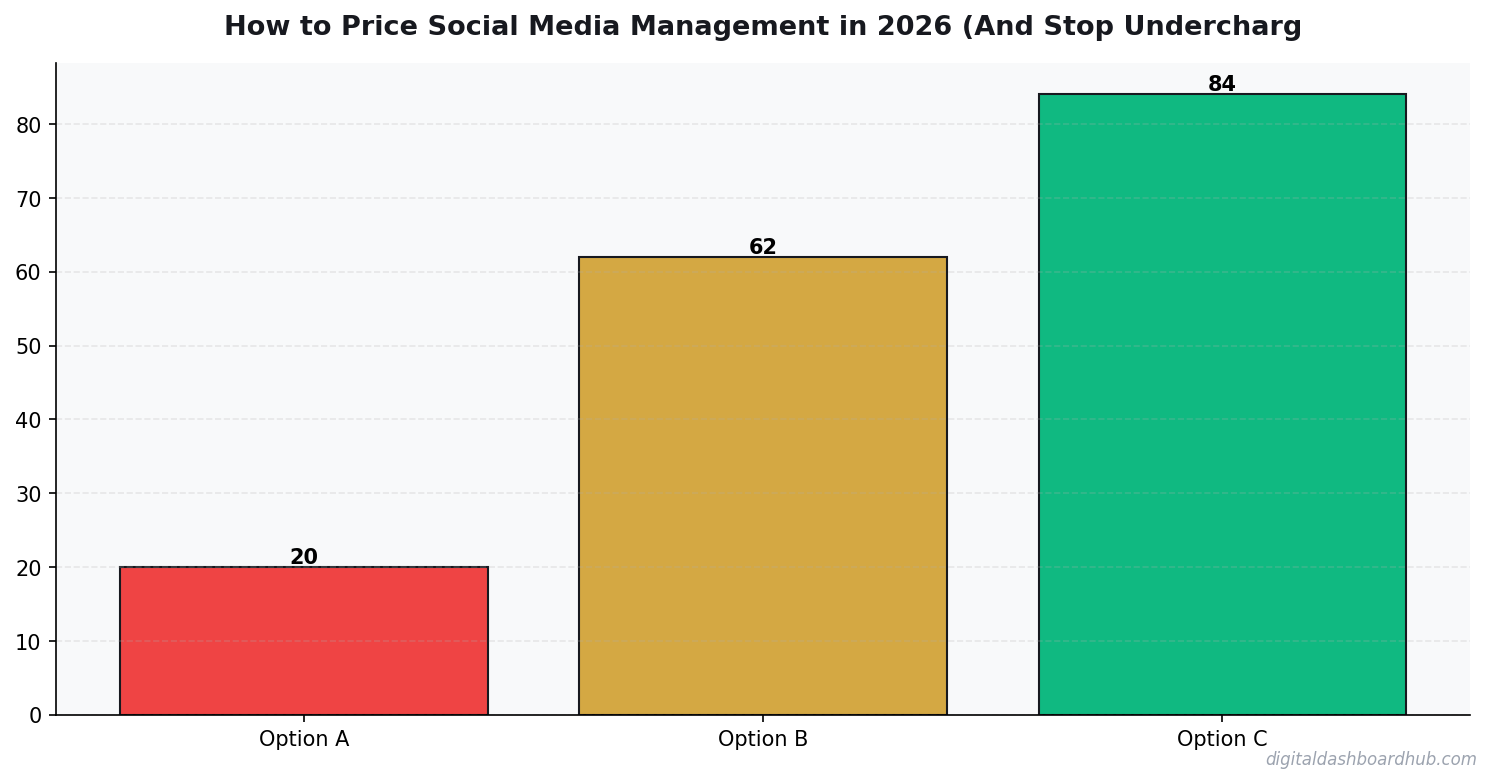
Notice how the effective hourly rate increases at each tier. That’s intentional. The higher-tier clients are usually better organized, have brand assets ready, and require less hand-holding per dollar of revenue. They’re more profitable, not less.
Platform-Specific Pricing Considerations
Not all platforms require the same amount of work, and your pricing should reflect that. Managing a LinkedIn company page with 3 text posts per week is fundamentally different from managing a TikTok account that needs 5 short-form videos per week.
Instagram: The most labor-intensive platform per post. Between Reels (scripting, filming direction, editing), carousels (multi-slide design), Stories (daily content), and engagement management (DMs, comments, story replies), a full Instagram management scope can be 20+ hours/month alone. Price accordingly — Instagram-only management should start at $1,500/month minimum.
TikTok: Even more labor-intensive than Instagram because the algorithm rewards daily posting. Quality TikTok management means 15-30 videos per month, trend monitoring, and rapid content pivots. This is a $2,000-$4,000/month service if you’re producing the video content. If the client provides raw footage and you’re editing/posting, $1,200-$2,000/month.
LinkedIn: The highest ROI per hour for B2B clients, and relatively low effort compared to visual platforms. Three thoughtful text posts per week, article sharing, and comment engagement runs about 8-10 hours/month. Price range: $800-$1,500/month. The clients who need LinkedIn management often have the budget to pay well.
Twitter/X: Volume game. Effective Twitter management means 5-10 posts per day, real-time engagement, and trend participation. It’s either very cheap (automated/scheduled content) or very expensive (genuine community management). $600-$2,000/month depending on the level of engagement expected.
Retainer vs. Hourly vs. Project: When to Use Each
Monthly retainer is the standard for ongoing social media management and it’s what you should push for in 90% of cases. It provides predictable income for you and predictable costs for the client. Lock in 3-month minimum contracts with 30-day cancellation notice after the initial term.
Hourly works for consulting and audits. If a business wants you to review their social strategy and give recommendations without ongoing management, charge $100-$200/hour for consulting. I do 2-hour social media audits for $350 and they’re my highest-margin service — mostly because I’ve done hundreds of them and can diagnose problems in minutes.
Project-based works for specific campaigns. A product launch campaign across three platforms for 6 weeks? Quote a flat fee. A holiday campaign with 30 posts and 10 Stories? Flat fee. Projects should be priced at a premium over retainer rates because they involve ramp-up time and typically have tighter deadlines.
freelancer-revenue-calculator-handles-this”>How the DDH Freelancer Revenue Calculator Handles This
The biggest pricing mistake social media managers make is setting rates without understanding how they translate to annual income. A $2,000/month retainer sounds great until you realize you can only manage 5-6 clients at that tier before quality drops — and five clients at $2,000 is $120K/year gross, which is maybe $78K after taxes and expenses.
The Freelancer Revenue Projection Calculator inside Digital Dashboard Hub lets you model your client capacity, average retainer size, and project income to see the full annual picture. You can factor in seasonality (client budgets often get cut in Q1), churn rate (you’ll lose 2-3 clients per year on average), and the time you need for sales to replace lost clients.
Seeing the full picture changes how you price. When you realize losing one $3,000/month client costs you $36K/year in revenue, you start investing more in client retention — and pricing high enough that losing one client doesn’t break your business.
What Top Earners Charge (And Why They Can)
The social media managers earning $150K-$250K+ per year aren’t doing anything magical. They’ve done three things consistently:
They specialize. “Social media manager for restaurants” gets more clients than “social media manager.” Specialization lets you reuse strategies across clients, build a portfolio that speaks directly to prospects, and charge a premium because you understand the industry. The best-paid SMMs I know specialize in real estate, med spas, SaaS companies, or restaurants.
They tie their work to revenue. Instead of reporting on follower growth and engagement rate, they report on leads generated, appointments booked, and revenue influenced. When a client can see that your social media management generated 45 leads and $28,000 in revenue last month, your $3,000 fee looks like a bargain.
They say no to bad clients. Every bad client at $1,000/month costs you a good client at $3,000/month. Bad clients take more time, cause more stress, and prevent you from doing your best work. The top earners fire the bottom 20% of their client base every year and replace them with higher-paying clients.
Mid-Article Bonus: The Pricing Conversation Script
When a prospect asks “how much do you charge?”, don’t answer with a number. Answer with a question: “It depends on the scope. Can I ask you a few questions to understand what you need?” Then ask: What platforms are you on? How often do you want to post? Do you need content creation or just strategy? What’s your primary goal — brand awareness, leads, or sales?
Their answers will tell you which package tier to recommend. Present two options (never one, never three). “Based on what you’ve described, I’d recommend our Growth package at $3,000/month. For businesses that also need paid social management, our Scale package at $5,000/month includes that.” Let them pick. The anchoring effect of the higher number makes the lower number feel reasonable.
14-Day
Free Trial
No credit card required to start
Try This Today
Step 1: Audit your current client roster. Calculate your effective hourly rate for each client. If any client is below your floor rate ($75/hour), they need a price increase or a scope reduction. Send that email this week.
Step 2: Build your three-tier package structure. Define exactly what’s included, what’s not included, and what costs extra. Write it up as a professional PDF you can send within 5 minutes of any inquiry.
Step 3: Start a free trial of Digital Dashboard Hub and run your numbers through the Freelancer Revenue Projection Calculator. Model your current pricing vs. a 30% increase. See what the annual difference looks like. I’m betting the increase gets you to your income goal with fewer clients and less stress.
Keep reading (related guides):
- Auto Mechanic Revenue: What Owners Make vs. What Youd Expect (2026)
- Boutique Revenue Calculator
- PMU Artist Revenue Calculator: Brows, Lips, and Touch-Up Income (2026)
- Freelancer Tax Guide 2026: What to Track All Year So April Doesnt Destroy You
- Small Business Finance Basics: The Only 5 Numbers You Need to Track Weekly
How to Move Clients to Value-Based Pricing
Hourly pricing caps your income at your hours. Value-based pricing ties your fee to the client’s outcome, which is both fairer and more lucrative. Here’s how to make the shift.
1. Audit your current client value creation
Pull the last six months of results for every client: follower growth, engagement rate, leads generated, booked calls, tracked sales. If you’re generating $40K of tracked revenue for a $2K/month retainer, you’re the bargain of the year. That data is your leverage.
2. Propose tiered outcome packages, not hourly
Instead of “I’ll post 4x a week for $1,500/month,” propose three tiers: Growth ($2,500, focused on follower growth), Conversion ($4,000, focused on lead generation), and Revenue ($6,000+, focused on tracked sales). Let the client self-select.
3. Bundle strategy, not just execution
Execution (posting, scheduling, community management) is commodity work competing against $8/hour offshore labor. Strategy (content calendar design, funnel mapping, analytics deep dives) is where premium pricing lives. Every retainer should include at least 20% strategic work.
4. Raise rates on renewal, not mid-contract
Six months in, you know exactly what the client is worth. On renewal, propose the new rate based on results delivered. Clients renew at higher rates when the ROI is clearly documented — keep a monthly impact report that writes itself.
5. Drop 20% of your book every year
The bottom 20% of your clients always pay the least, demand the most, and block you from taking on better work. Replace them systematically each year with clients who value what you do and pay accordingly.
Quick FAQ: Social Media Management Pricing
What’s the market rate for Instagram management in 2026?
$1,500-$2,500/month for small business (20 posts, 15 Stories, 3 Reels). $3,000-$5,500/month for growth-focused work (content strategy, community management, ad integration). $6,500+/month for enterprise. Below $1,500 is almost always unprofitable work.
How should I charge for content creation?
Either bundled into monthly management (flat rate) or per-deliverable (a la carte). Per-Reel: $200-$600. Per-photo: $75-$200. Per-carousel: $150-$350. Most clients prefer bundled pricing for budget predictability.
Is paid ad management separate from organic?
Yes. Organic social management and paid ad management are different skill sets with different deliverables. Charge separately — usually 10-20% of ad spend for paid management, minimum $800-$1,500/month retainer.
What retainer terms should I use?
Month-to-month with 30-day notice is standard. Six-month commitments with a 5-10% discount work for established clients. Avoid annual contracts with no exit clause — the client feels trapped and the relationship sours.
How do I handle scope creep?
Document scope in the contract, then track every out-of-scope request in a log. Hit 3 requests? Send a “we’ve done $X of out-of-scope work this month, here’s what it would cost as an add-on” note. Most clients respond by tightening requests rather than paying for them — exactly the outcome you want.
255+ interactive tools for your money, time, and health.
14 days free · No charge today · 2-click cancel
Keep Reading
- Freelancer Finance Dashboard: Track Income, Taxes, and Cash Flow in One Visual Hub
- The Side Hustle Tax Trap: Track Every Dollar
- Freelancer Tax Guide 2026: What to Track All Year So April Doesn’t Destroy You

Andy Gaber is the founder of Digital Dashboard Hub, a suite of 255+ interactive financial, productivity, and wellness tools. He built DDH after getting frustrated with financial apps that gave outputs without context. Follow along for tool tutorials, revenue analytics breakdowns, and honest takes on personal finance.