The Day I Opened My First 1099 and Nearly Choked
Scroll down — the interactive tool runs live with your inputs. Full version lives inside Digital Dashboard Hub. Two-click trial, Stripe-secure.
In 2019, I left a salaried W-2 job paying $72,000 to take a contract gig paying $95/hour. Quick napkin math said I’d be making around $190,000. I felt like I’d cracked the code. Six months later, I was sitting in my accountant’s office watching him calculate my quarterly estimated tax payment, and the number made my stomach drop.
$14,200. For one quarter. That’s what I owed in estimated taxes — and I’d saved exactly zero for it because nobody told me about self-employment tax. That 15.3% hit on top of income tax turned my “huge raise” into something much closer to my old salary than I wanted to admit.
Since then, I’ve gone back and forth between W-2 and 1099 work twice more. I’ve lived both sides. And I’ve built a spreadsheet that compares the two honestly — not the “contractors make more!” hype you see online, and not the “stay safe with a salary” fear either. Just the actual math.
The Self-Employment Tax Nobody Warns You About
When you’re a W-2 employee, your employer pays half of your Social Security and Medicare taxes. You never see it. It’s invisible. Your pay stub shows your half — 7.65% — and that’s it.
When you’re a 1099 contractor, you pay both halves. The full 15.3% on the first $168,600 of net self-employment income (2026 threshold), then 2.9% on everything above that. This is in addition to your federal income tax and state income tax.
What surprised me was that looks like in practice:
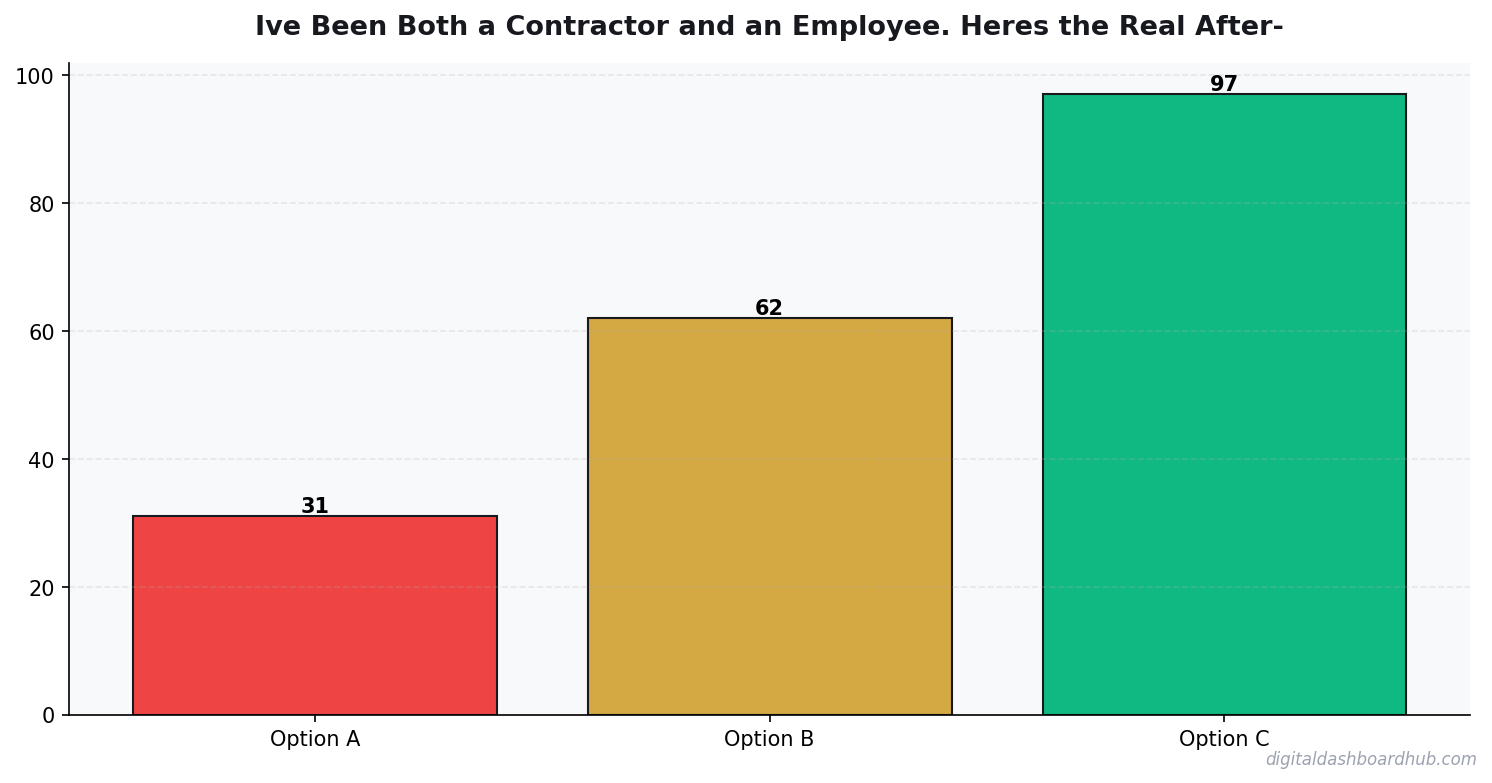
At the same gross income, the contractor takes home $4,114 less. And this is before we talk about benefits the employee gets for free.
The Hidden Cost of “No Benefits”
My W-2 job offered health insurance, a 401(k) match, paid time off, and short-term disability. I never thought about what those were worth in dollars because they just… existed. Then I had to buy them myself.
Health insurance as a self-employed individual: $450-$850/month for a decent plan, depending on your state and age. That’s $5,400-$10,200/year. My employer had been paying roughly $8,000/year for my coverage, and I paid $120/month. I went from $1,440/year to $7,800/year overnight.
The 401(k) match is the one that really stings. My employer matched 4% of my salary. At $90K, that’s $3,600 in free money every year. As a contractor, nobody gives you free money. You can open a Solo 401(k) and contribute, but every dollar comes from your own pocket.
Paid time off is the invisible killer. As an employee, I had 15 days PTO plus holidays — about 4 weeks total. That’s 4 weeks where I earned money by not working. As a contractor billing hourly, every day off is money not earned. Four weeks off at $95/hour is $15,200 in lost billings.
When the Contractor Math Actually Works
I’m not saying contracting is a bad deal. I’m saying it’s a bad deal at the wrong rate. There’s a rate at which contracting clearly wins, and most people set it too low.
The rule I use: your contractor hourly rate needs to be at least 1.4x what your equivalent W-2 hourly rate would be. And by “equivalent W-2 hourly rate,” I mean your salary divided by 2,080 hours, because that’s what the employer is paying for.
$90,000 salary ÷ 2,080 hours = $43.27/hour equivalent. Multiply by 1.4 = $60.58/hour minimum contract rate to break even after taxes and lost benefits. At $95/hour, I was well above that threshold — which is why the gig was worth taking despite the tax surprise.
But here’s the trap: many contractors set their rate at 1.1x or even 1.0x their W-2 equivalent, thinking “no boss, flexible schedule” makes up the difference. It doesn’t. Not when you factor in self-employment tax, health insurance, no PTO, no retirement match, and the feast-or-famine income cycle.
The Deductions That Actually Move the Needle
Contracting does come with tax advantages that employees don’t get. But let me be honest about which ones actually matter and which ones are noise.
Deductions that make a real difference:
- Health insurance premiums — fully deductible above the line. If you’re paying $7,800/year, that’s $7,800 off your taxable income. At a 22% bracket, that saves you $1,716 in federal tax.
- Home office deduction — simplified method is $5/sq ft up to 300 sq ft = $1,500 max. Actual expense method can be higher if your home costs are significant. My actual expense came to $3,400.
- Qualified Business Income (QBI) deduction — the Section 199A deduction gives you up to 20% off your qualified business income. On $90K of net business income, that’s up to $18,000 off your taxable income. This is the big one. It can save $4,000-$6,000 in taxes depending on your bracket.
- Retirement contributions — Solo 401(k) lets you contribute up to $23,500 as an employee (2026) plus 25% of net self-employment income as the employer. This isn’t a “deduction” in the fun sense — you’re just putting money away — but it reduces your current tax bill significantly.
Deductions that barely move the needle: Office supplies ($200-500/year savings), business meals (50% deductible, maybe $300-800/year savings), mileage (unless you drive a lot for client work). These are real but they’re not going to offset a $12,000 self-employment tax bill.
How the DDH Contractor vs. Employee Calculator Handles This
I built the spreadsheet that showed me the truth. Then I found out the DDH Income Comparison Calculator does it better than my janky Google Sheet ever could.
You plug in your W-2 salary on one side and your 1099 rate on the other. It calculates self-employment tax, estimates your QBI deduction, adds the value of employer benefits (health insurance, 401K match, PTO), and shows you the real after-tax, after-benefits comparison side by side.
The feature I wish I’d had in 2019: it shows you the break-even contractor rate. Given a specific W-2 salary with specific benefits, what’s the minimum hourly rate you need as a contractor to actually come out ahead? That one number would have saved me six months of anxiety.
My Honest Assessment After Doing Both Three Times
I’ve been a W-2 employee at $65K, $72K, and $90K. I’ve been a 1099 contractor at $75/hour, $95/hour, and $120/hour. I found something interesting I’ve learned that no article ever told me.
The financial comparison is almost a wash at moderate rates. At $95/hour vs. a $90K salary, my actual lifestyle difference — after taxes, benefits, and unpaid time off — was maybe $8,000-$12,000 per year in favor of contracting. That’s real money, but it’s not life-changing money. It’s “nicer vacation” money.
The real differences are non-financial. As a contractor, I controlled my schedule completely. I could work intensely for 3 months, then take 2 weeks off without asking anyone’s permission. I could fire a bad client (I could never fire a bad boss). I could deduct my home office, my internet, and my equipment. I felt like I owned my career instead of renting it.
As an employee, I had stability that let me sleep at night. I didn’t check my pipeline every Sunday wondering if next month’s income was real. I didn’t spend 5-10 hours per week on unbillable admin — invoicing, tax prep, chasing late payments, updating my LinkedIn to attract new clients. I just did the work and got paid.
The Spreadsheet That Changed My Mind
The moment everything clicked was when I stopped comparing gross income and started comparing what I call “effective hourly rate.” This accounts for all the unbillable hours contractors work.
As a W-2 employee at $90K, I worked about 45 hours/week, 48 weeks/year (after PTO). That’s 2,160 hours. Effective hourly rate: $90,000 ÷ 2,160 = $41.67/hour.
As a contractor at $95/hour, I billed about 32 hours/week (the rest was admin, marketing, invoicing). I worked 48 weeks (no paid time off but I still took time off). Total billed hours: 1,536. Gross revenue: $145,920. After self-employment tax, health insurance, and other business costs: roughly $112,000 net. But I actually worked about 42 hours/week total (including unbillable time). That’s 2,016 total hours. Effective hourly rate: $112,000 ÷ 2,016 = $55.56/hour.
So yes, contracting at $95/hour beat the $90K salary. But not by the margin I expected when I first saw the rate. The gap was $55.56 vs. $41.67 — about 33% more, not the 120% more that the gross rates suggested.
The Decision Framework I Use Now
Take the contract gig if: your rate is 1.5x+ your W-2 equivalent, you have 6 months of expenses saved, you don’t mind the admin work, and you have a pipeline of potential clients (not just one contract).
Stay W-2 if: you value predictability, you’re in a high-match 401(k) situation, your employer-sponsored health insurance covers a family (that’s $15,000-$25,000/year in value), or you simply don’t want to run a business. There’s no shame in that. Employment is a perfectly rational economic choice.
The worst move: taking a contract at 1.0-1.1x your W-2 rate because you’re excited about “being your own boss.” You’ll end up working more hours for less money, and the freedom won’t feel so free when you’re doing your own payroll at 10 PM on a Sunday.
The Quick-Start Version
- Run the real comparison. Open the DDH Income Comparison Calculator and plug in both your current W-2 (or target salary) and the contract rate you’re considering. Include benefits values. Look at the after-tax, after-benefits number — not the gross.
- Calculate your break-even rate. Find the minimum contractor rate where you actually come out ahead of your W-2 option. Add 20% to that for a safety margin. If the contract offer is below that number, negotiate or walk.
- Track everything from day one. If you go contractor, track every dollar in and out. Quarterly estimates, deductible expenses, billable hours, total hours. The contractors who get burned are the ones who “figure out taxes later.”
I don’t regret any of my switches — W-2 to 1099 or back again. Each one taught me something. But I regret not running the real numbers before my first switch. That $14,200 quarterly tax bill didn’t need to be a surprise. Don’t let it be one for you.
Related Articles
- Freelancer Tax Guide 2026: What to Track All Year So April Doesn’t Destroy You
- The Side Hustle Tax Trap: Track Every Dollar
- Freelancer Finance Dashboard: Track Income, Taxes, and Cash Flow in One Visual Hub
Keep reading (related guides):
- Mortgage Comparison Calculator: Find the Best Rate and Term
- How to Calculate Your Freelance Rate (So You Stop Undercharging)
- Web Designer Pricing in 2026: How to Set Rates That Reflect Your Skill (Not Your Fear)
- General Contractor Revenue: What Owners Make vs. What Youd Expect (2026)
- Debt Snowball vs Avalanche Calculator: Which Method Saves You More Money
255+ interactive tools for your money, time, and health.
14 days free · No charge today · 2-click cancel

Andy Gaber is the founder of Digital Dashboard Hub, a suite of 255+ interactive financial, productivity, and wellness tools. He built DDH after getting frustrated with financial apps that gave outputs without context. Follow along for tool tutorials, revenue analytics breakdowns, and honest takes on personal finance.