YouTube Guys Claim $300K/Year Pressure Washing. Here’s What Actually Happens.
Before you scroll: the calculator below is running in your browser right now. For the full feature set — saved scenarios, history, exports — open the dashboard.
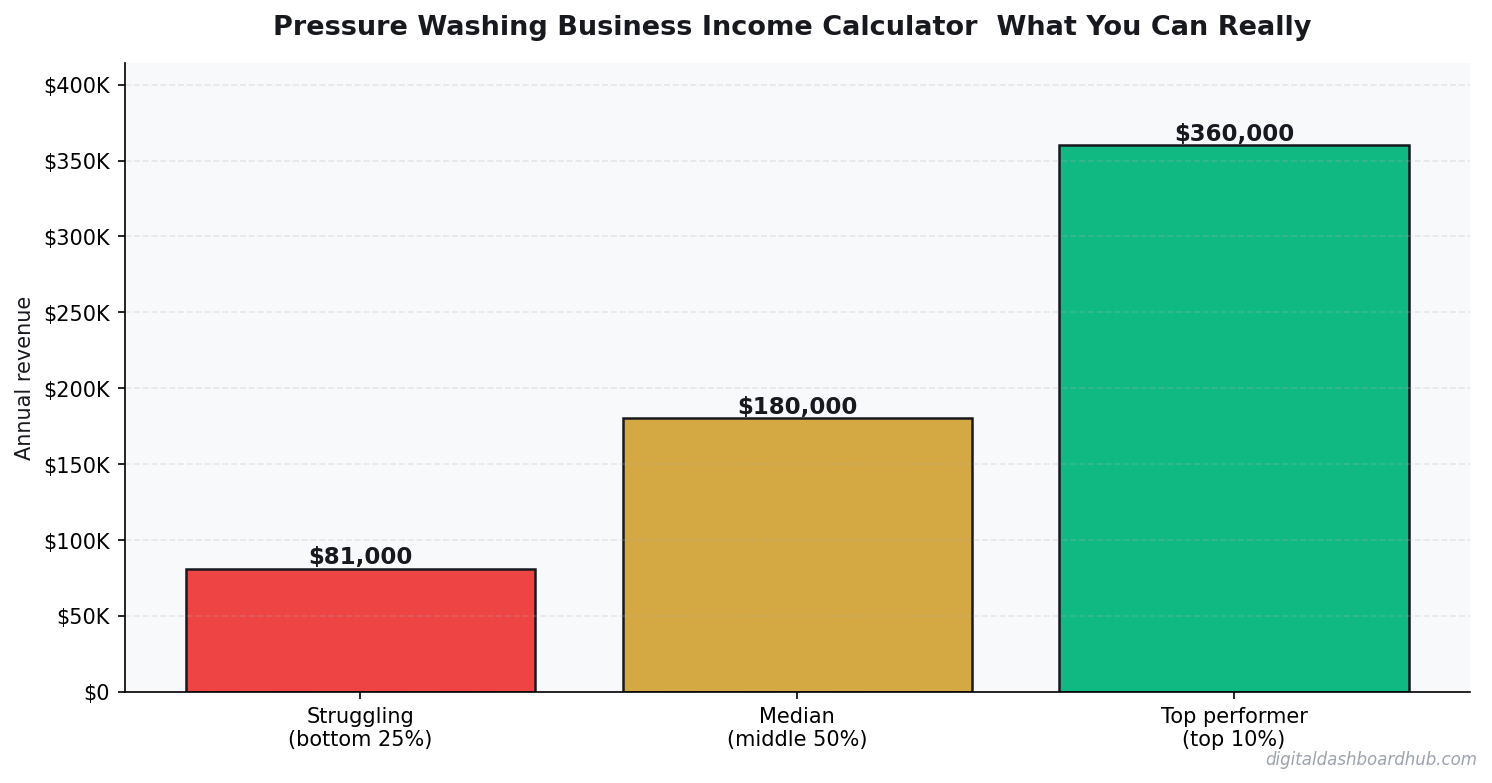
Every pressure washing “business guru” shows their best month and calls it an annual projection. The reality for most solo operators in their first two years is $45,000-$85,000 in gross revenue, and significantly less after equipment, gas, insurance, and the jobs you quoted but never landed. I talked to eleven pressure washing business owners across four states to get numbers that aren’t designed to sell you a course.
Revenue by Job Type
Pressure washing pricing varies wildly by region, but here are the ranges that showed up consistently across all eleven operators I spoke with:
Notice that commercial jobs pay more per hour and repeat more often. Every experienced operator I spoke with said the same thing: residential gets you started, commercial pays the bills.
Realistic Monthly Revenue Projections
Here’s where the YouTube fantasy meets scheduling reality. You can’t do 8 jobs a day. Travel time, weather cancellations, quoting time, equipment loading, and the fact that you’re also running a business all cut into billable hours.
Solo Operator, Year One
- Billable days per month: 18-22 (weather, no-shows, admin days)
- Jobs per day: 2-3 (residential) or 1-2 (commercial)
- Average job revenue: $200 (blended residential/commercial)
- Monthly gross: $7,200-$13,200
- Annual gross: $65,000-$120,000 (with seasonal variation)
Solo Operator, Year Two-Three (Established)
- Higher commercial mix, repeat clients
- Average job revenue: $300 (more commercial, fewer small driveways)
- Monthly gross: $12,000-$20,000
- Annual gross: $100,000-$180,000
The Expense Side Nobody Posts About
Gross revenue means nothing without the cost picture.
Startup Costs
- Pressure washer (4,000+ PSI commercial): $2,500-$6,000
- Surface cleaner attachment: $300-$800
- Hoses, nozzles, fittings: $500-$1,200
- Chemical system + initial chems: $400-$800
- Trailer setup: $2,000-$5,000 (used) or $8,000-$15,000 (new rig)
- Truck (if you don’t own one): $15,000-$30,000 used
- Insurance (GL + commercial auto): $2,000-$4,000/year
- Licensing/registration: $200-$800
Total startup: $8,000-$20,000 if you already have a truck. $25,000-$50,000 if you don’t.
Monthly Operating Costs
- Gas/fuel: $400-$800
- Chemicals: $200-$500
- Equipment maintenance: $100-$300
- Insurance: $200-$350
- Marketing: $200-$500 (Google Local Services ads are the best ROI)
- Software/CRM: $50-$150
- Phone/internet: $100-$150
Monthly operating: $1,250-$2,750. On $10K/month gross, your net before taxes is roughly $7,250-$8,750. Self-employment tax takes another 15.3%, leaving $6,100-$7,400 actual take-home.
Bonus: Pricing Formula Worksheet
I built a pricing formula that accounts for square footage, surface type, chemical cost, and travel time. It prevents underpricing — which is the #1 revenue killer for new operators. Available inside Digital Dashboard Hub when you start a free trial.
Seasonality Is Real
Unless you’re in Florida or Southern California, expect a dead season:
- Peak season (April-October): 80-100% capacity
- Shoulder months (March, November): 40-60% capacity
- Off-season (December-February): 10-25% capacity (holiday lighting installs can fill some gaps)
A $10K/month average means $15K in July and $3K in January. If you spend based on July, January will hurt.
Start With This
- Price your first 5 job types using the table above, adjusted for your local market. Check competitors on Google and Thumbtack, but don’t race to the bottom — the cheapest bid attracts the worst clients.
- Calculate your break-even. Monthly operating costs ÷ average job price = minimum jobs per month to stay afloat. If that number is above 15, your costs are too high or your prices are too low.
- Build a 12-month projection with seasonal adjustments. Our calculator does this automatically based on your region and service mix.
Over 500 business owners use Digital Dashboard Hub to project revenue, track expenses, and price jobs accurately. Start your free trial and model your pressure washing business in under 5 minutes.
What a Pressure Washing Business Actually Earns: Weekly Numbers
A solo operator in the Southeast running a trailer rig, working 5 days/week in spring and summer:
Daily mix: 1 house wash ($350), 1 driveway cleaning ($180), 1 deck or fence project ($420). Daily gross: $950. Monthly (22 working days): $20,900. Expenses: truck/trailer payment ($600), equipment maintenance ($300), chemicals ($500), insurance ($350), fuel ($450). Net: $18,700/month during peak season.
The catch: pressure washing is highly seasonal in northern climates. A 6-month season in Wisconsin versus year-round in Florida is the difference between $80K and $170K annual income. Geography matters enormously here.
The 3 Moves That Separate $60K and $120K Operators
Upselling soft wash for roofs. A basic roof soft wash adds $400-$800 to a job that already has you on the property. Customers who already said yes to a house wash convert to roof add-ons at 35-50% rates when offered. This is found money — no extra marketing, no extra travel.
Building a recurring account base. Restaurants, apartment complexes, and commercial properties need regular exterior cleaning — often monthly or quarterly. One commercial account at $600/month is 12 months of predictable revenue. Five commercial accounts smooth out residential seasonality almost completely.
Google Local Service Ads. Pressure washing is one of the most cost-effective niches for local Google ads. A $500-$800/month ad budget in a mid-size market can generate 15-25 new leads monthly. At a 60% close rate and $400 average job, that’s $3,600-$6,000 in new monthly revenue from $800 in ad spend.
Equipment That Pays for Itself vs Equipment That Just Costs Money
New operators frequently overspend on equipment before they have the volume to justify it. A $15,000 truck mount when a $4,000 trailer setup does the same work at your current volume is cash flow you didn’t need to spend. The better framework: buy the equipment that matches your current route volume, then upgrade when you have confirmed demand that would otherwise require turning work down.
The equipment that pays back fastest in pressure washing: a surface cleaner attachment ($400-$800) that cuts flat surface cleaning time by 60%, and a downstream chemical injector ($150-$250) for soft wash capability. These two additions transform the types of jobs you can bid and the speed you complete them. Everything else — extra hose reels, bigger tanks, specialized nozzle kits — comes later when specific job types justify it.
Pricing Your First Jobs Correctly
New pressure washing operators routinely underprice their first jobs to build reviews and a portfolio. This works as a strategy for 30-60 days. Beyond that, it trains the local market to expect low prices from you specifically and makes raising rates feel like a betrayal to early clients. A better approach: price at your target rate from day one, do exceptional work, and build reviews at the right price point. You’ll grow slightly slower but build a business worth owning.
Build a referral incentive into your business from day one. A simple “refer a neighbor, get $50 off your next service” program costs almost nothing and generates the highest-quality leads available — people who found you through a trusted recommendation are 3-4x more likely to book than cold leads from ads. In residential neighborhoods where houses cluster with similar needs, a single happy customer can become the source of 5-10 new accounts.
Keep reading (related guides):
- Auto Mechanic Revenue: What Owners Make vs. What Youd Expect (2026)
- Boutique Revenue Calculator
- Free Ice Cream Shop Revenue Calculator — Estimate Your Profit in 60 Seconds
- Photography Business Revenue Calculator: Packages, Bookings, and Real Profit
- How Journaling Rewires an Anxious Brain: A Science-Backed Guide
255+ interactive tools for your money, time, and health.
14-day trial · Stripe checkout · Cancel anytime
Keep Reading
- The Side Hustle Tax Trap: Track Every Dollar
- Side Hustle Income & Tax Tracker
- Freelancer Finance Dashboard
Common Questions About Pressure Washing Business Income Calculator: What You Can Really Make
How long does it take to see results?
Most people see meaningful progress within 30-90 days when they apply these strategies consistently. The key is tracking your numbers from day one so you have a baseline to measure against.
What’s the biggest mistake people make?
Trying to do everything at once. Pick one or two strategies from this guide, implement them fully, then layer in additional tactics. Spreading yourself thin is the fastest way to see no results from any of it.
Do I need special tools or software?
Not necessarily to start — but the right tools eliminate hours of manual work. Our free calculators and trackers at Digital Dashboard Hub are a good starting point before you invest in paid software.

Andy Gaber is the founder of Digital Dashboard Hub, a suite of 255+ interactive financial, productivity, and wellness tools. He built DDH after getting frustrated with financial apps that gave outputs without context. Follow along for tool tutorials, revenue analytics breakdowns, and honest takes on personal finance.