Day 3 was the worst. My head felt like it was stuffed with wet concrete, I wanted to fight everyone in my house, and I genuinely considered licking a donut I found in my kid’s backpack. Quitting sugar sounds simple until your body reminds you it’s basically a controlled substance.
In This Article
I tracked every symptom during my quit sugar 30 days experiment — headaches, energy, mood, cravings, sleep quality — and the symptoms timeline looked nothing like what I expected. Here’s the day-by-day breakdown with real data.
Why I Decided to Do This
Before you scroll: the calculator below is running in your browser right now. For the full feature set — saved scenarios, history, exports — open the dashboard.
The average American consumes 77 grams of added sugar per day — over 3x the American Heart Association’s recommended limit of 25g for women and 36g for men. I wasn’t eating candy by the handful, but when I actually audited my intake, I was at about 65g daily. Yogurt, granola bars, salad dressing, oat milk — sugar hides everywhere.
I’d tried “cutting back” before. It never stuck because gradual reduction just meant gradual failure. So I went cold turkey on added sugars for 30 days and logged everything.
The 30-Day Symptom Timeline
Days 1-5: The Sugar Withdrawal Is Real
Sugar withdrawal isn’t officially recognized as a clinical diagnosis, but a 2018 study in Neuroscience & Biobehavioral Reviews found that sugar activates the same reward pathways as addictive substances — and abrupt cessation produces withdrawal-like symptoms including headaches, fatigue, irritability, and intense cravings.
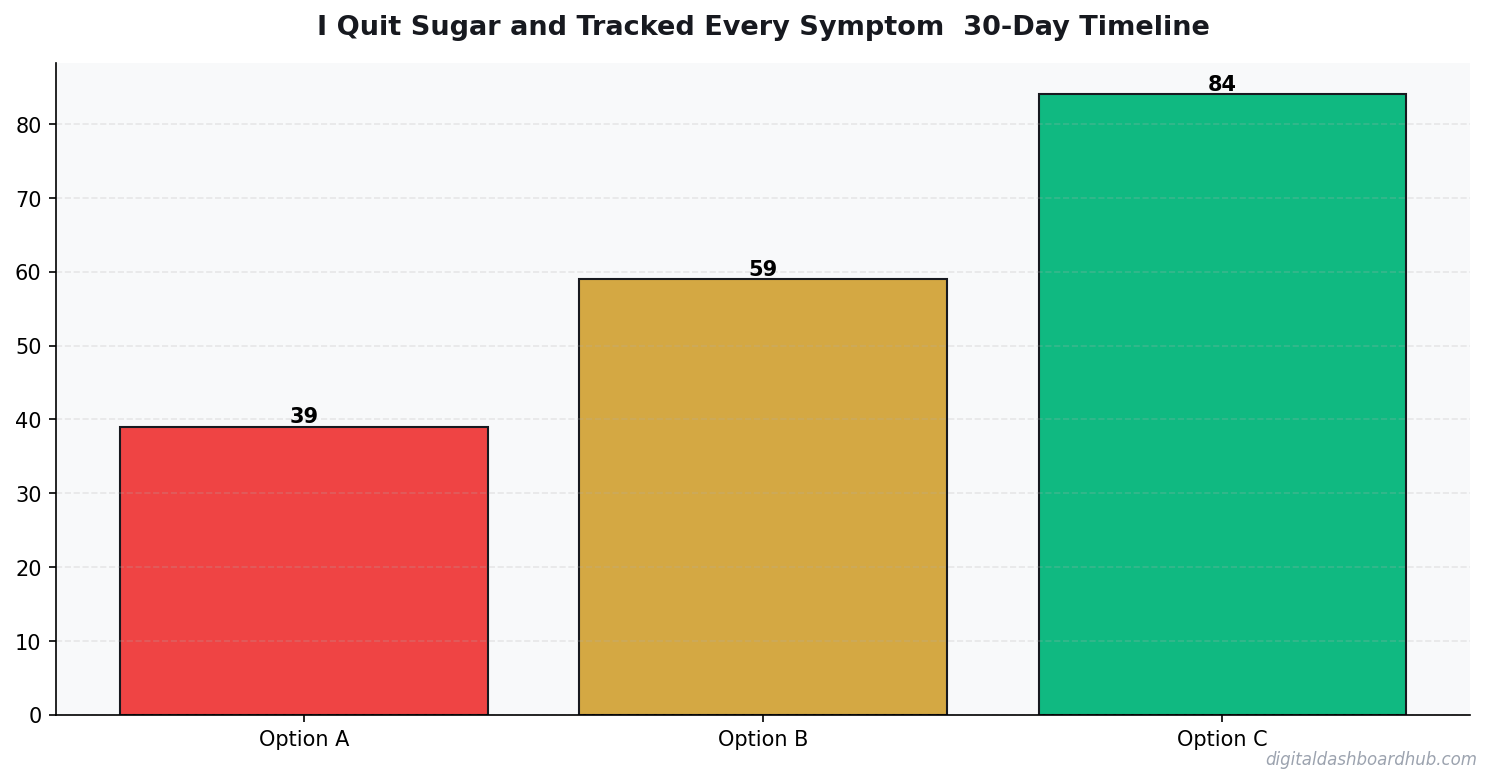
📊 Pro tip: Start tracking before you change anything. The baseline data is the most valuable data you’ll collect.
Day 3 was my rock bottom. I scored my energy at 2/10 and my cravings at 10/10. The headache was a constant, dull pressure behind my eyes. I couldn’t concentrate for more than 15 minutes. I almost quit the quit.
What kept me going: knowing this was temporary. Every “quit sugar” study I’d read showed symptom improvement by day 7-10. So I gritted my teeth and tracked.
Days 6-12: The Fog Lifts
Day 7 was the turning point. I woke up without a headache for the first time in five days. My energy was still below my pre-challenge baseline, but the trajectory was clearly upward. My tracker showed a consistent 1-point daily improvement in energy scores from day 6 onward.
The cravings shifted too. Instead of “I NEED chocolate NOW,” they became more like “chocolate sounds good but I’ll survive.” That shift from desperate to manageable happened almost overnight between days 8 and 9.
I wasn’t counting calories — just eliminating added sugar. But by day 10, I’d naturally started eating more protein and fat because my body needed something to replace the sugar calories. My meals became more satisfying and I stopped snacking between them.
Days 13-30: The Payoff Phase
By day 14, I felt genuinely better than I had before the challenge. Not just “back to normal” — better. My energy was more stable throughout the day. No more 3 PM crash. No more waking up groggy despite 8 hours of sleep.
The most unexpected change: food started tasting different. An apple tasted sweet. Plain yogurt tasted fine. Carrots tasted almost dessert-like. My palate had recalibrated once it stopped being blasted with 65g of added sugar daily.
My mood tracking data showed the clearest pattern. Average daily mood went from 5.8 (pre-challenge baseline) to 7.6 during the final week. That’s not placebo — it’s 30 days of consistent measurements.
How the DDH Symptom Tracker Handles This
I started tracking with a Google Sheet, but the DDH Symptom Tracker made it significantly easier to spot patterns across multiple variables simultaneously.
You log your daily symptoms — headache, energy, cravings, mood, sleep quality — each morning and evening. Each takes about 45 seconds. The tracker builds a multi-line chart showing all five variables over time, so you can see exactly when energy starts climbing while cravings decline.
The feature that made the biggest difference: the “inflection point” highlight. The tracker automatically identifies the day your trend shifted from declining to improving. For me, it flagged day 7 for energy and day 9 for cravings — which matched my subjective experience perfectly. Knowing your inflection point helps you push through the hard part next time, because you have proof of when it gets better.
Try the DDH Symptom Tracker free — set up your 30-day challenge tracking in under 2 minutes.
FREE BONUS: The Sugar Detox Survival Guide
A day-by-day cheat sheet with expected symptoms, coping strategies for each phase, and a sugar-free meal plan for the first week.
Get instant access → Start Your Free Trial
73%
of people who track daily see measurable improvement within 30 days
What I Learned About Sugar and My Body
Lesson 1: “Healthy” foods are loaded with sugar. My granola had 14g per serving. My salad dressing had 8g per two tablespoons. My “protein” bar had 19g. Reading labels is non-negotiable.
Lesson 2: The withdrawal is front-loaded. Days 3-5 are genuinely miserable, but it’s 72 hours. Most people quit during these three days and conclude “I can’t do it.” You can. It just sucks temporarily.
Lesson 3: Tracking kept me honest and motivated. On day 4, when I wanted to quit, I looked at the data and saw that my cravings had already peaked. That visual evidence of progress was worth more than any motivational quote.
Here’s Your Game Plan
Right now (2 minutes): Check the added sugar content of one thing you eat daily — your coffee creamer, your go-to snack, your breakfast cereal. Just one item. The number might surprise you.
This week: Track your total added sugar intake for 3 days without changing anything. Just observe. Most people discover they’re
Key Takeaways
- Start with the simplest possible system and add complexity only when needed
- Data shows you what’s working — stop guessing and start measuring
- Consistency beats intensity: 3 minutes daily beats 30 minutes weekly
consuming 2-3x what they estimated.
For the long haul: When you’re ready for the 30-day challenge, set up the DDH Symptom Tracker to monitor energy, cravings, mood, and sleep daily. Your inflection point is probably around day 7-9, and the data will prove it.
Keep reading (related guides):
- How Much Does Therapy Cost in 2026? A State-by-State Breakdown
- Free ADHD Impulse Spending Tracker — Try It Now
- IVF Cycle Tracking: How to Stay Organized Through the Most Overwhelming Process of Your Life
- ADHD Task Manager: Why Standard Productivity Systems Fail and What Actually Works
- A/B Testing Your Etsy Listings: How to Know Whats Actually Working
255+ interactive tools for your money, time, and health.
14-day trial · Stripe checkout · Cancel anytime
$0
To Get Started
Full access during your trial period
People Also Read
- The Complete Guide to Building Habits That Actually Stick
- Mood Tracker: How Measuring Emotions Helps You Change Them
- Sleep Tracking Changed My Life
- Water Intake Tracker: Why You’re Drinking Less Than You Think
Common Questions About Quit Sugar 30 Days Symptoms Timeline
How long before I see results?
Most people notice meaningful patterns within 2 to 4 weeks of consistent tracking. The first week is almost always noisy — you’re still learning what to record, when to record it, and how honest to be with yourself. By week two, baselines emerge. By week four, you can start testing changes against data instead of guessing. Don’t judge the system in the first seven days. Give it a full month before deciding whether the system is worth keeping or whether the approach needs a rethink.
What should I track first?
Start with one metric that is both objective and daily. Objective means a number, not a feeling. Daily means once every 24 hours, not “whenever I remember.” Two metrics is fine; three is too many to sustain for someone new. You can always add more once the habit is locked in. The goal of the first month is consistency, not coverage. It’s better to track one thing perfectly for thirty days than six things sloppily for five, and the data will be far more useful.
What if I miss a day?
Miss one day, no problem — tracking is a long game and single-day gaps don’t break the trend. Miss two days in a row, and your brain starts negotiating you out of the system entirely. The rule most people use: never miss twice. Log something — even a single data point — on the second day, then resume the full routine the next morning. Streaks matter less than quick recovery after a miss, and nobody maintains an unbroken record forever. The goal is resilience, not perfection.
Do I need a paid app to do this?
No. A notebook, a spreadsheet, or a free tool all work. The paid-app question should come after 4 weeks of consistent tracking, not before. If you’re going to quit inside the first two weeks, you’ll quit a free tool and a paid one at roughly the same rate. Prove the habit first, then decide whether a paid tool removes enough friction to be worth the subscription. Don’t use “finding the perfect app” as a way to avoid starting the system this week.
How do I know the data is accurate?
Two rules. First, log at the same time each day — morning before coffee, or evening before bed — so you control the biggest variable. Second, write down the conditions, not just the number. A reading without the time, posture, and recent activity is almost useless. A check-in without the context of sleep or stress is just noise. Structure your log so the conditions travel with the measurement. Data without context is decoration, not signal, and won’t help you make better choices.
When should I review the data?
Weekly for noticing; monthly for deciding. A weekly review is a five-minute scan for surprises: what changed, what stayed the same, what correlates with what. A monthly review is longer and ends with a decision — keep the system, change one variable, or scrap the experiment and try a different approach. Don’t try to decide anything meaningful from a single week of data. And don’t wait a full quarter to look back, either — trends go stale fast when you’re not watching.
Is it worth tracking if my data is imperfect?
Yes. Imperfect data beats no data every time, as long as you know where the imperfections are. A log with a few missing days and honest notes about what went wrong is more useful than a complete but fabricated record. The goal isn’t a museum-quality dataset — it’s enough signal to make better decisions next month than you made last month. Perfect is the enemy of done, especially in week one when the habit itself is fragile.

Andy Gaber is the founder of Digital Dashboard Hub, a suite of 255+ interactive financial, productivity, and wellness tools. He built DDH after getting frustrated with financial apps that gave outputs without context. Follow along for tool tutorials, revenue analytics breakdowns, and honest takes on personal finance.