You Love Kids, but Love Doesn’t Pay the Licensing Fees
Jump in: the tool below is live and free to play with. Upgrade to a dashboard account when you want to save scenarios and track over time.
What to Remember
In This Article
- You Love Kids, but Love Doesn’t Pay the Licensing Fees
- Home-Based vs. Center-Based: Two Very Different Businesses
- Revenue Per Child: The Core Math
- Staffing: The Number That Makes or Breaks You
- Full Revenue Model: 60-Child Center
- The Costs Most New Operators Miss
- Home-Based Model: Simpler Math, Real Money
- Your Action Plan
That’s $92K/year take-home from a business you run from your living room. Not glamorous. Very profitable per dollar invested.
Starting a daycare because you’re good with children is like opening a restaurant because you like eating — the skill that draws you in has almost nothing to do with whether the business survives. The operators who make it past year two are the ones who ran the math before signing a lease. And the math on daycares is more specific and regulation-dependent than almost any other small business.
Real Talk
The difference between people who hit their targets and those who don’t? They measure weekly, not yearly.
Home-Based vs. Center-Based: Two Very Different Businesses
Home-based daycares have higher margins because you eliminate rent (your biggest fixed cost) and need fewer staff. Center-based daycares make more total dollars but the margin pressure from labor, rent, and compliance costs is relentless.
Revenue Per Child: The Core Math
Daycare pricing varies dramatically by location, age group, and program type:
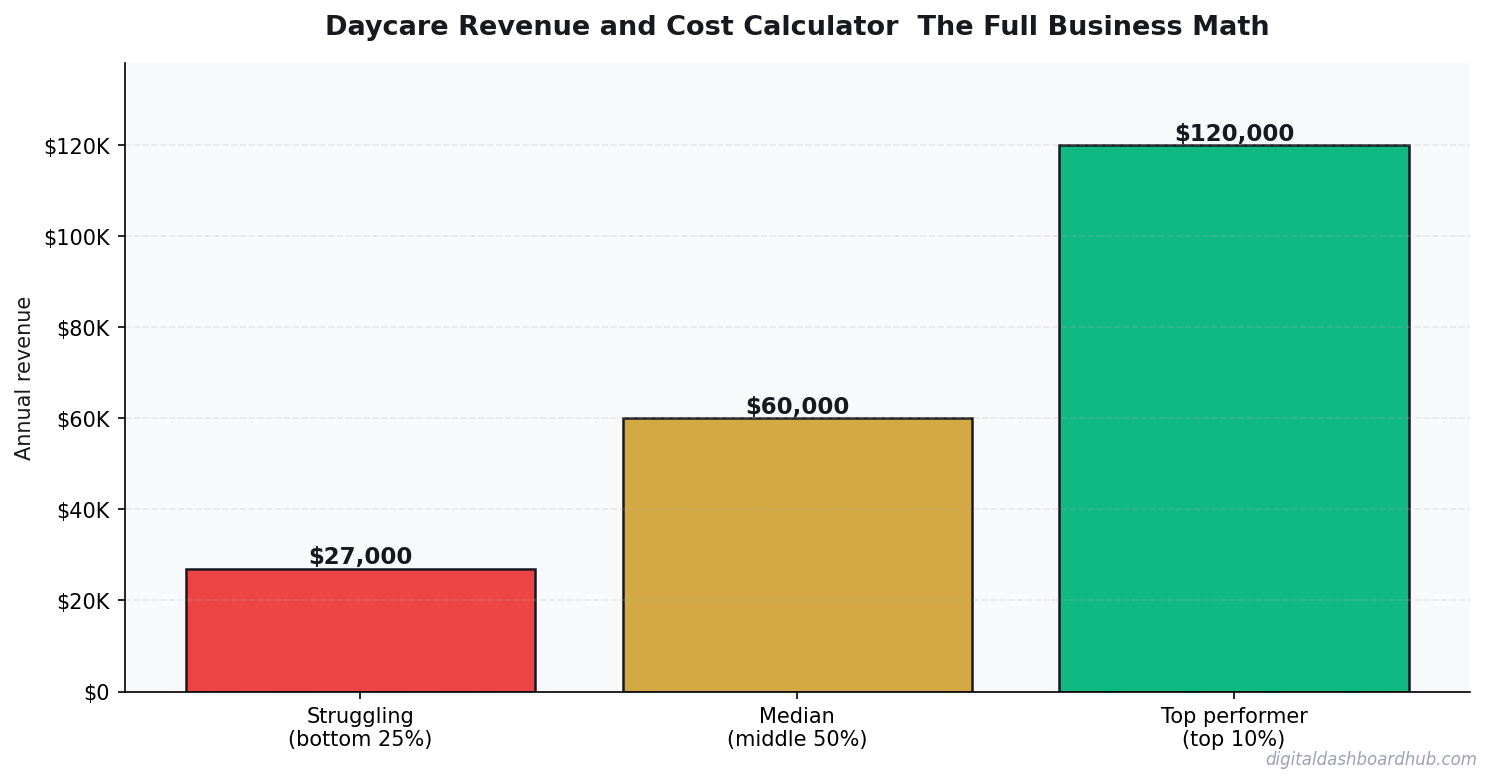
Infant care commands the highest rates because of mandatory staff-to-child ratios. Most states require 1 adult per 3-4 infants vs. 1 per 8-12 for preschoolers. This means infant rooms generate more revenue per child but often less profit per labor dollar.
Staffing: The Number That Makes or Breaks You
Labor is 50-65% of a center-based daycare’s total expenses. State-mandated ratios aren’t suggestions — violating them can shut you down.
Typical mandated ratios (check your state — they vary significantly):
- Infants: 1:3 or 1:4
- Toddlers: 1:4 or 1:6
- Preschool: 1:8 to 1:12
- School-age: 1:12 to 1:15
For a 60-child center with 10 infants, 15 toddlers, 25 preschoolers, and 10 school-age kids, you need roughly 3 + 3 + 3 + 1 = 10 teachers minimum, plus a director and assistant. At $14-$18/hour for teachers and $45K-$65K for a director, your monthly payroll runs $25,000-$40,000.
Full Revenue Model: 60-Child Center
Monthly Revenue
- 10 infants × $300/week = $13,000/month
- 15 toddlers × $260/week = $16,900/month
- 25 preschoolers × $230/week = $24,900/month
- 10 school-age × $130/week = $5,600/month
- Total monthly revenue: $60,400
Monthly Expenses
- Payroll (staff + director): $32,000
- Rent: $5,000-$10,000
- Food/snacks: $3,600 ($2/child/day × 60 × 30)
- Insurance: $800-$1,500
- Supplies/curriculum: $1,000-$2,000
- Utilities: $800-$1,200
- Licensing/compliance: $200-$400
- Marketing: $500-$1,000
- Misc/maintenance: $500-$1,000
- Total monthly expenses: $44,400-$52,700
Monthly net: $7,700-$16,000 — and that’s at full enrollment. Most centers operate at 80-90% capacity due to turnover, which drops net to $3,000-$11,000. At 70% enrollment, you may be losing money.
Download the Full Budget Template
I created a complete daycare budget template that includes enrollment ramp-up projections (you won’t be full on day one), seasonal attendance patterns, and state-specific ratio requirements. It’s inside Digital Dashboard Hub — start your free trial to access it.
The Costs Most New Operators Miss
- Licensing and inspection prep: $2,000-$10,000 before you open (fire safety upgrades, playground requirements, kitchen certifications)
- Background checks and training: $200-$500 per employee, every hire
- Enrollment ramp-up period: 3-6 months to reach 80% capacity. You’re paying full staff costs on partial revenue during this period.
- Summer enrollment drops: 10-20% of families pull kids for vacation, killing your July-August revenue
- Staff turnover costs: Daycare teacher turnover averages 26-40% annually. Each replacement costs $3,000-$5,000 in recruiting, training, and lost productivity.
Home-Based Model: Simpler Math, Real Money
A home-based daycare with 8 children at $250/week average generates $8,700/month. Your costs: food ($480), supplies ($200), insurance ($150), licensing ($50), activities ($100). Monthly net: roughly $7,700 — without rent, without most staffing costs, and with significant tax deductions for home business use.
That’s $92K/year take-home from a business you run from your living room. Not glamorous. Very profitable per dollar invested.
255+
Interactive Tools
Your Action Plan
- Check your state’s licensing requirements at your state’s Department of Human Services website. Ratio requirements and licensing costs vary enough to change the entire business case.
- Survey local pricing. Call 5-10 daycares in your target area and ask rates by age group. Your revenue ceiling is set by what parents in your market will pay.
- Run a 12-month projection with an enrollment ramp — starting at 30% capacity month one and building to 85% by month six. If the cash requirements during ramp-up exceed your reserves, you need more startup capital.
Over 500 business owners use Digital Dashboard Hub’s revenue calculators to model realistic projections with all expenses included. Start your free trial and build your daycare financial model in 10 minutes.
Building a Daycare: What the Math Actually Looks Like Year 1
A licensed home daycare in suburban Milwaukee taking 8 children (Wisconsin’s max for a family home daycare license) at $275/week. Full enrollment gross: $2,200/week or $8,800/month. Reality: you won’t run full enrollment in month 1. Plan for 60% occupancy for months 1–3, 80% for months 4–6, full enrollment by month 7.
That means actual revenue: months 1–3 average $5,280/month, months 4–6 average $7,040/month, month 7+ at $8,800/month. Year 1 average: roughly $6,800/month — not $8,800. Almost every first-year daycare owner is cash-flow negative for the first 3–4 months. Planning for that gap with operating reserves (3–4 months of fixed costs) is the difference between surviving year 1 and not.
The Fixed Cost Structure That Surprises New Operators
Food costs run higher than expected: USDA reimbursement covers some of it, but quality providers spend $5–$8/child/day on food beyond reimbursement. For 8 children, that’s $40–$64/day, or $880–$1,408/month. Add liability insurance (~$600/year), CPR/first aid certification renewals, annual inspection fees, and backup staffing for sick days, and fixed costs easily run $1,500–$2,000/month before paying yourself anything.
The supply costs that people forget: cribs/cots (if taking infants), child-proofing, outdoor play equipment inspection and maintenance, curriculum materials, and the ongoing replacement of materials that get genuinely destroyed by toddlers. Budget $200–$300/month for consumable supplies.
The licensing path matters more than most new daycare owners realize. A home daycare license in most states allows 6–8 children with a single caregiver. A group family daycare license (where available) allows 10–14 children but requires additional certified staff — which changes the unit economics significantly. Understand the licensing tier ceiling before signing a lease or making home modifications. The difference between a 6-child capacity and a 12-child capacity is roughly $2,500–$4,000/month in potential revenue with only moderately higher operating costs.
Keep reading (related guides):
255+ interactive tools for your money, time, and health.
Instant signup · Stripe-secure · Cancel in one click
Keep Reading
- How Sinking Funds Saved Me from Financial Emergencies
- The Side Hustle Tax Trap: Track Every Dollar
- Freelancer Finance Dashboard
Common Questions About Daycare Revenue and Cost Calculator: The Full Business Math
How long does it take to see results?
Most people see meaningful progress within 30-90 days when they apply these strategies consistently. The key is tracking your numbers from day one so you have a baseline to measure against.
What’s the biggest mistake people make?
Trying to do everything at once. Pick one or two strategies from this guide, implement them fully, then layer in additional tactics. Spreading yourself thin is the fastest way to see no results from any of it.
Do I need special tools or software?
Not necessarily to start — but the right tools eliminate hours of manual work. Our free calculators and trackers at Digital Dashboard Hub are a good starting point before you invest in paid software.
How long before I see results?
Most people notice meaningful patterns within 2 to 4 weeks of consistent tracking. The first week is almost always noisy — you’re still learning what to record, when to record it, and how honest to be with yourself. By week two, baselines emerge. By week four, you can start testing changes against data instead of guessing. Don’t judge the system in the first seven days. Give it a full month before deciding whether the system is worth keeping or whether the approach needs a rethink.
What should I track first?
Start with one metric that is both objective and daily. Objective means a number, not a feeling. Daily means once every 24 hours, not “whenever I remember.” Two metrics is fine; three is too many to sustain for someone new. You can always add more once the habit is locked in. The goal of the first month is consistency, not coverage. It’s better to track one thing perfectly for thirty days than six things sloppily for five, and the data will be far more useful.
What if I miss a day?
Miss one day, no problem — tracking is a long game and single-day gaps don’t break the trend. Miss two days in a row, and your brain starts negotiating you out of the system entirely. The rule most people use: never miss twice. Log something — even a single data point — on the second day, then resume the full routine the next morning. Streaks matter less than quick recovery after a miss, and nobody maintains an unbroken record forever. The goal is resilience, not perfection.
Do I need a paid app to do this?
No. A notebook, a spreadsheet, or a free tool all work. The paid-app question should come after 4 weeks of consistent tracking, not before. If you’re going to quit inside the first two weeks, you’ll quit a free tool and a paid one at roughly the same rate. Prove the habit first, then decide whether a paid tool removes enough friction to be worth the subscription. Don’t use “finding the perfect app” as a way to avoid starting the system this week.
How do I know the data is accurate?
Two rules. First, log at the same time each day — morning before coffee, or evening before bed — so you control the biggest variable. Second, write down the conditions, not just the number. A reading without the time, posture, and recent activity is almost useless. A check-in without the context of sleep or stress is just noise. Structure your log so the conditions travel with the measurement. Data without context is decoration, not signal, and won’t help you make better choices.

Andy Gaber is the founder of Digital Dashboard Hub, a suite of 255+ interactive financial, productivity, and wellness tools. He built DDH after getting frustrated with financial apps that gave outputs without context. Follow along for tool tutorials, revenue analytics breakdowns, and honest takes on personal finance.