You’ve tried to build a morning routine at least three times this year. Each attempt lasted somewhere between 4 days and 2 weeks before life got in the way and the habit quietly died. The frustrating part isn’t failing — it’s not knowing why you failed or what to change next time.
In This Article
That’s exactly what a habit tracker app fixes. Not by adding another thing to your to-do list, but by giving you data on your own behavior so you can finally see what’s working, what’s not, and what triggers your best (and worst) days.
The Science Is Annoyingly Clear
The dashboard below loads instantly in your browser. Plug in your numbers, see your answer. No signup to try the basics.
The psychology behind it is simple: what gets measured gets managed. When you can see that you meditated 18 out of the last 30 days, you have real information. Not a feeling. Not a guess. Data. And data lets you make adjustments instead of just feeling guilty.
There’s also the “don’t break the chain” effect, popularized by Jerry Seinfeld. Streaks create their own momentum. Once you’ve hit 14 days in a row, the pain of breaking the chain often outweighs the effort of continuing. A good habit tracker app weaponizes this psychology for you.
Why Most Habit Apps Get Abandoned in 2 Weeks
I’ve tested over a dozen habit tracking apps. The ones that fail share three problems:
❤️ Quick win: even tracking for just 7 days gives you more insight than a month of guessing.
Too many habits at once. Apps like Habitica and Streaks let you track 12+ habits simultaneously. This feels ambitious on Day 1 and overwhelming by Day 5. Research from University College London suggests it takes an average of 66 days to form one habit. Trying to form six at once is a recipe for zero.
No weekly review. Most apps show you a daily checkbox view but never prompt you to zoom out. Without a weekly pattern view, you can’t spot that you always miss your workout on Wednesdays (because that’s your long meeting day) or that your reading habit dies on weekends.
Guilt-based design. Red X marks for missed days. Broken streak warnings. Shame notifications. This works for about 10% of people and actively demotivates the other 90%. The best habit trackers celebrate consistency without punishing imperfection.
What to Actually Look For in a Habit Tracker
How the DDH Habit Tracker Handles This
I built the DDH Habit Tracker after getting frustrated with apps that either treated me like a child (gamification overload) or like a project manager (custom fields, tags, categories, sub-habits). I wanted something that took 30 seconds per day and showed me useful patterns after a month.
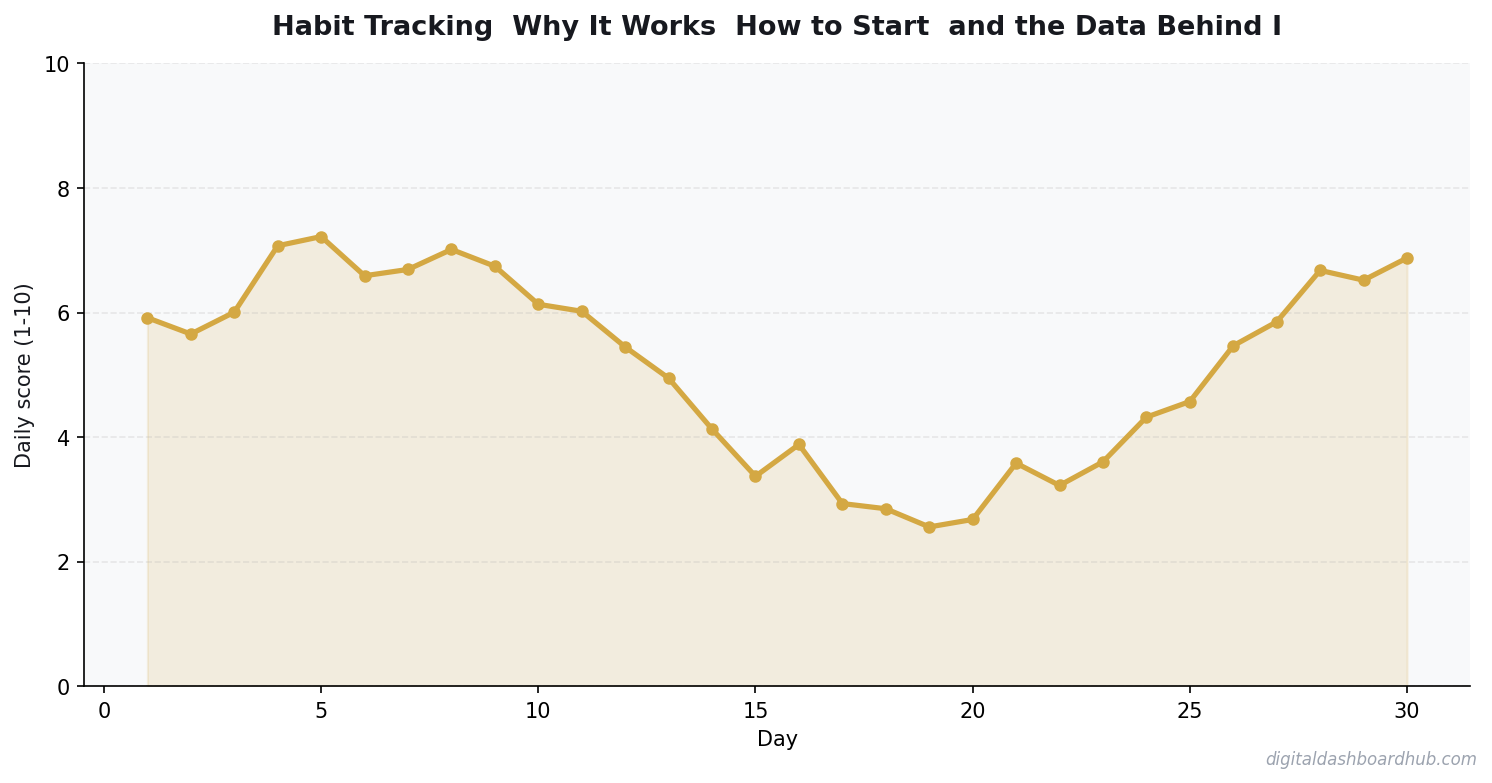
Here’s how it works: you pick up to 3 habits to track. That’s the hard limit, and it’s intentional. Each morning you open the dashboard, tap the habits you completed yesterday, and you’re done. The whole interaction takes less than 30 seconds.
The magic happens in the weekly view. After 7 days, you start seeing color-coded patterns — green for consistent days, yellow for partial, gaps for misses. After 30 days, the trend chart shows your real consistency rate as a percentage. I discovered that my meditation habit had an 87% consistency rate on weekdays but only 40% on weekends. That one insight let me adjust my weekend routine instead of beating myself up about “not being consistent enough.”
Try the DDH Habit Tracker free — pick your 3 habits and start tracking in under 2 minutes.
FREE BONUS: The Habit Stacking Cheat Sheet
12 proven habit stacks that pair new habits with existing routines. Based on James Clear’s research, formatted as a one-page reference.
Get instant access → Sign up free
How to Start Tracking Without Overcomplicating It
Step 1: Pick ONE habit. Not three. Not five. One. The one you most want to be consistent with. If you can nail one habit for 30 days, you’ve proven the system works, and adding a second becomes natural.
Step 2: Define the minimum version. “Exercise” is not a trackable habit. “Do 10 pushups” is. “Read” is vague. “Read 1 page” is concrete. Make the bar so low that even on your worst day, you can still check it off. This is what BJ Fogg calls a “tiny habit,” and it works because consistency matters more than intensity.
Step 3: Track at the same time every day. Attach your tracking to an existing habit. “After I pour my morning coffee, I open my tracker and log yesterday’s habits.” This anchor prevents the tracker from becoming another thing you forget to do.
$1,524/yr
average amount lost to forgotten subscriptions without expense tracking
The Streak Psychology That Changes Everything
Here’s something I didn’t expect: my behavior changed more between Day 15 and Day 20 of a streak than between Day 1 and Day 14. The first two weeks felt like effort. After Day 15, the streak itself became the motivator. I wasn’t meditating because I wanted to meditate — I was meditating because I didn’t want to see my 17-day streak reset to zero.
This is well-documented in behavioral psychology. Loss aversion is roughly twice as powerful as the desire for gains. A good habit tracker exploits this by making your streak visible and valuable. You’re not just building a habit — you’re protecting an investment.
Try This Today
Right now (2 minutes): Write down the one habit you most want to build. Define its minimum version (the version you can do even on a terrible day).
This week: Track that one habit for 7 days using any method — a notebook, a free app, even a sticky note on your mirror. The t
Key Takeaways
- Track one thing consistently rather than five things sporadically
- Review your data weekly — daily logging without weekly review is just data hoarding
- The best tool is the one you’ll actually open every day
ool doesn’t matter yet. The consistency of recording does.
The long play: Start a free DDH account and use the Habit Tracker to see your weekly patterns and consistency trends. After 30 days of data, you’ll know exactly where your habits break down — and what to change.
Keep reading (related guides):
255+ interactive tools for your money, time, and health.
Full dashboard access · Stripe-secure checkout · Cancel anytime
You Might Also Like
- The Complete Guide to Building Habits That Actually Stick
- The Science of Habit Tracking: Why Writing It Down Works
- Mood Tracker: How Measuring Your Emotions Helps You Change Them
- Sleep Tracking Changed My Life
Common Questions About Habit Tracker App
How long before I see results?
Most people notice meaningful patterns within 2 to 4 weeks of consistent tracking. The first week is almost always noisy — you’re still learning what to record, when to record it, and how honest to be with yourself. By week two, baselines emerge. By week four, you can start testing changes against data instead of guessing. Don’t judge the system in the first seven days.
What should I track first?
Start with one metric that is both objective and daily. Objective means a number, not a feeling. Daily means once every 24 hours, not “whenever I remember.” Two metrics is fine; three is too many to sustain for someone new. You can always add more once the habit is locked in. The goal of the first month is consistency, not coverage.
What if I miss a day?
Miss one day, no problem — tracking is a long game and single-day gaps don’t break the trend. Miss two days in a row, and your brain starts negotiating you out of the system entirely. The rule most people use: never miss twice. Log something — even a single data point — on the second day, then resume the full routine the next morning. Streaks matter less than quick recovery after a miss.
Do I need a paid app to do this?
No. A notebook, a spreadsheet, or a free tool all work. The paid-app question should come after 4 weeks of consistent tracking, not before. If you’re going to quit inside the first two weeks, you’ll quit a free tool and a paid one at roughly the same rate. Prove the habit first, then decide whether a paid tool removes enough friction to be worth the subscription.
How do I know the data is accurate?
Two rules. First, log at the same time each day — morning before coffee, or evening before bed — so you control the biggest variable. Second, write down the conditions, not just the number. A blood pressure reading without the time, posture, and recent activity is almost useless. A habit check-in without the context of sleep or stress is just noise. Structure your log so the conditions travel with the measurement.
When should I review the data?
Weekly for noticing; monthly for deciding. A weekly review is a five-minute scan for surprises: what changed, what stayed the same, what correlates with what. A monthly review is longer and ends with a decision — keep the system, change one variable, or scrap the experiment and try a different approach. Don’t try to decide anything from a week of data. And don’t wait a full quarter to look back, either.
Is it worth tracking if my data is imperfect?
Yes. Imperfect data beats no data every time, as long as you know where the imperfections are. A log with a few missing days and honest notes about what went wrong is more useful than a complete but fabricated record. The goal isn’t a museum-quality dataset — it’s enough signal to make better decisions next month than you made last month. Perfect is the enemy of done, especially in week one when the habit itself is fragile.
How do I stay consistent past the first month?
Motivation isn’t the goal — structure is. The people who keep going past 30 days don’t feel more motivated than anyone else; they’ve just wired the tracking into their day so it runs without willpower. Pair it with an existing habit (morning coffee, evening teeth-brushing), keep the entry under 30 seconds, and review weekly so you can see your own progress. Motivation will spike and crash; structure keeps running through both phases without drama.
What's the biggest mistake beginners make?
Tracking too many things at once. The second-biggest is tracking vague things — “felt okay today” is not a useful data point. Pick one thing you can measure with a number. Log it at the same time each day. Review it once a week. That’s the entire system. Everything else is optimization you don’t need yet. Complexity is the enemy of consistency, and consistency is the whole game in the first month — maybe the first three months, honestly.

Andy Gaber is the founder of Digital Dashboard Hub, a suite of 255+ interactive financial, productivity, and wellness tools. He built DDH after getting frustrated with financial apps that gave outputs without context. Follow along for tool tutorials, revenue analytics breakdowns, and honest takes on personal finance.