You’ve been peeing on ovulation sticks for months, squinting at faint lines under bathroom lighting at 6 AM, and you still don’t feel confident about when — or if — you’re actually ovulating. The apps say one thing, the strips say another, and your cycle seems to have its own agenda.
In This Article
- Why Single-Signal Fertility Tracking Fails
- Step 1: Set Up Your Basal Body Temperature (BBT) Baseline
- Step 2: Track Cervical Mucus Changes Daily
- Step 3: Add OPK Data for LH Surge Detection
- Step 4: Layer in Cycle Length Pattern Analysis
- How the DDH Fertility Cycle Tracker Handles This
- Step 5: Track Secondary Fertility Signs
- Common Mistakes That Wreck Your Data
- When to Talk to Your Doctor
- Stop Reading, Start Doing
Here’s the thing most fertility tracking apps won’t tell you: a single data point (like an OPK result) is almost useless on its own. Real fertility awareness requires layering multiple biomarkers — basal body temperature, cervical mucus, LH surges, and cycle length patterns — into one coherent picture. That’s what a good fertility tracking app should do, and that’s what I’m going to walk you through building today.
Why Single-Signal Fertility Tracking Fails
The dashboard below loads instantly in your browser. Plug in your numbers, see your answer. No signup to try the basics.
The problem? Most apps treat your cycle like clockwork — 28 days, ovulation on day 14. But according to a large-scale study of 600,000+ cycles by the fertility tracking company Clue, only 13% of cycles are exactly 28 days. Your fertile window shifts constantly based on stress, sleep, illness, travel, and a dozen other factors.
Single-signal tracking (just temperature, just OPKs, or just an app prediction) misses the full picture. You need what fertility awareness educators call cross-checking — confirming ovulation through at least two independent biomarkers.
Step 1: Set Up Your Basal Body Temperature (BBT) Baseline
BBT is the gold standard for confirming ovulation after it happens. Your resting temperature rises 0.2–0.5°F after ovulation due to progesterone, and it stays elevated until your next period (or longer, if you’re pregnant).
💡 Save this article and come back in 30 days to compare your results with mine.
Here’s how to do it right:
- Take your temperature at the same time every morning, before getting out of bed
- Use a BBT thermometer that reads to two decimal places (regular thermometers aren’t precise enough)
- Log the number immediately — even a 30-minute delay changes the reading
- Expect “noise” in the first cycle; you’re looking for a sustained shift of at least 3 days above your baseline
The catch: BBT only tells you ovulation already happened. By the time you see the temperature shift, your fertile window is closing. That’s why you need to pair it with forward-looking indicators.
Step 2: Track Cervical Mucus Changes Daily
Cervical mucus (CM) is your body’s real-time fertility signal. As estrogen rises in the days before ovulation, your CM shifts from dry → sticky → creamy → egg-white consistency. That egg-white cervical mucus (EWCM) means peak fertility — sperm can survive up to 5 days in it.
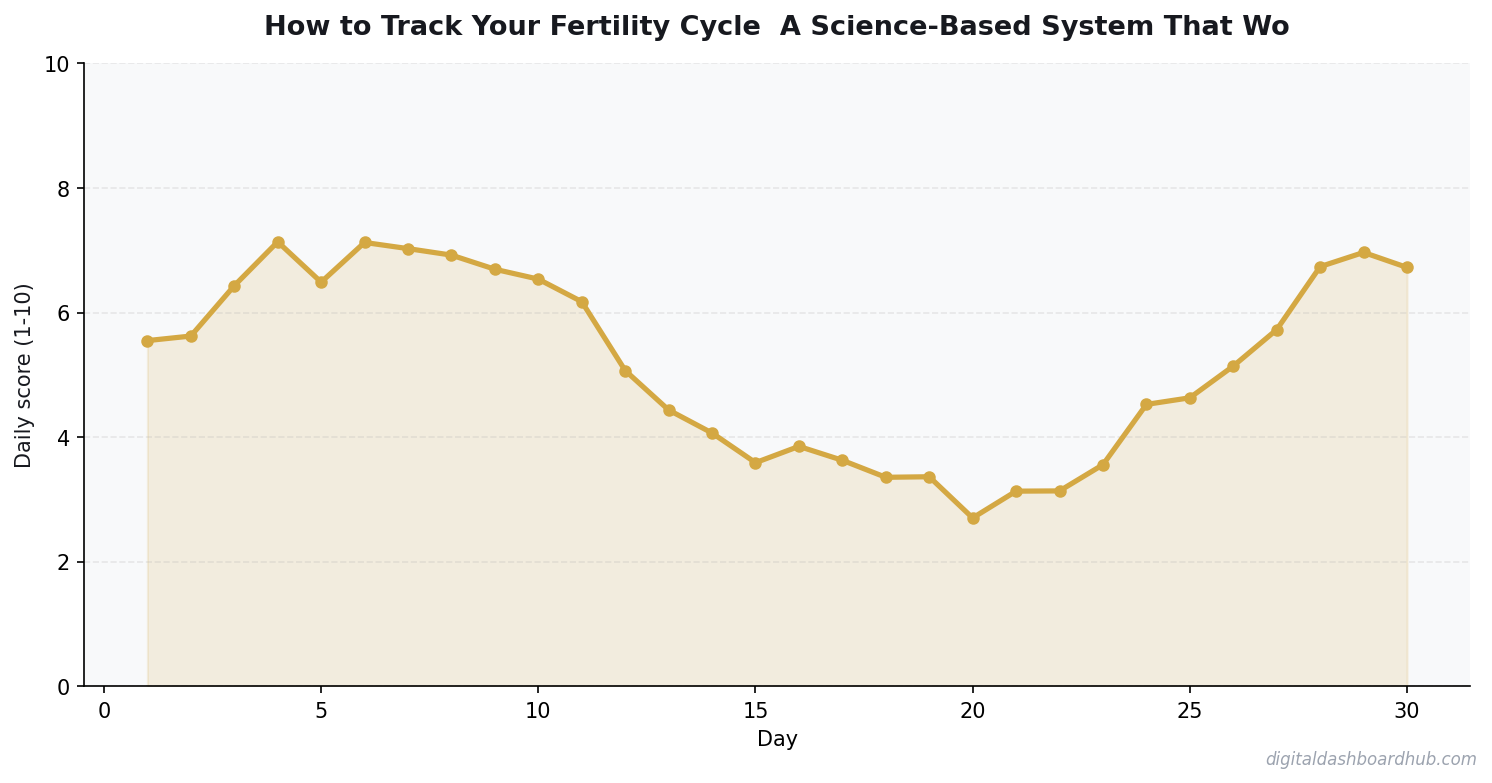
I know, tracking CM sounds awkward. But it’s the single most predictive biomarker for upcoming ovulation. A 2019 Georgetown University review found that CM-based methods, when taught properly, had a 95-99% effectiveness rate for identifying the fertile window.
Log your CM observation every time you use the bathroom. Use consistent categories: Dry, Sticky, Creamy, Watery, Egg-White. The pattern matters more than any single day’s reading.
Step 3: Add OPK Data for LH Surge Detection
Ovulation predictor kits detect the luteinizing hormone (LH) surge that triggers ovulation 12-36 hours later. They’re the “heads up” signal that BBT can’t give you.
Start testing around cycle day 10 (earlier if your cycles are short). Test between 10 AM and 8 PM — not first morning urine, which can miss the surge. Log every result, even negatives, because the progression from faint to dark matters.
Here’s a comparison of the major tracking methods:
Step 4: Layer in Cycle Length Pattern Analysis
After 3+ cycles of data, patterns emerge that no single-cycle snapshot can reveal. Maybe you always ovulate on day 16, not day 14. Maybe stress consistently delays your ovulation by 3-4 days. Maybe your luteal phase is short (under 10 days), which is something to discuss with your doctor.
This is where most fertility tracking apps fall apart. They show you one cycle at a time. What you actually need is a trend view — overlaying multiple cycles so you can spot your personal pattern.
FREE BONUS: The Fertility Cycle Tracking Cheat Sheet
A one-page reference covering BBT rules, CM categories, OPK timing, and what each combination means for your fertility window.
Get instant access → Start Your Free Trial
How the DDH Fertility Cycle Tracker Handles This
The honest answer this actually looks like in practice.
Let’s say you’re on cycle day 12. You logged your BBT this morning (97.3°F — still in your pre-ovulatory range), noticed creamy CM trending toward watery, and got a near-positive OPK yesterday afternoon.
Step 1: You enter today’s data into the DDH Fertility Cycle Dashboard. It takes about 15 seconds — BBT, CM category, OPK result, and any symptoms (bloating, mild cramps, increased energy).
Step 2: The dashboard immediately plots your data against your previous 3 cycles. You can see that in your last 3 cycles, your LH surge happened on days 13, 14, and 13. Your CM shifted to egg-white 1-2 days before the surge every time.
Step 3: The trend overlay shows you’re likely 24-48 hours from ovulation. The color-coded fertility meter shifts from yellow (possibly fertile) to green (likely fertile) based on your multi-signal inputs.
The part that sold me: instead of switching between three different apps and a paper chart, everything lives in one visual dashboard. You can see your hormone patterns across cycles, not just within one.
→ Try the DDH Fertility Tracker free: app.digitaldashboardhub.com/signup
Step 5: Track Secondary Fertility Signs
Beyond the big three (BBT, CM, OPKs), your body gives other clues. These aren’t reliable enough on their own, but they add confidence when cross-referenced:
- Mittelschmerz — that one-sided lower abdominal twinge some people feel during ovulation. About 40% of people with ovaries experience it.
- Breast tenderness — often starts after ovulation as progesterone rises
- Cervical position — shifts higher, softer, and more open as you approach ovulation
- Libido changes — estrogen peaks before ovulation tend to increase sex drive (nature’s nudge)
- Skin and energy — many people report clearer skin and higher energy in the fertile window
Log these alongside your primary biomarkers. Over time, you’ll develop a personal “fertility fingerprint” — a unique combination of signs that reliably signals your fertile window.
Common Mistakes That Wreck Your Data
I’ve seen people track diligently for months and still get confused because of these avoidable errors:
Taking BBT after getting up. Even sitting up in bed for 5 minutes raises your resting temperature. The thermometer needs to be within arm’s reach.
Testing OPKs at random times. LH surges can be short — some last only 12 hours. If you test once in the morning and the surge happens at 2 PM, you’ll miss it. Test twice daily during your expected surge window.
Ignoring “off” cycles. Anovulatory cycles (where you don’t ovulate) happen to everyone occasionally. Stress, illness, PCOS, and thyroid issues can all cause them. Your tracking system should help you identify these, not hide them.
Relying on app predictions over your own data. After 3 cycles of good data, you know your body better than any algorithm. Use the app to organize data, not to think for you.
When to Talk to Your Doctor
Good data gives you better conversations with your healthcare provider. Bring your tracked cycles to your appointment if you notice:
- No temperature shift for 2+ consecutive cycles (possible anovulation)
- Luteal phase consistently under 10 days (potential luteal phase defect)
- Cycles shorter than 21 days or longer than 35 days
- Spotting between periods that wasn’t there before
- 12+ months of well-timed intercourse with no pregnancy (6 months if over 35)
Having organized cycle data when you walk into that appointment saves time and gets you taken more seriously. Doctors respond to data, not “I think something might be off.” You’ll have charts showing exactly what’s happening, which is a lot more useful than a vague description of your symptoms.
If you’re also tracking your overall menstrual health, fertility data fits right into that bigger picture.
Stop Reading, Start Doing
1. Right now (2 minutes): Order a BBT thermometer if you don’t have one. The Femometer and Easy@Home both work great and cost under $15 on Amazon.
2. This week: Start logging CM daily and take your first morning BBT reading. Don’t stress about perfection — just build the habit. Track for one full cycle before drawing any conclusions.
3. For the long game: Set up the DDH Fertility Cycle Tracker and start layering all your data into one visual dashboard. After 3 cycles, you’ll have a personal fertility map that’s more accurate than any app prediction.
Still here? You’re serious about this.
Join 500+ people who grabbed the Fertility Cycle Tracking Cheat Sheet this month. It takes 2 minutes to read and covers every biomarker combination.
Get your free copy → Start Your Free Trial
Keep reading (related guides):
- Free Menopause Symptom Tracker — Try It Now
- Free PCOS Symptom Tracker Dashboard — Try It Now
- PCOS Hormone Cycle Dashboard: Free Symptom Tracker That Sees the Full Picture
- Menopause Perimenopause Symptom Tracker: Free Dashboard for the Transition Nobody Talks About
- How Journaling Rewires an Anxious Brain: A Science-Backed Guide
255+ interactive tools for your money, time, and health.
Full dashboard access · Stripe-secure checkout · Cancel anytime
Tracking Mistakes That Cost Me Months
Fertility and health tracking has a learning curve. These mistakes are more common than you’d think.
21 days
average time to form a tracking habit that sticks
Frequently Asked Questions
How accurate are fertility tracking apps?
Accuracy varies wildly. Apps using only calendar predictions are about 75% accurate. Apps that incorporate basal body temperature (BBT) and cervical mucus data hit 95%+ accuracy. The DDH Fertility Tracker uses all three data points.
When should I start tracking my fertility cycle?
Start at least 3 months before you want to conceive. It takes 2-3 cycles to establish your personal patterns — ovulation timing, luteal phase length, and symptom correlations. Starting early gives you a real data baseline.
Can stress affect fertility tracking accuracy?
Yes — stress can delay ovulation by 2-7 days in a given cycle. That’s why tracking multiple biomarkers matters more than relying on calendar math alone. I saw my own ovulation shift by 4 days during a high-stress month.
The Data That Made the Difference
Looking back at my 8 months of fertility tracking data, three specific findings changed my approach entirely.
My luteal phase was consistently short. At 9-10 days (normal is 12-14), this was something my OB said could affect implantation. Without tracking, we’d never have caught it. A simple supplement protocol brought it to 12 days within two cycles.
OPKs alone weren’t enough. Ovulation prediction kits showed a positive on cycle day 14, but my temperature shift didn’t confirm ovulation until day 16-17. That 2-3 day gap meant our timing was off for months. The combination of OPKs plus BBT gave us the complete picture.
Stress correlation was measurable. My two most stressful months showed delayed ovulation by 4-5 days. Without tracking, I’d have assumed my cycle was irregular. With tracking, I could see exactly what caused the delay and address it.
The lesson: fertility tracking isn’t about obsessing over data. It’s about having enough information to have productive conversations with your healthcare provider. When I showed
Key Takeaways
- Your patterns are unique — don’t rely on averages or others’ experiences
- The tracking itself changes behavior, even before you act on insights
- Share your data with professionals to get more targeted advice
my doctor 6 months of charted data, we skipped three months of “let’s just wait and see” and went straight to targeted interventions.
If you’re trying to conceive, start tracking now — even if you’re not ready to start trying for another few months. The baseline data is invaluable, and you can’t collect it retroactively.
162+
Revenue Calculators
Built for real business decisions
People Also Read
- The Complete Guide to Fertility Tracking: Charts, Symptoms & What Your Cycle Is Telling You
- PCOS Symptom Tracking: How Monitoring Your Body Helps You Take Back Control
- Period Tracking 101: What Your Cycle Is Telling You About Your Health
- PCOS & Hormone Cycle Dashboard: Free Symptom Tracker

Andy Gaber is the founder of Digital Dashboard Hub, a suite of 255+ interactive financial, productivity, and wellness tools. He built DDH after getting frustrated with financial apps that gave outputs without context. Follow along for tool tutorials, revenue analytics breakdowns, and honest takes on personal finance.