You Already Know You Want Out — You Just Don’t Know When the Math Says You Can Leave
Before you scroll: the calculator below is running in your browser right now. For the full feature set — saved scenarios, history, exports — open the dashboard.
The FIRE (Financial Independence, Retire Early) community loves to debate strategy, but the actual question is dead simple: at your current savings rate, investment returns, and spending level, when does your portfolio throw off enough to cover your life? That’s a math problem, not a philosophy debate.
The problem with most FIRE calculators is they give you a single number and call it done. “You’ll be financially independent in 14.3 years!” Cool. But what happens if you cut $500/month in spending? What if you boost income by $1,000/month? Which lever moves the date faster? That’s what this calculator actually shows you.
The Core FIRE Math (It’s Simpler Than You Think)
FIRE boils down to one formula: Annual Expenses × 25 = Your FIRE Number. That’s the 4% rule — you need a portfolio 25x your annual spending to safely withdraw 4% per year indefinitely.
Lean FIRE uses a 5% withdrawal rate (riskier, but works if you’re flexible). Fat FIRE uses 3% (safer, accounts for healthcare inflation and lifestyle creep). Standard FIRE at 4% has survived every historical market period since 1926.
Savings Rate Is the Only Number That Matters
What changed everything most people miss: your income doesn’t determine your FIRE timeline — your savings rate does. Someone earning $200K who saves 15% reaches FIRE later than someone earning $80K who saves 50%.
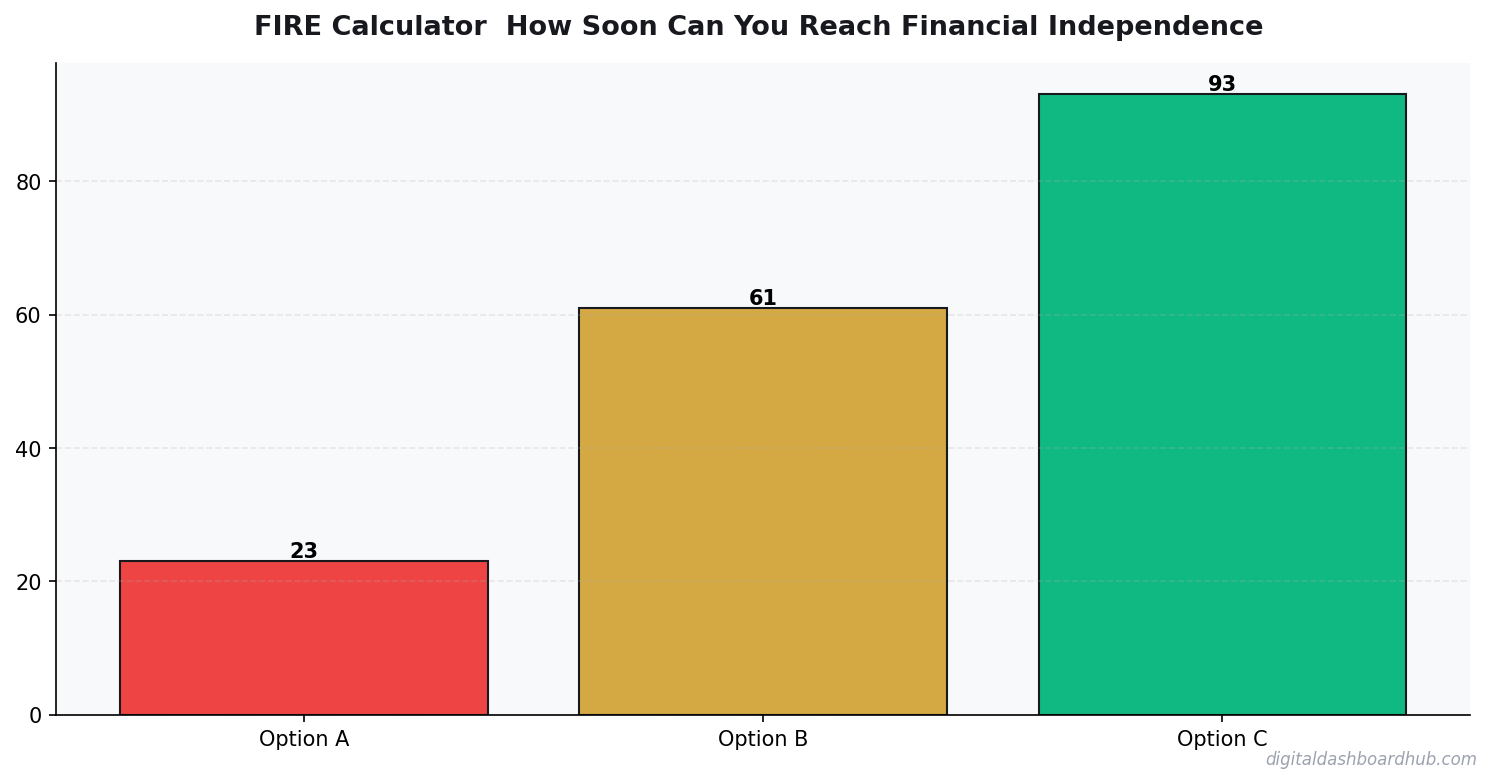
These assume 7% real returns (10% nominal minus 3% inflation) and starting from zero. If you already have savings, your timeline shortens considerably. The calculator factors in your current portfolio balance to give you an accurate date.
Spending Cuts vs. Income Increases: Which Moves the Needle?
This is the FIRE community’s favorite argument, and the answer depends on where you sit. If you’re already lean, another $500/month in spending cuts might mean eating rice and beans. An extra $500/month in income is more sustainable.
But here’s the math that surprises people: cutting $500/month in spending is worth more than earning $500/month extra. Why? Because cutting spending reduces your FIRE number AND increases your savings rate simultaneously. Earning more only increases savings rate — your FIRE number stays the same (unless you keep spending flat, which is hard).
Example: $5,000/month income, $3,500/month spending, $1,500/month savings (30% rate). FIRE number: $1,050,000.
- Cut $500 spending: FIRE number drops to $900,000 AND savings rate jumps to 40%. Time to FIRE: ~19 years (down from 28).
- Earn $500 more: FIRE number stays $1,050,000, savings rate goes to 36%. Time to FIRE: ~24 years.
Nine years of difference from the same $500. That’s why spending cuts are so powerful in the FIRE equation.
The Variables Most Calculators Ignore
Healthcare Before Medicare
If you FIRE at 40, you need 25 years of self-funded healthcare. ACA marketplace plans run $400-$800/month for a couple. That’s $5,000-$10,000/year your calculator needs to account for.
Sequence of Returns Risk
A market crash in your first 3 years of FIRE can permanently damage your portfolio. The calculator models this by showing your success rate across historical periods, not just average returns.
Social Security Bridge
If you FIRE at 45, you still get Social Security at 62 or 67. That future income effectively reduces your FIRE number. Most calculators ignore this completely.
Want the full interactive model? The FIRE Calculator inside Digital Dashboard Hub lets you toggle every variable — healthcare costs, Social Security timing, different return assumptions, and inflation scenarios. Grab the free trial and model your exact situation.
The 3 FIRE Flavors (and Which One Fits You)
Lean FIRE ($25K-$40K/year spending): Live simply, probably in a low-cost area. Works great if you genuinely enjoy a minimalist lifestyle. Falls apart if you have kids or health issues.
Regular FIRE ($40K-$80K/year spending): Normal middle-class life without a job. The sweet spot for most people. Requires $1M-$2M portfolio.
Fat FIRE ($80K-$150K+/year spending): Upper-middle-class lifestyle, travel, nice restaurants. Requires $2M-$4M+. Usually means high income and a longer accumulation phase.
Your Next Move
- Calculate your FIRE number: Start your free trial and plug in your real numbers. The calculator shows your exact FIRE date and which levers move it fastest.
- Pick your FIRE flavor: Be honest about what spending level makes you happy. Aiming for Lean FIRE when you want Fat FIRE just leads to quitting the plan.
- Automate your savings rate: Set up automatic transfers on payday. If you don’t see it, you don’t spend it. Increase by 1% every quarter until you hit your target rate.
Over 1,200 people have modeled their FIRE path with this calculator. Start your free trial and find out when your portfolio can replace your paycheck.
A Real FIRE Scenario: Hitting Independence at 41
Alex and Jordan, dual income household, combined income $145,000/year, annual spending $62,000. Savings rate: 43%. Starting portfolio: $280,000 at age 31.
At a 7% average annual return, saving $62,300/year, they hit $1,550,000 (their 4% number for $62,000/year spending) in approximately 10 years — at age 41. That’s not a fantasy number. It’s arithmetic. The uncomfortable truth is that FIRE isn’t a special strategy — it’s a savings rate problem, and most people have a savings rate problem.
The math changes significantly with lifestyle inflation. If their spending grows 3%/year (keeping pace with inflation but not accelerating), their target number also grows — from $1,550,000 to $2,080,000 by the time they hit it. Same math, same timeline, higher target. If spending grows 5%/year (one new car, one lifestyle upgrade, a bigger apartment), the target and timeline both shift materially. Tracking spending growth rate alongside investment growth rate is the actual discipline FIRE requires.
What Most FIRE Calculators Get Wrong
They assume a flat return rate and ignore sequence-of-returns risk. If the market drops 35% in your first year of retirement, your safe withdrawal rate drops from 4% to more like 3.2% — because you’re selling shares at the bottom to fund living expenses. The year you retire matters almost as much as the portfolio size when you retire.
The practical hedge: build a 2-year cash buffer before retiring. Keep 2 years of expenses in high-yield savings so you don’t have to sell equities in a downturn in your first critical years. This costs you some return in the accumulation phase but dramatically improves the probability that your money outlasts you.
One aspect the FIRE community doesn’t discuss enough: semi-retirement as a viable intermediate step. Dropping from full-time income to $20,000–$30,000/year in part-time or freelance work radically extends portfolio longevity — because you’re no longer pulling the full 4% from investments. A couple with $900,000 saved who earns $25,000/year part-time needs only $37,000/year from the portfolio — a 4.1% withdrawal on a portfolio that should last indefinitely at that rate. Semi-retirement often beats waiting for the full number.
Keep reading (related guides):
- Never Work Again Calculator: The Exact Number by Age
- How Much Money You Need to Retire Early at 40, 45, and 50 (Real Numbers by Age)
- Should You Buy Rental Property? How to Run the Numbers Before You Invest
- Roth vs Traditional IRA Calculator: Which Saves You More by Retirement?
- A/B Testing Your Etsy Listings: How to Know Whats Actually Working
How to Read Your FIRE Calculator Results
Getting a number is the easy part. Knowing whether to trust it is where most people get stuck. Here is how to pressure-test your output before you build a 20-year plan around it.
Check the assumptions first, not the answer
Before you celebrate a FIRE date of 2039, confirm three inputs: your assumed real return (after inflation), your post-FIRE annual spending, and your withdrawal rate. If any of these is optimistic by even 0.5%, your actual FIRE date slides back by three to five years.
Run three scenarios, not one
Pessimistic: 4% real return, 3.25% withdrawal. Base: 5% real return, 3.5% withdrawal. Optimistic: 6% real return, 4% withdrawal. If all three land within two years of each other, you have a reliable target. If they span a decade, your plan is too dependent on assumptions you can’t control.
Stress-test the first five years
Sequence-of-returns risk is concentrated in the first five to ten years of retirement. Ask: what happens if the market drops 30% in year one and stays flat for three years? If your plan breaks under that scenario, you need either more cushion, a bond tent, or flexible spending rules before you pull the trigger.
Factor in healthcare specifically
Pre-Medicare healthcare is the single biggest variable for early retirees in the US. ACA subsidies help if you control your MAGI, but you need $900 to $1,800 per month per person budgeted depending on state and income. Most calculators bury this assumption — confirm yours is realistic.
Recalibrate every 12 months
Your FIRE date isn’t a prophecy, it’s a projection. Run the calculator every January with updated portfolio values, last year’s actual spending, and revised return expectations. The goal isn’t to hit the exact date you calculated in 2026 — it’s to know whether you’re still on track.
Quick FAQ: FIRE Calculator Results
How often should I update my FIRE projection?
Quarterly at minimum, annually at maximum. Market returns, tax law changes, and your own savings behavior all shift quickly enough that an 18-month-old projection is often meaningfully wrong. The calculator takes five minutes to re-run.
What return assumption should I use?
For a globally diversified 80/20 portfolio, 5% real (post-inflation) is reasonable. Some planners use 6-7% nominal with a 2.5% inflation subtraction. Never model more than 7% real returns — historical averages don’t guarantee future ones.
Should I plan for Social Security?
If you’re under 45, most advisors recommend modeling at 70-80% of projected benefits to account for potential benefit cuts. If you’re over 55, model full benefits. Either way, don’t let Social Security be the difference between success and failure.
What about one-time windfalls — inheritance, equity, business sale?
Model them as separate lump sums with a probability weight. A 40% chance of a $300K inheritance in 15 years is not the same as counting $300K today. Calculators that let you add probabilistic events give more honest projections than ones that don’t.
When should I stop running projections and just retire?
When your projected success rate is above 90% across all three scenarios (pessimistic, base, optimistic) and you’ve tested your plan against the 2000-2002 and 2008-2009 sequences. Below that, you’re guessing. Above that, you’re probably over-working.
Quick FAQ: FIRE Calculator Results
How often should I update my FIRE projection?
Quarterly at minimum, annually at maximum. Market returns, tax law changes, and your own savings behavior all shift quickly enough that an 18-month-old projection is often meaningfully wrong. The calculator takes five minutes to re-run.
What return assumption should I use?
For a globally diversified 80/20 portfolio, 5% real (post-inflation) is reasonable. Some planners use 6-7% nominal with a 2.5% inflation subtraction. Never model more than 7% real returns — historical averages don’t guarantee future ones.
Should I plan for Social Security?
If you’re under 45, most advisors recommend modeling at 70-80% of projected benefits to account for potential benefit cuts. If you’re over 55, model full benefits. Either way, don’t let Social Security be the difference between success and failure.
What about one-time windfalls — inheritance, equity, business sale?
Model them as separate lump sums with a probability weight. A 40% chance of a $300K inheritance in 15 years is not the same as counting $300K today. Calculators that let you add probabilistic events give more honest projections than ones that don’t.
When should I stop running projections and just retire?
When your projected success rate is above 90% across all three scenarios (pessimistic, base, optimistic) and you’ve tested your plan against the 2000-2002 and 2008-2009 sequences. Below that, you’re guessing. Above that, you’re probably over-working.
255+ interactive tools for your money, time, and health.
14-day trial · Stripe checkout · Cancel anytime
Keep Reading
- How Sinking Funds Saved Me from Financial Emergencies
- Sinking Fund Savings Goal Planner (Free Tool)
- Why Traditional Budgets Fail ADHD Brains
Common Questions About FIRE Calculator: How Soon Can You Reach Financial Independence?
How long does it take to see results?
Most people see meaningful progress within 30-90 days when they apply these strategies consistently. The key is tracking your numbers from day one so you have a baseline to measure against.
What’s the biggest mistake people make?
Trying to do everything at once. Pick one or two strategies from this guide, implement them fully, then layer in additional tactics. Spreading yourself thin is the fastest way to see no results from any of it.
Do I need special tools or software?
Not necessarily to start — but the right tools eliminate hours of manual work. Our free calculators and trackers at Digital Dashboard Hub are a good starting point before you invest in paid software.

Andy Gaber is the founder of Digital Dashboard Hub, a suite of 255+ interactive financial, productivity, and wellness tools. He built DDH after getting frustrated with financial apps that gave outputs without context. Follow along for tool tutorials, revenue analytics breakdowns, and honest takes on personal finance.