You’ve downloaded Mint, YNAB, and three other budget apps. You’ve watched 10 videos on the envelope system. You’ve made exactly 47 spreadsheets. And you’re still overdrawing your account because your brain decided that a $200 keyboard was “basically a necessity” at 11 PM last Tuesday. Same.
In This Article
- Why Traditional Budgets Fail ADHD Brains (The Science)
- System 1: The Anti-Budget (Automate Everything, Track Nothing)
- System 2: The Visual Cash Envelope (Digital Version)
- System 3: The “Spend First, Audit Weekly” Approach
- System 4: The 48-Hour Impulse Rule
- How the DDH Expense Tracker Handles This
- The “ADHD Tax” — What Poor Money Management Actually Costs
- “But I’ve Tried Budgeting and I Always Quit”
- Put This Into Action
- Common Mistakes That Sabotage ADHD Systems
Traditional budgeting assumes you can consistently resist impulses, remember spending limits, and delay gratification — three things the ADHD brain is neurologically wired to struggle with. That’s not a character flaw. That’s dopamine regulation working differently. You need an ADHD budget system built for how your brain actually works, not how productivity gurus think it should work.
Why Traditional Budgets Fail ADHD Brains (The Science)
Scroll down — the interactive tool runs live with your inputs. Full version lives inside Digital Dashboard Hub. Two-click trial, Stripe-secure.
Running a SaaS business means I track these numbers obsessively. Here’s what the data actually shows:
The prefrontal cortex handles impulse control, working memory, and future planning — all critical for budgeting. In ADHD brains, the prefrontal cortex is chronically under-aroused, which creates three specific budget-killing problems:
1. Impulsive spending: The ADHD brain seeks dopamine, and buying things delivers an immediate dopamine hit. A 2023 study in Journal of Financial Therapy found adults with ADHD reported 3x more impulse purchases per month than neurotypical adults, with an average impulsive spending total of $417/month.
2. Object permanence issues with money: If you can’t see your budget limits at the moment of purchase, they don’t exist. Digital bank balances are abstract numbers. ADHD brains need visual, tangible representations of money. Our close look into ADHD and money covers the full neuroscience.
3. Avoidance of boring tasks: Budget tracking is tedious. Tedium is kryptonite for ADHD. So the budget gets set up on January 1st and abandoned by January 19th. You know the pattern.
System 1: The Anti-Budget (Automate Everything, Track Nothing)
This is the system for people who will never consistently track expenses, and that’s okay.
💡 Most people overcomplicate this. Start with ONE metric and expand from there.
How it works:
- Calculate your monthly fixed costs (rent, utilities, subscriptions, debt payments, savings goals)
- Set up automatic transfers on payday: fixed costs go to a bills account, savings go to a savings account
- Whatever’s left in your checking account is your spending money. All of it. No categories, no tracking.
That’s it. You never have to categorize a coffee run or feel guilty about a Target impulse buy — because it’s all coming from the “already accounted for” pile. The important stuff (bills, savings) happened automatically before you could spend it.
Best for: ADHD brains that will never consistently track expenses. This system requires zero ongoing effort after the initial 30-minute setup.
Limitation: No visibility into spending patterns. You won’t know if you’re spending $300/month on DoorDash unless your bank balance tells you by running out.
System 2: The Visual Cash Envelope (Digital Version)
The classic envelope system works because physical cash creates visual scarcity — you can see the money disappearing. But carrying cash in 2026 is impractical for most people. Here’s the digital adaptation:
How it works:
- Create 4-5 separate digital “envelopes” (you can use separate bank sub-accounts, or a visual dashboard)
- Categories: Groceries, Fun/Entertainment, Gas/Transport, Personal, and “Oh Crap” (unplanned needs)
- Allocate specific amounts to each envelope on payday
- When an envelope hits $0, that category is done for the month
The key insight for ADHD: fewer categories = less decision fatigue. YNAB has 30+ categories by default. That’s 30 decisions to make every time you spend money. Five categories means five decisions. Your dopamine-starved brain can handle five.
System 3: The “Spend First, Audit Weekly” Approach
This system flips the script: instead of planning what to spend (which requires predicting the future — tough for ADHD time blindness), you spend freely and review weekly.
How it works:
- Spend normally throughout the week
- Every Sunday (15 minutes max), review the past week’s spending in one sitting
- Categorize it after the fact: “Needs,” “Wants,” “Oops”
- If “Oops” is over 15% of your total, identify the biggest culprit and make one specific rule to address it next week
This works because ADHD brains are better at reflecting on past behavior than predicting future behavior. You’re not fighting your impulses — you’re learning from them. Over time, the weekly audit naturally reduces impulse spending because you start anticipating the Sunday review. That visual impulse spending tracker becomes your accountability mirror.
FREE BONUS: The ADHD Budget System Matching Quiz
Answer 8 questions about your spending patterns, attention style, and pain points. Get a personalized recommendation for which of the 5 systems matches your ADHD profile.
Get instant access → Start Your Free Trial
System 4: The 48-Hour Impulse Rule
This isn’t a budget — it’s a single rule that reduces impulse spending by 40-60%:
Any non-essential purchase over $30 gets a 48-hour waiting period.
Add the item to a wishlist (Amazon, Notes app, whatever). If you still want it after 48 hours, buy it guilt-free. If you forgot about it, you just saved yourself $30-300.
A 2021 behavioral economics study found that 62% of impulse purchase urges fade within 48 hours. For ADHD brains, that number is likely higher because the dopamine spike that triggered the purchase desire dissipates faster than neurotypical brains.
I’ve saved roughly $340/month since implementing this single rule. Some months more, some less. The key is making the wishlist frictionless — if adding an item takes more than 10 seconds, you’ll skip it and buy impulsively instead.
How the DDH Expense Tracker Handles This
System 5 is the DDH Visual Dashboard approach. Here’s how it works for ADHD brains specifically.
Step 1: You connect your spending data (manual entry or CSV import — takes about 10 minutes for the first month). The dashboard immediately shows a color-coded spending breakdown. Not categories in a spreadsheet — actual visual blocks sized proportionally to spending. The biggest block is where the most money went. You can see it in 2 seconds.
Step 2: The “Impulse Spending” detector flags purchases that match impulse patterns: late-night online orders, same-day purchases from the same store, and charges under $50 that add up (the “latte factor” on steroids). My first month, it flagged $387 in impulse spending I hadn’t noticed across 23 small purchases.
Step 3: The weekly trend view shows your spending curve through the month. Most ADHD spenders see a pattern: heavy spending in the first week after payday, then progressively less as the account drains. The dashboard makes this pattern impossible to ignore — which is the first step to changing it.
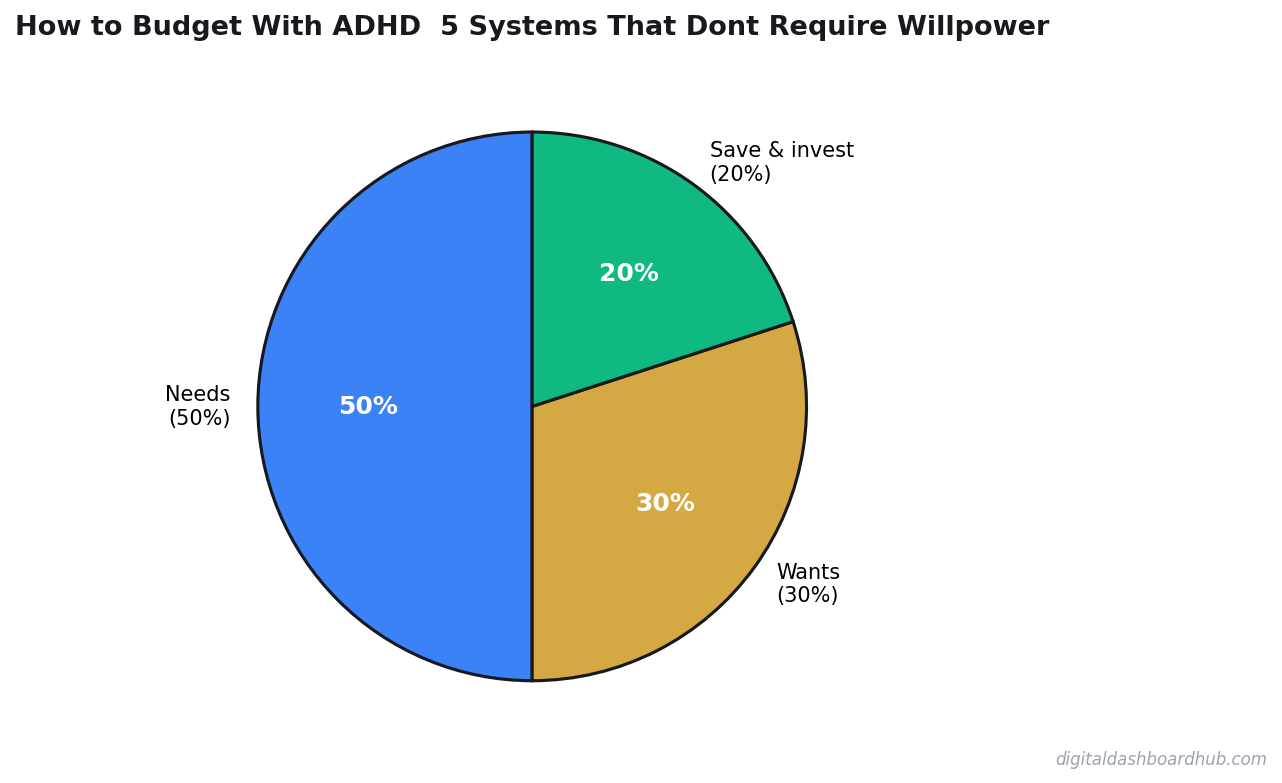
The part that sold me: the dashboard is visual. No spreadsheets, no columns of numbers, no accounting jargon. It looks more like a fitness dashboard than an accounting tool — which is exactly why it works for ADHD brains that tune out anything that looks like “homework.” If you want the broader picture, our 50/30/20 budget rule guide shows how to set the right spending proportions.
→ Try the DDH Expense Tracker free: app.digitaldashboardhub.com/signup
The “ADHD Tax” — What Poor Money Management Actually Costs
Let’s put numbers on this. The average ADHD adult pays an invisible “ADHD tax” on their finances:
- Late fees: $35-50/month from forgotten bills (average ADHD adult has 2-3 late payments/year)
- Impulse spending: $200-500/month above what they’d spend with a working system
- Subscription creep: $50-150/month in forgotten recurring charges
- Overdraft fees: $34 average per incident, 2-4 times per year for ADHD adults
- Interest on carried credit card balances: $100-300/month for the 67% of ADHD adults who carry a balance
Add it up and the ADHD tax is $400-1,000+ per month — $4,800-12,000 per year. A working budget system doesn’t need to be perfect. It just needs to close half that gap to pay for itself hundreds of times over. If tracking your impulse spending saves even $200/month, that’s $2,400/year.
“But I’ve Tried Budgeting and I Always Quit”
Of course you quit. The system was designed for neurotypical brains. Here are the actual reasons ADHD budgets fail, and what to do instead:
“I forget to enter my spending.” → Use the Anti-Budget (System 1). If you won’t track, don’t force it. Automate the important stuff and spend the rest.
“The categories are overwhelming.” → Use 5 categories max. Groceries, Bills, Fun, Savings, Everything Else. That’s it. If YNAB wants you to split “Groceries” into “Food” and “Household Items,” ignore it.
“I get a dopamine hit from buying things.” → The 48-Hour Rule (System 4). You’re not saying “no” — you’re saying “not yet.” That’s a massive difference for the ADHD brain. The dopamine menu gives you alternative reward sources.
“I’m ashamed of my spending and avoid looking at it.” → The Spend & Audit system (System 3) reframes reviewing spending as data collection, not judgment. You’re a scientist studying your patterns, not a defendant on trial.
Put This Into Action
1. Right now (2 minutes): Pick ONE system from this article — the one that sounds least painful. Not the “best” one. The one you’ll actually do. For most ADHD brains, start with the Anti-Budget or the 48-Hour Rule.
2. This week: Implement it. If you chose the Anti-Budget, set up your automatic transfers. If you chose the 48-Hour Rule, create a wishlist note on your phone. One action, done.
3. For the long game: Once your basic system is running for a month, add the DDH Expense Tracker for visibility. The visual dashboard shows you what’s working without requiring daily tracking — a weekly glance is enough.
Still here? You’re ready to stop fighting your brain.
Join 900+ people who took the ADHD Budget System Matching Quiz this month. It takes 3 minutes and most people say “oh, THAT’s why my old system failed.”
Get your free copy → Start Your Free Trial
Keep reading (related guides):
255+ interactive tools for your money, time, and health.
14 days free · No charge today · 2-click cancel
Common Mistakes That Sabotage ADHD Systems
Using envelope budgeting with physical cash. This works for neurotypical brains because they can maintain the system. For ADHD brains, the envelopes get lost, the cash gets mixed up, and the whole system collapses by week 3. Digital automation removes the maintenance burden entirely.
Setting up a complex spreadsheet as your first step. I spent 6 hours building a beautiful budget spreadsheet. Used it twice. The setup WAS the dopamine hit — the maintenance was the boring part my brain avoided. Start with the simplest possible system and add complexity only when the simple version proves insufficient.
I’ve made every one of these. Sharing them so you don’t waste the same months I did.
-0.81
correlation between consistent tracking and reported stress levels
Your Questions, Answered
What’s the best free tool for managing ADHD tasks?
How do I stop hyperfocusing on the wrong things?
Does medication alone fix ADHD productivity issues?
The Autopilot Budget That Survives ADHD Impulse Spending
Traditional budgets ask you to make 30+ spending decisions per day. That’s 30 opportunities for ADHD impulsivity to derail your plan. My system reduces it to zero daily decisions.
On payday, automated transfers split my income: 50% to bills (auto-pay), 20% to savings (auto-transfer), 10% to investments (auto-buy), 20% to a “spend” account. The spend account is my play money — no guilt, no tracking, no decisions. When it’s empty, I stop
Key Takeaways
- Start with the simplest possible system and add complexity only when needed
- Data shows you what’s working — stop guessing and start measuring
- Consistency beats intensity: 3 minutes daily beats 30 minutes weekly
spending.
The breakthrough: I don’t budget categories within the 20% spend account. Budgeting “entertainment” vs “clothes” vs “eating out” is executive function torture for ADHD brains. One pool of discretionary money, one simple rule (when it’s gone, it’s gone), zero willpower required. My savings rate went from 4% to 22% in 6 months.
Real-Time
Calculations
Results update as you type your numbers
Related Articles
- ADHD and Money: Why Your Brain Makes Budgeting Feel Impossible
- Why Traditional Budgets Fail ADHD Brains — And the Visual Tracker That Works
- ADHD Impulse Spending Tracker: Free Visual Dashboard
- The ADHD Dopamine Menu: Hack Your Brain’s Reward System

Andy Gaber is the founder of Digital Dashboard Hub, a suite of 255+ interactive financial, productivity, and wellness tools. He built DDH after getting frustrated with financial apps that gave outputs without context. Follow along for tool tutorials, revenue analytics breakdowns, and honest takes on personal finance.