I always assumed my anxiety caused my bad sleep. Turns out, it was the other way around — and I only figured that out because I tracked both on the same dashboard for 90 days. The correlation between my sleep quality and next-day anxiety wasn’t just noticeable. It was almost mechanical.
About this article: I’m Andy, founder of Digital Dashboard Hub. I built DDH’s 255 free interactive tools to solve the specific financial, productivity, and wellness tracking gaps I kept seeing — starting with the problem this article covers. The free tool below is available without signup and works instantly. Try it and see your numbers in real time.
In This Article
If you’ve been treating your anxiety without looking at your sleep anxiety connection, you might be fighting the symptom while ignoring the engine. Here’s the tracking data that changed my entire approach.
The Chicken-or-Egg Problem
Scroll down — the interactive tool runs live with your inputs. Full version lives inside Digital Dashboard Hub. Two-click trial, Stripe-secure.
Does anxiety cause bad sleep, or does bad sleep cause anxiety? Research says: yes. A 2019 study from UC Berkeley published in Nature Human Behaviour found that sleep deprivation increased anxiety levels by up to 30% — and that deep sleep specifically was the natural anti-anxiety mechanism most people were missing.
The problem is, when you’re living it, the two feel like one inseparable blob of misery. You can’t sleep because you’re anxious. You’re anxious because you didn’t sleep. Which one do you fix first?
Tracking answered that question for me in two weeks.
My Tracking Setup
For 90 days, I logged two things every morning:
📊 Pro tip: Start tracking before you change anything. The baseline data is the most valuable data you’ll collect.
Sleep data: Hours slept, time to fall asleep, number of wake-ups, subjective sleep quality (1-10).
Anxiety data: Morning anxiety level (1-10), number of anxious thoughts before noon, physical symptoms (chest tightness, stomach knots, jaw clenching).
I used a consistent scale and logged at the same time every day — within 30 minutes of waking up — so the data wasn’t contaminated by whatever happened during the day.
The Pattern I Couldn’t Ignore
After two weeks of data, the pattern was slapping me in the face. Every single day where my anxiety score exceeded 7/10, I had slept fewer than 6 hours the night before. Every. Single. One.
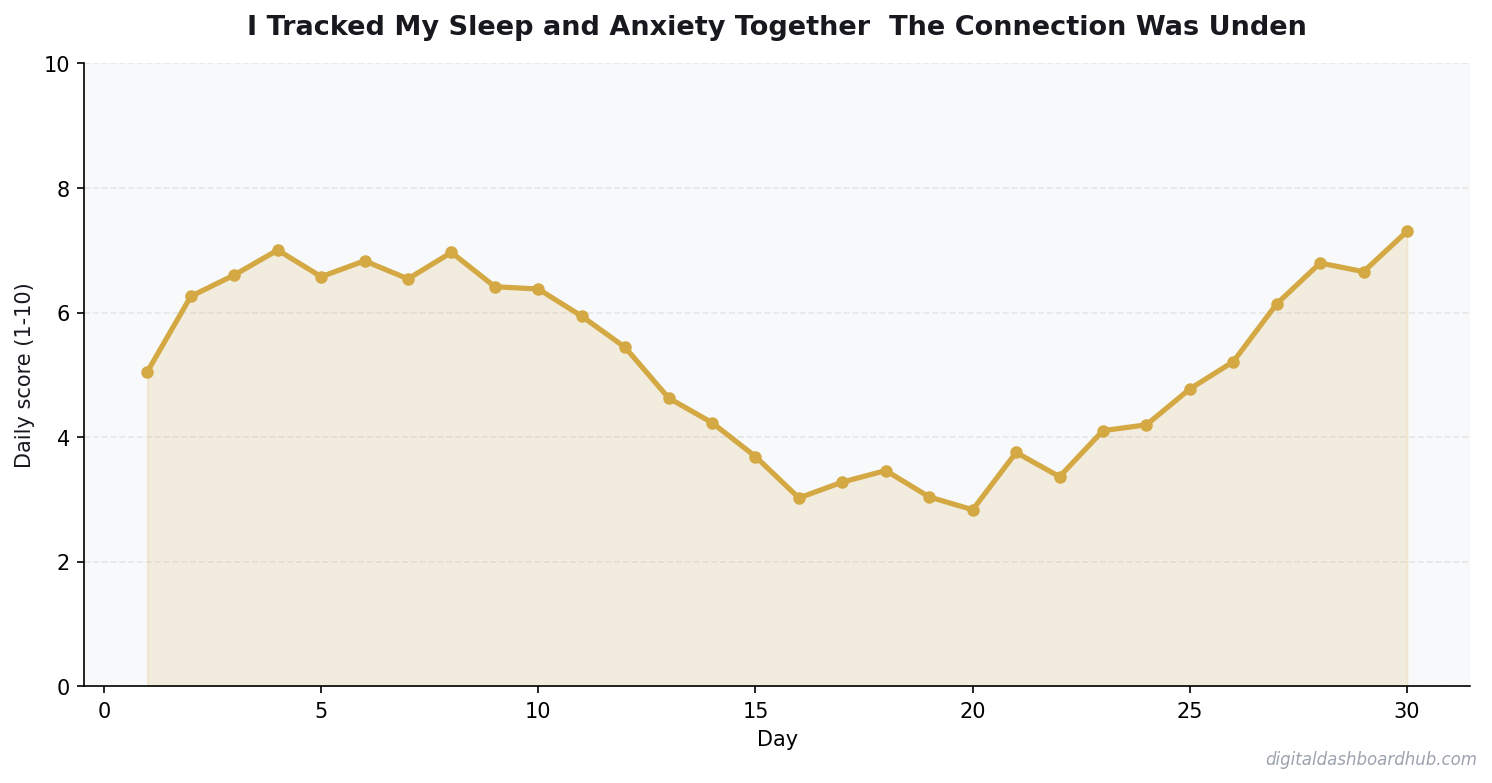
On the flip side, days where I got 7+ hours of quality sleep? My anxiety averaged 3.2/10 — basically background noise. I had maybe one anxious thought before noon instead of a parade of catastrophizing.
The relationship wasn’t just correlated — it was lagged. Bad sleep tonight predicted high anxiety tomorrow. But high anxiety today only predicted bad sleep tonight about 40% of the time. The arrow pointed more strongly from sleep to anxiety than the other way around.
This matched the UC Berkeley research perfectly. The study found that deep (NREM) sleep acts as a “natural anxiolytic” — literally a built-in anti-anxiety treatment. Miss it, and your amygdala (the brain’s fear center) becomes 60% more reactive the next day.
How the DDH Sleep & Anxiety Tracker Handles This
Tracking two separate variables in a spreadsheet works, but seeing them together on one timeline is where the insight lives. The DDH tracker plots sleep quality and anxiety on the same chart with a one-day offset — so you’re comparing last night’s sleep with today’s anxiety.
After 14 days, the tracker generates a correlation score. Mine was -0.81 (strong negative correlation: better sleep = lower anxiety). The dashboard highlights your “threshold” — the minimum sleep hours where your anxiety stays manageable. For me, it was 6.5 hours. Below that, anxiety spiked. Above it, anxiety stayed below 4/10.
The most actionable feature: the “sleep debt” warning. If you’ve had two consecutive nights below your threshold, the tracker flags it — because my data showed that two bad nights in a row was the tipping point where anxiety went from “elevated” to “spiraling.”
Try the DDH Sleep & Anxiety Tracker free — log your first night’s data in 60 seconds.
FREE BONUS: The Sleep-Anxiety Connection Worksheet
A 14-day tracking template that captures both sleep and anxiety data side by side, with instructions for identifying your personal sleep threshold.
Get instant access → Start Your Free Trial
What I Changed Based on the Data
Once I realized sleep was the primary driver, I stopped trying to “fix” my anxiety directly and focused on sleep instead. Counterintuitive, but the data was clear.
Change 1: Hard phone cutoff at 9 PM. My data showed that nights where I used my phone after 9 PM had, on average, 35 minutes longer sleep latency (time to fall asleep). That alone was costing me almost an hour of sleep.
Change 2: Same bedtime every night, including weekends. My weekend sleep schedule was shifted 2 hours later, which created “social jet lag” that took until Tuesday to recover from. My highest-anxiety days? Mondays and Tuesdays. Not a coincidence.
Change 3: 10-minute meditation before bed. Not because meditation “cures” anxiety — but because it reduced my time-to-sleep from an average of 38 minutes to 19 minutes, giving me nearly 20 more minutes of actual sleep per night.
2.6x
average underestimate of time needed for tasks (without tracking)
The 90-Day Results
Average sleep hours: 5.9 (month 1) → 6.8 (month 2) → 7.2 (month 3)
Average anxiety score: 6.4 (month 1) → 4.2 (month 2) → 3.1 (month 3)
Days with anxiety above 7: 14 (month 1) → 5 (month 2) → 1 (month 3)
Physical symptoms per week: 11 (month 1) → 4 (month 2) → 2 (month 3)
I didn’t start therapy. I didn’t change medications. I fixed my sleep, and my anxiety dropped by 52%. The data tells the story better than I can.
Make It Happen
Right now (2 minutes): Rate last night’s sleep quality (1-10) and your current anxiety level (1-10). Write both down. Tomorrow morning, do it again. Even two data points start showing the relationship.
This week: Track both sleep and anxiety scores daily for 7 days. Look for the pa
Key Takeaways
- Track one thing consistently rather than five things sporadically
- Review your data weekly — daily logging without weekly review is just data hoarding
- The best tool is the one you’ll actually open every day
ttern: do your worst anxiety days follow your worst sleep nights?
For the long haul: Set up the DDH Sleep & Anxiety Tracker to see the correlation score and identify your personal sleep threshold. Two weeks of data is usually enough for the pattern to emerge.
Keep reading (related guides):
255+ interactive tools for your money, time, and health.
14 days free · No charge today · 2-click cancel
255+
Interactive Tools
Related Guides
- Sleep Tracking Changed My Life: How to Understand and Fix Your Sleep
- How to Track Your Anxiety and Actually Reduce It
- I Tracked My Nervous System for 90 Days
- Stress Level Tracker: How Measuring Stress Helps You Manage It
Common Questions About Sleep Anxiety Connection Tracking
How long before I see results?
Most people notice meaningful patterns within 2 to 4 weeks of consistent tracking. The first week is almost always noisy — you’re still learning what to record, when to record it, and how honest to be with yourself. By week two, baselines emerge. By week four, you can start testing changes against data instead of guessing. Don’t judge the system in the first seven days. Give it a full month before deciding whether the system is worth keeping or whether the approach needs a rethink.
What should I track first?
Start with one metric that is both objective and daily. Objective means a number, not a feeling. Daily means once every 24 hours, not “whenever I remember.” Two metrics is fine; three is too many to sustain for someone new. You can always add more once the habit is locked in. The goal of the first month is consistency, not coverage. It’s better to track one thing perfectly for thirty days than six things sloppily for five, and the data will be far more useful.
What if I miss a day?
Miss one day, no problem — tracking is a long game and single-day gaps don’t break the trend. Miss two days in a row, and your brain starts negotiating you out of the system entirely. The rule most people use: never miss twice. Log something — even a single data point — on the second day, then resume the full routine the next morning. Streaks matter less than quick recovery after a miss, and nobody maintains an unbroken record forever. The goal is resilience, not perfection.
Do I need a paid app to do this?
No. A notebook, a spreadsheet, or a free tool all work. The paid-app question should come after 4 weeks of consistent tracking, not before. If you’re going to quit inside the first two weeks, you’ll quit a free tool and a paid one at roughly the same rate. Prove the habit first, then decide whether a paid tool removes enough friction to be worth the subscription. Don’t use “finding the perfect app” as a way to avoid starting the system this week.
How do I know the data is accurate?
Two rules. First, log at the same time each day — morning before coffee, or evening before bed — so you control the biggest variable. Second, write down the conditions, not just the number. A reading without the time, posture, and recent activity is almost useless. A check-in without the context of sleep or stress is just noise. Structure your log so the conditions travel with the measurement. Data without context is decoration, not signal, and won’t help you make better choices.
When should I review the data?
Weekly for noticing; monthly for deciding. A weekly review is a five-minute scan for surprises: what changed, what stayed the same, what correlates with what. A monthly review is longer and ends with a decision — keep the system, change one variable, or scrap the experiment and try a different approach. Don’t try to decide anything meaningful from a single week of data. And don’t wait a full quarter to look back, either — trends go stale fast when you’re not watching.
Is it worth tracking if my data is imperfect?
Yes. Imperfect data beats no data every time, as long as you know where the imperfections are. A log with a few missing days and honest notes about what went wrong is more useful than a complete but fabricated record. The goal isn’t a museum-quality dataset — it’s enough signal to make better decisions next month than you made last month. Perfect is the enemy of done, especially in week one when the habit itself is fragile.
How do I stay consistent past the first month?
Motivation isn’t the goal — structure is. The people who keep going past 30 days don’t feel more motivated than anyone else; they’ve just wired the tracking into their day so it runs without willpower. Pair it with an existing habit (morning coffee, evening teeth-brushing), keep the entry under 30 seconds, and review weekly so you can see your own progress. Motivation will spike and crash; structure keeps running through both phases without drama.

Andy Gaber is the founder of Digital Dashboard Hub, a suite of 255+ interactive financial, productivity, and wellness tools. He built DDH after getting frustrated with financial apps that gave outputs without context. Follow along for tool tutorials, revenue analytics breakdowns, and honest takes on personal finance.