You’ve heard “just journal” so many times it sounds like the wellness equivalent of “just eat less.” Vague, annoying, and unhelpful. But here’s the thing — the research on journaling reduces stress science is actually stacked, and the effect size is larger than most people realize.
In This Article
The problem isn’t journaling itself. The problem is that nobody tells you what to write, how long to write, or how to track whether it’s actually working. Let’s fix that with data.
The Research: What 40+ Studies Actually Show
Enter your own numbers in the interactive tool below and get a real-time read. The dashboard version adds saved scenarios, history, and full feature access.
A 2022 meta-analysis in Psychotherapy Research found that expressive writing produced a moderate effect size (d = 0.42) on stress reduction — comparable to the effect of regular exercise. Participants who wrote about emotions showed a 28% reduction in perceived stress after just four sessions.
And it’s not just feelings. A study in Psychosomatic Medicine found that expressive writing improved immune function — participants who journaled had stronger T-cell responses compared to controls who wrote about neutral topics. Your journal is literally boosting your immune system.
Why Most Journaling Advice Fails
“Write about your day.” Cool, but that’s a diary, not a stress intervention. The research is clear: the stress reduction comes from writing about emotions and meaning-making, not from recording events.
💰 Pro tip: Start tracking before you change anything. The baseline data is the most valuable data you’ll collect.
Writing “Had a meeting, ate lunch, worked on project” does nothing for stress. Writing “I felt completely dismissed in that meeting and I’m realizing it’s a pattern with my manager that reminds me of how my dad talked over me” — that’s the therapeutic mechanism at work.
The other failure point: consistency. People journal for 3 days, feel good, stop for 2 weeks, and then decide “journaling doesn’t work for me.” That’s like going to the gym twice and concluding exercise is useless. Data-driven stress management requires sustained tracking.
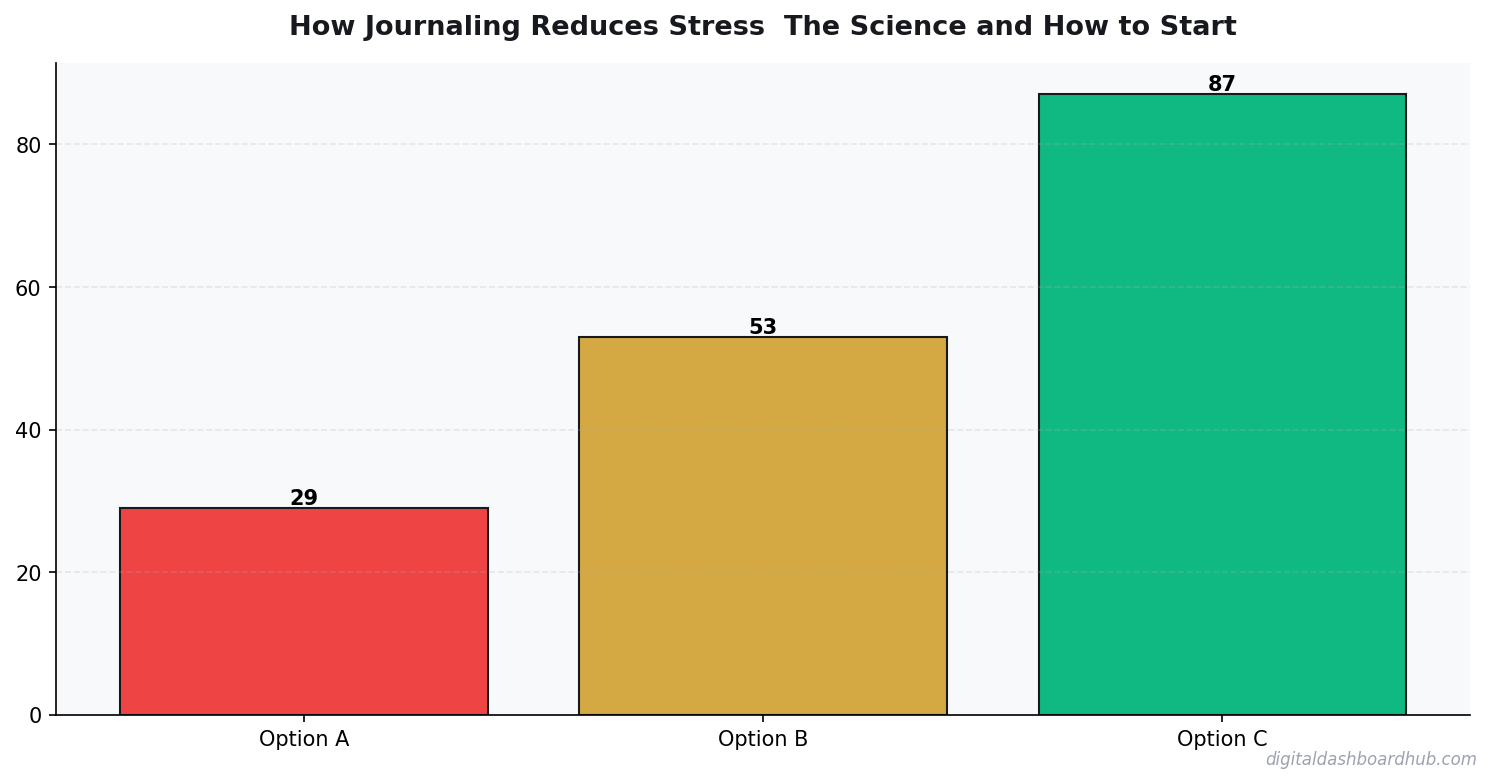
The 3 Journaling Methods Ranked by Stress Reduction
Notice free-form diary writing barely moves the needle. If you’re going to spend the time, use a method that’s actually been proven to work. Expressive writing and worry journaling have the strongest evidence. Gratitude journaling is a solid daily baseline — the 5-minute gratitude practice shows how small the time commitment really is.
How the DDH Stress & Journal Tracker Handles This
Most journal apps are just blank pages with a date stamp. They don’t help you see patterns, track what methods work, or prove that journaling is actually reducing your stress over time. That’s the gap the DDH tracker fills.
Step 1: Each journal entry starts with a 1-10 stress rating. Takes 2 seconds. This creates the data point you’ll thank yourself for later.
Step 2: Write your entry using one of three guided prompts (expressive, gratitude, or worry dump). The prompt guides you toward the kind of writing that research shows actually reduces stress — not just “write whatever.”
Step 3: The dashboard charts your stress ratings over time. After 2-3 weeks, you can literally see your stress line trending downward. I went from an average of 7.2 to 4.8 in my first month. That visual proof is what keeps the habit alive.
The part that sold me: seeing the before/after in a graph instead of relying on my own biased memory of “am I less stressed?” Our brains are terrible at remembering past emotional states accurately. The data doesn’t lie.
Try the DDH Stress Tracker free — rate your stress today and start building your baseline.
The Minimum Effective Dose
You don’t need an hour-long journaling session. Research suggests the sweet spot is 15-20 minutes, 3-4 times per week. That’s about 1 hour total per week for a 28% stress reduction. Show me another intervention with that kind of ROI on time.
If even that feels like too much, start with the 5-minute anxiety journaling method. Five minutes of worry dumping before bed can reduce sleep-onset time by up to 9 minutes (Scullin et al., Baylor University, 2018). Not bad for a habit that takes less time than scrolling Instagram.
$1,524/yr
average amount lost to forgotten subscriptions without expense tracking
Common Objection: “I Don’t Know What to Write”
This is the #1 reason people quit. Here are three no-fail prompts stolen directly from the research:
For expressive writing: “What happened this week that I’m still thinking about? What emotions come up when I replay it? What does this situation remind me of from the past?”
For worry journaling: “What am I worried about right now? What’s the worst that could realistically happen? What would I tell a friend in this situation?”
For gratitude: “What surprised me today in a good way? Who did something kind that I didn’t expect? What’s one thing I usually take for granted that I noticed today?”
Keep a stress level tracker alongside your journal to connect your entries with actual stress changes.
Do This First
Right now (2 min): Rate your stress right now on a 1-10 scale. Write it down somewhere. That’s your baseline. Tomorrow, do a 15-minute expressive writing session and rate your stress again after.
This week: Do
Key Takeaways
- Start with the simplest possible system and add complexity only when needed
- Data shows you what’s working — stop guessing and start measuring
- Consistency beats intensity: 3 minutes daily beats 30 minutes weekly
three 15-minute journaling sessions using the prompts above. Notice if your stress rating shifts by the end of the week.
Long game: Start tracking with DDH so you can see the pattern over weeks and months. The magic isn’t in any single session — it’s in the trend line.
Keep reading (related guides):
- How Journaling Rewires an Anxious Brain: A Science-Backed Guide
- Meditation for Beginners: How to Start When Your Brain Wont Shut Up
- Best Meditation Apps for Stress Relief Mental Clarity
- Sleep Tracking Changed My Life: How to Finally Understand (and Fix) Your Sleep
- Free Menopause Symptom Tracker — Try It Now
255+ interactive tools for your money, time, and health.
Full features for 14 days · Secure payment · Stop anytime
3 Brands
One Platform
Finance, Creator, and Wellness tools
Worth Reading Next
- Stress Management: A Data-Driven Approach
- Gratitude Journaling: The 5-Minute Brain Rewire
- How Journaling Rewires an Anxious Brain
Common Questions About How Journaling Reduces Stress: The Science and How to Start
How long does it take to see results?
Most people see meaningful progress within 30-90 days when they apply these strategies consistently. The key is tracking your numbers from day one so you have a baseline to measure against.
What’s the biggest mistake people make?
Trying to do everything at once. Pick one or two strategies from this guide, implement them fully, then layer in additional tactics. Spreading yourself thin is the fastest way to see no results from any of it.
Do I need special tools or software?
Not necessarily to start — but the right tools eliminate hours of manual work. Our free calculators and trackers at Digital Dashboard Hub are a good starting point before you invest in paid software.

Andy Gaber is the founder of Digital Dashboard Hub, a suite of 255+ interactive financial, productivity, and wellness tools. He built DDH after getting frustrated with financial apps that gave outputs without context. Follow along for tool tutorials, revenue analytics breakdowns, and honest takes on personal finance.