You love kids, you’re good with them, and every parent in your neighborhood is desperate for childcare. But “I should open a daycare” is a very different statement from “I can make a living running a daycare.” The financials are where the dream either gets validated or saved from becoming a $50,000 lesson.
In This Article
I’m going to give you the actual numbers for starting a daycare revenue costs — not the optimistic projections from franchise brochures, but the real math from publicly available data and operator surveys. Grab a calculator.
Startup Costs: The Real Number Range
Scroll down — the interactive tool runs live with your inputs. Full version lives inside Digital Dashboard Hub. Two-click trial, Stripe-secure.
I launched Digital Dashboard Hub because the tools I found online were either too generic or too complicated. Here’s the honest breakdown:
Home-based daycare and commercial-space daycare are completely different businesses financially. Here’s the honest breakdown:
Home-based daycare startup: $3,000 – $15,000. This covers licensing fees ($50-500 depending on state), liability insurance (~$400-800/year), safety modifications (outlet covers, gates, fire extinguisher — $500-2,000), supplies and equipment ($1,000-3,000), and background checks and training ($200-500).
Commercial daycare center startup: $50,000 – $500,000+. Lease deposits and renovation ($20,000-200,000), licensing and permits ($1,000-5,000), furniture and equipment ($10,000-50,000), staffing for first 3 months before revenue stabilizes ($15,000-100,000), and insurance ($2,000-6,000/year).
The gap between those two numbers is why most first-time operators start from home. You need far less capital, your overhead is lower, and you can test the business model before committing to a commercial space. For business fundamentals, the 5 essential business numbers framework applies perfectly here.
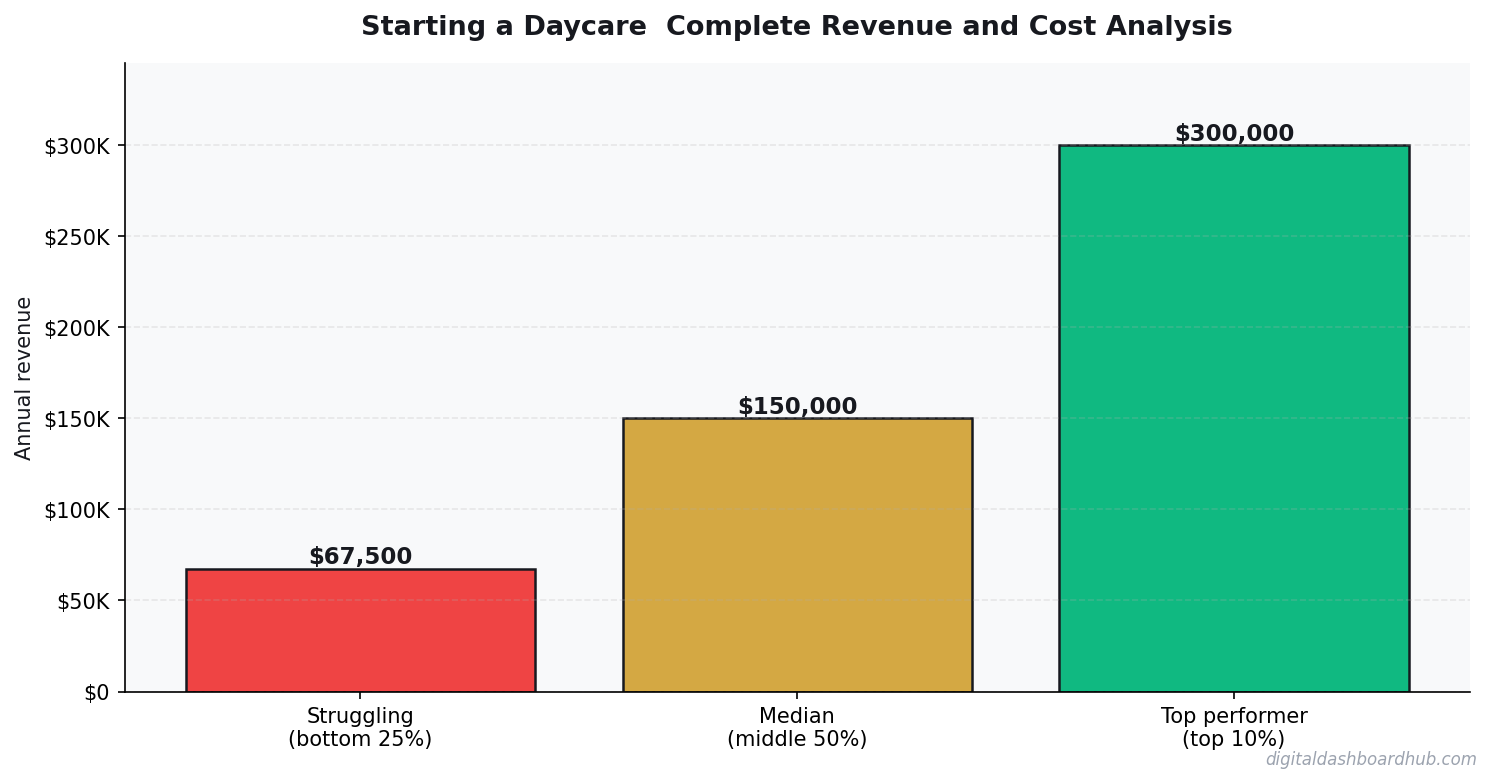
Revenue: What Daycare Operators Actually Earn
These numbers look great until you subtract expenses. The national average childcare rate in 2025 was $1,230/month per child (Care.com Cost of Care Survey), but that varies wildly by geography. Manhattan parents pay $2,500+/month. Rural Alabama might be $600/month. Your zip code IS your revenue ceiling.
The Expense Reality Check
Here’s where the dream meets math. For a home-based daycare with 8 children:
Monthly revenue: $9,600 (8 kids × $1,200/month)
Monthly expenses: Food ($800-1,200 — kids eat constantly), supplies and activities ($200-400), insurance ($70-150/month), additional liability coverage ($100-200/month), utilities increase ($100-200), assistant wages if required by ratio ($1,500-2,500), licensing renewal prorated ($25-50), and marketing ($50-150).
Total monthly expenses: $2,845 – $4,850
Net monthly income: $4,750 – $6,755
That’s a 49-70% profit margin for home-based — genuinely solid for a small business. But remember, that’s at full capacity. The first 3-6 months you’ll likely operate at 50-70% capacity while building enrollment. Your effective income during ramp-up is more like $2,000-4,000/month.
How the DDH Revenue Calculator Handles This
Before you sign a lease or buy $3,000 in tiny chairs, run your specific numbers through a calculator that accounts for your local rates, your capacity, and your actual expenses.
Step 1: Enter your planned capacity and your area’s average childcare rate. The DDH calculator pulls market rate data so you’re not guessing. It factors in the ramp-up period — because nobody opens at full capacity on day one.
Step 2: Input your expected expenses across each category. The dashboard flags when your staffing costs exceed 50% of revenue (the danger zone for childcare profitability) or when your food costs are above the $150/child/month benchmark.
Step 3: The breakeven analysis shows exactly how many enrolled children you need to cover your monthly costs. For most home daycares, it’s 3-4 children. For a commercial center, it’s typically 15-25 children depending on your lease and staffing.
The part that sold me: the 12-month cash flow projection. It shows the valley — those first few months where you’re spending more than you’re earning — and exactly when you cross into profitability. Knowing you need $12,000 in reserves to survive the ramp-up is better than discovering it in month 3.
Try the DDH Revenue Calculator free — run your daycare numbers before you commit a single dollar.
The Three Things That Kill Daycare Businesses
1. Underpricing. New operators set rates 20% below market because they feel guilty charging “that much.” Then they can’t afford an assistant, burn out working 55-hour weeks solo, and close within a year. Charge market rate from day one. Parents paying $1,200/month expect professionalism, not a discount operation. Check the pricing framework for service businesses — the psychology applies.
2. Licensing violations. Every state has specific child-to-adult ratios, background check requirements, and facility standards. One violation can shut you down and get you blacklisted. Research your state’s requirements before anything else — the childcare.gov database has state-by-state licensing info.
3. No financial tracking. Daycare has dozens of small expenses that add up invisibly. The operator who says “I think I’m making money” is usually making less than they think. Track every dollar from day one using a system that shows you expenses without the headache.
Start With This
Right now (2 min): Look up the average childcare rate in your zip code on Care.com’s cost of care page. Multiply by your planned capacity. That’s your revenue ceiling — does it excite you or concern you?
This week: Contact your state’s childcare licensing offic
e and get the requirements list. Some states require 40+ hours of pre-service training, which takes 2-4 weeks to complete.
Long game: Run your full financial model through DDH before spending money on setup. A $0 reality check now beats a $15,000 lesson later.
A Real Daycare Business: What the Numbers Actually Look Like
Let’s make this concrete. Imagine a licensed home daycare in Columbus, Ohio. The provider takes 6 full-time infants at $260/week each. That’s $1,560/week or roughly $6,240/month in gross revenue. After food reimbursements from the USDA Child and Adult Care Food Program (~$500/month), actual food costs of ~$300, and supplies/insurance of ~$400, she’s netting about $6,040/month before taxes. That’s not a bad income for a home-based business.
Scale that to a licensed center with 40 kids across three age groups and you’re looking at $40,000–$55,000/month gross — but your labor costs jump to 60–65% of revenue immediately. That’s the trap most first-time daycare owners walk into: the revenue looks exciting, the margins don’t.
The Three Numbers That Make or Break a Daycare
1. Infant-to-toddler ratio. Infants generate $250–$350/week but require 1:3 or 1:4 staffing ratios depending on your state. Toddlers at $200/week can be staffed 1:6. The math on toddlers is almost always better unless your market will pay a significant infant premium.
2. Occupancy rate. Most daycares budget for 85–90% occupancy because life happens — kids age out, families move, spots sit empty between placements. If you model 100% occupancy in your projections, your real numbers will disappoint you every single month.
3. Director salary timing. New owners often don’t pay themselves a market salary in their projections, then “discover” the business is profitable only because they’re working for free. Model a real director salary from day one — around $45,000–$55,000/year in most markets — and see if the numbers still work. If they don’t, your pricing or capacity is the problem.
What Most Daycare Business Plans Get Wrong
The biggest mistake I see: treating licensing as a one-time hurdle rather than an ongoing cost. Fire inspections, health department visits, staff background checks, CPR renewals, continuing education credits — these run $2,000–$4,000/year for a small center and are non-negotiable. Miss one and you’re shut down.
The second mistake is underestimating the parent relationship factor. Referrals drive 70% of new enrollments in most daycares. If a parent leaves unhappy, they don’t just leave — they tell 10 people at the school pickup line. Your customer service budget is your marketing budget.
Keep reading (related guides):
255+ interactive tools for your money, time, and health.
14 days free · No charge today · 2-click cancel
$0
To Get Started
Full access during your trial period
- Small Business Finance Basics: The Only 5 Numbers You Need
- How to Calculate Your Rate (So You Stop Undercharging)
- Small Business Expense Tracking Without Losing Your Mind
Common Questions About Starting a Daycare: Complete Revenue and Cost Analysis
How long does it take to see results?
Most people see meaningful progress within 30-90 days when they apply these strategies consistently. The key is tracking your numbers from day one so you have a baseline to measure against.
What’s the biggest mistake people make?
Trying to do everything at once. Pick one or two strategies from this guide, implement them fully, then layer in additional tactics. Spreading yourself thin is the fastest way to see no results from any of it.
Do I need special tools or software?
Not necessarily to start — but the right tools eliminate hours of manual work. Our free calculators and trackers at Digital Dashboard Hub are a good starting point before you invest in paid software.

Andy Gaber is the founder of Digital Dashboard Hub, a suite of 255+ interactive financial, productivity, and wellness tools. He built DDH after getting frustrated with financial apps that gave outputs without context. Follow along for tool tutorials, revenue analytics breakdowns, and honest takes on personal finance.