You’ve Been a Gym Rat for 10 Years. That Doesn’t Mean You Can Run a Gym Business.
The dashboard below loads instantly in your browser. Plug in your numbers, see your answer. No signup to try the basics.
The gap between “I love working out” and “I can manage 200 memberships, a payroll, equipment maintenance schedules, and a lease negotiation” is enormous. I’ve watched fitness professionals open gyms with passion and close them with debt because they treated it like a lifestyle project instead of a business with razor-thin margins.
Here’s the actual financial picture — the one the franchise sales reps won’t show you.
Startup Costs: The Real Range
Equipment is typically the second-largest cost behind buildout. A single commercial-grade squat rack runs $2,000-$5,000. Treadmills: $3,000-$8,000 each. A set of dumbbells from 5-100 lbs: $3,000-$6,000. It adds up brutally fast.
The Four Revenue Streams
Gyms that rely only on memberships struggle. The ones that thrive stack multiple revenue streams:
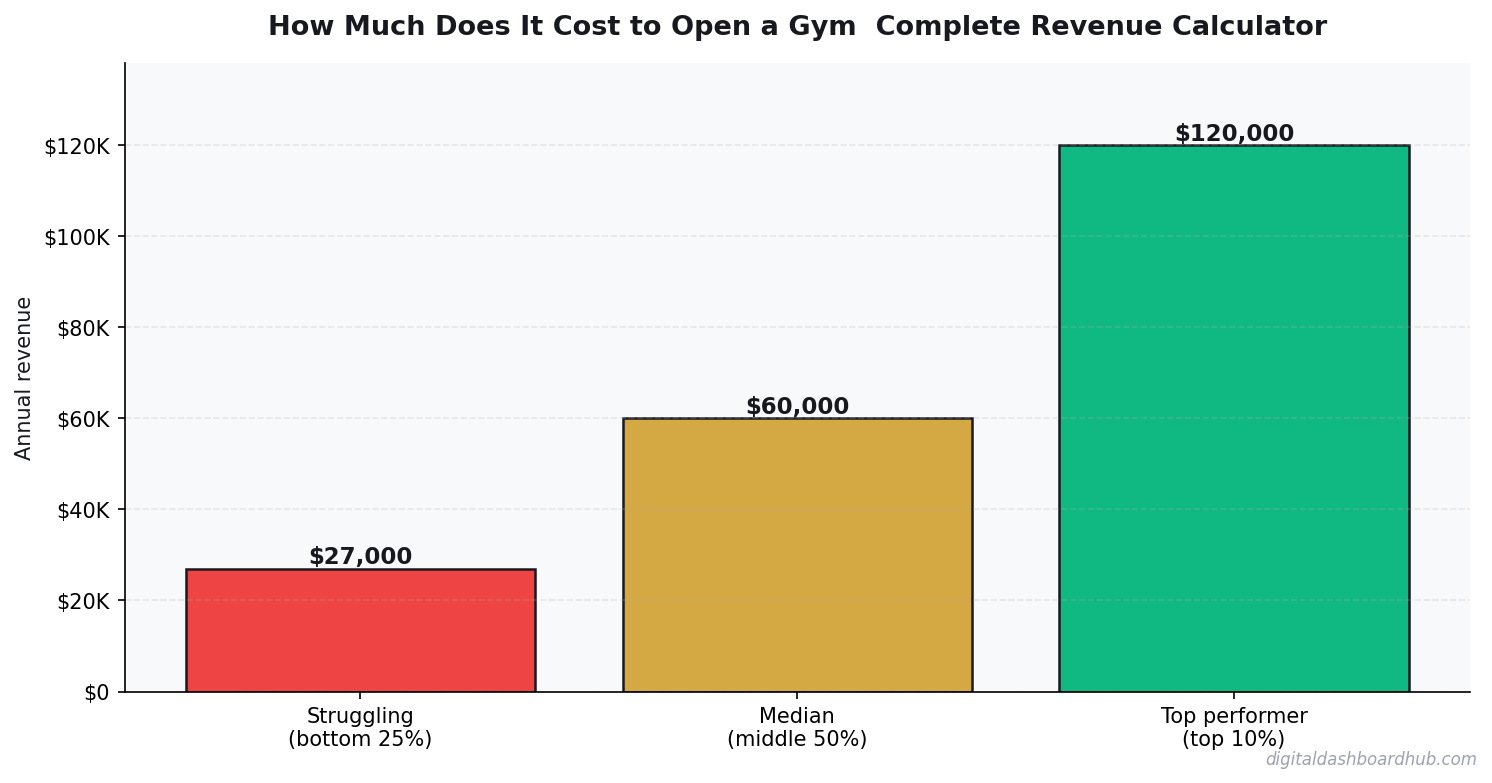
Monthly Revenue Projections by Gym Type
The boutique model charges more per member but has a lower ceiling. A CrossFit box with 150 members at $175/month does $26,250 in membership revenue — solid for a 3,000 sq ft space. A big-box gym needs 1,000+ members at $40 to hit similar numbers, but requires 10x the space and equipment.
The Expense Reality
Monthly operating costs for a mid-size gym (4,000-6,000 sq ft):
- Rent: $4,000-$12,000/month (varies wildly by market. $2/sq ft in suburbs, $4-$6 in metro areas)
- Payroll: $6,000-$15,000/month (front desk, trainers, cleaning)
- Insurance: $500-$1,500/month (general liability + professional liability)
- Utilities: $800-$2,500/month (HVAC for a gym is expensive — all that body heat)
- Equipment maintenance/replacement: $500-$1,500/month (budget 5-10% of equipment value annually)
- Software (billing, scheduling): $200-$500/month
- Marketing: $500-$2,000/month
- Cleaning/supplies: $300-$800/month
Total monthly operating cost for a mid-size gym: $13,000-$36,000. You need significant membership volume before you see profit.
Want to model your specific gym concept? Our business revenue calculators let you plug in your membership tiers, square footage, and local rent rates to see exactly when you’ll break even — and what your take-home looks like at different membership levels.
The Membership Math: Churn Is the Silent Killer
Average gym membership churn rate: 30-50% annually. That means if you start January with 300 members, you’ll lose 90-150 of them by December. To grow, you need to replace every lost member AND add new ones on top.
If your gym charges $50/month and churns 35% annually:
- You lose ~105 members per year (300 x 0.35)
- That’s ~9 members per month walking out the door
- At $50/month each, that’s $450/month in recurring revenue disappearing
- You need 9+ new signups per month just to stay flat
Gyms with the best retention (under 25% annual churn) share three traits: strong community programming, accountability systems (check-ins, goal tracking), and staff who know members’ names.
Break-Even Timeline
Realistic break-even timelines by model:
- Micro gym/garage: 3-8 months
- Boutique studio: 10-18 months
- Mid-size gym: 18-30 months
- Full-service gym: 24-42 months
If your financial model doesn’t show break-even within 24 months, rework the model before spending money. Either reduce startup costs, increase pricing, or find a cheaper location.
What to Do Now
- Choose your model first. Boutique vs. general gym is a fundamentally different business. Don’t try to be both — it doubles your costs and confuses your market.
- Survey your local market. Count competing gyms within 5 miles. Check their pricing on Google. If three CrossFit boxes already exist within a 10-minute drive, that market might be saturated.
- Build the financial model before the business plan. Revenue projections, expense estimates, break-even analysis. If the numbers don’t work at 60% of your optimistic membership estimate, they definitely won’t work in reality.
Over 200 entrepreneurs use Digital Dashboard Hub’s business calculators to plan before they invest. Start your free trial and build a gym revenue model based on math, not motivation.
A Real Gym Revenue Model: What Actually Happens in Year 1
Let’s put real numbers to this. A 4,000 sq ft CrossFit-style gym in a mid-tier market (think: Austin, Denver, or Charlotte suburbs). Build-out cost: $180,000. Equipment: $60,000. 6 months operating reserve: $90,000. Total startup: $330,000.
Month 1-3 membership ramp: 45 members paying $175/month average. Revenue: $7,875. Monthly expenses: $19,000 (rent $6K, staff $7K, utilities $1.5K, insurance $800, marketing $2K, misc $1.7K). Net: -$11,125/month. This is not a failure — this is a normal gym ramp period. The question is whether you have the runway to survive it.
Month 8: 120 members at $180 average. Revenue: $21,600. Expenses: $20,500 (scaled staffing). Net: +$1,100/month. Break-even. Month 14: 175 members. Net: +$11,500/month. The numbers work — at scale, after a long ramp. That’s what most gym calculators miss.
The 3 Variables That Move Gym Revenue Most
- Membership pricing: A $25/month price difference across 150 members is $3,750/month — $45,000/year. Pricing is the highest-leverage single variable in a gym P&L. Most gym owners underprice by $20-40 vs what the market tolerates.
- Retention rate: At $175/month, losing 15% of members annually means replacing 22-23 members just to stay flat. Getting retention from 85% to 91% (6 percentage points) is worth more than adding 15 new members.
- Personal training attachment rate: Members who buy even one PT session per month at $80 increase revenue per member by 46%. Getting 20% of members to buy monthly PT sessions doubles profit margin at stabilized membership.
What Most Gym Business Plans Miss
The 12-18 month cash valley. You’ll know the gym is working at month 8. You’ll be out of money at month 11 if you didn’t plan for it. Undercapitalization kills more viable gym businesses than bad concepts do. Model the pessimistic ramp (80 members at month 6 instead of 120), extend your runway calculation, then raise or save accordingly.
Keep reading (related guides):
255+ interactive tools for your money, time, and health.
Full dashboard access · Stripe-secure checkout · Cancel anytime
Keep Reading
- How Sinking Funds Saved Me from Financial Emergencies
- Rental Property ROI Calculator
- The Side Hustle Tax Trap: Track Every Dollar
Common Questions About How Much Does It Cost to Open a Gym? Complete Revenue Calculator
How long does it take to see results?
Most people see meaningful progress within 30-90 days when they apply these strategies consistently. The key is tracking your numbers from day one so you have a baseline to measure against.
What’s the biggest mistake people make?
Trying to do everything at once. Pick one or two strategies from this guide, implement them fully, then layer in additional tactics. Spreading yourself thin is the fastest way to see no results from any of it.
Do I need special tools or software?
Not necessarily to start — but the right tools eliminate hours of manual work. Our free calculators and trackers at Digital Dashboard Hub are a good starting point before you invest in paid software.

Andy Gaber is the founder of Digital Dashboard Hub, a suite of 255+ interactive financial, productivity, and wellness tools. He built DDH after getting frustrated with financial apps that gave outputs without context. Follow along for tool tutorials, revenue analytics breakdowns, and honest takes on personal finance.