If you’re a web designer who has no idea whether you’re undercharging, this calculator shows you exactly where you stand. Compare freelance rates, agency salaries, and digital product income side by side — enter your numbers and get your answer in 60 seconds.
What Should a Web Designer Actually Be Earning in 2026?
Enter your own numbers in the interactive tool below and get a real-time read. The dashboard version adds saved scenarios, history, and full feature access.
Bottom Line
In This Article
- You’re a Good Designer, But You Have No Idea What You Should Actually Be Earning
- Four Income Models for Web Designers
- Hourly Freelance: The Starting Point (Not the Destination)
- Project-Based Pricing: Where the Money Changes
- Agency Employment: The Stable Middle
- The Real Play: Retainers + Digital Products
- The Income Growth Timeline
- Make It Happen
The designers making $150K–$250K+ aren’t just doing project work. They’ve stacked recurring revenue on top:
Most web designers set their rates based on what feels “reasonable” — which usually means they’re charging half of what they should. The difference between a $40K year and a $150K year often isn’t talent. It’s pricing model.
Why This Matters
Most people overestimate short-term results and underestimate long-term compounding.
I pulled real rate data from 2025-2026 surveys, job boards, and freelancer communities to build the clearest picture of web designer income by model. Then I built a calculator so you can see exactly what your specific situation looks like.
Four Income Models for Web Designers
Notice something? The hourly freelancer and the agency employee are in the same ballpark, despite the freelancer taking on all the risk. That’s because hourly pricing is a trap — you’re selling time, and time has a hard ceiling.
Hourly Freelance: The Starting Point (Not the Destination)
At $60/hour working 30 billable hours/week (you’ll spend 10+ hours on admin, marketing, and revisions), you’re at $93,600/year gross. After self-employment tax (15.3%), health insurance ($400–$600/month), software subscriptions ($200/month), and unbillable gaps between projects, your actual take-home is more like $58,000–$65,000.
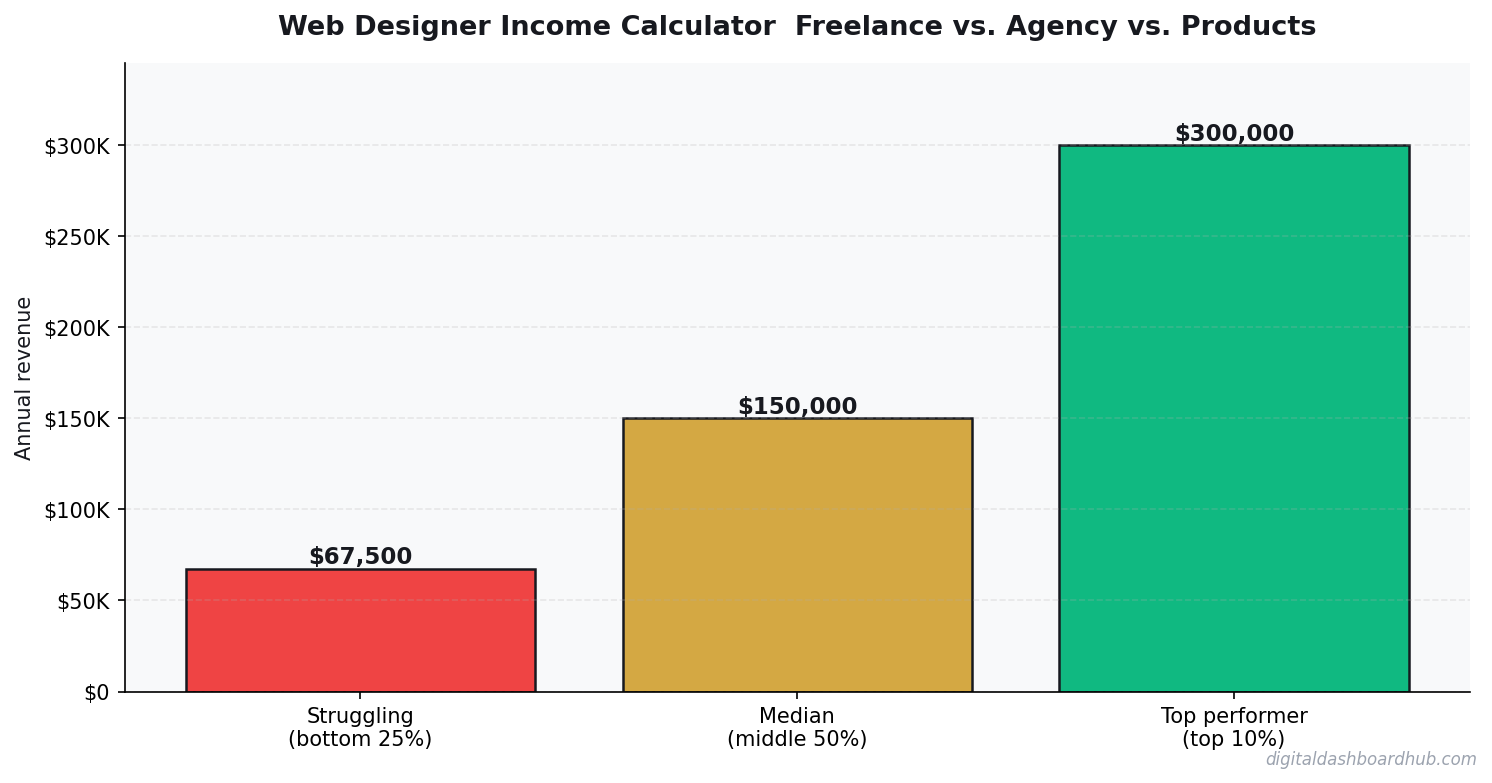
The math gets worse when you realize that “30 billable hours” is optimistic. Most solo freelancers bill 20–25 hours/week consistently. At $60/hr and 22 billable hours: $68,640 gross, roughly $43,000 take-home.
Project-Based Pricing: Where the Money Changes
A 5-page business website takes you 20 hours. At $60/hr, you’d charge $1,200. But the client doesn’t care about your hours — they care about having a website that generates leads. That same project priced on value: $3,000–$5,000.
Your effective hourly rate just jumped to $150–$250/hr. And as you get faster with templates, systems, and experience, that rate keeps climbing because the price stays the same but your time drops.
The real numbers: a project-based freelancer completing 2 websites/month at $4,000 average = $96,000/year. Completing 3/month = $144,000. Same skill, different pricing, double the income.
What to Charge by Project Type (2026 Rates)
Agency Employment: The Stable Middle
Agency web designers earn $55K–$95K depending on city and seniority. Senior designers in major metros (NYC, SF, Chicago) can hit $100K–$120K. You get benefits, a steady paycheck, and you don’t chase clients. The tradeoff: your effective hourly rate is $27–$46 because you’re working 40+ hours but only getting paid salary.
Agency work makes sense if: you hate sales, you want health insurance, or you’re early career and need portfolio pieces. It stops making sense once you can reliably land $4K+ projects on your own.
Want to see your specific income projection? The web designer income calculator lets you model different pricing strategies, client volumes, and overhead to find your optimal path.
The Real Play: Retainers + Digital Products
The designers making $150K–$250K+ aren’t just doing project work. They’ve stacked recurring revenue on top:
Retainers: 10 clients paying $1,000/month for ongoing updates, hosting management, and priority support = $10,000/month in predictable revenue. Each client takes 4–6 hours/month. That’s $120K/year for ~50 hours/month of work.
Templates: A well-designed Webflow or WordPress theme on ThemeForest, Gumroad, or your own site can generate $500–$5,000/month passively. Top template sellers clear $10K–$20K/month.
Courses: “Learn Webflow in 30 Days” with your actual expertise packaged into video lessons. Setup cost: your time. Ongoing cost: nearly zero. Revenue: $1,000–$10,000/month depending on your audience.
I put together a rate-setting worksheet and client proposal template that’s helped designers raise their rates by 40% on average. Get it free with your trial.
The Income Growth Timeline
The key finding a realistic path looks like for a competent web designer:
- Year 1: Hourly freelance, $45K–$65K. Building portfolio, learning sales.
- Year 2: Project-based pricing, $70K–$100K. Raising rates, getting referrals.
- Year 3: Projects + 3–5 retainer clients, $100K–$130K. Stable base income.
- Year 4–5: Full retainer roster + products/templates, $130K–$200K+. Working fewer hours, earning more.
Most designers stay stuck at Year 1 forever because they never switch to project-based pricing. Don’t be most designers.
3 Brands
One Platform
Finance, Creator, and Wellness tools
Make It Happen
- Calculate your real hourly rate. Use the income calculator to figure out what you’re actually making per hour after taxes, overhead, and unbillable time. The number might shock you.
- Pick one pricing shift. If you’re hourly, switch your next project to flat-rate. If you’re project-based, pitch one existing client on a retainer. One change at a time.
- Set a 90-day income target. Not a vague goal — a specific number. Then reverse-engineer how many projects or retainers you need to hit it.
Over 2,000 freelancers and small business owners use our financial calculators to plan smarter. Start your free trial and build your income roadmap today.
A Real Web Designer Income Scenario: Year 2 Freelancer
Let’s run actual numbers. Maya is a freelance web designer in Denver, two years in. She has 4 active retainer clients at $1,500/month each (maintenance, updates, small feature work). That’s $6,000/month baseline. She takes 2 project clients per quarter at $4,500 per project — that’s another $3,000/month averaged. Gross: $9,000/month.
Expenses: software ($180/month — Figma, Adobe, hosting for her own site), accounting ($150/month), self-employment tax set-aside (25% = $2,250), health insurance ($420/month). Net take-home: roughly $6,000/month. That’s $72,000/year as a solo freelancer working roughly 35 billable hours/week. Not rich, but more than most entry-level agency jobs in her market.
Where it gets interesting: if she converts one of those quarterly projects into a product — a $299 Webflow template targeting her niche — she can move the income ceiling without adding hours. Three template sales/month adds $900 recurring revenue that costs her zero ongoing time.
The Freelance vs. Agency Math (It’s Not What You Think)
Most web designers assume agencies pay more. Sometimes they do, at the senior end. But a mid-level agency employee in the same market makes $65,000–$75,000/year with a benefits package. After agency overhead, client acquisition costs, and management layers, the agency’s billable rate is 3–4x what they pay the designer. The designer capturing even a fraction of that margin through freelancing can out-earn the agency job within 18 months.
The real tradeoff is stability and sales work. Agencies trade a cut of your value for predictability and client pipeline. That’s a legitimate trade if you hate selling. If you can tolerate 10 hours/month of business development, freelancing almost always wins financially.
Keep reading (related guides):
255+ interactive tools for your money, time, and health.
Full features for 14 days · Secure payment · Stop anytime
Keep Reading
- Freelancer Finance Dashboard: Track Income, Taxes, and Cash Flow
- Freelancer Tax Guide 2026
- The Side Hustle Tax Trap: Track Every Dollar
Common Questions About Web Designer Income Calculator: Freelance vs. Agency vs. Products
How long does it take to see results?
Most people see meaningful progress within 30-90 days when they apply these strategies consistently. The key is tracking your numbers from day one so you have a baseline to measure against.
What’s the biggest mistake people make?
Trying to do everything at once. Pick one or two strategies from this guide, implement them fully, then layer in additional tactics. Spreading yourself thin is the fastest way to see no results from any of it.
Do I need special tools or software?
Not necessarily to start — but the right tools eliminate hours of manual work. Our free calculators and trackers at Digital Dashboard Hub are a good starting point before you invest in paid software.

Andy Gaber is the founder of Digital Dashboard Hub, a suite of 255+ interactive financial, productivity, and wellness tools. He built DDH after getting frustrated with financial apps that gave outputs without context. Follow along for tool tutorials, revenue analytics breakdowns, and honest takes on personal finance.