Three Trainers, Three Models, Wildly Different Paychecks
Enter your own numbers in the interactive tool below and get a real-time read. The dashboard version adds saved scenarios, history, and full feature access.
I talked to 12 personal trainers across all three business models to get real income data — not Bureau of Labor Statistics averages that lump everyone together. The differences are massive. One solo trainer makes $42K working 45 hours a week. A studio owner grosses $180K but nets $55K after rent and staff. An online trainer clears $95K working 25 hours from her apartment.
Same industry. Same certification. Completely different financial outcomes. The model you choose matters more than how good you are at programming workouts.
Model 1: Solo Personal Trainer (Gym Floor or Mobile)
This is where most trainers start. You work at a commercial gym (either as an employee or independent contractor) or you go to clients’ homes/condos. Your income is directly tied to hours on the floor.
The income math: A typical solo trainer charges $60-$100/session in a mid-size city. At 25 sessions per week (the realistic sustained max before burnout), that’s $1,500-$2,500/week gross. But you’re not training 52 weeks a year — client cancellations, vacations, and your own rest days cut that to about 46 productive weeks.
If you’re a gym employee, the gym takes 40-60% of your session rate. A $80 session nets you $32-$48. At 25 sessions/week: $800-$1,200/week. Annual: $36,800-$55,200.
If you’re independent (renting space or mobile), you keep 100% minus your costs. A $80 session with $15 in gym rental or travel costs nets you $65. At 25 sessions/week: $1,625/week. Annual: $74,750. Minus insurance, marketing, and continuing education: net roughly $62,000-$68,000.
The Solo Trainer Reality Check
The numbers above assume 25 sessions a week. That sounds manageable until you realize each “session” also includes 5-10 minutes of transition, programming time between clients, and admin (billing, scheduling, responding to texts). A “25-session week” is actually a 40-45 hour week.
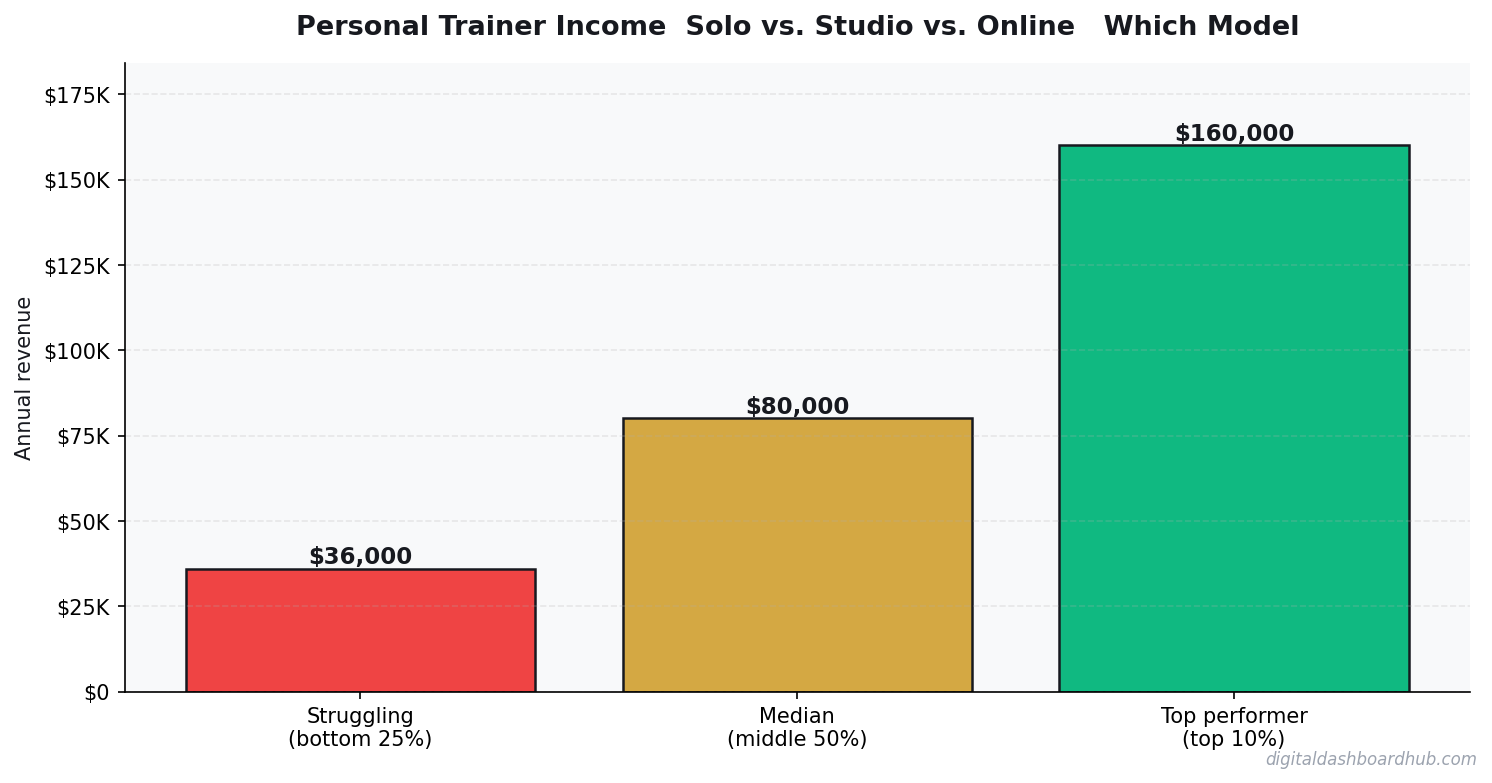
Every trainer I talked to in this model mentioned the same ceiling: you can’t scale income without adding hours. A 5% raise means charging clients more — and at some point, the market won’t pay more for one-on-one training. The solo model has a hard cap around $80,000-$100,000/year in most markets, and reaching that requires working at full capacity with premium pricing.
Burnout is the other issue. Three trainers told me they hit a wall at 18-24 months of full booking. Early mornings (5-6 AM clients), split shifts (morning and evening blocks with dead time in between), and weekend sessions grind you down. Two of the three reduced their client load and took a $15,000-$20,000 income hit to preserve their sanity.
Model 2: Studio Owner
Owning a studio means you’re not just a trainer — you’re a business operator. You have a lease, staff (or contractors), equipment, and overhead. The revenue is higher, but so is the risk and complexity.
Net owner income: approximately $70,000/year — but the owner is also training 15-20 clients personally, managing staff, handling marketing, dealing with landlord issues, and working 50-55 hours a week.
The studio model only becomes significantly more profitable than solo training when you scale to 3-4 trainers and fill group classes. At that point, you can pull back from personal training and earn primarily from your cut of other trainers’ sessions. But that requires a $150,000+ investment in build-out and 12-18 months to reach profitability.
Model 3: Online Personal Trainer
This is the model that’s changed the most since 2020. Online training used to mean “emailing PDFs.” Now it means app-based programming, video check-ins, community groups, and content-driven lead generation.
The income model is fundamentally different because you’re selling programming and accountability, not hours. A typical online trainer charges $150-$300/month per client. You spend 15-30 minutes per client per week on programming updates, form check videos, and messaging. That means you can serve 30-50 clients in 20-25 hours per week.
Revenue at 40 clients × $200/month: $8,000/month = $96,000/year.
Expenses: App platform ($100-$200/month), email marketing ($50/month), content creation tools ($100/month), insurance ($100/month). Total: roughly $5,400/year. Net: approximately $90,600.
The online model’s advantage is time use. You’re not trading hours for dollars — you’re trading expertise and systems for monthly subscriptions. Adding one more client doesn’t require another hour on the gym floor.
How the DDH Personal Trainer Revenue Calculator Handles This
The DDH Personal Trainer Revenue Calculator models all three business structures side by side. You input your session rate, client capacity, and hours available, and it shows you projected annual income for solo, studio, and online models.
The burnout indicator is a feature trainers appreciate. It flags when your projected schedule exceeds sustainable training hours (based on industry data on trainer longevity) and shows the income impact of reducing your load to sustainable levels. Because earning $85K for two years and then quitting the industry is worse than earning $70K sustainably for a decade.
The Head-to-Head Comparison
Which Model Wins? It Depends on Your Timeline
Best for immediate income: Solo training. You can be earning within a week of getting certified. No build-out, no audience needed. If you need money now, this is the fastest path.
Best for long-term wealth: Online training — if you’re willing to invest 6-12 months building an audience and content library before seeing significant income. The use and scalability are unmatched.
Best for community builders: Studio ownership. If you love the in-person energy, want to build a team, and have capital to invest, a studio can become a community anchor and a valuable asset you can eventually sell.
The smart play that several successful trainers use: start solo to build skills and income, transition to online to build use, then open a studio later if you want a physical space — funded by online revenue, not a bank loan.
The Hybrid Approach: What Top Earners Actually Do
The highest-earning trainers I interviewed ($150K+) don’t fit neatly into one model. They combine elements: 10-15 premium in-person clients at $120+/session, 20-30 online clients at $200-$300/month, and a digital product (workout program or course) generating $1,000-$3,000/month in passive revenue.
This hybrid approach provides income stability (in-person clients are sticky), scalability (online clients grow without more hours), and passive income (digital products earn while you sleep). It’s more complex to manage, but the income ceiling is significantly higher than any single model.
The Practical Takeaway
Step 1: Honestly assess your current situation. Do you need income now (go solo), have capital to invest (consider a studio), or have time to build an audience (start online)?
Step 2: Pick your primary model and calculate your realistic Year 1 income using the tables above. Be conservative — use 60% booking rate for solo, 50% capacity for online.
Step 3: Model your specific numbers in the DDH Personal Trainer Revenue Calculator to see your monthly cash flow and identify when you’ll need to raise prices or add a secondary income stream.
You Might Also Like
- Side Hustle Tax Trap: Track Every Dollar
- Freelancer Finance Dashboard
- Side Hustle Income Tax Tracker
Keep reading (related guides):
- Mortgage Comparison Calculator: Find the Best Rate and Term
- How to Calculate Your Freelance Rate (So You Stop Undercharging)
- Web Designer Pricing in 2026: How to Set Rates That Reflect Your Skill (Not Your Fear)
- Free ADHD Freelancer Ops Tool: Finally a System That Works With Your Brain
- Small Business Finance Basics: The Only 5 Numbers You Need to Track Weekly
Choosing the Right Personal Training Model for You
No model is universally better. The right choice depends on your goals for time, income ceiling, and how much operational complexity you’re willing to take on.
Solo: best for steady income, lowest risk
Solo training — renting space at a gym or training in clients’ homes — gets you to $40K-$65K with the lowest overhead and almost zero business risk. You trade income ceiling for simplicity. Ideal if you want predictable cash flow, minimal management work, and control over your schedule.
Studio: best for income ceiling, highest complexity
Owning a studio unlocks $150K-$400K gross revenue but introduces rent, employees, marketing, insurance, and 60-hour weeks in year one. Most studio owners I talked to net 25-35% of gross after all expenses. If you love building systems and hiring, this is your path. If you just want to train, don’t do it.
Online: highest variance, highest scalability
Online coaching has the widest outcome spread of any model. The bottom half of online coaches earn under $25K because they never solve client acquisition. The top 10% clear $200K+ because they built a funnel, product, and audience. Plan for 18-24 months of heavy marketing investment before income stabilizes.
Hybrid: the sweet spot for most people
Many six-figure trainers run a hybrid: 15-20 in-person hours per week at premium rates ($90-$150/hr) plus an online program that runs in the background. Hybrid reduces risk, diversifies income, and lets you scale selectively without committing to a full studio build.
Numbers to watch regardless of model
Revenue per hour worked. Client lifetime value. Monthly recurring revenue as a percent of total. If you’re below $75/hour effective rate, or below 40% MRR, your model needs adjustment — not your hustle.
How Personal Trainer Income Compounds Over Time
Year 1: the grind year
Expect $28K-$45K as a new solo trainer or starting employee. You’re learning client acquisition, programming, and operations simultaneously. Income ceiling is low because your time is spent on low-value activities — marketing, scheduling, admin — not premium sessions.
Year 2-3: the client base forms
If you retain 60%+ of year-one clients, year two jumps to $55K-$85K. Referrals start arriving. You can raise rates on new clients (keeping grandfathered pricing for originals). The hourly trap starts easing as you fill your best time slots.
Year 4-5: the leverage inflection
This is when you either stay solo and plateau at $90K-$130K, or start leveraging — hiring subcontractor trainers, launching a group program, or building an online coaching arm. The trainers who keep earning more after year 5 almost always added a leverage layer.
Year 6+: the compound years
At this point, the top third of trainers clear $150K-$300K, often by combining in-person (steady), group (scalable), and online (high-margin). The bottom third plateaus because they never diversified income sources — still trading one hour of time for one hour of pay.
The retention lever that beats everything
A client who trains with you for 4 years is worth 5-8x a new client after acquisition costs. The trainers with the highest incomes are almost always the ones with the highest retention — not the ones with the highest session rates.
Additional Considerations for New Trainers
Beyond the model itself, certain operational choices make the difference between a sustainable career and a burnout exit. Here is what separates trainers still doing this at year ten from those who quit at year three.
Nutrition coaching add-ons
Trainers who add a nutrition component (even if not formally certified) increase client results, retention, and pricing power. Precision Nutrition Level 1 is $2K-$3K and unlocks $30-$60 per client per month in additional pricing for many trainers.
Assessment fees and onboarding packages
Charging $150-$400 for an initial assessment + program design separates serious clients from tire-kickers. It also sets up the expectation that your time is valuable. Trainers who skip this step attract more price-sensitive clients.
Recovery and wellness integration
Mobility work, sleep coaching, stress management — these push clients toward longer-term goals and justify premium pricing. A holistic “performance” positioning commands 30-60% more than pure strength coaching in most markets.
Client communication standards
Top trainers respond to client messages within a defined window (24-48 hours) and post regular check-ins. This infrastructure takes 30-45 minutes daily but dramatically improves retention — clients who feel supported renew 4x more often than those who don’t.
The slow, boring path to six figures
Nobody tells new trainers this, but hitting $100K takes 3-5 years for most people. The trainers who get there aren’t the most talented — they’re the ones who didn’t quit when year two paid less than an office job. The math works eventually.
255+ interactive tools for your money, time, and health.
Full features for 14 days · Secure payment · Stop anytime

Andy Gaber is the founder of Digital Dashboard Hub, a suite of 255+ interactive financial, productivity, and wellness tools. He built DDH after getting frustrated with financial apps that gave outputs without context. Follow along for tool tutorials, revenue analytics breakdowns, and honest takes on personal finance.