
Three Businesses, One Question: Which One Pays Best?
The dashboard below loads instantly in your browser. Plug in your numbers, see your answer. No signup to try the basics.
Running a SaaS business means I track these numbers obsessively. Here’s what the data actually shows:
Every week someone posts in a small business forum asking the same question: “I’ve got $5,000 and a truck. Should I start a pressure washing business, a landscaping company, or a cleaning service?” The answers are always a mess of opinions from people who’ve only done one of the three.
I’ve spent the last year talking to operators in all three industries and pulling data from business forums, SBA reports, and actual P&L statements people have shared. The answer isn’t as simple as “pressure washing wins” — it depends on what you optimize for. Let’s break it down with real numbers.
Startup Costs: Getting Off the Ground
The barrier to entry is the first filter. After testing each business actually costs to start — not the “you can start for $500!” fantasy you see on YouTube, but the realistic minimum to do quality work and look professional.
Cleaning wins the startup cost competition by a mile. You can genuinely start a cleaning business with $1,000 and a Honda Civic. Pressure washing and landscaping both require a truck and meaningful equipment investment.
Revenue Per Job: Where the Money Actually Is
Low startup costs mean nothing if the revenue per job is tiny. Here’s where things get interesting.
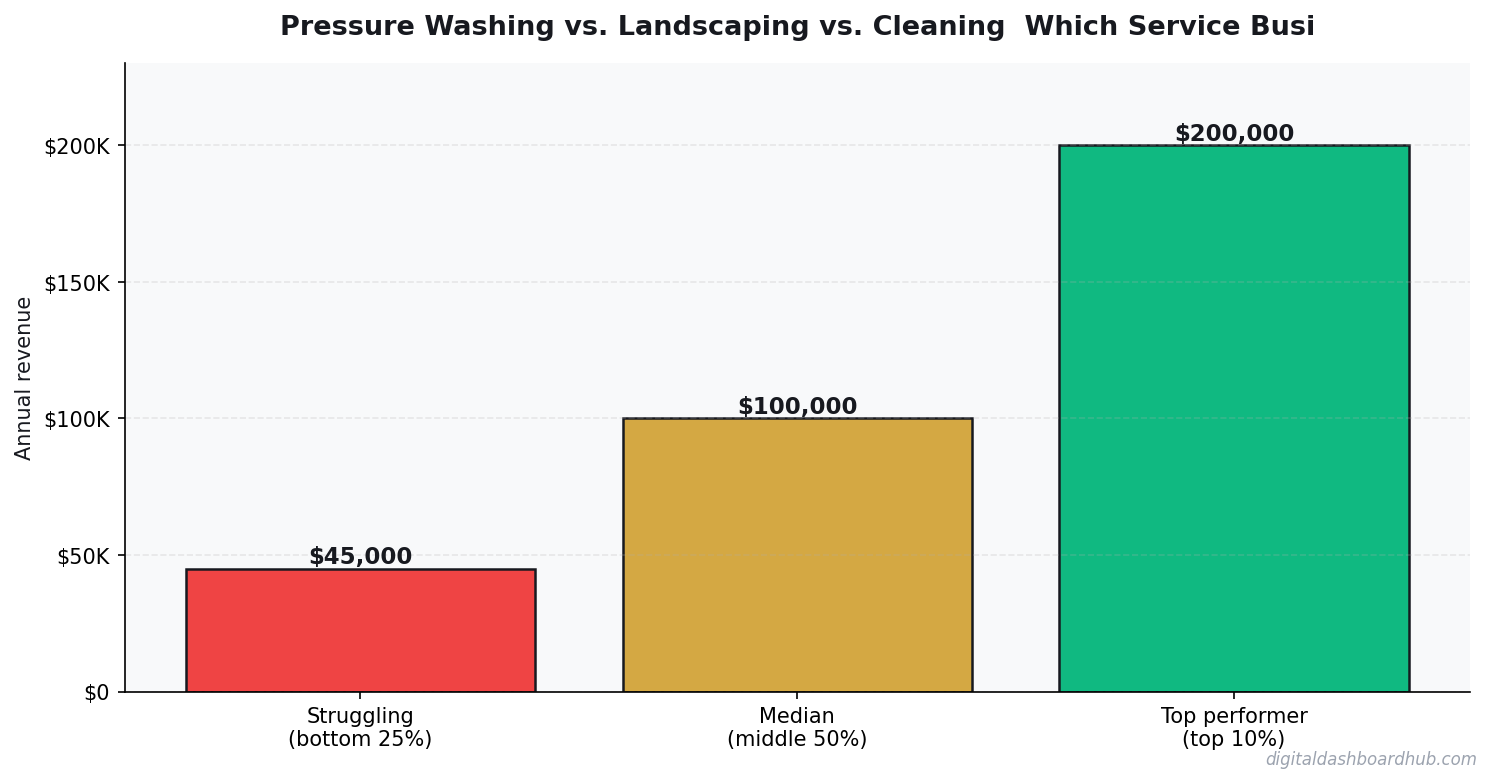
Pressure washing has the highest per-job revenue of the three. A residential driveway and house wash runs $250-$500 and takes 2-3 hours. Commercial jobs (parking lots, building exteriors) can be $1,000-$5,000 per job. I talked to a solo operator in Texas who averages $380 per residential job and does 3 per day, pulling $1,140 in daily revenue.
Landscaping maintenance — mowing, edging, blowing — averages $35-$75 per yard for a 30-45 minute job. A solo operator can knock out 8-12 yards per day. At $50 average, that’s $400-$600 per day. space installation (patios, retaining walls, plantings) is higher: $1,500-$10,000 per project, but those jobs are less frequent and more seasonal.
Cleaning service residential jobs run $100-$250 per house for a standard clean, taking 2-4 hours with a two-person team. Solo, you’re doing 2-3 houses per day at $120-$180 each, so $240-$540 daily. Commercial cleaning contracts (offices, medical facilities) are the real money — $500-$2,000/month per contract, recurring.
The Recurring Revenue Question
This is where cleaning and landscaping pull ahead of pressure washing. Mowing is weekly. Cleaning is weekly or biweekly. Pressure washing is typically annual — sometimes every two years.
A landscaping operator with 40 weekly mowing clients at $50 each has $2,000/week in predictable, recurring revenue. That’s $8,000/month before doing a single extra job. A cleaning operator with 20 biweekly clients at $150 each has $6,000/month in recurring revenue.
A pressure washing operator has to constantly find new customers because the same homeowner only needs their house washed once a year. The revenue can be higher per job, but the sales effort never stops. Several pressure wash operators I spoke with said they spend 20-30% of their time on marketing and quoting — time that spacers and cleaners spend earning.
How the DDH Service Business Revenue Calculator Handles This
Comparing these three businesses gets complicated fast because the revenue models are fundamentally different. The DDH Service Business Revenue Calculator lets you model each one side by side, accounting for job frequency, seasonal variation, customer acquisition costs, and the time you spend on non-billable work.
The recurring revenue modeling is what makes it particularly useful. You can build a 12-month projection that shows how a landscaping business with 30 weekly clients looks versus a pressure washing business doing 15 jobs per week with no repeats. The compounding effect of recurring clients becomes obvious when you see it graphed out month by month.
Seasonality: The Income Killer Nobody Talks About on YouTube
Landscaping and pressure washing both have significant seasonal dips depending on your market. In the northern half of the U.S., landscaping revenue drops 60-90% from November through March. Pressure washing slows 40-60% in winter months. Some operators shift to snow removal or holiday lighting, but that requires additional equipment and skills.
Cleaning is the most season-proof of the three. People need their houses and offices cleaned year-round. The only real dip is the week between Christmas and New Year’s when some clients skip their regular clean. Otherwise, revenue is remarkably stable across 12 months.
Here’s the annual revenue distribution for a solo operator in a northern market:
If you live in Florida, Texas, or Arizona, the seasonality issue is much smaller for all three. But for anyone in the Midwest, Northeast, or Pacific Northwest, you need to plan for 3-5 months of reduced or zero income in outdoor services.
Scalability: From Solo to Crew
All three businesses can scale, but the path looks different for each.
Cleaning scales the most naturally. Training a new cleaner takes 1-2 weeks. Equipment cost per new employee is minimal ($100-200 in supplies). You can add teams in pairs and put them on existing routes. Many cleaning business owners reach $20,000-$40,000/month in revenue with 3-5 two-person teams within 2 years.
Landscaping scales moderately well. Crew-based mowing is straightforward — add a truck, a trailer, a mower, and 2-3 guys. But equipment cost per crew is $15,000-$25,000, and finding reliable workers is the number one complaint I hear from every landscaping business owner. Turnover is brutal. Operators with 2-3 crews typically hit $30,000-$60,000/month in revenue but spend a significant portion managing personnel issues.
Pressure washing is the hardest to scale. The equipment is expensive per truck ($5,000-$10,000 for a professional setup), training takes longer because mistakes are costly (you can etch concrete, strip paint, damage wood), and the customer acquisition problem multiplies with each new crew. Most successful pressure washing businesses stay at 1-3 trucks and focus on maximizing revenue per truck rather than adding more.
Profit Margins: What You Actually Keep
Revenue means nothing without margins. Here’s the reality:
Pressure washing solo: 55-70% net margins. Low consumable costs (gas, detergent, water). Main expenses are equipment maintenance and marketing. A solo operator doing $120,000/year in revenue keeps $66,000-$84,000.
Landscaping solo: 40-55% net margins. Higher consumable costs (fuel is significant), equipment maintenance is constant, and truck/trailer expenses add up. $100,000 in revenue = $40,000-$55,000 net.
Cleaning solo or with partner: 45-60% net margins. Low equipment costs but cleaning supplies add up. Higher mileage than the others due to multiple stops per day. $80,000 in revenue = $36,000-$48,000 net.
With crews, margins compress significantly for all three: landscaping drops to 15-25%, cleaning to 20-30%, and pressure washing to 25-35%. The owner makes more in total dollars, but a larger percentage goes to labor, workers’ comp, and management overhead.
The Honest Verdict
Best for fast cash, solo operation: Pressure washing. Highest per-job revenue, best solo margins. But you’ll work harder at marketing and have a seasonal dip.
Best for building a sellable business: Cleaning. Recurring contracts, easy to train employees, year-round demand. Cleaning businesses with established client lists and trained teams regularly sell for 1-2x annual revenue.
Best for someone who loves being outside and doesn’t mind physical work: Landscaping. Steady weekly revenue once you build the route, good community visibility, add-on services (irrigation, hardscaping) that boost revenue over time.
The wrong answer is picking based on which YouTube video was most convincing. The right answer is running the numbers for your specific market, your available capital, and your lifestyle tolerance for seasonality.
Try This Today
- Model your market. Open the DDH Service Business Revenue Calculator and plug in the rates, costs, and seasonality specific to your area. National averages don’t apply to your ZIP code.
- Talk to three operators in your target business. Buy them lunch. Ask about their worst month, their customer acquisition cost, and whether they’d do it again. Real data beats YouTube motivation every time.
- Start the lowest-risk option first. If you’re torn, start with cleaning — lowest startup cost, least seasonality, fastest path to first revenue. You can always add pressure washing or lawn care as a service line once you have cash flow.
Run the numbers for your specific market and stop guessing. The data will tell you which business works where you live.
- The Side Hustle Tax Trap: Track Every Dollar
- Freelancer Finance Dashboard: Track Income, Taxes, and Cash Flow in One Visual Hub
- Side Hustle Income & Tax Tracker Free Tool
Keep reading (related guides):
255+ interactive tools for your money, time, and health.
Full dashboard access · Stripe-secure checkout · Cancel anytime

Andy Gaber is the founder of Digital Dashboard Hub, a suite of 255+ interactive financial, productivity, and wellness tools. He built DDH after getting frustrated with financial apps that gave outputs without context. Follow along for tool tutorials, revenue analytics breakdowns, and honest takes on personal finance.