Your heart is pounding, your hands are shaking, and you’re pretty sure you’re either dying or losing your mind. But is this a panic attack or an anxiety attack? The internet uses these terms interchangeably, which is incredibly unhelpful when you’re trying to figure out what just happened to you.
About this article: I’m Andy, founder of Digital Dashboard Hub. I built DDH’s 255 free interactive tools to solve the specific financial, productivity, and wellness tracking gaps I kept seeing — starting with the problem this article covers. The free tool below is available without signup and works instantly. Try it and see your numbers in real time.
In This Article
- The Clinical Difference (In Plain English)
- What a Panic Attack Actually Feels Like
- What an Anxiety Attack Actually Feels Like
- Why Tracking Episodes Changes Everything
- How the DDH Symptom Tracker Handles This
- When to See a Professional
- Coping Strategies That Actually Work (For Each Type)
- Start With This
- Continue Learning
The panic attack vs anxiety attack difference matters because they have different triggers, different durations, and different treatment approaches. I’ve experienced both, tracked both, and I can tell you — once you know which one you’re dealing with, it stops being quite so terrifying.
The Clinical Difference (In Plain English)
Before you scroll: the calculator below is running in your browser right now. For the full feature set — saved scenarios, history, exports — open the dashboard.
Here’s the thing most articles won’t tell you: “anxiety attack” isn’t actually a clinical term. The DSM-5 recognizes panic attacks but not anxiety attacks. That said, what people mean when they say “anxiety attack” is a real experience — it’s just clinically categorized as acute anxiety or an anxiety episode.
The practical differences are significant:
What a Panic Attack Actually Feels Like
I’ll never forget my first one. I was sitting at my desk on a normal Tuesday — no deadline, no crisis — and suddenly my heart rate spiked, my vision narrowed, and I was absolutely convinced I was having a cardiac event. I drove to the ER. EKG was normal. The doctor said “panic attack” like it was no big deal.
💰 Real talk: the tracking itself changes your behavior. That’s not a bug — it’s the feature.
Panic attacks are your body’s fight-or-flight response firing at full blast with no actual threat. According to the Anxiety and Depression Association of America, about 11% of Americans experience a panic attack each year, and most people who have one will have more.
The signature features: sudden onset (0 to peak in under 10 minutes), physical symptoms that mimic cardiac events, a feeling of unreality or detachment, and intense fear of dying or losing control. They typically resolve within 20-30 minutes, but the aftermath — exhaustion, heightened vigilance, fear of the next one — can last the rest of the day.
What an Anxiety Attack Actually Feels Like
Anxiety attacks are more like a slow boil. You feel the tension building over hours — maybe you’ve been worrying about a presentation, a medical test, or a financial decision. The physical symptoms creep in: jaw clenching, stomach churning, difficulty breathing deeply, restlessness that makes sitting still feel impossible.
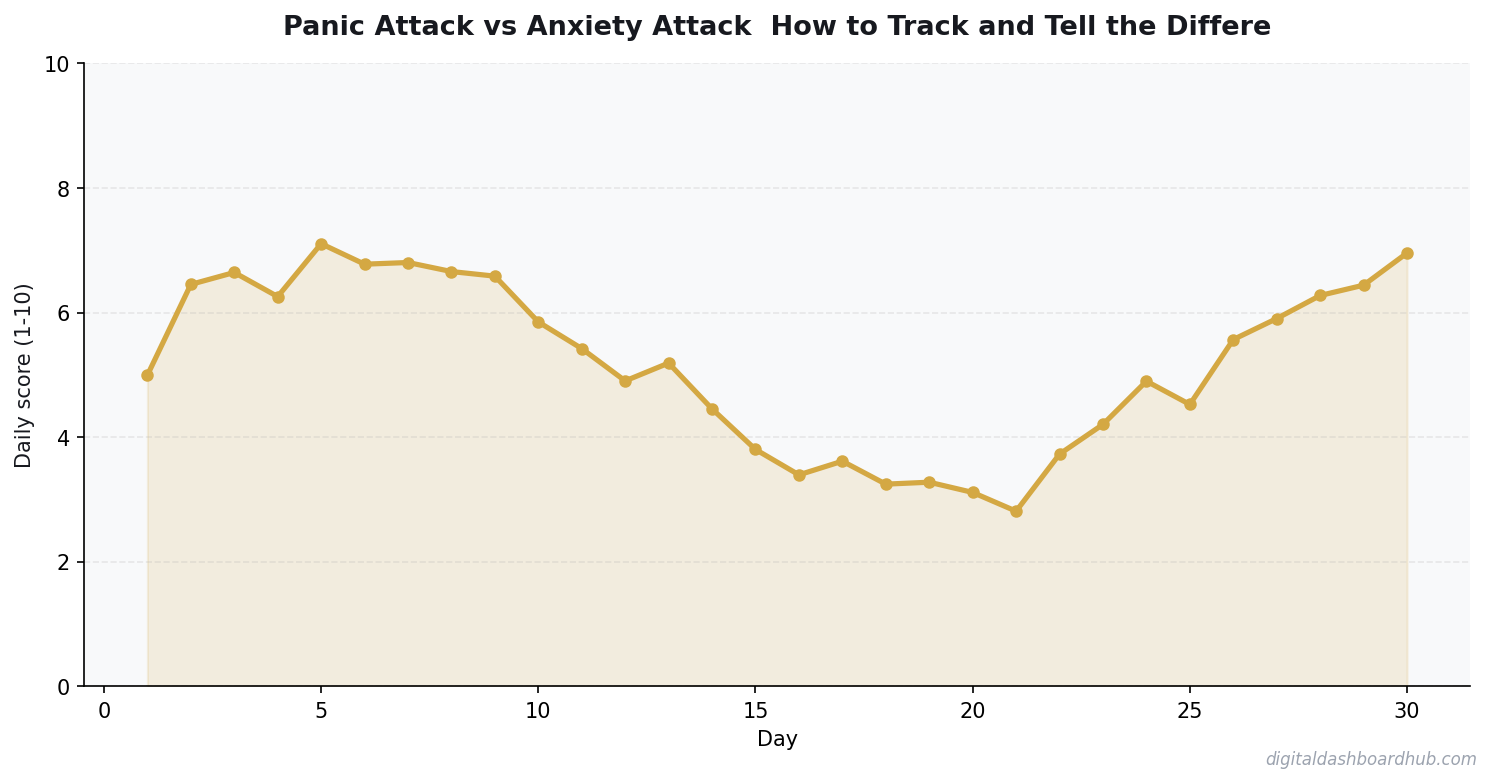
Unlike panic attacks, you can usually point to the source. And unlike panic attacks, they don’t peak and crash — they can simmer at a 6 or 7 out of 10 for an entire day. In some ways, that sustained misery is harder to deal with than a short, intense panic episode.
Why Tracking Episodes Changes Everything
After my third ER visit for suspected cardiac events that turned out to be panic attacks, I started logging every episode. Date, time, what I was doing, symptoms, intensity, duration, and whether I could identify a trigger.
Three months of data revealed patterns I never would have seen otherwise. My panic attacks clustered around Sunday evenings and Wednesday mornings. My anxiety episodes tracked almost perfectly with my sleep quality from the night before. Nights with less than 6 hours of sleep preceded an anxiety episode 80% of the time.
How the DDH Symptom Tracker Handles This
Manual logging in a notebook worked, but I kept forgetting details by the time I sat down to write. The DDH tracker lets you log an episode in real-time — right when it’s happening or immediately after.
You tag the episode type (panic or anxiety), rate the intensity, check off physical symptoms from a pre-built list, and note the trigger if there is one. The tracker auto-categorizes your episodes and builds a timeline view so you can see frequency, severity trends, and trigger patterns over weeks and months.
The insight that changed my approach: the tracker showed me that my panic attacks were actually decreasing in intensity over time, even though they felt just as bad in the moment. Going from an average of 9.2 to 7.1 over three months gave me evidence that what I was doing (therapy + tracking) was working — even when my anxious brain insisted nothing was helping.
Try the DDH Symptom Tracker free — log your first episode in under a minute.
FREE BONUS: The Panic & Anxiety Episode Log Template
A printable tracking sheet for logging episodes with all the right fields — intensity, symptoms, triggers, duration, and context.
Get instant access → Start Your Free Trial
When to See a Professional
Tracking is not a substitute for professional help. See a doctor or therapist if: you’re having panic attacks more than once a month, anxiety episodes are affecting your work or relationships, you’re avoiding situations because you’re afraid of triggering an episode, or you’re using alcohol or substances to cope.
What tracking does is give you data to bring to that appointment. “I had 7 panic attacks this month, mostly on Sunday evenings, with an average intensity of 8/10” is infinitely more useful to a therapist than “I’ve been feeling anxious lately.”
42%
of people abandon complex systems within 2 weeks
Coping Strategies That Actually Work (For Each Type)
During a panic attack: The 5-4-3-2-1 grounding technique (name 5 things you see, 4 you hear, 3 you can touch, 2 you smell, 1 you taste). Cold water on your wrists. Slow exhales longer than inhales. Do NOT try to “think your way out” — your prefrontal cortex is offline during a panic attack.
During an anxiety episode: Identify the specific worry and write it down. Ask yourself “what’s the actual probability of this happening?” Movement helps — even a 10-minute walk. Guided meditation can interrupt the rumination loop if you catch it early.
Start With This
Right now (2 minutes): Think about your last “attack” or intense anxiety episode. Was it sudden or gradual? Did it peak and crash, or simmer for hours? Your answer tells you which pattern you’re likely dealing with.
This week: Log any episodes using the panic vs. anxiety framework above. Not
Key Takeaways
- Your patterns are unique — don’t rely on averages or others’ experiences
- The tracking itself changes behavior, even before you act on insights
- Share your data with professionals to get more targeted advice
e the onset speed, duration, and whether you can identify a trigger.
For the long haul: Set up the DDH Symptom Tracker so you have data for your next therapy appointment — or just for yourself. Patterns become visible around the 3-week mark.
Keep reading (related guides):
255+ interactive tools for your money, time, and health.
14-day trial · Stripe checkout · Cancel anytime
Continue Learning
- How to Track Your Anxiety and Actually Reduce It
- How to Regulate Your Nervous System: 8 Steps to Calm
- Depression Mood Tracker: How Tracking Mental Health Data Helps You Heal
- I Tracked My Nervous System for 90 Days
Common Questions About Panic Attack Vs Anxiety Attack
How long before I see results?
Most people notice meaningful patterns within 2 to 4 weeks of consistent tracking. The first week is almost always noisy — you’re still learning what to record, when to record it, and how honest to be with yourself. By week two, baselines emerge. By week four, you can start testing changes against data instead of guessing. Don’t judge the system in the first seven days. Give it a full month before deciding whether the system is worth keeping or whether the approach needs a rethink.
What should I track first?
Start with one metric that is both objective and daily. Objective means a number, not a feeling. Daily means once every 24 hours, not “whenever I remember.” Two metrics is fine; three is too many to sustain for someone new. You can always add more once the habit is locked in. The goal of the first month is consistency, not coverage. It’s better to track one thing perfectly for thirty days than six things sloppily for five, and the data will be far more useful.
What if I miss a day?
Miss one day, no problem — tracking is a long game and single-day gaps don’t break the trend. Miss two days in a row, and your brain starts negotiating you out of the system entirely. The rule most people use: never miss twice. Log something — even a single data point — on the second day, then resume the full routine the next morning. Streaks matter less than quick recovery after a miss, and nobody maintains an unbroken record forever. The goal is resilience, not perfection.
Do I need a paid app to do this?
No. A notebook, a spreadsheet, or a free tool all work. The paid-app question should come after 4 weeks of consistent tracking, not before. If you’re going to quit inside the first two weeks, you’ll quit a free tool and a paid one at roughly the same rate. Prove the habit first, then decide whether a paid tool removes enough friction to be worth the subscription. Don’t use “finding the perfect app” as a way to avoid starting the system this week.
How do I know the data is accurate?
Two rules. First, log at the same time each day — morning before coffee, or evening before bed — so you control the biggest variable. Second, write down the conditions, not just the number. A reading without the time, posture, and recent activity is almost useless. A check-in without the context of sleep or stress is just noise. Structure your log so the conditions travel with the measurement. Data without context is decoration, not signal, and won’t help you make better choices.
When should I review the data?
Weekly for noticing; monthly for deciding. A weekly review is a five-minute scan for surprises: what changed, what stayed the same, what correlates with what. A monthly review is longer and ends with a decision — keep the system, change one variable, or scrap the experiment and try a different approach. Don’t try to decide anything meaningful from a single week of data. And don’t wait a full quarter to look back, either — trends go stale fast when you’re not watching.

Andy Gaber is the founder of Digital Dashboard Hub, a suite of 255+ interactive financial, productivity, and wellness tools. He built DDH after getting frustrated with financial apps that gave outputs without context. Follow along for tool tutorials, revenue analytics breakdowns, and honest takes on personal finance.