You’ve tried building habits before. Maybe it was a morning routine, a workout schedule, or a daily journaling practice. You started strong, stayed consistent for a week — maybe two — and then life happened. The streak broke. The motivation evaporated. And that shiny new habit joined the graveyard of good intentions alongside “learn Spanish” and “meditate every day.”
You’re not alone, and you’re not broken. Research from the European Journal of Social Psychology found that habit formation takes anywhere from 18 to 254 days, with an average of 66 days. That’s over two months of consistent effort before something becomes automatic. Without the right tracking system, most people don’t make it past week three.
That’s where a digital habit tracker changes the game — and not just any tracker. You need one that makes the invisible visible, turns consistency into a visual streak you don’t want to break, and gives you data-driven insights into what’s actually working in your life.
Why Most People Fail at Building Habits (And What Science Says About It)
Before we talk solutions, let’s understand the problem. Habit failure isn’t about willpower — it’s about systems.
The Motivation Trap
Most habit-building attempts rely on motivation as fuel. The problem? Motivation is an emotion, and emotions fluctuate. You feel pumped on January 1st. By January 17th — statistically the day most New Year’s resolutions die — that motivation has been replaced by the daily grind of actually doing the thing.
Dr. BJ Fogg’s research at Stanford’s Behavior Design Lab reveals that sustainable habits aren’t built on motivation. They’re built on three elements: a prompt (trigger), the ability to do the behavior, and a motivation boost — but the motivation piece needs to be minimal. If a habit requires high motivation to maintain, it’s designed to fail.
The Tracking Gap
Here’s what most people miss: tracking isn’t just about accountability. It’s about feedback loops. When you can see your consistency patterns, you spot the triggers that derail you. Maybe you always skip your workout on Wednesdays (that’s your heaviest meeting day). Maybe your meditation streak dies every time you travel. Without tracking data, these patterns stay invisible — and invisible problems don’t get solved.
The All-or-Nothing Fallacy
Missing one day feels like failure, which triggers the “what-the-hell effect” — a well-documented psychological phenomenon where a single slip leads to total abandonment. A visual tracker with streak recovery features helps combat this by showing you that one missed day in a 30-day streak is still a 96.7% success rate. That’s an A+, not a failure.
The Science-Backed Framework for Habit Building
The most effective habit-building approach combines insights from multiple research streams. Here’s the framework that actually works.
Step 1: Start Ridiculously Small
James Clear’s atomic habits principle and BJ Fogg’s tiny habits methodology both converge on the same insight: the initial version of your habit should be so small it’s almost impossible to fail. Want to build a reading habit? Start with one page. Exercise? Start with one pushup. Meditation? Start with one breath.
This isn’t about the action itself — it’s about building the neural pathway. Every time you complete the tiny habit, you’re reinforcing the identity of being “someone who does this thing.” The habit tracker records each completion, building evidence for your new identity.
Step 2: Stack and Link
Habit stacking — attaching a new habit to an existing one — leverages your brain’s existing neural networks. “After I pour my morning coffee, I will write in my gratitude journal for two minutes.” The coffee is the trigger. The journal is the new habit. Your tracker captures both, showing you which stacks are working and which need adjustment.
Step 3: Design Your Environment
Environment design is the most underrated habit strategy. If you want to drink more water, put a water bottle on your desk. If you want to read more, put a book on your pillow. If you want to exercise, lay out your workout clothes the night before. Your tracker should help you log not just whether you did the habit, but the environmental conditions around it.
Step 4: Track, Review, Adjust
This is where most people’s systems fall apart — and where a digital habit tracker becomes indispensable. Weekly reviews of your tracking data reveal patterns that gut feeling alone can’t detect. You need visibility into completion rates, streak data, time-of-day patterns, and correlation between different habits.
What to Look for in a Habit Tracking System
Not all habit trackers are created equal. The difference between a tracker that gathers dust and one that transforms your life comes down to a few key features.
Visual Streak Display
The power of “don’t break the chain” is real. Seeing a visual representation of your consistency streak activates loss aversion — one of the most powerful psychological motivators. A good tracker makes your streak prominent and satisfying to look at.
Flexible Tracking Frequencies
Not every habit needs to be daily. Some habits are best tracked weekly (meal prep Sunday), some are weekday-only (morning workout), and some have custom schedules. Your tracker needs to accommodate all of these without marking non-scheduled days as failures.
Progress Analytics
Raw completion data is useful, but insights are transformative. What’s your average completion rate this month versus last month? Which day of the week is your strongest? Which habit has the longest current streak? These analytics turn tracking from record-keeping into a growth tool.
Correlation Views
The most powerful insight a habit tracker can provide is showing you how your habits relate to each other. When you track your sleep, exercise, water intake, and mood together, patterns emerge. Maybe your mood scores are 40% higher on days you exercise. Maybe your sleep quality tanks when you skip your evening wind-down routine. These correlations are invisible without systematic tracking.
Low-Friction Input
If logging a habit takes more than five seconds, you won’t do it consistently. The best trackers use simple toggles, one-tap completion, or automated tracking where possible.
Building Your Habit Tracking Dashboard
Let’s get practical. Here’s how to set up a habit tracking system that actually drives results.
Phase 1: Choose Your Core Habits (Week 1)
Start with no more than three to five habits. This is critical. Tracking fifteen habits simultaneously is a recipe for overwhelm and abandonment. Choose habits that fall into these categories:
Keystone Habits — habits that create a positive ripple effect in other areas. Exercise is the classic keystone habit: people who exercise regularly also tend to eat better, sleep better, and be more productive. Identify your keystone habits and prioritize them.
Identity Habits — habits that reinforce who you want to become. If you want to be a writer, your identity habit is “write every day.” If you want to be healthy, your identity habit might be “move my body every day.” These habits build self-concept, which drives all other behavior change.
Support Habits — habits that make your keystone and identity habits easier. Preparing your gym bag the night before supports your exercise habit. Keeping a full water bottle at your desk supports your hydration habit.
Phase 2: Establish Your Tracking Rhythm (Weeks 2-4)
The tracking habit itself needs to become automatic. Choose a specific time to log your habits — ideally anchored to an existing routine. Many people find that logging habits during their evening wind-down works well: you review the day, check off what you completed, and note anything relevant.
Set a weekly review appointment with yourself. Every Sunday (or whatever day works), spend fifteen minutes reviewing your tracking data. Look at your completion rates. Notice which habits are trending up and which are struggling. Identify patterns and obstacles.
Phase 3: Optimize Based on Data (Month 2+)
After a month of consistent tracking, you’ll have enough data to start optimizing. This is where the magic happens. Your tracker will reveal things like:
Time-of-day patterns: Maybe you’re 85% consistent with morning habits but only 40% consistent with evening ones. That’s not a willpower problem — it’s a scheduling problem. Move your important habits to the morning.
Try Our Free Wellness Dashboard
Track your numbers automatically with our interactive cloud dashboard. No spreadsheet skills needed.
Day-of-week patterns: If your Wednesday completion rate is consistently low, look at what’s different about Wednesdays. Heavy meeting days, long commutes, or social obligations can all create predictable gaps. Plan for them.
Habit interactions: If your exercise habit and your healthy eating habit have a 0.8 correlation, that’s a signal that they reinforce each other. Prioritize the one that’s easier to maintain — it’ll pull the other one along.
Streak recovery speed: How quickly do you get back on track after a missed day? If it typically takes three to four days to restart after a break, that’s valuable data. You can implement a “never miss twice” rule and track your recovery speed as its own metric.
Advanced Habit Tracking Strategies
Once your basic system is running smoothly, these advanced strategies can accelerate your results.
The Two-Day Rule
Never miss the same habit two days in a row. One missed day is a rest day. Two missed days is the start of a new (bad) habit. Track not just completions but also your “maximum consecutive misses” — keeping that number at one or below is a powerful secondary metric.
Habit Graduation
As habits become automatic, they require less tracking energy. When a habit hits a 90%+ completion rate for three consecutive months, consider “graduating” it to a maintenance track — you still log it, but it moves off your primary dashboard. This frees up tracking bandwidth for new habits you want to build.
Context Tagging
Add context to your habit completions. Did you exercise at home or the gym? Was your meditation guided or silent? Did you journal in the morning or evening? Over time, this context data reveals which versions of each habit are most sustainable for you.
Accountability Sharing
Some trackers allow you to share your streaks or progress with an accountability partner. The social element adds a layer of commitment that significantly increases follow-through. Even sharing a weekly screenshot of your habit dashboard with a friend can boost your completion rates by twenty to thirty percent.
The Digital Dashboard Advantage
Paper trackers work, but digital habit tracking dashboards offer capabilities that paper simply can’t match. Automatic streak calculation, trend analysis, correlation detection, and visual progress charts all require computation. A well-designed digital tracker also eliminates the friction of setup — you don’t need to draw grids or create templates every month.
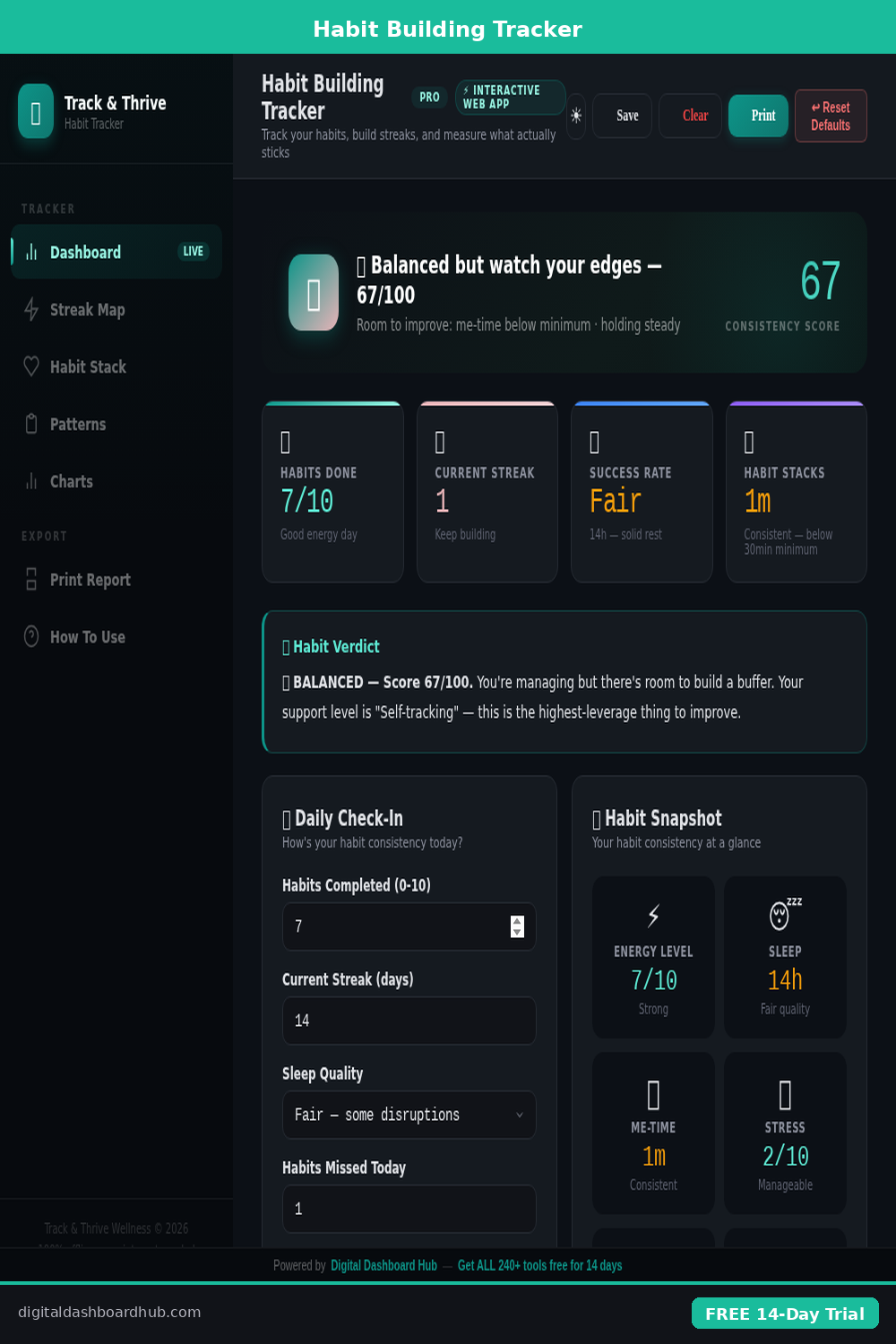
The Habit Building Tracker on Digital Dashboard Hub gives you all of this in an interactive web dashboard you can access from any device. Track up to twenty habits simultaneously, view streak analytics, see correlation heat maps between habits, and get weekly insight reports — all without installing an app or creating an account during your free trial.
Your habit data tells a story. The question is whether you’re reading it. Start tracking today, and in thirty days you’ll know more about your own behavior patterns than most people learn in a lifetime.
Ready to build habits that actually last? Try the Habit Building Tracker free for 14 days at digitaldashboardhub.com/trial — no credit card required. See your streaks, spot your patterns, and finally build the life you keep planning to start tomorrow.
Related articles: The Science of Habit Tracking, How to Build a Meditation Practice That Sticks, Why Most Goal-Setting Systems Fail Creators
Get Free Wellness Tools & Resources
Join our newsletter for exclusive templates, calculators, and expert tips delivered weekly.
Disclaimer: This article is for informational purposes only and does not constitute professional advice. Always consult with a qualified professional for your specific situation.