You’ve tried meditation. You downloaded an app, sat cross-legged on your bedroom floor, closed your eyes, and tried to “clear your mind.” Thirty seconds in, you were mentally composing a grocery list. Sixty seconds in, you were reliving an awkward conversation from 2019. Ninety seconds in, you opened your eyes, decided meditation “isn’t for me,” and went back to scrolling your phone.
Here’s the problem: that was meditation. The thoughts, the wandering, the inability to sustain attention for more than a breath — that’s not you failing at meditation. That’s meditation working. Every time you notice your mind has wandered and bring it back, you’ve done one “rep” of the fundamental exercise. You didn’t fail. You just didn’t know what success looks like.
The second problem is sustainability. Even people who enjoy meditation and understand the practice struggle to maintain it. A 2023 study published in PLOS ONE found that 95% of people who start a meditation practice quit within ninety days. Not because the practice isn’t beneficial — the science on meditation’s benefits is overwhelming — but because there’s no feedback mechanism. You sit in silence, your mind wanders, and you have no idea whether you’re making progress or wasting your time.
A meditation tracker solves both problems. It gives you a concrete measure of consistency (did I practice today?), a visual record of progress (my average session length has doubled in two months), and the streak-based motivation that turns sporadic practice into a real habit.
What the Science Actually Says About Meditation
Before DDH, I was doing this manually in spreadsheets. Here’s the faster way:
The Neuroscience
Meditation isn’t mystical — it’s neurological. Regular meditation practice produces measurable changes in brain structure and function. MRI studies show increased gray matter density in the prefrontal cortex (executive function and emotional regulation), the hippocampus (learning and memory), and the insula (self-awareness and empathy). Simultaneously, the amygdala — the brain’s fear and stress center — shows decreased gray matter density and reduced reactivity.
These changes aren’t subtle, and they’re not permanent from birth — they develop through practice, just like muscles develop through exercise. Research by Sara Lazar at Harvard found significant brain changes after just eight weeks of consistent meditation practice.
The Mental Health Benefits
A meta-analysis of 47 clinical trials involving over 3,500 participants found that meditation programs showed moderate evidence of improving anxiety, depression, and pain. The effect sizes were comparable to those found for antidepressant medications — a remarkable finding for a practice with zero side effects.
Regular meditators also report improved emotional regulation, reduced rumination (the repetitive negative thinking that drives anxiety and depression), better stress resilience, improved sleep quality, and enhanced focus and attention.
The Dose-Response Relationship
How much meditation do you need to see benefits? Less than you think. Research consistently shows that even ten minutes per day produces measurable benefits. Longer sessions and more frequent practice increase the benefits, but the relationship is logarithmic, not linear — you get the biggest bang for your buck in the first ten to twenty minutes. A consistent ten-minute daily practice is dramatically more beneficial than an inconsistent forty-five-minute practice.
This is the most important finding for building a sustainable practice: consistency trumps duration every single time.
Why Most Meditation Practices Fail
No Clear Success Metric
With most habits, success is obvious. Did you go to the gym? Did you eat the healthy meal? With meditation, the experience often feels like failure even when it’s working. You sat for ten minutes, your mind wandered constantly, and you feel like you “didn’t meditate right.” Without a clear metric to evaluate against, discouragement builds quickly.
A tracker redefines success as showing up. Did you sit? Did you complete your session? That’s success. Everything else — the quality of focus, the depth of calm — develops over time and becomes visible in your tracking data.
No Visible Progress
Meditation’s benefits accumulate gradually. You won’t notice a daily improvement, just like you won’t notice getting stronger from one gym session. But if you’re tracking your practice — session length, consistency, and subjective quality — you can see the trend line moving up over weeks and months. That visible progress sustains motivation through the inevitable “why am I doing this?” plateaus.
The Streak Pressure Problem
Meditation apps that emphasize streaks create a paradox: missing one day triggers the “what-the-hell effect” and people abandon the entire practice. A well-designed tracker handles this by showing both your current streak and your overall consistency rate. Missing one day out of thirty is a 97% success rate, and seeing that number prevents the all-or-nothing collapse.
Building Your Meditation Practice (The Practical Guide)
| Option | Cost | Time Investment | Customizable? | Best For |
|---|---|---|---|---|
| DIY approach | Free | High | Fully | Those with time to build from scratch |
| Generic tool | $5-$50/mo | Medium | Limited | Standard use cases |
| DDH Free Tool | Free trial | 5-10 min setup | Yes | Getting real answers without spreadsheet hell |
Week 1-2: Tiny Sessions, Daily Practice
Start with two to five minutes per session. This feels absurdly short, and that’s the point. You’re building the habit of sitting, not the capacity for deep meditation. At this stage, your tracker should show a streak of daily sessions, not impressive durations.
Use guided meditation if it helps — an instructor’s voice gives your attention something to anchor to. Unguided practice in silence comes later, once the habit is established.
Week 3-4: Gradual Extension
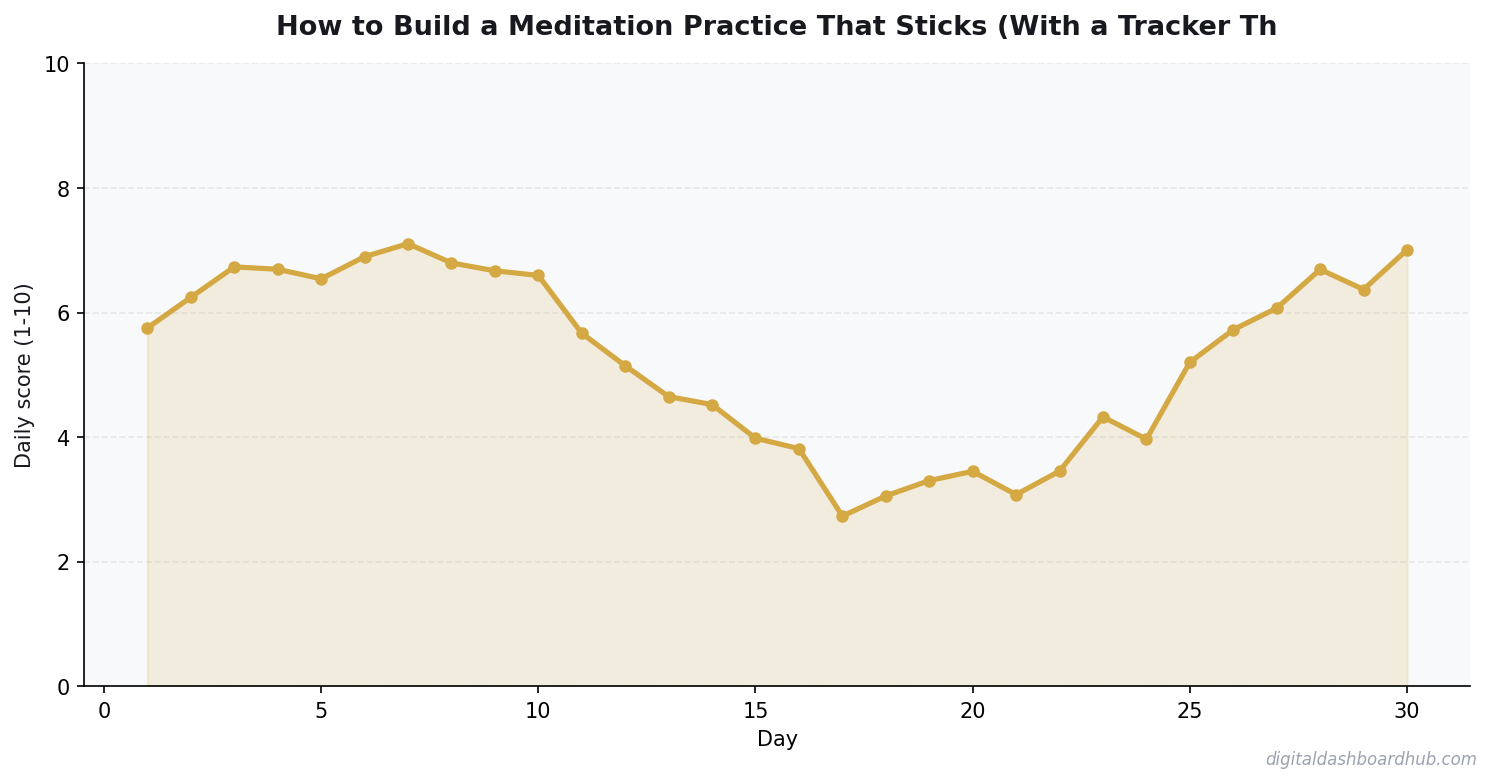
Add one to two minutes per week. By the end of month one, you should be at eight to twelve minutes per session. Your tracker will show this progression visually — a gentle upward curve in session duration that matches the steady streak of daily practice.
Month 2: Experiment with Techniques
Now that the habit is stable, experiment with different meditation styles: focused attention (concentrating on the breath), open monitoring (observing thoughts without attachment), body scan (systematic attention to physical sensations), loving-kindness (generating feelings of goodwill toward self and others), and walking meditation (meditative awareness during movement).
Track which techniques you use each session and rate your experience. Over time, your data will reveal which techniques produce the best results for you specifically.
Month 3+: Deepen and Maintain
By month three, you’ll have a clear picture of your optimal practice: best time of day, preferred technique, ideal session length, and the conditions that support consistency. Your tracker maintains accountability while your practice deepens naturally.
Try Our Free Wellness Dashboard
Track your numbers automatically with our interactive cloud dashboard. No spreadsheet skills needed.
What to Track in Your Meditation Dashboard
Keep tracking simple — meditation is about reducing complexity, not adding it. Track session date and time, duration in minutes, technique used, a focus quality rating of 1-10 (how present did you feel?), a post-session mood rating of 1-10, and any notable observations in one sentence. That’s it. Six data points per session, logged in under a minute.
Using Your Meditation Data
Weekly Review
Once per week, look at your consistency (how many days did you practice out of seven?), your average session length, and your average focus quality. Notice trends without judging them. A dip in consistency during a stressful week isn’t failure — it’s data about how stress affects your practice.
Monthly Analysis
Compare this month to last month. Is your average session length increasing? Is your focus quality improving? Are you practicing more or fewer days? Monthly analysis reveals the slow, steady progress that daily experience can’t detect.
Correlation Insights
Over time, correlate your meditation data with other life metrics. Many trackers show that meditation practice correlates with better sleep, lower anxiety, improved mood, and higher productivity. Seeing these correlations in your own data provides powerful motivation to maintain the practice.
Your Meditation Tracking Dashboard
The Meditation Practice Tracker on Digital Dashboard Hub gives you a clean, calming interface for logging and analyzing your meditation practice. Track sessions with one tap, view streak and consistency data, analyze technique effectiveness, and see how meditation correlates with your overall well-being. The dashboard celebrates consistency over perfection — because showing up is the only thing that matters.
Meditation isn’t about emptying your mind. It’s about training your attention. And like any training, progress comes from consistent practice and honest tracking.
Ready to build a meditation practice that lasts? Try the Meditation Practice Tracker free for 14 days at app.digitaldashboardhub.com/signup — no credit card required. Two minutes today. Three tomorrow. Your brain will thank you.
Related articles: Meditation for Beginners, How to Track Your Anxiety and Actually Reduce It, Gratitude Journaling: The 5-Minute Practice
Get Free Wellness Tools & Resources
Join our newsletter for exclusive templates, calculators, and expert tips delivered weekly.
Disclaimer: This article is for informational purposes only and does not constitute professional advice. Always consult with a qualified professional for your specific situation.
Keep reading (related guides):
- Free Sinking Fund Calculator — Try It Now
- Free Menopause Symptom Tracker — Try It Now
- Nervous System Regulation Tracker: The Visual Dashboard That Helps You Understand Your Bodys Stress Signals
- I Owed $47,000 in Taxes and Had $11,000 in the Bank: How I Rebuilt My Freelance Finances From the Ground Up
- Free ADHD Impulse Spending Tracker — Try It Now
255+ interactive tools for your money, time, and health.
Full dashboard access · Stripe-secure checkout · Cancel anytime

Andy Gaber is the founder of Digital Dashboard Hub, a suite of 255+ interactive financial, productivity, and wellness tools. He built DDH after getting frustrated with financial apps that gave outputs without context. Follow along for tool tutorials, revenue analytics breakdowns, and honest takes on personal finance.